# 1 position


Audited and Verified:
Our Editorial and Data Verification Process
Research.com uses government datasets, official education statistics and primary institutional information to support its career and degree guides. Our review process checks factual accuracy, occupational definitions, source dates and the requirements associated with the credentials discussed.
How This Article Was Fact-Checked
Our editorial team verifies salary estimates, employment projections, education requirements and program information against original data providers and official organizations. Salary figures are checked against the relevant occupational definitions and reporting periods. Information about licensure, accreditation and required in-person training is reviewed separately.
Fact-checked and verified on:

Co-Founder and Chief Data Scientist

Reviewed by Karolina Broda
Fact-Checker and Data Verification
Choosing electrician training in Columbia, Maryland, means comparing more than tuition: a short school program and a paid apprenticeship can lead to very different costs and work experience. The U.S. Bureau of Labor Statistics projects 9.2% national growth in electrician employment from 2025 to 2035. For career changers and first-time trainees, this guide explains credentials, hands-on training, costs, and Maryland licensing. It also accompanies the Most Affordable Electrician Trade Schools in Columbia for 2027 ranking, created by the Research.com team of data scientists to help students make an informed choice about programs worth considering.
Expect a mix of electrical theory and physical practice: reading diagrams, calculating loads, installing conduit and wiring, using test instruments, and following the National Electrical Code and jobsite safety procedures. A useful program lets you demonstrate these tasks in a supervised lab rather than only watching demonstrations or completing quizzes. Ask for the current curriculum and scheduled lab hours; similarly named credentials can involve very different amounts of practice.
In Columbia, Maryland, the main decision is whether to pay for school before seeking work or enter work-based training sooner. Lincoln College of Technology-Columbia is a school option to investigate; registered apprenticeships through electrical contractors or labor-management sponsors and employer-sponsored entry routes offer different combinations of classroom instruction, supervised work, and pay. A school may help a beginner build confidence and find an employer, but applicants who can secure an apprenticeship directly should compare its wage and training arrangement before paying tuition.
Electrical training can prepare you to seek an entry-level role with residential or commercial electrical contractors, building-maintenance teams, industrial employers, or contractors installing controls and power systems. According to the U.S. Bureau of Labor Statistics, electricians work across construction, maintenance, and manufacturing settings. The equipment and supervision differ: a contractor may rotate among jobsites, while a maintenance role may focus on one facility.
Columbia's position within the Baltimore-Washington employment corridor can widen the pool of potential worksites, but commuting time and transportation costs matter when shifts begin early or jobsites change. Ask a program where its recent trainees obtained supervised electrical work - not simply whether it advertises "career services." For electrician licensure experience, confirm that the work and supervisor will meet Maryland's applicable rules.
The U.S. Bureau of Labor Statistics reports a $63,190 national median annual wage for electricians in May 2025. That figure describes employed electricians across experience levels, not pay for a new Columbia trainee. An apprentice's offer, hours worked, overtime, benefits, and progression schedule are more useful for a near-term budget; request them from the prospective employer or sponsor.
Do not compare a school's total price with the national median as though the difference were a guaranteed return. For a realistic investment comparison, account for your current earnings, the time spent training, wages received during training, aid, borrowing costs, likelihood of completion, expected post-training pay, and how long you expect to work in the occupation. Discounting future earnings also matters when comparing a paid apprenticeship with a shorter program that requires an upfront payment.
A school certificate or diploma and an apprenticeship answer different timing questions. A school program may finish before you have accumulated the supervised work needed for independent practice; a registered apprenticeship integrates related instruction with paid, supervised employment over multiple years. The U.S. Department of Labor describes electrician apprenticeships as commonly lasting about four to five years, but a sponsor's registered standards - not a national example - determine its actual schedule.
Ask for both the program's calendar length and its classroom, lab, and worksite hours. If you need income immediately, compare the date you could begin earning as an apprentice with the date you could finish school and secure a supervised job. The fastest online degree completion programs for working adults address a different education decision: completing remote coursework cannot shorten supervised electrical experience simply because it fits around work.
Online instruction can be practical for code concepts, electrical calculations, and some safety coursework. It cannot replace hands-on evaluation of wiring, conduit installation, testing, troubleshooting, or safe use of tools. A hybrid option is credible only when it identifies where practical sessions occur, how often you must attend, who supervises them, and how worksite experience is arranged.
For someone commuting around Columbia, fewer campus trips may reduce costs, but a distant lab or mandatory worksite can erase that benefit. Ask for the full in-person schedule before paying a deposit. A program promoted as an easy degree to get online is not a substitute for assessed electrical shop skills or supervised work. Never assume remote coursework by itself satisfies Maryland licensing requirements.
There is no reliable Columbia-wide average here that covers school programs, apprenticeships, and employer training on a comparable basis. Published tuition is also not the amount you need to become job-ready. Request an itemized, current quote from Lincoln College of Technology-Columbia and any other eligible training route you are considering, then compare costs over the same time period.
Build the comparison around these expenses and offsets:
Federal aid depends on both student and program eligibility; accreditation alone does not guarantee access to it, according to Federal Student Aid. A lower-cost apprenticeship can be financially attractive because it pays while you learn, but compare its offered wage, availability, and time to completion with the school route. Ask whether tools and books are included before treating any advertised tuition as a final price.
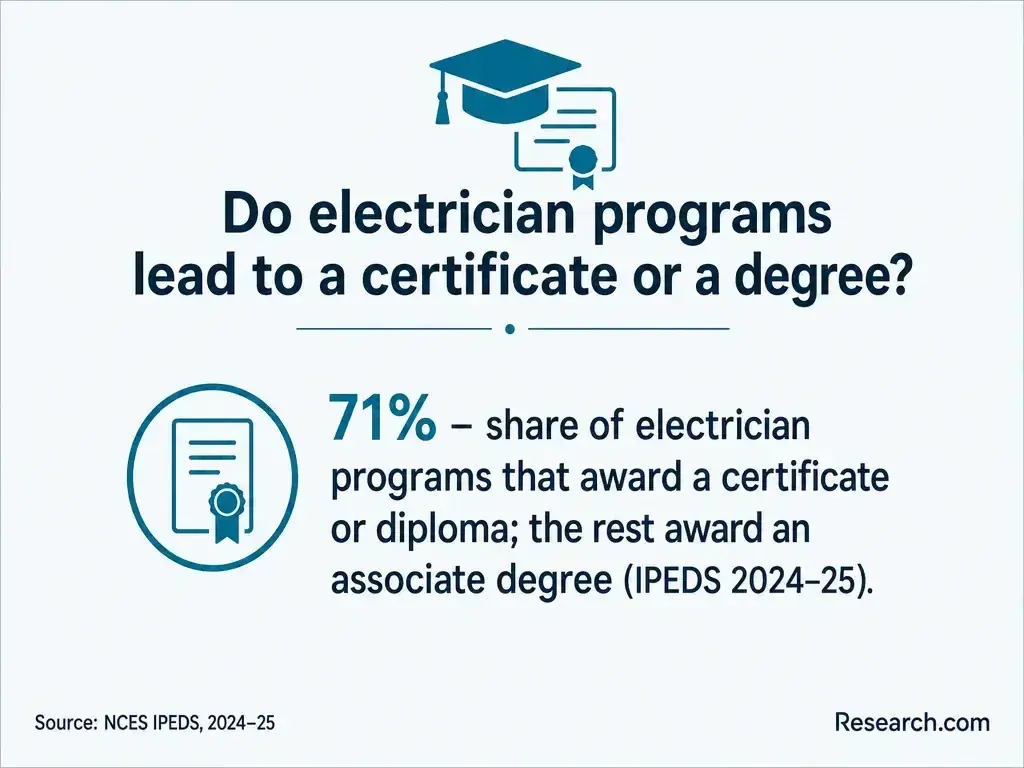
The credential depends on the route. A trade school may award a certificate or diploma; an eligible community or technical college program may award a certificate or an associate degree; a registered apprenticeship leads to its own completion credential under the sponsor's standards. An industry credential, such as one associated with NCCER training, is distinct from each of those and from a Maryland occupational license. Confirm the exact credential listed on the enrollment agreement.
Ask whether prior electrical coursework can count toward later instruction or whether an apprenticeship sponsor grants advanced standing. Get that answer from the receiving sponsor in writing: a school cannot promise that another organization will accept its hours. Searches for a doctorate degree online no dissertation concern an unrelated credential; for electrician entry, supervised practical training and the applicable licensing pathway matter more than an academic title.
Requirements vary by provider and route. A school may ask for proof of secondary-school completion, an application, and an assessment of math readiness. An apprenticeship sponsor may also use aptitude testing, interviews, and employer hiring criteria; applicants need to meet its stated age, work-authorization, and physical job requirements. Obtain the current checklist directly from the provider rather than assuming admission to a school secures an apprenticeship position.
Ask whether you must find your own supervising employer, whether a driver's license is needed for available jobsites, and whether past electrical experience changes placement or instruction requirements. If application fees are a concern, resources about how to apply free to accredited online colleges concern a different provider category; verify fees and aid eligibility for the electrical program itself.
Core instruction typically covers electrical safety, circuits, blueprint reading, code use, raceways, wiring methods, motors, controls, and testing. The U.S. Bureau of Labor Statistics identifies troubleshooting, reading technical diagrams, and using testing devices as central electrician tasks. For a beginner, the meaningful question is how often instruction progresses from a diagram to a correctly built, safely tested installation.
Compare programs by the work you can actually perform at completion. Residential-focused practice may be a good start for a housing contractor; someone targeting commercial facilities should ask about conduit, three-phase systems, controls, and larger installations. Newer equipment can also change employers' needs, but do not pay extra for a claimed specialization unless the provider can show relevant equipment, instructor experience, and supervised practice.
Maryland regulates electrician licensing through the Maryland State Board of Electricians. A school certificate does not itself authorize independent electrical contracting or prove eligibility for a journeyperson or master license. The appropriate status depends on the work you will perform and the supervision you will have. Before enrolling, check the board's current application, experience, examination, and any applicable apprentice requirements against the program's training plan; licensing rules can change.
Keep the distinctions clear: institutional accreditation concerns a school; state school authorization concerns permission to operate; an industry certificate documents specified training; registration governs an apprenticeship; and an occupational license governs regulated electrical work. None automatically substitutes for another. If you intend to work across the Maryland border, check the destination jurisdiction's rules separately rather than assuming your Maryland training or license transfers.
Start with the job you want and work backward to the training and supervised experience it requires. The most affordable ranking is a shortlist tool, not proof that its lowest-cost entry provides the best practical preparation. Before committing, use the following checks to compare a school offer with an apprenticeship or employer route:
A red flag is a promise that a short course alone makes you a licensed electrician. Another is a price that omits required tools or a "fully online" claim with no plan to assess hands-on skills. If you already have a credible paid apprenticeship offer, evaluate it first; if you cannot yet obtain one and need structured shop practice, a school program may be worth considering.
A common progression is entry-level helper or apprentice, experienced electrician working within applicable licensing rules, and later specialization or supervision. Residential service, commercial construction, industrial maintenance, and controls work call for overlapping but not identical skills. Ask employers which experience they recognize before paying for a niche credential. Master-level licensing and contracting involve additional requirements; a starting school credential is not equivalent to either.
Some workers move toward estimating, crew leadership, or operating an electrical business after substantial field experience. Those paths depend on demonstrated work, employer opportunity, and applicable licensing - not automatic promotion after graduation. If earnings are your main reason for changing occupations, compare electrician work with other highest paid trades using their training costs, working conditions, and time to qualification rather than salary alone.
The U.S. Bureau of Labor Statistics projects 9.2% growth in electrician employment nationally from 2025 to 2035. This indicates expanding demand across the occupation, not that every Columbia graduate will find a local opening. Hiring depends on construction activity, facility-maintenance needs, an applicant's experience, and whether a contractor can provide the required supervision.
For a local decision, ask training providers and apprenticeship sponsors which Maryland employers currently take beginners and how far trainees typically travel. Compare real entry-level postings with the skills taught: an employer seeking independent troubleshooting experience is not advertising the same opportunity as an apprentice opening. National growth makes the field worth investigating, while a confirmed local training-to-work connection makes a particular program more compelling.
Investing in electrician training is a consequential decision, especially when a low advertised price may exclude tools or provide limited hands-on experience. Research.com's team evaluates programs against others in the same occupation and location so readers can identify affordable options to investigate further. Only programs with completions reported to the Integrated Postsecondary Education Data System (IPEDS) are eligible; a registered apprenticeship or employer program absent from IPEDS may still be a strong option.
For this most affordable ranking, the score uses tuition, cost of attendance, median student debt, and the federal loan default rate. Weights are distributed using an entropy-based method, which assigns more weight to measures that differ more across eligible programs. Accreditation and other quality indicators are not part of the affordability score. Research.com's separate best programs rankings also consider completion and retention, earnings and return on investment, student support, institutional accreditation, and occupation-relevant programmatic accreditation or industry recognition. Their stated weights are 20% for programmatic accreditation or industry recognition, 10% for institutional accreditation, 10% for student support, and 60% for outcomes, earnings, and costs, distributed among those indicators using the entropy-based method.
The team draws on the following sources to check comparable education data and, where relevant, occupation-specific recognition. Allied-health and dental organizations in this source set do not establish electrician-program approval.
Use the ranking to narrow a shortlist, then verify each program's current price, practical training, and fit with Maryland licensing requirements. More detail on the ranking approach appears in Research.com's methodology.
# 1 position
# 2 position
Not necessarily. A registered apprenticeship or employer-sponsored route may combine classroom instruction with supervised work. Check Maryland's current licensing requirements and each sponsor's entry rules before choosing between routes.
No. A school credential documents program completion; occupational licensing has separate requirements administered by the Maryland State Board of Electricians.
Some theory can be taught remotely, but wiring, testing, safety procedures, and supervised work require in-person practice and assessment. Confirm the hands-on schedule before enrolling.
It can be because apprentices generally earn wages during training, but availability, starting pay, required purchases, and time to completion vary. Compare written offers and full costs rather than tuition alone.
Ask how many completers obtained supervised electrical work, when outcomes were measured, and whether the provider arranged interviews or only offered general career advice. Request definitions and a reporting period for any placement figure.