# 1 position


Audited and Verified:
Our Editorial and Data Verification Process
Research.com uses government datasets, official education statistics and primary institutional information to support its career and degree guides. Our review process checks factual accuracy, occupational definitions, source dates and the requirements associated with the credentials discussed.
How This Article Was Fact-Checked
Our editorial team verifies salary estimates, employment projections, education requirements and program information against original data providers and official organizations. Salary figures are checked against the relevant occupational definitions and reporting periods. Information about licensure, accreditation and required in-person training is reviewed separately.
Fact-checked and verified on:

Co-Founder and Chief Data Scientist

Reviewed by Karolina Broda
Fact-Checker and Data Verification
Choosing electrician training in Meridian means deciding whether to pay for classroom preparation, pursue a paid apprenticeship, or combine both. The stakes are practical: Mississippi licensing rules, access to supervised work, and total training costs can matter more than a program's name. Nationally, electrician employment is projected to grow 9.2% from 2025 to 2035, according to the U.S. Bureau of Labor Statistics (BLS). The Research.com team of data scientists created its Best Electrician Trade Schools in Meridian for 2027 ranking to help students identify programs worth considering. This guide explains how to assess the options.
Expect a mix of electrical theory, code interpretation, safety, and hands-on practice. A school-based certificate or diploma can help a newcomer learn wiring fundamentals and qualify for entry-level interviews; it does not, by itself, confer independent-work status. An associate-level electrical technology program may add broader technical coursework, but students should confirm that its labs and courses match the electrical work they intend to do.
A registered apprenticeship takes a different approach: paid, supervised work is paired with related instruction under a sponsor's training plan, according to the U.S. Department of Labor. Ask Meridian Community College whether a current electrical offering includes shop hours, which credential it awards, and whether a local sponsor accepts its coursework for advanced standing. Readers comparing types of college majors should keep the electrician decision narrower: the decisive question is how training leads to recognized work experience.
Electrical training can lead toward building-construction contractors, industrial maintenance teams, facilities departments, and utility-related employers. In and around Meridian, those settings may involve different schedules and skills: a contractor's apprentice may travel among jobsites, while a facilities trainee may spend more time troubleshooting equipment at one site. BLS describes electricians as installing, maintaining, and repairing electrical power, communications, lighting, and control systems.
Choose training around the work you want, rather than assuming every electrical opening uses the same curriculum. Before enrolling, examine local apprentice and helper postings for required travel, shift work, and experience. A list of majors that lead to high paying jobs cannot tell you what a Meridian electrical employer will pay a new apprentice.
The BLS reports a $63,190 national median annual wage for electricians in May 2025. Half of employed electricians earned less and half earned more; the figure includes experienced workers and is neither an entry wage nor a Meridian-specific estimate. It should not be used as a promised return on tuition.
For a realistic local comparison, request current apprentice wage schedules from sponsors and compare nearby job postings by experience level. Account for paid hours, overtime variability, commuting, and the possibility that industrial maintenance and construction employers use different pay structures. Compare an offer's likely earnings during training with the income you would give up for full-time school.
Length depends on the pathway. A short preparatory program can teach foundations sooner, while a more extensive certificate, diploma, or associate-level program requires additional terms. A registered apprenticeship generally extends across multiple years because it combines related instruction with substantial supervised jobsite experience; the sponsor's registered standards, not a school's marketing description, establish its required hours and progression, according to the U.S. Department of Labor.
Ask providers for both calendar length and scheduled lab/contact hours. Then ask a prospective sponsor whether any prior coursework earns credit and whether credit shortens classroom instruction, on-the-job requirements, or neither. An accelerated class may get you to an interview faster without shortening the path to independent work.
Online coursework can be useful for electrical theory, mathematics, blueprint reading, and some code study. It cannot reproduce supervised installation, tool use, testing, or jobsite safety practice. A hybrid option makes sense for someone who needs scheduling flexibility and has reliable access to its required labs or employer worksite.
Compare formats by asking where every practical assessment occurs, who supervises it, and whether an apprenticeship sponsor recognizes the instruction. An entirely online completion credential is not evidence of eligibility for electrical licensing or independent work. Even when browsing accredited colleges online that waive application fees, evaluate an electrician option by its in-person competencies and connection to supervised employment, not application convenience.
There is no defensible single "average" Meridian electrician-training price across school programs and paid apprenticeships. Obtain each provider's current, written cost of attendance rather than treating advertised tuition as the total. Budget for mandatory fees, books, tools, meter and other equipment, protective gear, consumables, travel to labs or jobsites, and any applicable exam or license-application fees. Lost wages matter if the schedule prevents you from working.
Compare net cost and time to paid work: subtract confirmed grants, scholarships, or employer-paid expenses, and distinguish those offsets from loans that must be repaid. Ask the school whether its specific program qualifies for federal aid and ask workforce offices about eligibility-based training assistance. Apprenticeship wages can offset costs, but entry may be competitive and tools or transportation may still be your responsibility. Someone searching for the cheapest online bachelor degree should not apply that price comparison to hands-on electrical training.
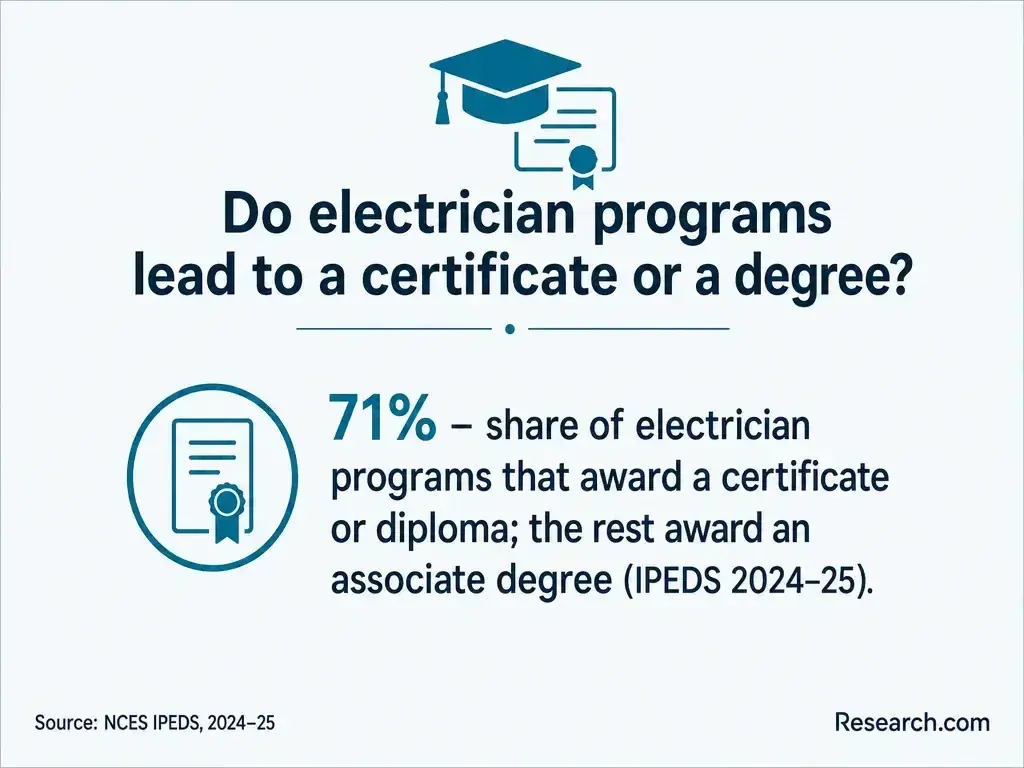
The credential depends on the route: a school may award a certificate, diploma, or associate degree, while a registered apprenticeship documents completion under its sponsor's standards. An industry training credential, such as one associated with NCCER, documents specified competencies; it is not an occupational license. Ask the provider for the exact award name and the employer or sponsor that recognizes it.
Institutional accreditation, state authorization to offer education, industry recognition, apprenticeship registration, and permission to perform licensed work answer different questions. None automatically substitutes for another. A school credential may be worthwhile as preparation even when its courses do not reduce an apprenticeship's required work experience.
Entry rules vary by provider. Schools may assess reading and mathematics readiness and require an application or placement process. Apprenticeship sponsors set their own selection criteria, which may include minimum age, educational preparation, an aptitude assessment, an interview, and the ability to reach worksites. Confirm requirements directly rather than assuming that admission to a class also secures an apprenticeship position.
If algebra or transportation is a barrier, ask whether preparatory instruction or a closer work assignment is available before committing to a schedule. Applicants with prior construction experience should ask both the school and the sponsor, in writing, whether documented learning or work qualifies for credit or advanced standing.
Strong introductory training connects calculations and code concepts to actual circuits. Look for supervised practice in reading plans, selecting materials, bending conduit, making terminations, using test instruments, diagnosing faults, and following lockout and other safety procedures. BLS identifies technical knowledge, troubleshooting, color vision, and physical stamina as relevant to electrician work.
Request the course outline and a lab tour. Ask how many hours students personally spend building and testing installations, rather than watching demonstrations, and how the program handles current code instruction. The most useful practice matches the setting you intend to enter: construction wiring and industrial controls are related, but they are not interchangeable specialties.
Do not assume a Meridian school credential is an electrician license. Mississippi's State Board of Contractors regulates qualifying contractor work, while requirements for an individual doing electrical work can depend on the local jurisdiction and role. An employee working under supervision, someone seeking to work independently, and someone establishing a contracting business should not assume they face the same requirements. Verify the applicable rules with the Mississippi State Board of Contractors and the authority having jurisdiction where you expect to work before selecting a program.
Ask which examinations, experience records, business credentials, or local registrations apply to your intended next step. Apprenticeship registration records a training arrangement; optional industry certification demonstrates particular skills. Neither should be presented as a replacement for a required occupational or contractor license.
The best choice is the one that moves you toward your intended electrical job at a cost and pace you can sustain. A school program may suit someone who needs structured basics before applying to employers. Direct entry into a registered apprenticeship may suit someone ready for competitive selection and paid, supervised training. Neither route is automatically cheaper or faster for every applicant.
Use the ranking to form a shortlist, then make these checks with each provider or sponsor:
A red flag is a promise that a certificate alone makes you a licensed electrician, especially if the provider will not identify the relevant authority or explain where practical experience occurs. Readers arriving from broader searches such as easy phd degrees should assess this trade investment on its own terms: supervised competence and regulatory eligibility matter more than a credential's title.
A common progression is electrical helper or apprentice, followed by more independent installation or maintenance work as experience and applicable requirements permit. With additional experience, an electrician may pursue industrial troubleshooting, controls, estimating, supervision, or contracting. These are possible paths, not automatic outcomes of completing a school program.
Match the first training step to the destination. Someone interested in industrial equipment should seek substantial motors, controls, and diagnostic practice; someone aiming to operate a contracting business should learn the separate Mississippi and local requirements for that work. Optional specialty credentials can support advancement, but they do not erase experience or licensing obligations.
BLS projects 9.2% growth in U.S. electrician employment from 2025 to 2035. That national projection suggests continuing demand for the occupation, but it does not measure Meridian openings or guarantee that a local graduate will find work. Construction activity, maintenance needs, and employers' willingness to take on apprentices will shape opportunities closer to home.
Check current postings and speak with apprenticeship sponsors before choosing a start date. Look for openings that accept beginners, not only advertisements seeking experienced electricians. If nearby apprentice positions are scarce, compare the cost of commuting or relocating with the value of delaying enrollment until a supervised-work route is clearer.
Education is a significant investment, so Research.com designed the ranking to help readers compare electrician programs with other programs in the same occupation and location - not with unrelated schools nationwide. The team examines reported outcomes, costs, recognition, and student support, and checks the underlying data for quality and credibility. The ranking is a starting point for choosing a program, not a substitute for confirming its current schedule, costs, and apprenticeship connections.
Only programs with completions reported to IPEDS are eligible. Best-program scores consider completion and full-time and part-time retention; earnings one year after completion and earnings relative to annual attendance cost; tuition, attendance cost, debt, and federal loan default rates; and relevant recognition and support. Programmatic accreditation or industry recognition carries 20%, institutional accreditation 10%, and student support 10%. The remaining 60% covers outcomes, earnings, and costs, with entropy-based weights that give more weight to indicators that vary more across programs. A separate most-affordable ranking scores only costs and debt using entropy-based weights; it does not score accreditation or other quality measures.
The ranking draws on the following sources. Some cover occupations beyond electrical work; their inclusion does not mean a healthcare accreditor approves an electrician program.
IPEDS and college-oriented outcomes databases do not capture every union, employer, or registered-apprenticeship route. An omitted provider is not necessarily unapproved or poor quality. Readers can find further details on Research.com's ranking methodology.
# 1 position
# 2 position
Not necessarily. A registered apprenticeship or employer-supported route may provide instruction and supervised work without a separate preparatory school program. Confirm the requirements for your intended job and jurisdiction.
No. A certificate documents completed training; applicable work experience, examinations, local requirements, or contractor licensing must be checked separately.
Theory may be taught online, but installation, testing, safety practice, and supervised jobsite work require in-person participation.
Choose school if you need structured preparation and its cost is justified by a clear route to work. Consider direct apprenticeship entry if you can meet sponsor requirements and want to earn while completing supervised training.
Request the full cost, credential name, lab hours, current schedule, placement process, and written confirmation of whether an apprenticeship sponsor accepts prior coursework.