# 1 position
Hinds Community College - Electrician.
associate

Audited and Verified:
Our Editorial and Data Verification Process
Research.com uses government datasets, official education statistics and primary institutional information to support its career and degree guides. Our review process checks factual accuracy, occupational definitions, source dates and the requirements associated with the credentials discussed.
How This Article Was Fact-Checked
Our editorial team verifies salary estimates, employment projections, education requirements and program information against original data providers and official organizations. Salary figures are checked against the relevant occupational definitions and reporting periods. Information about licensure, accreditation and required in-person training is reviewed separately.
Fact-checked and verified on:

Co-Founder and Chief Data Scientist

Reviewed by Karolina Broda
Fact-Checker and Data Verification
Choosing electrician training near Raymond, Mississippi, means deciding whether to pay for school first or earn while learning through an apprenticeship. The stakes are real: the U.S. Bureau of Labor Statistics projects 9.2% growth in electrician employment from 2025 to 2035. This guide compares credentials, practical training, costs, and Mississippi entry rules so you can judge which route fits your goal. It also accompanies the Best Electrician Trade Schools in Raymond for 2027 ranking, created by the Research.com team of data scientists to help students identify programs worth considering.
An electrician training program should teach more than how to connect wires. Expect electrical theory, circuit calculations, blueprint reading, National Electrical Code use, grounding, testing, troubleshooting, and safe tool use. Labs should let students install and diagnose circuits under supervision. The U.S. Bureau of Labor Statistics describes apprenticeships as combining technical instruction with paid, supervised jobsite training; a classroom-only course does not provide the same work experience.
Near Raymond, a student may compare Hinds Community College's current electrical-related offerings with registered apprenticeships, employer training, and other providers within a realistic commute. Confirm the particular campus, schedule, credential, and lab location before applying: a college's presence in Raymond does not establish that every electrical course is taught there. School-based preparation can suit someone who wants structured fundamentals before seeking an employer; an apprenticeship can suit someone ready for a longer paid work-and-instruction commitment.
Electrical training can lead to work for residential and commercial electrical contractors, industrial maintenance employers, construction firms, and facilities teams. Tasks differ: a new-construction crew may install conduit and wiring, while a maintenance crew may trace faults in existing equipment. Those differences should guide your program choice; ask whether its labs and employer contacts match the work you want.
Raymond applicants should consider the commute to both instruction and jobsites, including opportunities across the Jackson-area labor market. An apprenticeship may require travel to changing worksites even when its classroom location is convenient. Ask a sponsor about its usual service area before accepting a position.
The U.S. Bureau of Labor Statistics reports a $63,190 national median annual wage for electricians in May 2025. Half of employed electricians earned more and half earned less; the figure includes experienced workers and should not be used as an apprentice wage or a Raymond-specific offer. BLS does not establish a Raymond wage in that national figure.
For a useful local comparison, request the starting wage, scheduled increases, benefits, and travel expectations from apprenticeship sponsors and employers serving Raymond and Jackson. Compare those offers with any wages you would give up during full-time school. The higher long-run occupational median cannot, by itself, tell you how quickly a particular training expense will pay off.
The route determines the timeline. The U.S. Bureau of Labor Statistics describes electrician apprenticeships as typically taking four to five years, with paid on-the-job training and technical instruction. A school certificate or diploma can be shorter, but finishing it generally does not replace the supervised experience required by an employer or an apprenticeship sponsor. Ask for a written calendar showing classroom hours, lab hours, field experience, and the date you could begin paid electrical work.
Before choosing an accelerated course, ask whether its hours or prior learning can count toward a specific registered apprenticeship. Do not assume credit transfers: the receiving sponsor decides whether it grants advanced standing. Part-time study may ease lost earnings, but a schedule that conflicts with daytime jobsites can delay work experience.
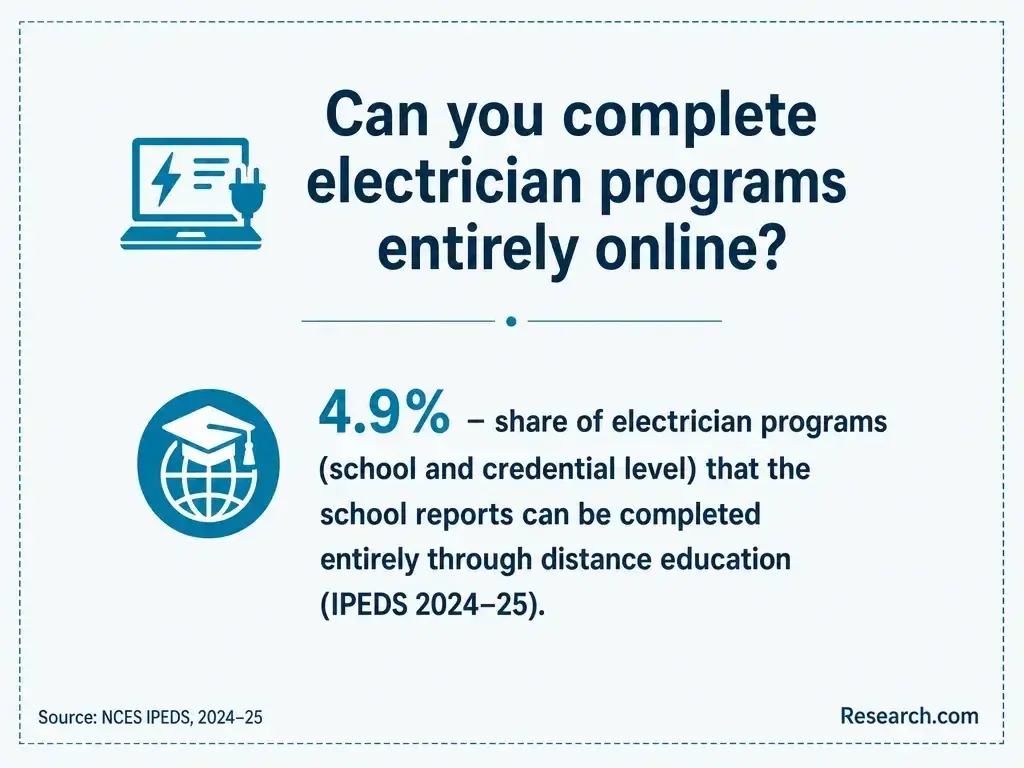
Online instruction can work for electrical math, code study, and some theory. It cannot by itself show that a student can safely bend conduit, use test equipment, wire a panel, or troubleshoot a live-work scenario under appropriate supervision. For an online or hybrid offering, obtain the required lab schedule, location, equipment access, and assessment method before enrolling. An entirely online completion claim is not evidence of jobsite competence or licensing eligibility.
For someone comparing online universities with open admission, electrician training presents a different entry decision: access to supervised practical work matters as much as access to coursework. A campus program may make practice easier to schedule; a hybrid program may reduce classroom trips but still require travel to labs and worksites.
There is no defensible single average price for Raymond electrician training: a school program and a paid apprenticeship have different charges, durations, and earnings during training. Get a current, itemized quote for the exact program and campus rather than relying on an advertised tuition figure.
To compare the total cost of becoming job-ready, include these items in each option's estimate:
Ask Hinds Community College or another provider whether its particular program is eligible for federal aid, and verify eligibility through Federal Student Aid; not every short course qualifies. A reader exploring colleges online that accept FAFSA should likewise check the specific electrician program, not assume institutional aid eligibility covers every course. For return on investment, consider completion probability, borrowing, earnings before and after training, and how long you expect to work - not tuition alone.
The credential depends on the route. A school may award a certificate, diploma, or associate degree; a pre-apprenticeship may document preparation for entry; and a completed registered apprenticeship provides a recognized completion credential alongside substantial supervised experience. NCCER training credentials, where offered, document specified construction skills but are not the same as apprenticeship completion or occupational licensure (National Center for Construction Education and Research; U.S. Department of Labor).
Ask what the credential says, who awards it, and whether the employers or apprenticeship sponsors you are targeting accept it for hiring or advanced standing. A longer academic credential can be useful if its additional courses fit your goals, but paying for extra coursework solely because it sounds more advanced may not shorten your route to electrician work.
Entry requirements differ among school programs, apprenticeship sponsors, and employers. Request each provider's current requirements for prior education, math preparation, application or placement tests, age, ability to reach jobsites, and any job-related screening. A registered apprenticeship is employment-based training, so meeting minimum criteria does not necessarily mean receiving an offer (U.S. Department of Labor).
If you need to strengthen electrical math or reading before an apprenticeship application, a preparatory course may help - but first ask the sponsor which preparation it recognizes. If you already have electrical work experience, ask whether a school or sponsor evaluates it for credit or advanced standing before you pay to repeat introductory material.
Strong electrician training connects theory to repeatable practical tasks: interpreting diagrams, calculating loads, selecting conductors and overcurrent protection, installing raceways, testing circuits, and finding faults without bypassing safety procedures. Code instruction should teach students how to locate and apply requirements, not merely memorize an edition of the National Electrical Code. Employers also need clear documentation, teamwork, and communication with other trades (U.S. Bureau of Labor Statistics).
Ask to see the lab task list and how each skill is assessed. A program with substantial supervised installation and troubleshooting practice is more relevant to entry-level electrical work than one that awards a similarly named credential after lectures alone. For longer-term education comparisons, what are the best college majors is a separate question from whether a trade credential develops these jobsite skills.
School completion, apprenticeship registration, certification, and a contractor license are different things. Mississippi's State Board of Contractors regulates covered electrical contracting work; its rules should be checked if your goal is to bid on or operate a contracting business. Employee work and local permitting requirements can depend on the jurisdiction and the work performed. Before enrolling, ask the relevant local building authority and, for a contracting goal, the Mississippi State Board of Contractors what applies to your intended work.
Do not accept a claim that an accredited school automatically makes you a licensed electrician. Institutional accreditation concerns the school; industry credentials document particular training; apprenticeship registration concerns a work-based program; and any applicable contractor licensing has separate requirements (Mississippi State Board of Contractors; U.S. Department of Labor). Ask the provider to identify precisely which requirement, if any, its credential satisfies.
The best option is the one that gets you competent, employable, and appropriately eligible for your intended work at a cost you can manage. Use a ranking as a shortlist, then make these checks before committing:
A red flag is a promise that a short online certificate alone makes you licensed or guarantees a particular wage. Another is a price quote that omits tools or required travel. If your main objective is a paid route to field experience, apply to apprenticeships as well as schools rather than treating admission to a classroom program as the only starting point. Comparisons with cheap online bachelor degrees should not distract from the practical-hours and work-entry requirements of this trade.
A common progression is helper or apprentice, then more independent installation or maintenance work as supervised experience and competence increase. With further experience, electricians may move into troubleshooting, industrial controls, crew leadership, estimating, or contracting, subject to applicable requirements. Specialized manufacturer or industry training can support advancement, but an optional certificate should not be confused with permission to perform regulated work (U.S. Bureau of Labor Statistics; Mississippi State Board of Contractors).
Choose initial training with the next step in mind. Someone aiming at industrial maintenance should ask about motors, controls, and diagnostic labs; someone aiming at construction should prioritize installation practice and access to active jobsites. If your interest is actually which masters degree makes the most money, that is a different decision from selecting an electrician entry pathway.
The U.S. Bureau of Labor Statistics projects 9.2% growth in U.S. electrician employment from 2025 to 2035. That national projection supports considering the trade, but it is not a forecast of openings in Raymond or a promise of placement after training. Construction activity, maintenance needs, and an employer's service area will determine where a new worker can actually find opportunities.
For a Raymond-specific decision, ask nearby sponsors and employers about current apprentice intake, worksite locations, and whether they expect applicants to arrive with prior training. Compare those answers with your ability to commute. If suitable work is concentrated beyond Raymond, access to transportation can matter as much as the distance to a classroom.
Investing in training is a consequential decision, so Research.com designed its ranking to compare programs with other options in the same occupation and location. Its team evaluates reported outcomes, costs, recognition, and student support rather than treating a program's name as proof of value. Only programs with completions reported to IPEDS are eligible. A registered apprenticeship or employer training program absent from the ranking may still be a strong option; its absence does not indicate poor quality.
Best-program rankings assess student completion and full- and part-time retention; earnings one year after completion and earnings relative to annual attendance cost; tuition, attendance cost, debt, and federal loan default rates; and accreditation, relevant industry recognition, and support services. Occupation-relevant programmatic recognition receives 20% of the score, institutional accreditation 10%, and student support 10%. The remaining 60% covers outcomes, earnings, and costs, with weights distributed using an entropy-based method that gives more weight to indicators that distinguish programs. Separate most-affordable rankings score only costs and debt using entropy-based weights; accreditation and other quality measures are not part of that score.
The team uses the following data sources across its trade-program ranking work. Not every source applies to electrician training; health and dental organizations, for example, should not be interpreted as electrician accreditors.
Use the ranking to narrow your school search, then confirm current campus availability, total charges, lab access, and apprenticeship connections directly with each provider. Research.com explains its broader approach on its methodology page.
# 1 position
# 2 position
No single school route fits everyone. A registered apprenticeship combines paid work and instruction and is a realistic alternative. Confirm an employer's entry requirements and any rules applicable to your intended work.
You can study some theory online, but installation, testing, and safe troubleshooting require supervised practical work. Check where and when a program provides it.
No. A school credential is not a contractor license. Check the Mississippi State Board of Contractors and the relevant local authority for requirements tied to your planned work.
Choose based on the experience you still need. A certificate may build fundamentals before employment; an apprenticeship provides paid, supervised work over a longer period. Ask whether a sponsor recognizes prior school training.
Obtain its current total cost, lab schedule, credential, completion information, and employer or apprenticeship connections. Compare those details with a paid-training offer and your likely commuting costs.