# 1 position
HVAC Technical Institute - Electrician.
certificate or diploma

Audited and Verified:
Our Editorial and Data Verification Process
Research.com uses government datasets, official education statistics and primary institutional information to support its career and degree guides. Our review process checks factual accuracy, occupational definitions, source dates and the requirements associated with the credentials discussed.
How This Article Was Fact-Checked
Our editorial team verifies salary estimates, employment projections, education requirements and program information against original data providers and official organizations. Salary figures are checked against the relevant occupational definitions and reporting periods. Information about licensure, accreditation and required in-person training is reviewed separately.
Fact-checked and verified on:

Co-Founder and Chief Data Scientist

Reviewed by Karolina Broda
Fact-Checker and Data Verification
Choosing electrician training in Chicago means deciding whether to pay for school first or earn while learning through an apprenticeship. The U.S. Bureau of Labor Statistics projects 9.2% national growth in electrician employment from 2025 to 2035, but demand alone does not make every program a good investment. The Research.com team of data scientists created its Best Electrician Trade Schools in Chicago for 2027 ranking to help students identify programs worth considering. This guide helps prospective students and career changers compare training, costs, credentials, and routes into local electrical work.
Expect a mix of electrical theory and physical practice: reading plans, calculating loads, installing conduit and wiring, testing circuits, troubleshooting faults, and following safety procedures. A classroom-heavy certificate can prepare you to seek entry-level work, but ask how much supervised lab time it includes and whether employers recognize the credential. If a shorter training route appeals to you, compare its practical component - not just its calendar length - with other short certificate options.
The main routes serve different goals. A school certificate or diploma may suit someone who needs structured preparation before applying for electrical work. An associate degree adds broader technical study and may suit someone seeking more academic depth. A registered apprenticeship combines related instruction with paid, supervised jobsite training and is the more direct choice for someone who can secure a place and wants to earn while learning. Employer-sponsored entry can also be viable if the employer provides documented instruction and supervision. These routes are not interchangeable simply because each teaches electrical skills.
Chicago-area electrical work spans residential construction, commercial buildings, industrial facilities, building maintenance, and infrastructure. Worksite matters: installing branch circuits on a construction site differs from diagnosing equipment in a factory or maintaining systems in an occupied building. The U.S. Bureau of Labor Statistics describes electricians as installing, maintaining, and repairing electrical power, communications, lighting, and control systems.
Before choosing a program, look at the work its labs and employer partners actually prepare students to do. Someone interested in industrial controls should seek motor-control and troubleshooting practice; someone targeting construction should prioritize conduit, plans, code instruction, and a route to supervised field experience. Chicago's dense commercial building stock also makes commuting to changing jobsites a practical consideration.
The U.S. Bureau of Labor Statistics reports a $63,190 national median annual wage for electricians in May 2025. Half of employed electricians earned less and half earned more; the figure combines workers with different experience, specialties, and locations. It is not a Chicago-specific wage estimate or a realistic starting-pay guarantee for a new trainee.
For an investment decision, request recent local wage information for the roles a program's graduates actually enter. Compare any apprentice wage schedule with the pay you would give up while studying full time, then consider how later progression could change the calculation. Do not use an experienced electrician's wage as the assumed first-year return on a certificate.
Length depends on the route and the credential. A school certificate may take months; an associate degree generally takes longer because it includes additional coursework. Electrician registered apprenticeships typically run several years because participants complete both related instruction and extensive supervised work, according to the U.S. Department of Labor. Published calendar length alone does not reveal how much installation practice a student receives.
Ask each provider for its current required classroom or contact hours, lab hours, schedule, and any separately arranged fieldwork. Also ask whether prior trade coursework or documented work experience earns advanced standing; the apprenticeship sponsor or receiving program - not the original school - decides what it will accept. A faster program is worthwhile only if it supplies the skills and access to supervised work needed for your intended job.
Online instruction can cover electrical calculations, code concepts, blueprint reading, and some troubleshooting theory. It cannot by itself demonstrate safe tool use, conduit bending, wiring installation, live-work precautions, or supervised jobsite performance. A hybrid option makes sense when its in-person labs and work placements are accessible from where you live and work.
Compare formats by asking where practical assessments occur, who supervises them, and whether required attendance fits your commute. A fully online credential should not be treated as equivalent to hands-on electrician training - or as proof of eligibility for locally regulated work. Readers comparing flexible study generally may also encounter online open admission colleges; for this trade, admissions flexibility is less important than access to a real electrical lab and supervised experience.
There is no reliable single "average Chicago electrician school cost" that covers public programs, private career schools, and paid apprenticeships on comparable terms. Request each provider's current, itemized price rather than relying on an advertised tuition figure. Include mandatory fees, books, tools, meters, personal protective equipment, consumable materials, transportation to labs or jobsites, and any applicable examination or application charges. A full-time student should also count earnings forgone while training.
A paid apprenticeship changes the comparison because wages can offset training costs, although entry may be competitive and tools or travel may still cost money. Ask schools whether an eligible program participates in federal aid and whether Illinois workforce funding or other grants apply to you; eligibility depends on the provider, program, and student. Lists of low-tuition online colleges that accept FAFSA can help frame aid questions, but online tuition alone does not price the hands-on route into electrical work. For return on investment, weigh aid and debt alongside completion likelihood, lost earnings, expected pay changes, and how long you plan to work in the trade.
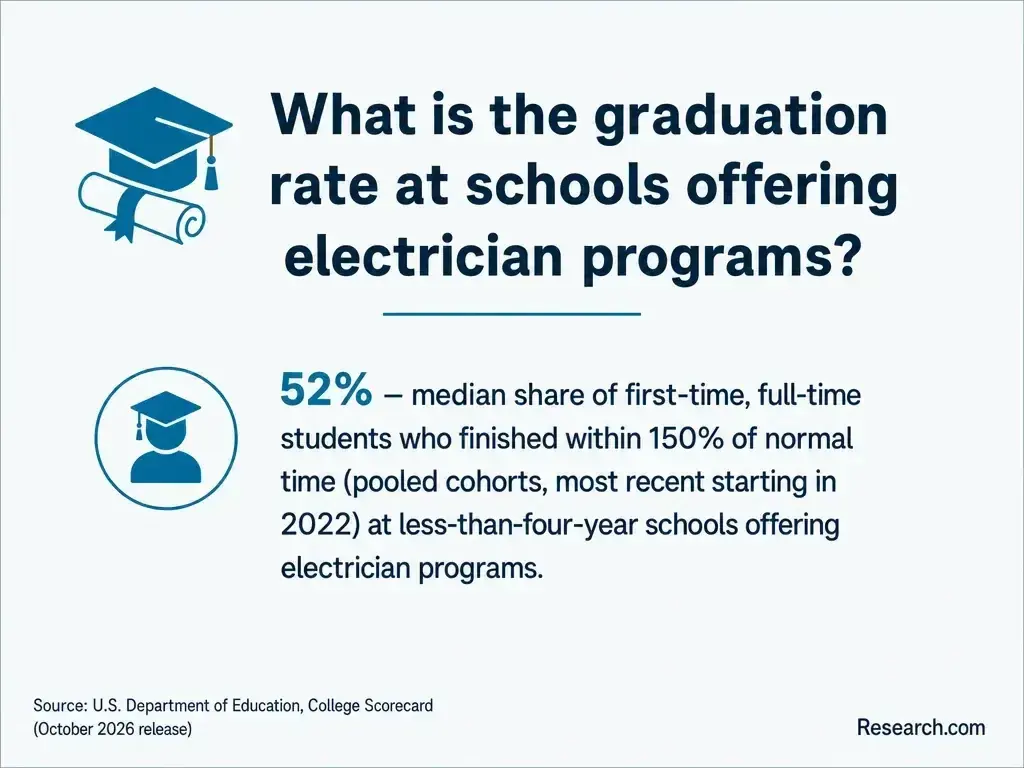
Your credential depends on the route: a school may award a certificate, diploma, or associate degree; a registered apprenticeship documents completion of a structured work-and-instruction program. Individual courses or industry credentials may demonstrate particular skills, but they do not automatically establish independent-work authority. Verify the exact award printed on completion documents and whether local employers or apprenticeship sponsors accept it for hiring or advanced standing.
Institutional accreditation concerns a school, while state authorization concerns its permission to operate. Relevant program recognition and apprenticeship registration are separate matters; none substitutes for practical competence or a locally required license. This distinction matters most when a school advertises a credential as "career-ready" without explaining what work graduates can actually perform.
Entry rules vary by provider. A school may require an application, proof of prior schooling, placement assessment, or prerequisite math. An apprenticeship sponsor may also assess algebra and reading, require an interview, and set work-related eligibility conditions. Check the current requirements directly with the program or sponsor rather than assuming that admission to school also secures an apprenticeship position.
Before applying, ask whether you must arrange your own jobsite placement, whether evening classes are available, and when the next cohort starts. If an employer or sponsor offers training, ask how classroom instruction and supervised work are recorded. Those details can matter more than a quick acceptance decision.
Strong entry-level instruction connects theory to tasks: circuit calculations inform wire and overcurrent-protection choices; plans guide layout; hands-on practice develops conduit, device-installation, testing, and fault-finding skills. Code instruction should teach students how to locate and apply rules rather than memorize a few examples. Safety training should address de-energization, verification, protective equipment, ladders, and jobsite communication. These skills align with electrician duties described by the U.S. Bureau of Labor Statistics and O*NET.
Ask to see the lab and a sample practical assessment. Can students repeatedly build, test, diagnose, and correct installations, or do they mostly watch demonstrations? For a prospective apprentice, these details show whether preliminary schooling adds enough value to justify its cost.
Do not assume that Illinois issues one statewide electrician license or that a school certificate authorizes independent electrical work. Illinois does not administer a general statewide electrician occupational license; Chicago and other local jurisdictions set applicable rules for electrical contracting and work under their authority, according to the Illinois Department of Financial and Professional Regulation and local licensing authorities. Chicago's requirements should be checked with its Department of Buildings before planning to supervise work or operate a contracting business. Rules may differ in suburbs where you intend to work.
Ask the relevant authority which credential, experience, examination, supervision, and business-license requirements apply to your intended role. A registered apprenticeship documents training; school accreditation documents educational oversight; optional industry certification documents assessed knowledge. None automatically replaces a required local authorization.
Start with the job you want - construction apprentice, industrial electrical worker, maintenance electrician, or eventually a contractor - then compare programs by the evidence that matters for that goal. A ranking helps narrow choices, but it cannot confirm an available apprenticeship opening, your commute, or the current rules in every work jurisdiction.
Use these checks before making a deposit or accepting a place:
A warning sign is a promise that a short, entirely online course makes graduates licensed electricians. Another is a tuition quote that excludes tools or required travel. Compare the cost of training with your likely starting role, not with unrelated lists such as highest paying bachelors degree rankings; the training time, costs, and jobs are different.
Electrical training can lead toward construction installation, service and troubleshooting, industrial maintenance, controls, or building-systems work. The first role is usually supervised; greater independence follows demonstrated jobsite competence and any applicable local requirements. Further experience can support crew leadership, estimating, or contracting, while specialized training may help with controls or particular equipment. None of these advances follows automatically from an entry-level certificate.
If you are choosing among hands-on occupations rather than committed to electrical work, compare daily tasks and entry routes in this guide to the best careers for trade school graduates. Electrician training is the stronger fit if you want sustained work with electrical systems and can accommodate supervised, on-site learning - not simply because a wage figure looks attractive.
The U.S. Bureau of Labor Statistics projects 9.2% growth in electrician employment nationwide from 2025 to 2035. That is an occupation-wide projection, not a forecast of Chicago openings or a promise of placement. It supports considering the trade, while leaving the local hiring question to be answered through current employer listings, apprenticeship recruitment, and a provider's documented placement information.
When evaluating demand, separate openings for experienced electricians from positions accepting beginners. A program with active relationships to employers or a registered apprenticeship sponsor may offer a clearer first step than one citing national growth without explaining how students obtain supervised local work.
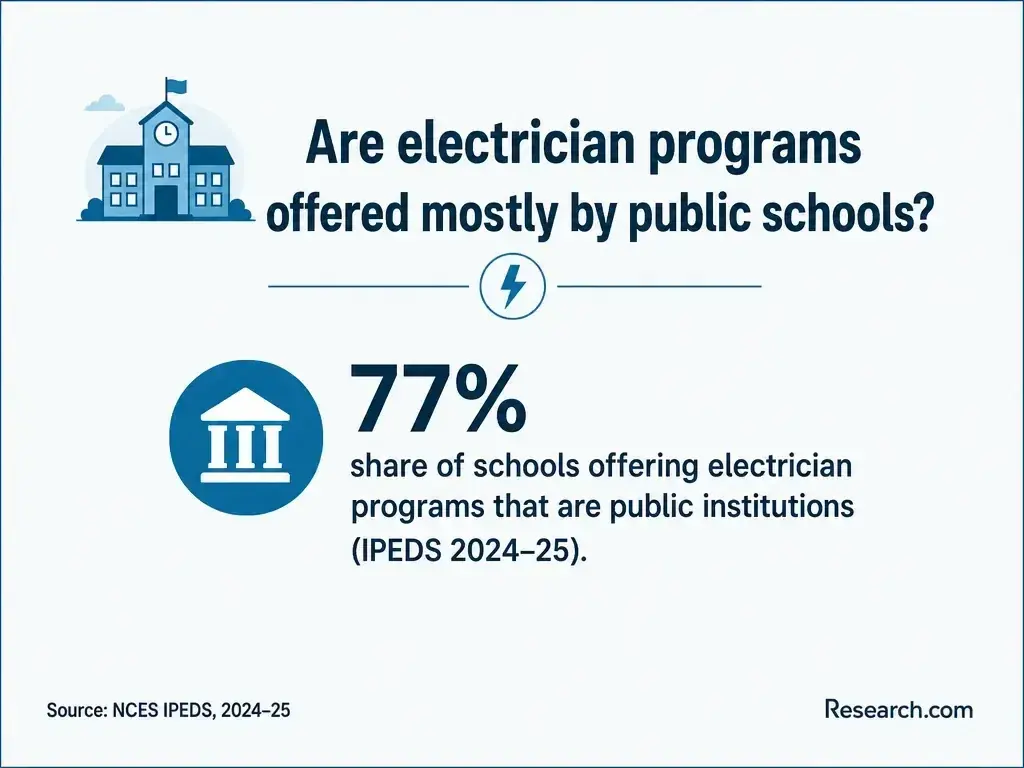
Education is a consequential investment, so the Research.com team built the ranking to compare electrician programs with other options in the same occupation and location - not with unrelated trades. Only programs reporting completions to the Integrated Postsecondary Education Data System (IPEDS) are eligible. That makes the ranking useful for comparing included schools, but it does not cover every registered apprenticeship, union program, or employer-sponsored route.
The best-programs ranking evaluates student completion and full-time and part-time retention; earnings one year after completion and earnings relative to annual attendance cost; tuition, attendance cost, debt - including debt held by students who withdrew - and federal loan defaults; and institutional accreditation, relevant program recognition, and student support. Programmatic accreditation or relevant industry recognition accounts for 20% of the score, institutional accreditation for 10%, and student support for 10%. The remaining 60% covers outcomes, earnings, and costs, with entropy-based weights that give more influence to indicators that vary more across programs. The separate most-affordable ranking scores only costs and debt, using entropy-based weights; accreditation and other quality measures are not part of that score.
The team used the following data sources to check program records, outcomes, recognition, and training pathways. Some recognition sources apply to other trades in the broader ranking methodology; their inclusion does not imply that an electrician program needs a healthcare or dental accreditation.
Readers can use the ranking to narrow school choices, then verify current program details and compare them with apprenticeships. Research.com explains its scoring approach further on its methodology page.
# 1 position
# 2 position

# 3 position
Not necessarily. A registered apprenticeship or documented employer training can provide another route. Check the work rules of the jurisdiction and role you are targeting.
No. A certificate documents completion of a school program; a registered apprenticeship combines related instruction with paid, supervised work and documents completion of that structured training.
You can study some theory online, but installation, testing, safety practice, and supervised work require in-person participation. Verify the practical component before enrolling.
It may help with an eligible program if you qualify. Confirm the program's aid eligibility and your full cost, including tools and travel; also compare paid apprenticeships and available workforce assistance.
No general statewide electrician occupational license applies. Check Chicago's rules and those of any suburb where you expect to work, especially before planning independent or contracting work.
Ask what credential you earn, how many hours are spent in hands-on labs, how supervised work is arranged, and what the total required cost will be. Then verify how local employers or apprenticeship sponsors treat that training.