# 1 position


Audited and Verified:
Our Editorial and Data Verification Process
Research.com uses government datasets, official education statistics and primary institutional information to support its career and degree guides. Our review process checks factual accuracy, occupational definitions, source dates and the requirements associated with the credentials discussed.
How This Article Was Fact-Checked
Our editorial team verifies salary estimates, employment projections, education requirements and program information against original data providers and official organizations. Salary figures are checked against the relevant occupational definitions and reporting periods. Information about licensure, accreditation and required in-person training is reviewed separately.
Fact-checked and verified on:

Co-Founder and Chief Data Scientist

Reviewed by Karolina Broda
Fact-Checker and Data Verification
Choosing electrician training in Indianapolis means comparing more than tuition: you need a route to safe, supervised work and the credentials your intended employer or locality recognizes. The U.S. Bureau of Labor Statistics projects electrician employment to grow 9.2% nationally from 2025 to 2035, making the choice timely without guaranteeing a local job. This guide compares trade-school programs with paid apprenticeships, costs, credentials, and career prospects. It also accompanies the Best Electrician Trade Schools in Indianapolis for 2027 ranking, created by the Research.com team of data scientists to help students identify programs worth considering.
Expect instruction in electrical theory, code use, and jobsite safety, followed by hands-on work with circuits, wiring methods, panels, and test instruments. The important distinction is school practice versus supervised field experience: a lab can build confidence before a jobsite, but it does not automatically replace the work hours an employer, apprenticeship sponsor, or local licensing authority may require.
Indianapolis applicants can investigate electrical training at Ivy Tech Community College or Lincoln College of Technology-Indianapolis, alongside union, nonunion, and employer-sponsored apprenticeship routes. Offerings, schedules, and employer partnerships can change; request the current campus-specific catalog rather than assuming a similarly named program provides the same hours or credential. The comparison below focuses on what each route actually supplies.
These pathways differ most in when you begin earning wages and how much supervised work is built into training. Use the table to identify the route that fits your immediate financial needs and intended job.
| Pathway | Typical outcome | Best fit and principal limitation |
| Trade-school certificate or diploma | School credential and foundational shop practice | Useful before applying for electrical helper or apprentice roles; does not itself confer apprenticeship completion. |
| Community-college associate degree in a relevant electrical field | Academic degree with broader technical coursework | Potential fit for students seeking a wider technical foundation; confirm how much instruction is construction-wiring practice. |
| Registered apprenticeship | Paid supervised work, related instruction, and an apprenticeship completion credential | Direct route for applicants ready to work while training; admission depends on sponsor openings and selection rules. |
| Employer-sponsored entry training | Employer-defined skills and experience; credential varies | May provide faster access to work, but ask whether hours and instruction transfer to another sponsor. |
Training can lead toward electrical-contractor work on homes and commercial buildings, industrial maintenance, facilities operations, or controls-related roles. The work is not interchangeable: a contractor installing building wiring may value code and conduit practice, while an industrial employer may emphasize motors, troubleshooting, and controls. Before choosing a program, compare its labs and employer connections with the work you actually want to do.
Electrical work often involves travel between sites, coordinating with other trades, and diagnosing faults with a team. If you are exploring careers for an introvert, consider the day-to-day setting rather than the job title alone: some maintenance roles involve sustained independent troubleshooting, but safety communication remains essential everywhere.
A reliable Indianapolis-specific starting wage cannot be inferred from a national occupational median. The U.S. Bureau of Labor Statistics reports a $63,190 national median annual wage for electricians in May 2025. It reflects workers across experience levels, industries, and locations, so use it as career context - not as a forecast of your first offer.
For a useful local comparison, request current apprentice wage schedules from Indianapolis-area sponsors and compare actual job postings by specialty, shift, benefits, travel requirements, and experience level. A paid apprenticeship may produce income during training; a full-time school program may instead delay earnings. That difference can matter more to your finances than a small gap in advertised tuition.
Length depends on the credential and, more importantly, the point at which you can perform electrical work under supervision. A short certificate may prepare you to seek an entry-level opening, while a registered apprenticeship generally spans multiple years of paid work and related instruction. The U.S. Bureau of Labor Statistics describes electrician apprenticeships as typically lasting four to five years. Ask each sponsor for its current work-hour, classroom-hour, and progression requirements rather than treating a school's graduation date as the end of occupational training.
Someone seeking a quick credential might also look at a best 6 month online course with high salary. For electrical work, however, a short online course cannot substitute for wiring labs and supervised jobsite practice. The faster route to starting paid work may be an apprenticeship opening, even though finishing the apprenticeship takes longer.
Online study can cover electrical calculations, blueprint reading, and code concepts. It cannot by itself demonstrate that you can safely terminate conductors, install equipment, use meters, or troubleshoot a live-work scenario under appropriate supervision. For an online or hybrid option, identify exactly where labs take place, who evaluates practical skills, and whether the schedule works with your commute and job.
Comparing online education generally - including searches for an online phd cheap - is not a reliable way to judge electrician training. The decisive feature here is accessible, assessed hands-on practice. An on-campus program may offer regular shop time; a hybrid program can work if its required in-person sessions are substantial and feasible for you.
There is no single defensible average for every Indianapolis electrician-training route: public-college programs, career-school programs, and paid apprenticeships charge and compensate students differently. Get a written, program-specific estimate instead of using an advertised tuition figure as the total price.
Your comparison should include mandatory fees, books, tools, boots and other personal protective equipment, consumable materials, transportation to labs or worksites, and any required application or examination charges. Add income you would give up while attending class; subtract grants, eligible aid, employer-paid expenses, or wages earned during apprenticeship. Ivy Tech Community College and Lincoln College of Technology-Indianapolis may have different aid eligibility and payment terms by program, so verify them directly. Federal Student Aid notes that federal aid eligibility depends on both the student and the eligible institution and program; it should never be assumed from a school's name alone.
For return on investment, compare the full cost and likely debt with your current earnings, a realistic entry wage, the probability of completing training, and how long you expect to work in the field. A cheaper program with too little practical instruction may be poor value; an expensive one is not automatically better because it is accelerated.
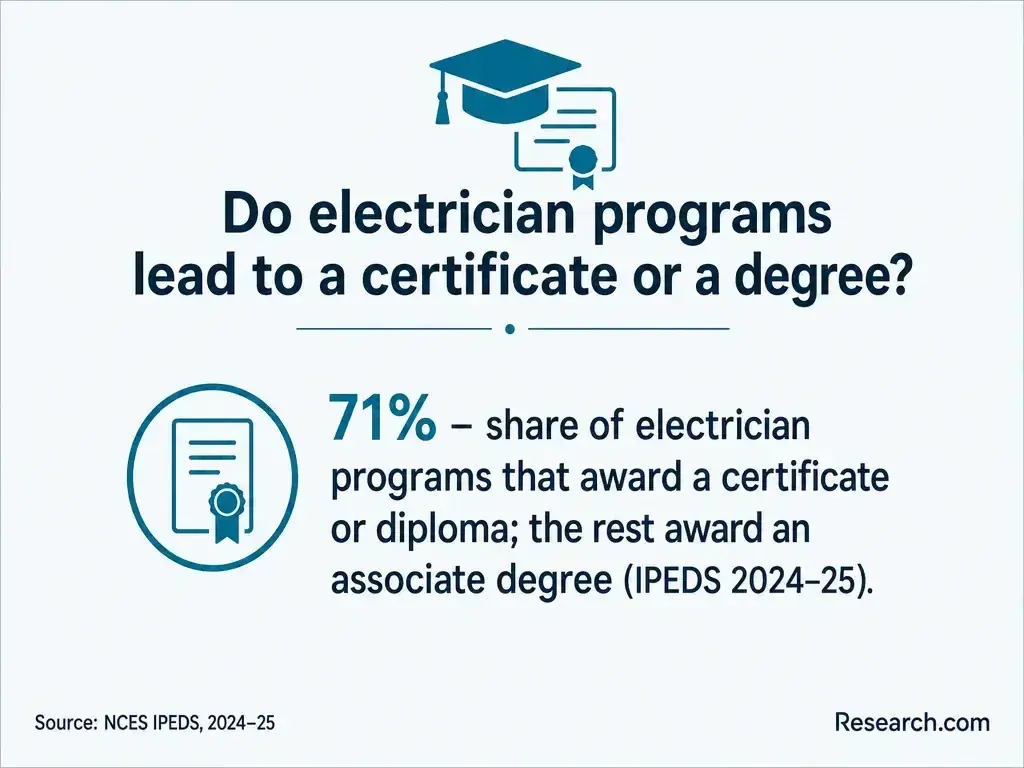
The credential depends on the route: a school may award a certificate, diploma, or relevant associate degree; a registered apprenticeship leads to an apprenticeship completion credential after its work and instruction requirements are met. A provider may also prepare students for an industry credential, but preparation is not the same as earning it. Ask for the exact award name and who issues it.
These credentials serve different purposes. Institutional accreditation concerns the school; state authorization concerns permission to operate; industry recognition concerns a particular curriculum or credential; and apprenticeship registration concerns a work-based training program. None is automatically an occupational license. If you hope to enter an apprenticeship after school, request written confirmation of any credit or advanced standing the specific sponsor will grant for prior coursework or experience.
Schools and apprenticeship sponsors set different entry rules. They may ask for evidence of prior schooling or math readiness, an application, and the ability to meet jobsite safety expectations. An apprenticeship may also involve an aptitude assessment, interview, employer selection, or ability to travel to changing worksites. Do not assume admission to a classroom program includes placement in a paid apprenticeship.
Ask admissions staff which requirements apply before enrollment and which apply later when seeking a worksite. If a provider advertises job placement, request its definition of placement, the period measured, and whether the figure covers electrical work specifically. That makes the claim more useful than a general employment percentage.
A useful entry curriculum combines electrical theory with measured, repeatable shop tasks: reading drawings, calculating loads, selecting wiring methods, installing raceways and devices, using test equipment, and applying electrical-code and safety practices. The U.S. Bureau of Labor Statistics identifies reading blueprints, installing wiring and equipment, and testing electrical systems among electricians' core duties. For Indianapolis applicants, the question is whether the program lets you practice those tasks before an employer expects you to perform them on a site.
Look beyond a course title. Ask to see the lab schedule, equipment students use, how instructors assess safe work, and whether instruction covers the residential, commercial, or industrial setting you plan to enter. A controls-heavy curriculum may be valuable for plant maintenance but less directly aligned with an initial construction-wiring job.
Do not assume there is one statewide Indiana electrician license that every employee must obtain. Indiana's licensing arrangements differ from states with a single statewide journeyman system, while Indianapolis regulates electrical contracting locally through its contractor-licensing process. Whether you are seeking supervised employment or plan to operate as a contractor changes which rules you need to check. Confirm your intended role and current requirements with the City of Indianapolis before relying on a school's description of "license readiness."
A school credential, optional industry certification, and registered-apprenticeship completion are distinct from local authorization to contract for work. Ask the local licensing authority what experience, examinations, insurance, and application steps apply to the role you eventually want; ask the training provider which, if any, of those steps its program actually satisfies. Never assume graduation alone grants a contractor license.
Start with the job, not the ranking position: construction apprentice, industrial maintenance trainee, and future electrical contractor are different targets. A trade-school program is worth considering when its practical training, credential, schedule, and employer access address a gap you cannot more affordably close through paid training. If you can enter a suitable registered apprenticeship now, compare its wages and instruction with paying for school first.
Use these checks to turn a shortlist into a decision. Get answers in writing where a promise affects your cost or eligibility.
A common mistake is assuming that any accelerated credential carries over to an apprenticeship or license. Another is choosing by format alone. If you are weighing unrelated options such as the easiest bachelors to get, keep the investment questions separate: for electrician entry, the immediate test is whether training leads to safe practical competence and a viable first electrical job.
A common progression is helper or apprentice, then a more experienced electrician trusted with increasingly complex installation or troubleshooting. From there, a worker might specialize in commercial systems, industrial maintenance, controls, or supervision. Starting an electrical contracting business is a separate step that requires checking Indianapolis contractor rules; it is not an automatic outcome of finishing a certificate.
The best first credential depends on that progression. If industrial controls interest you, check whether an electrical program includes motors and diagnostics; if contracting is your goal, prioritize building-wiring experience and learn the local authorization process. Searches for short phd programs address a different kind of career planning and should not distract from the supervised experience needed to advance in this trade.
The U.S. Bureau of Labor Statistics projects 9.2% national growth in electrician employment from 2025 to 2035. That supports investigating the trade, but it is not an Indianapolis forecast or a guarantee that every graduate will find work. Local hiring will depend on construction activity, maintenance needs, employers' schedules, and the number of apprenticeship openings available when you apply.
For a decision you can act on, compare current Indianapolis-area electrical job postings with the specialties taught by each provider, then ask apprenticeship sponsors when they expect to accept applicants. A program aligned with openings you can commute to is more useful than one chosen on national growth alone.
Investing in training is a consequential decision. Research.com evaluates electrician programs against other programs in the same occupation and location so readers can compare realistic alternatives. The ranking includes only programs with completions reported to the Integrated Postsecondary Education Data System (IPEDS); an apprenticeship or training provider absent from IPEDS is not necessarily unapproved or lower quality.
For best-program rankings, student outcomes, earnings and costs account for 60% of the score, with weights distributed according to how much indicators differ across programs. Occupation-relevant programmatic accreditation or industry recognition accounts for 20%, institutional accreditation for 10%, and student support services for 10%. Outcomes include completion and full- and part-time retention; financial measures include earnings one year after completion relative to attendance cost, tuition, debt - including debt held by students who withdrew - and federal loan default rates. Most-affordable-program rankings instead score only tuition, attendance cost, debt, and loan defaults, using entropy-based weights; accreditation and other quality indicators are not part of that affordability score.
The Research.com team draws on the following sources to check coverage, outcomes, costs, and recognition across trade occupations. Some profession-specific sources listed here do not establish electrician-program approval or licensing eligibility.
Use the ranking to narrow your search, not to replace a conversation with each provider about practical training and local work requirements. Further detail about the ranking process is available in Research.com's methodology.
# 1 position
# 2 position
# 3 position
# 4 position

# 5 position
Not necessarily. A registered apprenticeship or employer-sponsored route may combine paid work with instruction. Trade school can help you build fundamentals, but confirm what an employer or apprenticeship sponsor accepts before paying for it.
Online coursework can teach theory, but electrical installation and troubleshooting require assessed hands-on practice. Check where a program provides its labs and how you will obtain supervised work experience.
Only if the receiving sponsor grants credit or advanced standing. Ask that sponsor for its policy in writing; a similarly named school course does not automatically replace apprenticeship hours.
No. A training credential and local contractor authorization are separate. Check current City of Indianapolis requirements for the work you intend to perform or contract for.
Choose based on access and total cost. An available apprenticeship may let you earn while gaining supervised experience; school may help if you need foundational practice before competing for an opening. Compare actual schedules, costs, wages, and employer recognition.