# 1 position
Hinds Community College - Electrician.
associate

Audited and Verified:
Our Editorial and Data Verification Process
Research.com uses government datasets, official education statistics and primary institutional information to support its career and degree guides. Our review process checks factual accuracy, occupational definitions, source dates and the requirements associated with the credentials discussed.
How This Article Was Fact-Checked
Our editorial team verifies salary estimates, employment projections, education requirements and program information against original data providers and official organizations. Salary figures are checked against the relevant occupational definitions and reporting periods. Information about licensure, accreditation and required in-person training is reviewed separately.
Fact-checked and verified on:

Co-Founder and Chief Data Scientist

Reviewed by Karolina Broda
Fact-Checker and Data Verification
Choosing electrician training in Mississippi means looking beyond a school's name: you need a workable route from classroom and lab to paid field experience. The U.S. Bureau of Labor Statistics projects 9.2% growth in electrician employment nationally from 2025 to 2035. For new entrants and working adults, this guide compares credentials, costs, apprenticeships, career prospects, and licensing questions. It also accompanies the Best Electrician Trade Schools in Mississippi for 2027 ranking, created by the Research.com team of data scientists to help students make an informed choice about programs worth considering.
Expect electrical theory paired with physical practice: reading plans, measuring circuits, installing wiring and conduit, troubleshooting faults, and working safely around energized equipment. A useful program gives students supervised time with tools and equipment - not just demonstrations - and explains how graduates move into an employer's training pipeline or apprenticeship.
Programs differ in purpose. A short certificate may suit someone seeking entry-level helper work; a longer diploma may provide more lab practice; an electrical-technology associate degree may fit someone who wants a broader technical curriculum. A registered apprenticeship is a different route: the sponsor combines paid, supervised work with related instruction. Direct-entry employer training may also make sense for someone who already has a qualifying job offer. If you are still comparing occupations rather than electrical programs, a broader career-interest comparison can help clarify your goal before you commit to trade-specific expenses.
Before enrolling, ask how many hours you will personally spend wiring, testing, bending conduit, and diagnosing faults; what equipment you will use; and whether employers or apprenticeship sponsors recognize the training. Two programs awarding similarly named certificates may offer very different amounts of practice.
Electrical training can lead toward residential and commercial construction, industrial maintenance, utilities-related work, and facility maintenance. These settings demand different skills: a residential crew may emphasize branch circuits and service work, while an industrial employer may value motors, controls, and systematic troubleshooting. The U.S. Bureau of Labor Statistics identifies electrical contractors and manufacturing among major electrician employment settings nationally.
Location should shape your program choice. If you plan to work near a Mississippi manufacturing site, ask about motor-control labs and industrial employer partnerships. If a program requires frequent campus trips or distant jobsite assignments, calculate that travel before choosing it. A placement claim is most useful when the school can identify the occupations, employers, and geographic area represented - not merely report that former students found work.
The U.S. Bureau of Labor Statistics reports a $63,190 national median annual wage for electricians in May 2025. This is the midpoint for employed electricians across experience levels, not a forecast of what a newly trained worker in Mississippi will earn. Apprentice pay can start lower and change as skills and experience accumulate.
For a local decision, compare current Mississippi electrician wage estimates from the state labor-market agency with actual apprentice and entry-level offers in the area where you intend to work. Also ask whether quoted pay assumes overtime, travel, or industrial shift work. Those details can matter more to your first-year budget than a national median.
School-based certificates generally take less time than diplomas or associate degrees, but duration varies by credit load, course sequencing, and whether you attend full- or part-time. Ask for the current program map and the earliest realistic completion date, including any courses offered only once a year. A faster classroom credential is not necessarily a faster route to independently performing electrical work.
Registered apprenticeships take several years because participants learn while completing supervised work and related instruction. The U.S. Department of Labor's typical model includes at least 2,000 hours of on-the-job learning annually and recommends at least 144 hours of related instruction annually; the sponsor's registered standards govern the actual program. Ask whether prior coursework earns advanced standing - never assume it will shorten an apprenticeship automatically.
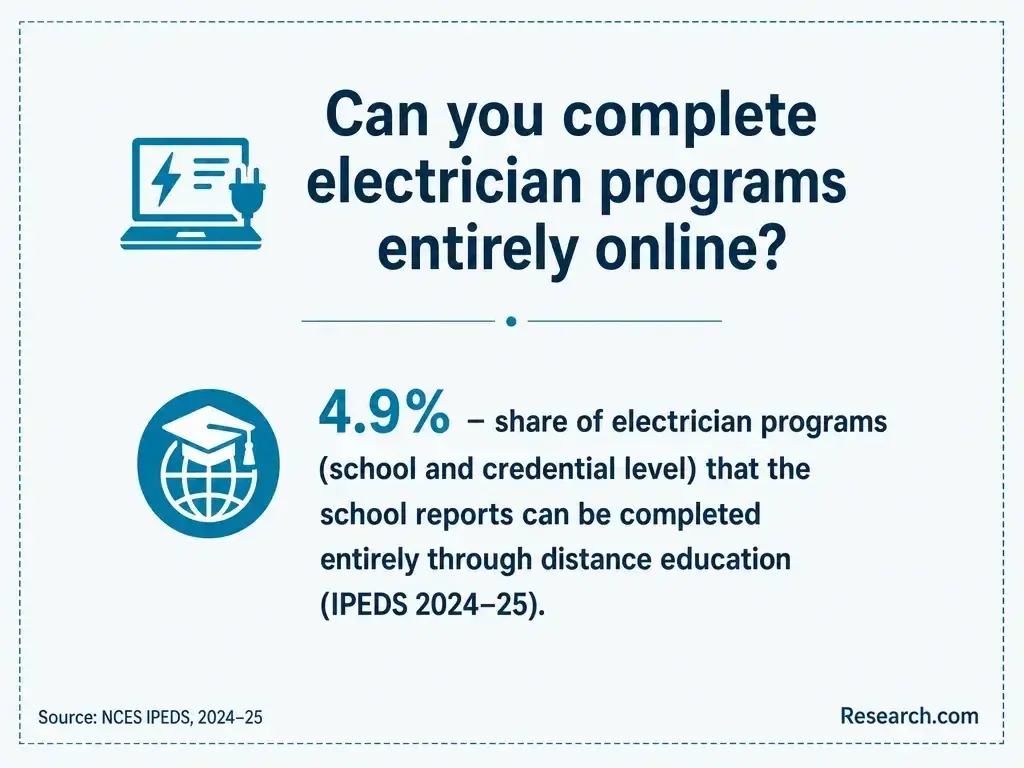
Online coursework can help with code concepts, calculations, blueprint reading, and scheduling flexibility. It cannot, by itself, show that you can install a circuit safely, use test instruments, or troubleshoot equipment under supervision. An on-campus or hybrid program is more useful when it gives you accessible, assessed lab practice and a clear path into field training.
Older adults and career changers comparing online learning options for older students should pay particular attention to travel and physical lab schedules. Ask a hybrid provider which sessions require attendance, where they occur, what equipment you will handle, and whether missed labs can be made up. Treat an entirely online electrical credential as supplemental learning unless an employer or applicable authority confirms how its practical-training requirements will be met.
There is no single reliable statewide price that covers community-college programs, private career training, and paid apprenticeships. Request a current, itemized cost sheet from every provider. For a public program, verify resident tuition eligibility; for a private program, compare its full price and financing terms rather than assuming a shorter schedule makes it cheaper.
The most useful comparison is total cost to become job-ready. The items below can differ substantially even when advertised tuition looks similar:
If an electrical-technology associate degree is on your shortlist, use online associate-degree cost guidance only as a prompt to ask about fees and aid - not as a substitute for a Mississippi electrical program's quote. To assess return on investment, weigh total cost and debt against completion probability, your current earnings, realistic post-training earnings, and how long it may take for higher earnings to offset the investment.
The award depends on the route: a school may offer a certificate, diploma, or electrical-technology associate degree; a registered apprenticeship has its own completion credential. An employer may instead document completed in-house training. These awards describe training completed, but they are not interchangeable with an occupational license or proof of equivalent supervised field experience.
Check the exact credential on the program page and transcript. Ask whether it carries credit toward a longer program, is recognized for advanced standing by a named apprenticeship sponsor, or prepares students for a particular industry assessment. NCCER-related training, for example, should be verified against the provider's actual curriculum and assessment arrangements rather than assumed from an electrical-sounding program title.
Requirements differ by provider and route. A school may request an application, prior education records, placement results, or math preparation; an apprenticeship sponsor may have its own age, eligibility, aptitude, interview, and employer-selection process. The U.S. Department of Labor notes that apprenticeship entry requirements are set by individual programs. Ask for the current written criteria before paying an application fee.
Prepare for electrical measurements, arithmetic, and reading technical instructions. If you need aid, confirm the specific program is eligible - not merely that its institution participates in federal aid. Guidance on online college courses that accept FAFSA can help frame the question, but Federal Student Aid eligibility must be checked with the school for your chosen electrical credential. Apprentices should instead ask the sponsor how wages progress and who pays for related instruction, tools, and travel.
Core training typically covers electrical fundamentals, circuit calculations, wiring methods, blueprint interpretation, testing, troubleshooting, and jobsite safety. Relevant code instruction matters because electricians must work to the requirements adopted and enforced for their projects. The U.S. Bureau of Labor Statistics describes electricians as installing, maintaining, and repairing electrical power, communications, lighting, and control systems.
Compare the practical curriculum with your target job. For construction, look for supervised wiring, conduit, panels, and plan reading. For industrial work, ask about motors, controls, and fault diagnosis. A program with extensive theory but little assessed tool use may be a poor fit for someone seeking immediate field work; conversely, a narrow installation course may not serve someone aiming for industrial maintenance.
Do not confuse three separate things: finishing school, working under supervision, and holding authority to contract for electrical work. Mississippi's State Board of Contractors oversees applicable contractor licensing, while local jurisdictions may impose their own permits, examinations, or electrician requirements. Rules can differ by the work performed and where it is performed; a school certificate is not itself a contractor license. Verify the rules for your intended work with the Mississippi State Board of Contractors and the relevant city or county before choosing training.
Ask an employer or apprenticeship sponsor what credentials are required for the position you want and who supervises your work. If your long-term goal is to operate an electrical contracting business, check applicable experience, examination, and business-licensing requirements early. Institutional accreditation, industry certification, apprenticeship registration, and occupational licensing serve different purposes; none automatically substitutes for another.
Start with the job you want, then compare routes that actually lead toward it. Hinds Community College, Itawamba Community College, East Mississippi Community College, Delta Technical College-Mississippi, and Pearl River Community College may be names to investigate, but confirm each provider's current electrical offerings, campus, schedule, and credential directly. Also compare a registered apprenticeship or employer-sponsored opening if earning while training would improve your finances.
Use this sequence to test whether a program is a sound investment rather than choosing by rank or advertised tuition alone:
A red flag is a promise that a brief course alone makes you a licensed electrician or guarantees a particular wage. Another is an "online-only" practical program that cannot explain where you will demonstrate tool and safety skills. A strong choice is the one that offers enough relevant practice, an affordable path to completion, and a credible next step into work - not necessarily the shortest program.
An entry-level helper role can lead to supervised electrical work, apprenticeship progression, and, with experience, more independent construction or maintenance assignments. Some workers specialize in industrial controls, commercial installations, service work, or supervision. Contracting or self-employment brings additional regulatory and business responsibilities; training completion alone does not confer that authority.
If you are comparing electrical work with other trade-school career paths, compare daily tasks as carefully as pay. Someone who enjoys diagnosing motors and controls may prefer industrial maintenance; someone who likes changing sites and installing new systems may prefer construction. Ask a potential training provider which path its labs and employer connections support best.
The U.S. Bureau of Labor Statistics projects 9.2% national electrician employment growth from 2025 to 2035. That signals demand across the occupation, but it does not predict openings in a particular Mississippi county or guarantee a job after training. The same BLS occupation spans construction, maintenance, and other settings, so local hiring conditions can differ by specialty.
For a practical local check, review current Mississippi labor-market projections and compare recent openings in your commuting area with the program's employer contacts. Ask whether advertised jobs accept beginners, require apprenticeship enrollment, or expect industrial experience. That distinction tells you whether a school's training is likely to help you enter the available jobs - or whether applying directly to a paid apprenticeship makes more sense.
Investing in training is a consequential decision. Research.com created its ranking to help readers compare electrician programs with other options in the same occupation and location. The team evaluates reported outcomes, costs, recognition, and support services, while checking the credibility and relevance of the underlying data. Only programs with completions reported to IPEDS are included; an apprenticeship or other provider absent from the ranking is not necessarily a poor option.
For its best-program rankings, Research.com evaluates student completion and full- and part-time retention; earnings one year after completion and earnings relative to annual attendance cost; tuition, attendance cost, debt - including debt held by students who withdrew - and federal loan default rates; and institutional accreditation, occupation-relevant programmatic accreditation or industry recognition, and student support. Occupation-relevant recognition carries 20% of the score, institutional accreditation 10%, and support services 10%. The remaining 60% covers outcomes, earnings, and costs, with weights distributed by an entropy-based method that gives more weight to indicators that vary more across programs.
Most-affordable-program rankings instead score tuition, attendance cost, median debt, and federal loan default rates using entropy-based weights; accreditation and other quality indicators are not part of that affordability score. The following sources inform Research.com's ranking work across occupations. Healthcare-specific organizations listed here should not be mistaken for electrician program accreditors.
Use the ranking to narrow a shortlist, then confirm each program's current price, electrical lab access, and employer or apprenticeship connections directly. More detail on the approach is available on Research.com's methodology page.
# 1 position
# 2 position
# 3 position

# 4 position
# 5 position
# 6 position
# 7 position
# 8 position

# 10 position

# 11 position
# 12 position
# 13 position

# 14 position
Electrical and Power Transmission Installation/Installer, General
Delivery mode: On Campus (May Include Online Courses)
27.42
/ 100
Final score
Accreditation
Institutional accreditation from Southern Association of Colleges and Schools Commission on Colleges.
Jones County Junior College received a Research.com Trade Program Score of 27.42/100.
# 15 position
# 16 position

# 17 position
Electrician
Delivery mode: On Campus (May Include Online Courses)
17.37
/ 100
Final score
Accreditation
Institutional accreditation from Southern Association of Colleges and Schools Commission on Colleges.
Coahoma Community College received a Research.com Trade Program Score of 17.37/100.
# 18 position

# 20 position

Not necessarily. A registered apprenticeship or employer-supervised route may provide the instruction and field experience you need. Confirm requirements for the specific job and locality before paying for school.
No. A certificate documents completion of a school program; a registered apprenticeship combines structured instruction with supervised, paid work under a sponsor's standards. Ask whether school coursework can earn apprenticeship credit.
You can study some theory online, but practical electrical competencies require supervised, hands-on work. Ask where and how a program assesses those skills before enrolling.
Not automatically. Mississippi contractor licensing and applicable local rules are separate from a school award. Check the Mississippi State Board of Contractors and the jurisdiction where you plan to work.
Compare time to paid work, instruction and lab quality, supervised experience, total out-of-pocket cost, wages during training, and the credential earned. Ask an apprenticeship sponsor whether it accepts credit for prior coursework.