# 1 position
Palm Beach State College - Electrician.
certificate or diploma

Audited and Verified:
Our Editorial and Data Verification Process
Research.com uses government datasets, official education statistics and primary institutional information to support its career and degree guides. Our review process checks factual accuracy, occupational definitions, source dates and the requirements associated with the credentials discussed.
How This Article Was Fact-Checked
Our editorial team verifies salary estimates, employment projections, education requirements and program information against original data providers and official organizations. Salary figures are checked against the relevant occupational definitions and reporting periods. Information about licensure, accreditation and required in-person training is reviewed separately.
Fact-checked and verified on:

Co-Founder and Chief Data Scientist

Reviewed by Karolina Broda
Fact-Checker and Data Verification
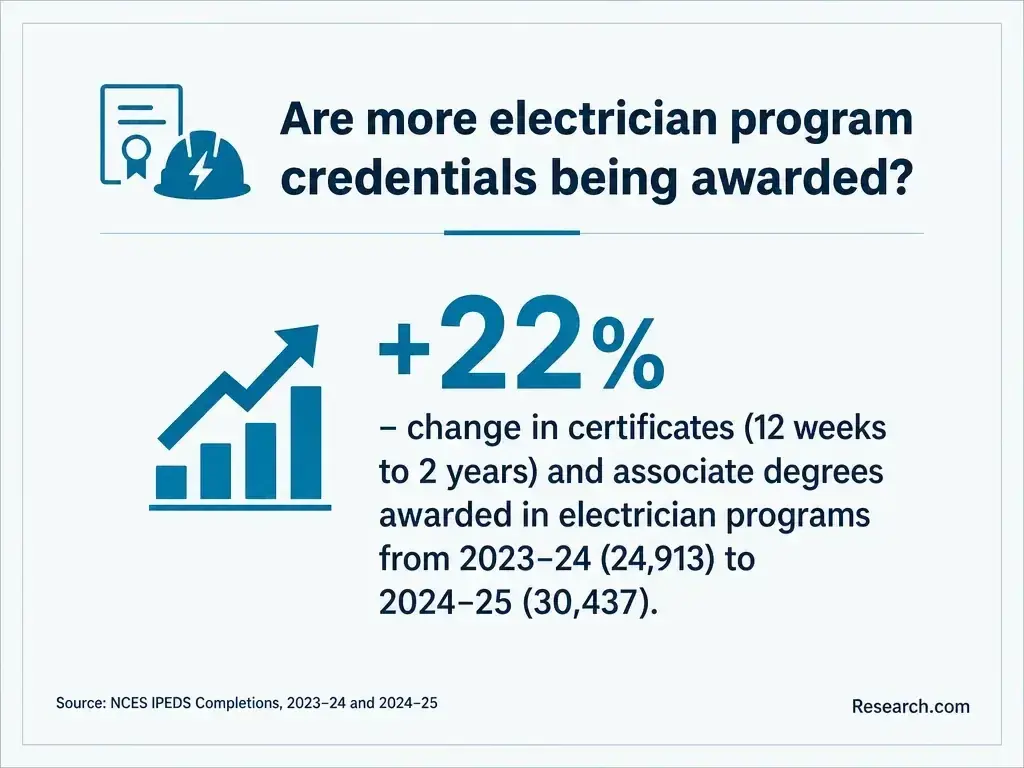
Choosing an electrician program in Florida means looking beyond the school name: you need hands-on training, a realistic route into paid work, and a clear understanding of local licensing rules. The U.S. Bureau of Labor Statistics projects 9.2% national growth in electrician employment from 2025 to 2035. For prospective students and career changers, this guide compares training pathways, costs, credentials, and career prospects. It also accompanies the Best Electrician Trade Schools in Florida for 2027 ranking, created by the Research.com team of data scientists to help students make an informed choice about programs worth considering.
Expect a mix of electrical theory and supervised practice - not simply lessons on wiring. Students typically learn to interpret plans, calculate loads, select materials, use meters, install circuits, and work safely under applicable electrical codes. Good lab instruction makes students demonstrate these tasks; it does not treat watching a demonstration as equivalent to doing the work. The U.S. Bureau of Labor Statistics identifies both classroom learning and on-the-job training as common parts of electrician preparation.
The central choice is school first or earn while learning. A technical-college or career-school certificate can provide structured preparation before applying for helper or apprentice jobs. A registered apprenticeship combines paid employment, related instruction, and progressively more demanding work from the start. An employer-sponsored route may also be viable, but applicants should ask who supervises the work, what instruction is provided, and whether the training is registered. A short school program is most useful when it leads to a credible next step - not when it is marketed as a substitute for years of field experience.
Electricians work for electrical contractors on residential and commercial construction, for industrial and facilities-maintenance employers, and on service and repair crews. Depending on the employer and additional training, work can involve building systems, controls, generators, or solar installations. The U.S. Bureau of Labor Statistics describes construction and electrical contracting as major employment settings; a school's placement claims should still be checked against actual local employers.
Location changes the practical choice. A program near a construction market may offer more contractor contacts, while a student farther from major job centers must account for travel to labs and worksites. Ask each Florida provider where recent trainees completed fieldwork and whether its employer contacts hire in the county where you plan to live. Training for a residential helper role and training aimed at industrial maintenance are not interchangeable simply because both teach electrical fundamentals.
The U.S. Bureau of Labor Statistics reports a $63,190 national median annual wage for electricians in May 2025. That is the midpoint for employed electricians across experience levels - not a Florida wage or an expected offer to a new trainee. For a local decision, compare the latest Florida and metropolitan-area electrician wage estimates from the BLS Occupational Employment and Wage Statistics program with actual apprentice or helper offers. Ask whether an offer includes paid travel, overtime, benefits, and scheduled wage increases.
Paid apprenticeships may produce income while a student in a full-time school program may forgo earnings. Conversely, a school program that helps someone secure a suitable apprenticeship sooner could have value. A worthwhile comparison uses likely entry pay and progression, not the occupation-wide median as a promised return.
A school certificate may be substantially shorter than an apprenticeship, but its exact clock hours and calendar length depend on the provider and whether attendance is full-time or part-time. Registered electrician apprenticeships commonly run for several years because they combine related instruction with extensive supervised on-the-job learning, according to Apprenticeship.gov. Finishing a shorter certificate does not mean finishing an apprenticeship or meeting a local journeyman requirement.
Request the program's published total clock hours, weekly schedule, lab hours, and expected completion date. Then ask an apprenticeship sponsor whether completed coursework earns advanced standing; do not assume credit transfers. An accelerated associate program may shorten an academic timetable, but speed alone does not replace the electrical lab and supervised work hours your intended pathway requires.
Online or hybrid delivery can make code concepts, calculations, and some theory easier to study around a job. Conduit work, circuit assembly, meter use, fault-finding, and safe work practices require supervised, in-person practice. A fully online course should therefore be evaluated as theory instruction or career exploration unless its provider can document how students obtain and are assessed on practical skills.
Before enrolling, ask where labs take place, how often attendance is required, who supplies equipment, and whether an employer or apprenticeship sponsor recognizes the training. Listings of top accredited non-profit online universities answer a different education question; institutional accreditation does not establish that an online electrician course provides hands-on occupational preparation.
There is no single reliable statewide average that captures Florida technical-college programs, private career schools, and paid apprenticeships on comparable terms. Published tuition is only the starting point. Request an itemized, current quote from each provider before deciding that the least expensive advertised program is the best value.
A job-ready budget should account for the following costs and offsets:
Ask a public provider about resident tuition and program eligibility for aid; ask any provider for the total amount payable through completion. Federal student aid depends on the eligibility of both the student and program, according to Federal Student Aid. Florida workforce funding may also depend on the local workforce board and approved-training status, according to CareerSource Florida. A paid apprenticeship can reduce borrowing, but compare its starting wage, travel demands, and completion timeline with the school option.
The award might be a career certificate, diploma, or associate degree, depending on the program. A registered apprenticeship instead leads to an apprenticeship completion credential after its required instruction and on-the-job training. Some providers also prepare students for industry credentials. These awards document different kinds of preparation; none should be described as an automatic Florida contractor license or a universal local journeyman license.
Read the exact award name and ask employers or apprenticeship sponsors whether they recognize it, whether coursework can count toward advanced standing, and what graduates typically do next. Someone comparing the easiest bachelor degree to get should keep that separate from this occupational decision: the relevant test here is whether the electrician credential connects to practical work and the rules in the intended jurisdiction.
Requirements vary by provider and pathway. Schools may ask for an application and evidence of foundational reading and math skills; apprenticeship sponsors may use separate eligibility checks, assessments, interviews, and employer hiring processes. Apprenticeship.gov advises applicants to review a sponsor's posted qualifications rather than assume that school admission secures an apprenticeship position.
Before applying, confirm the minimum age and education requirements, any assessment or orientation, the physical demands of lab and field tasks, and whether a driver's license or reliable transport is needed for assigned worksites. Ask separately whether admission guarantees a lab seat, an employer placement, or neither. A program that fits your schedule but requires travel you cannot reliably make is unlikely to be the fastest path into the trade.
Core instruction generally covers electrical principles, circuits, code use, blueprint reading, wiring methods, testing, and jobsite safety. Students may practice assembling installations and locating faults in a shop before performing similar tasks under supervision at work. The U.S. Bureau of Labor Statistics describes electricians as installing, maintaining, and repairing electrical power and control systems; those duties provide a useful check on whether a curriculum is occupationally relevant.
Compare the work students actually perform, not just course titles. Ask to see the lab equipment and sample assessments: Does each student use test instruments and build circuits? Is there practice in troubleshooting as well as installation? Is any field experience required or arranged? Training focused mainly on residential wiring may be a sensible first step, but someone targeting controls or industrial maintenance should look for relevant instruction and employer experience.
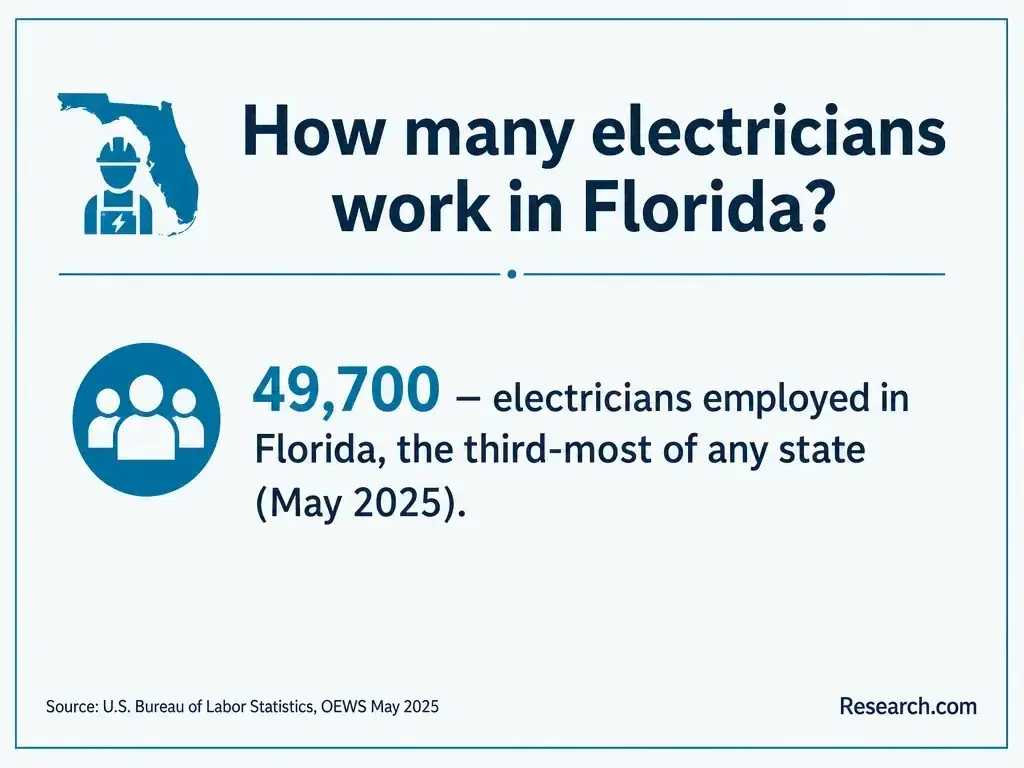
Florida's rules depend on the work and role. The Florida Department of Business and Professional Regulation oversees state electrical-contractor licensing through the Electrical Contractors' Licensing Board. A certified contractor holds a state credential permitting work statewide within the license scope; a registered contractor is tied to local competency requirements and the jurisdictions for which registration applies. Journeyman rules can be set locally rather than through one uniform statewide journeyman license. Entry-level employees should confirm the supervision and local rules applicable to their work.
School authorization, institutional accreditation, an industry certificate, registered-apprenticeship status, and an occupational license are separate things. Graduation alone does not confer contractor authority. Before choosing training, contact the building or licensing authority where you intend to work and the Florida Department of Business and Professional Regulation about the experience, examination, and application requirements for your intended next role. Keep records of supervised work and classroom instruction; ask how, if at all, a school program counts toward a future requirement.
Start with the job you want after training: helper, apprentice, or a role requiring additional experience. Then compare programs against that destination rather than relying on a ranking alone. A public technical program, private career school, and registered apprenticeship can all be reasonable choices, but they differ in price, admission, paid work, and the time needed to build field competence. Institution type alone does not determine return on investment.
Use these checks to narrow your shortlist before paying an enrollment deposit:
A program promising independent work immediately after a short course, refusing to specify lab hours, or quoting tuition without required expenses warrants closer scrutiny. If your goal is electrician entry, information about colleges with dual degree programs is not a substitute for checking supervised-work opportunities and local regulatory fit.
Many people begin as helpers or apprentices, develop competence under supervision, and move toward experienced electrician or locally recognized journeyman roles. With further experience, some pursue crew leadership, specialized maintenance or controls work, estimating, or electrical contracting. Contractor licensing is an additional regulated step, not a credential automatically earned through trade school, according to the Florida Department of Business and Professional Regulation.
A short program is most compelling if it helps you enter suitable paid electrical work without taking on disproportionate debt. A registered apprenticeship may be preferable if you can secure a place and need wages while learning; school-based preparation may help if you need foundational skills before competing for one. Searches for a cheapest master degree online address a different investment decision and should not be used to judge the cost of becoming job-ready in this trade.
For the United States, the U.S. Bureau of Labor Statistics projects 9.2% growth in electrician employment from 2025 to 2035. That signals national demand across the occupation, but it does not predict openings for graduates of a particular Florida program. Construction cycles, local contractors' hiring, and access to apprenticeships can change an individual's prospects.
Use Florida's official labor-market information and current local job postings to test demand where you expect to work. Look at the experience employers request: repeated calls for apprentices or helpers are more relevant to a new trainee than openings requiring years of independent work. Ask a prospective program which employers interview its students and whether those opportunities match your intended commute and specialty.
Education is a consequential investment, so the Research.com team designed the ranking to compare electrician programs with other programs serving the same occupation and location. The ranking uses reported outcomes, costs, and quality indicators to help readers build a shortlist - not to replace a check of each program's current training schedule, employer connections, and costs.
Only programs with completions reported to the Integrated Postsecondary Education Data System (IPEDS) are eligible. Best-program rankings assess student completion and full- and part-time retention; earnings one year after completion and earnings relative to annual attendance cost; tuition, attendance cost, debt, and federal loan default rates; and accreditation, relevant industry recognition, and student support. Programmatic accreditation or relevant industry recognition receives 20% of the score, institutional accreditation 10%, and student support 10%. An entropy-based method distributes the remaining 60% among outcomes, earnings, and cost indicators according to how much they vary across programs.
The following sources inform the ranking dataset and checks. Some cover occupations other than electrical work; their inclusion does not imply that a healthcare accreditor approves electrician programs.
Most-affordable-program rankings use only tuition, attendance cost, median debt, and federal loan default rates, with entropy-based weights; accreditation and other quality indicators do not enter that score. IPEDS does not cover every union, employer-sponsored, or other apprenticeship provider. A provider's absence from this ranking is therefore not evidence that its training is unavailable or inferior. Readers can find further details on Research.com's ranking methodology.
# 1 position
# 2 position
# 3 position
# 4 position
# 5 position
# 6 position

# 7 position
# 8 position

# 9 position

# 10 position

# 11 position
# 12 position
# 13 position

# 14 position
# 15 position
# 16 position
# 17 position

# 18 position

# 19 position

# 20 position
Not necessarily. A registered apprenticeship or qualifying employer-based training may provide an alternative. Check the rules for your intended role and jurisdiction before deciding that a school credential is required.
No. A certificate documents completed training; contractor licensing and locally administered journeyman requirements are separate. Ask the relevant licensing authority whether and how your training counts.
You can study some theory online, but electrical installation, testing, and safety skills require in-person practice and assessment. Verify a program's lab arrangements before enrolling.
It may be if you can obtain a place and need income while training. A school program may be useful for building foundational skills or qualifying for an opportunity. Compare actual admission prospects, total costs, wages, and supervised-work access.
Ask how placement is defined, what share of completers the figure covers, which employers hire trainees, and whether positions are electrical helper or apprentice jobs in a location you can reach.