# 1 position
Jackson College - Electrician.
associate

Audited and Verified:
Our Editorial and Data Verification Process
Research.com uses government datasets, official education statistics and primary institutional information to support its career and degree guides. Our review process checks factual accuracy, occupational definitions, source dates and the requirements associated with the credentials discussed.
How This Article Was Fact-Checked
Our editorial team verifies salary estimates, employment projections, education requirements and program information against original data providers and official organizations. Salary figures are checked against the relevant occupational definitions and reporting periods. Information about licensure, accreditation and required in-person training is reviewed separately.
Fact-checked and verified on:

Co-Founder and Chief Data Scientist

Reviewed by Karolina Broda
Fact-Checker and Data Verification
Choosing electrician training in Michigan means comparing more than tuition: the program must help you build practical skills and meet the state's work-experience requirements. The U.S. Bureau of Labor Statistics projects 9.2% national growth in electrician employment from 2025 to 2035, making the pathway worth a close look - not a guaranteed job. This guide explains costs, credentials, apprenticeships, licensing, and career prospects. It also accompanies a Best Electrician Trade Schools in Michigan for 2027 ranking created by the Research.com team of data scientists to help students identify programs worth considering.
Expect a mix of electrical theory and supervised practice: reading plans, identifying circuits, using test instruments, installing wiring and equipment, and following electrical safety procedures. The U.S. Bureau of Labor Statistics describes electrician training as involving classroom learning and extensive on-the-job work. A classroom certificate can prepare you to seek an apprenticeship, but its labs are not automatically a substitute for the practical experience Michigan requires for journeyman licensure.
The routes below lead to different credentials and different amounts of paid experience. The key question is not which label sounds strongest, but where you will obtain supervised hours and whether the training fits your intended work.
| Pathway | Typical result | Best fit and main trade-off |
| Pre-apprenticeship or short certificate | School or sponsor credential; possible preparation for apprenticeship entry | Useful for exploring the trade or strengthening an application; ask whether hours count toward any later requirement. |
| Community-college or career-school electrical program | Certificate, diploma, or, where offered, associate degree | Useful for structured labs and theory; tuition and attendance time may precede paid work. |
| Registered apprenticeship | Documented work-based training and related instruction; completion credential | Useful for earning while learning and accumulating supervised experience; entry depends on sponsor openings and selection rules. |
| Employer-sponsored apprentice training | Employer instruction and documented work experience | Useful when a qualifying employer offers a clear training plan; verify state registration and related-instruction arrangements. |
Ask each provider how much instruction occurs in a lab, who supervises worksite training, and whether it helps place students with licensed electrical contractors. Similar-sounding certificates can offer very different access to the jobsite experience that matters most.
Electricians work for electrical contractors, construction firms, manufacturers, facilities departments, and employers maintaining electrical systems, according to the U.S. Bureau of Labor Statistics. In Michigan, someone interested in industrial work should look for training that includes motors, controls, and troubleshooting; someone targeting building construction should prioritize installation, plans, and code practice. Ask prospective employers which tasks apprentices actually perform, because a school's broad "electrical" label may not describe its strongest preparation.
Location affects access to supervised work. A campus may be convenient while its partner jobsites require a substantial commute; a rural applicant may need to consider a wider employer area than someone near a larger labor market. Before enrolling, compare the school's placement arrangements with apprenticeship openings and the distance to both classes and worksites. School training alone does not authorize independent electrical work where licensure applies; confirm job duties and supervision with Michigan's Department of Licensing and Regulatory Affairs (LARA).
Pay depends on experience, employer, specialty, hours, and location. The U.S. Bureau of Labor Statistics reports a $63,190 national median annual wage for electricians in May 2025. It covers experienced workers as well as newer ones and should not be treated as a Michigan graduate's starting salary. For a Michigan decision, compare current apprentice wage schedules and local job offers with the most recent state and metro electrician wage estimates published by the Bureau of Labor Statistics or Michigan's labor-market agency.
Also distinguish wages from take-home value. Overtime, benefits, travel time, and the progression from apprentice to licensed journeyman can change the appeal of two otherwise similar offers. If a school advertises a salary, ask which occupation, geography, worker experience level, and reference year it represents.
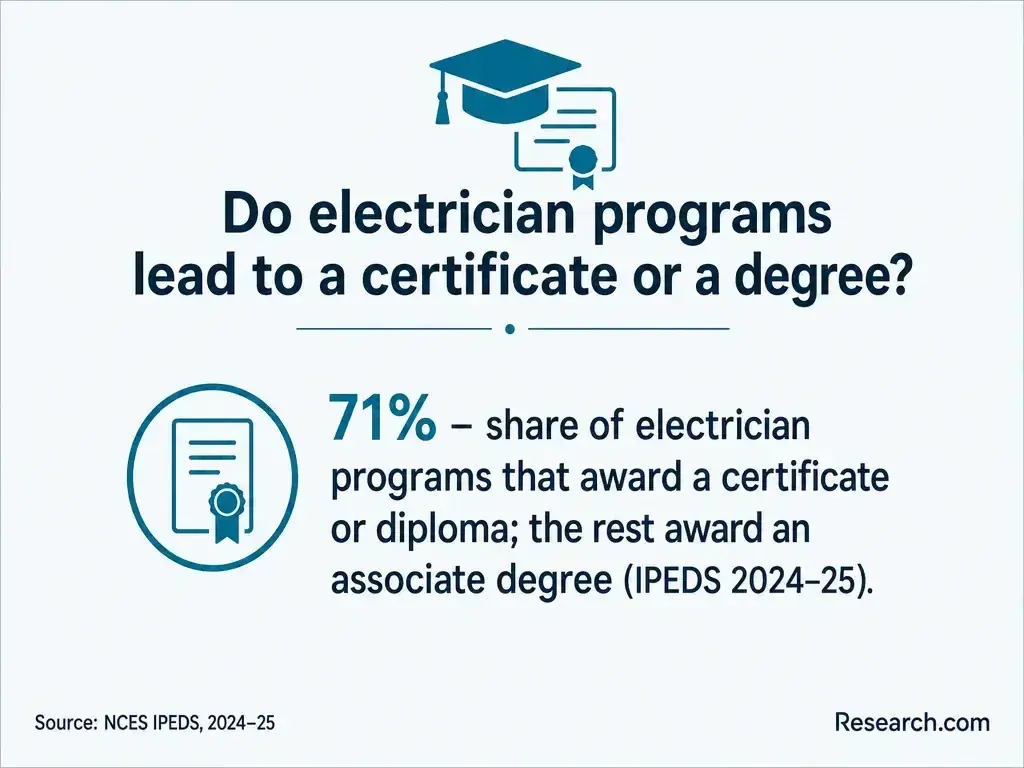
A school certificate may take substantially less time than the full path to journeyman status; its actual length depends on course load, scheduling, and lab requirements. An associate degree generally takes longer and may include broader coursework. Request each program's published clock hours or credits, weekly schedule, and required in-person lab hours rather than assuming programs with the same credential name take the same time.
For Michigan journeyman licensing, the longer milestone is qualifying work experience: LARA specifies at least 8,000 hours over no fewer than four years, along with applicable related instruction and an examination. Confirm the current instruction rules and how hours must be documented with LARA and your apprenticeship sponsor. An accelerated school schedule cannot compress a multi-year experience requirement; a part-time program may make it easier to keep earning, but can delay completion if its classes conflict with jobsite hours.
Online coursework can be practical for electrical theory, mathematics, plan reading, and some code study. Wiring assemblies, safe tool use, testing, troubleshooting, and supervised jobsite work require in-person practice. A hybrid program can reduce trips to class without removing the need to reach its lab and worksite.
Choose an online or hybrid option only after the provider identifies exactly where practical training occurs, who evaluates it, and how any work hours are documented. Michigan licensure depends on qualifying experience and other state requirements, not on a program's online delivery claim (LARA). If a provider describes an entirely online course as a complete route to becoming a licensed electrician, ask for written confirmation from the licensing authority before paying.
There is no single reliable Michigan-wide price that captures community-college programs, private career schools, and paid apprenticeships on the same basis. Compare each option's total cost to become job-ready, not a tuition figure alone. Obtain a written estimate covering mandatory fees, books or software, tools, safety gear, consumable materials, transportation to labs and worksites, and any examination or licensing fees. Include earnings you would give up while attending, then subtract grants, employer support, and wages earned during training.
For a public-college option, check whether your residency changes tuition and whether the quoted cost covers the entire program. Federal aid depends on both student and program eligibility; the U.S. Department of Education's Federal Student Aid office advises checking eligibility rather than assuming every short course qualifies. Ask the school about current Michigan aid or workforce funding, and ask apprenticeship sponsors what they pay for instruction, tools, or books.
A higher-priced program might still be worthwhile if its completion prospects, lab access, and route into paid supervised work justify the extra cost. Conversely, "free tuition" may not be cheapest if travel is extensive or work hours are hard to obtain. For a return-on-investment comparison, consider completion probability, debt, lost and earned wages, expected post-training earnings, and the time it takes for those earnings to repay costs.
The credential depends on the provider: it may be a pre-apprenticeship completion record, school certificate or diploma, associate degree, or registered-apprenticeship completion credential. These document different training. None is itself a Michigan journeyman electrician license. Ask what the certificate actually certifies, whether an employer or apprenticeship sponsor recognizes it, and whether completed coursework can receive advanced standing or transfer credit; obtain any promise about credit or hours in writing.
Keep four checks separate. Institutional accreditation concerns the school; state authorization concerns permission to operate; industry recognition or program approval concerns particular training standards; and occupational licensure is granted under Michigan's electrician rules. Accreditation or an industry certificate alone does not establish that your supervised hours qualify for a license. Verify school claims with the relevant accreditor or regulator and licensing claims with LARA.
Requirements vary by provider. A school may ask for an application, proof of prior schooling, placement results, or evidence that an applicant can safely participate in lab work. Apprenticeship sponsors may use a separate selection process involving education prerequisites, math assessment, interviews, employer availability, and the ability to travel to jobsites. Check the current written requirements with the school or sponsor rather than assuming admission to a class also secures an apprenticeship.
Before committing, ask whether you must find an employer yourself, when you can begin supervised work, and what happens if no apprenticeship opening is available when classes start. If you already have electrical experience, ask both the provider and LARA what documentation could support advanced standing or a licensing application; prior experience is not automatically credited.
A useful curriculum combines electrical fundamentals with practice: circuits, measurements, wiring methods, equipment installation, drawings, troubleshooting, and safe work procedures. The U.S. Bureau of Labor Statistics identifies blueprint reading, electrical theory, mathematics, and code requirements as parts of electrician training. Ask to see the syllabus and lab inventory, not just a course title. A learner aiming for industrial maintenance should examine coverage of motors and controls, while a building-construction applicant should examine installation and code exercises.
Hands-on quality matters because students must learn to test before touching, select the right equipment, and diagnose faults safely - not merely recognize answers on a screen. Ask how instructors assess individual work, whether labs mirror the intended job setting, and how classroom lessons connect to supervised field tasks. Current equipment and clear safety supervision are more useful than a long topic list with little practice.
Yes, licensing matters for independent electrician work in Michigan, but apprentices enter under different supervision and registration rules. LARA administers state electrician licensing and sets journeyman experience, instruction, and examination requirements. Its usual journeyman pathway requires at least 8,000 hours of qualifying practical experience over no fewer than four years. Ask LARA how your proposed apprenticeship, related instruction, and documented hours fit the current rules before assuming a school credential creates exam eligibility.
Registered apprenticeship is a structured training status, not the same thing as a journeyman license. Likewise, an optional industry training certificate does not replace a state examination or occupational license. Later advancement to master electrician involves additional requirements under LARA rules. Verify current state and any applicable local administrative requirements before taking a job or planning to work independently; do not rely on a school's statement that graduates are automatically "licensed."
Start with your intended job and work backward. A school program is a stronger investment when it provides substantial supervised practice and a credible connection to qualifying employment; a paid apprenticeship may be the better first move if you can enter one directly. Use the ranking to find possibilities, then test each against the questions that determine your actual cost and route to licensure.
Ask the same questions of every school, employer, or apprenticeship sponsor so that advertised advantages are comparable:
Watch for promises of instant licensure, salary figures presented as starting pay, unclear lab arrangements, or pressure to enroll before receiving a full cost breakdown. Neither a ranking position nor accreditation resolves those concerns. The best option is the one you can realistically complete, afford, and connect to documented supervised work.
An entry route commonly leads to supervised apprentice work, followed - once state requirements are met - by journeyman licensure. With further experience, an electrician may pursue master-level responsibilities or specialize in construction, industrial equipment, controls, maintenance, or related electrical systems. Running a contracting business can bring additional licensing and business obligations; check the intended scope with LARA rather than assuming a personal trade license covers every activity.
Choose training for the tasks you want to perform first. A construction-focused lab may be a sensible entry point for a future installer, while someone who prefers diagnosing equipment faults should ask about controls practice and industrial worksites. Readers weighing whether hands-on, independently focused work suits them can also explore best career options for introverts, while keeping the electrician role's teamwork, customer contact, and jobsite safety demands in view.
The U.S. Bureau of Labor Statistics projects 9.2% growth in U.S. electrician employment from 2025 to 2035. That national projection signals demand for the occupation, but it does not predict a Michigan graduate's hiring chances or the number of apprenticeship places nearby. Compare current openings by region and specialty, and ask sponsors how often they recruit and where apprentices are assigned.
Changing electrical equipment and installation needs make adaptable troubleshooting and code knowledge valuable, but job prospects still depend on local projects, employer needs, and the ability to complete supervised training. If your preferred program has limited worksite connections, a nearby registered apprenticeship or employer route may offer a more direct path despite a school's attractive course catalog.
Education is a consequential investment, so Research.com evaluates electrician programs against other programs serving the same occupation and location - not against unrelated fields. The ranking is intended to help readers narrow their options, while the program-level checks in this guide help them decide whether a particular option fits their licensing and career goals.
Only programs with completions reported to the Integrated Postsecondary Education Data System (IPEDS) are eligible. For the best-programs ranking, student outcomes, earnings, and costs collectively account for 60% of the score; their individual weights use an entropy-based method that gives more weight to indicators that differ more across programs. Occupation-relevant programmatic accreditation or industry recognition accounts for 20%, institutional accreditation for 10%, and student support services for 10%. Indicators include full- and part-time retention, completion, median earnings one year after completion, earnings relative to annual cost of attendance, resident and nonresident tuition, cost of attendance, median debt - including for students who withdrew - and federal loan default rates.
Most-affordable-program rankings use only tuition, cost of attendance, median debt, and federal loan default rates, weighted through the entropy-based method; accreditation and other quality measures do not enter that score. Research.com draws on the following sources to check coverage, outcomes, costs, recognition, and apprenticeship context. Some listed health-field organizations are part of the broader trade-ranking source set; their recognition is not an electrician licensing credential.
IPEDS and College Scorecard do not cover every union, employer-sponsored, or registered-apprenticeship pathway. A provider's absence from the ranking does not establish that it is unavailable or unsuitable. Readers can learn more about the scoring approach on the Research.com methodology page, then verify current program details and licensing implications directly before enrolling.
# 1 position
# 2 position
# 3 position
# 4 position
# 6 position

# 7 position
# 8 position
# 9 position

# 10 position

# 12 position

# 13 position

# 14 position

# 15 position

# 16 position
# 17 position
# 18 position
# 19 position
# 20 position
A registered apprenticeship or qualifying employer-sponsored route may combine related instruction with supervised work without a separate school-first program. Verify the route's registration, instruction, and licensing eligibility with the sponsor and LARA.
No. Michigan's journeyman route also involves qualifying supervised experience, applicable related instruction, and an examination under LARA rules.
It depends on access and your preparation. An apprenticeship can provide wages and documented work experience; a certificate can help you build initial skills. Ask whether the certificate improves entry into a specific apprenticeship before paying for it.
Online theory is possible, but practical electrical skills and supervised jobsite experience require in-person work. Do not assume an online course alone meets Michigan licensing requirements.
Get the full cost and refund terms, lab and worksite arrangements, credential awarded, and any claims about licensing eligibility in writing. Confirm licensing claims directly with LARA.