# 1 position
Western Iowa Tech Community College - Electrician.
certificate or diploma

Audited and Verified:
Our Editorial and Data Verification Process
Research.com uses government datasets, official education statistics and primary institutional information to support its career and degree guides. Our review process checks factual accuracy, occupational definitions, source dates and the requirements associated with the credentials discussed.
How This Article Was Fact-Checked
Our editorial team verifies salary estimates, employment projections, education requirements and program information against original data providers and official organizations. Salary figures are checked against the relevant occupational definitions and reporting periods. Information about licensure, accreditation and required in-person training is reviewed separately.
Fact-checked and verified on:

Co-Founder and Chief Data Scientist

Reviewed by Karolina Broda
Fact-Checker and Data Verification
The cheapest electrician program is not necessarily the least expensive route to a license: tools, travel, and time away from paid work can change the calculation. Electrician employment is projected to grow 9.2% nationally from 2025 to 2035, according to the U.S. Bureau of Labor Statistics. For Iowa students and career changers, the Research.com team of data scientists created a Most Affordable Electrician Trade Schools in Iowa for 2027 ranking to help identify programs worth considering. This guide explains how to compare their costs, practical training, credentials, and fit with Iowa's licensing pathway.
Expect a combination of electrical theory, code use, calculations, and supervised work with wiring and equipment. A classroom-only credential may help with entry into the trade, but it is not a substitute for demonstrating safe installation and troubleshooting on a jobsite. Ask how much of a program takes place in a lab and whether it arranges employer interviews, registered-apprenticeship entry, or documented work experience.
These pathways serve different starting points. The comparison matters because similarly named "electrician" programs can lead to different credentials and different amounts of paid experience.
| Pathway | What it provides | Best fit |
| College certificate or diploma | Structured classes and labs; the school awards the credential, but supervised employment may still be needed. | Someone who wants foundational practice before seeking an employer or apprenticeship. |
| Associate degree in an electrical trade | Electrical coursework and labs plus additional academic requirements; verify the exact occupational focus. | Someone who values a broader college credential and can justify its additional time and cost. |
| Registered apprenticeship | Paid, supervised work and related instruction under a registered training plan. | Someone ready to seek an employer or sponsor and earn while learning. |
| Employer-sponsored or direct-entry training | Training tied to an available job; structure and recognition vary by employer. | Someone with a credible job offer who has confirmed how experience will count toward licensing. |
A pre-apprenticeship can help applicants build basic skills, but it is not automatically a registered apprenticeship. In every route, verify the actual credential awarded and how the training fits Iowa's licensing rules before enrolling.
Possible worksites include residential construction, commercial buildings, manufacturing plants, agricultural facilities, and building-maintenance operations. The work differs: a contractor may emphasize new installations and travel between sites, while an industrial employer may prioritize motor controls, troubleshooting, and shift coverage. The U.S. Bureau of Labor Statistics describes electricians as installing, maintaining, and repairing electrical power, communications, lighting, and control systems.
Location affects access to training as well as jobs. A student near Des Moines may be able to compare more nearby employers; a rural student should ask where labs, apprenticeships, and jobsite assignments occur and budget for the commute. A school's local employer relationships are useful only if they lead toward the type of electrical work the student wants to do.
The U.S. Bureau of Labor Statistics reports a national median annual wage of $63,190 for electricians in May 2025. That figure covers workers at different experience levels and is not an Iowa starting-pay estimate. For an Iowa decision, compare current apprentice or entry-level offers in the area where you can work, including benefits, expected hours, travel time, and scheduled wage increases.
Do not calculate a program's payoff by subtracting tuition from the national median. A useful comparison considers your current earnings, pay while training, aid, borrowing, likelihood of finishing, expected earnings after training, and how long you expect to work in the trade. A paid apprenticeship may look more attractive once forgone wages are included, even if a college program has a lower advertised tuition.
The answer depends on which milestone you mean. A school certificate may finish before the supervised work required for a later license; an associate degree includes additional coursework; and a registered apprenticeship combines instruction with work over multiple years. The U.S. Bureau of Labor Statistics describes electrician apprenticeships as typically lasting four or five years, but applicants should confirm the current schedule and requirements with an Iowa sponsor and the Iowa Electrical Examining Board.
Ask a school for its calendar length, scheduled classroom and lab hours, and whether attendance is full-time, part-time, or evening-based. Then ask an apprenticeship sponsor whether any prior instruction can receive credit or advanced standing. Do not assume that completing a shorter school program shortens the time to independent practice.
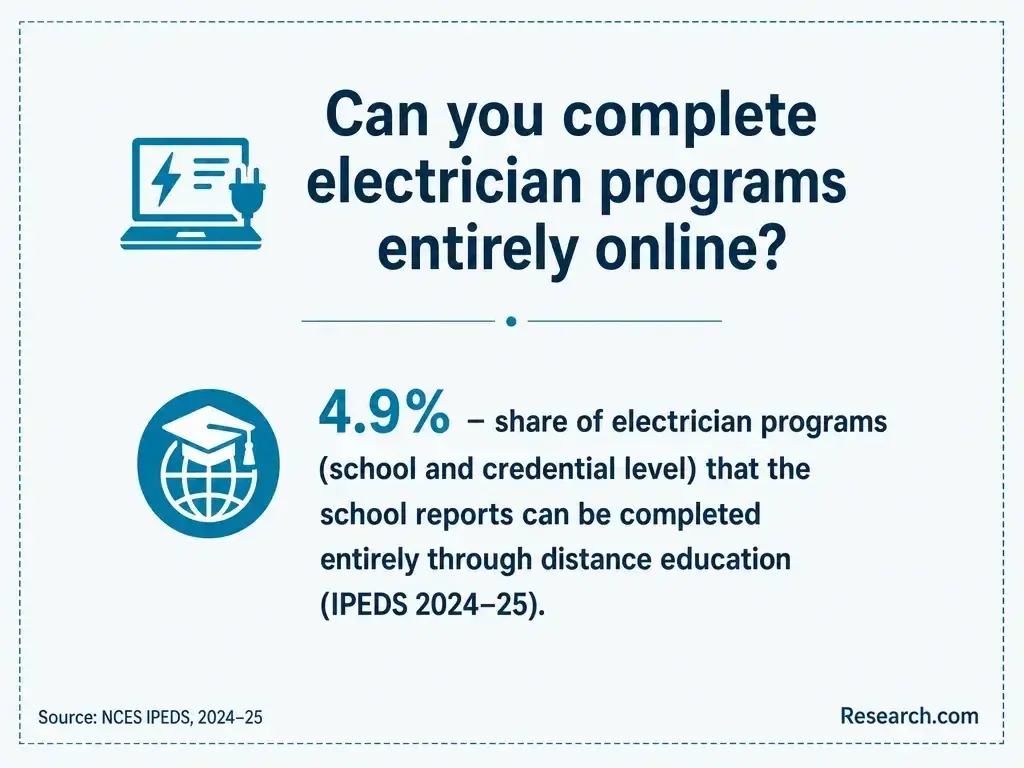
Electrical theory, calculations, and some code instruction can be delivered online. Wiring methods, tool use, testing, lockout procedures, and troubleshooting require supervised practice with equipment or at worksites. A hybrid option may reduce trips for lectures but still require travel to a lab and employer.
Choose a format by checking the practical-training schedule, not the online label. Ask where assessments occur, who supervises hands-on work, and whether a prospective apprenticeship sponsor accepts the instruction. An entirely remote course should not be assumed to satisfy Iowa experience or licensing requirements. Even a listing for the fastest associate degree online cannot answer those trade-specific questions.
There is no single dependable price for every Iowa electrician pathway: a college credential, a private training program, and a paid apprenticeship have different charges and wage arrangements. Published tuition is only the starting point. Request the current program-specific cost of attendance rather than treating a schoolwide average or an affordability rank as your final bill.
For a comparable estimate, ask each provider to identify these costs and offsets. This is especially important if one option requires daytime attendance and another pays wages during training.
Check aid eligibility with the provider and Federal Student Aid; it varies by program and student. An Iowa workforce office can also tell you whether you qualify for training assistance. Lists of the easiest degrees do not reveal the cost of becoming job-ready as an electrician.
The credential depends on the route: a school may award a certificate, diploma, or associate degree; a registered apprenticeship has its own completion credential. None should be described as an Iowa electrician license. The Iowa Electrical Examining Board controls occupational licensing, while apprenticeship registration and school accreditation serve different purposes.
Read the award name on the program page and ask what a graduate can do immediately afterward. Can they apply for an electrical job or apprenticeship? Will a sponsor consider prior training? What work experience remains? General lists of the best schools to go to for college cannot establish those electrician-specific outcomes.
Schools set their own admission rules; apprenticeships also have sponsor-specific selection and employer requirements. Applicants may need to demonstrate math readiness and the ability to attend labs or jobsites safely. Ask directly about prerequisites, placement assessments, required equipment, driving or travel expectations, and when you must secure an employer.
Admission is separate from occupational eligibility. Before accepting a place, check the Iowa Electrical Examining Board's current apprentice registration and supervision rules for the work you plan to perform. An unrelated search result such as doctorate degree online no dissertation provides no guidance on electrician entry requirements.
A relevant curriculum builds from electrical safety and measurements to reading plans, applying electrical-code provisions, installing circuits, and diagnosing faults. Depending on the program, students may practice conduit work, wiring, motors, or controls. The U.S. Bureau of Labor Statistics identifies critical thinking, troubleshooting, and physical dexterity as important electrician skills.
Compare what students actually do, not just course titles. Request a lab outline and ask whether students use current testing equipment, receive supervised feedback, and practice tasks relevant to residential, commercial, or industrial work. A program focused on general electrical concepts may be less useful to a prospective installer than one with substantial shop practice and a clear transition into supervised employment.
For electrical work covered by Iowa law, workers must follow the state's licensing and supervision rules. The Iowa Electrical Examining Board administers electrician licenses and related requirements; the appropriate starting status depends on the work and the worker's experience. Later progression can involve documented experience, examinations, and the applicable journeyman or master license requirements. Confirm current rules directly with the board before relying on a school's claims.
School accreditation is not an electrician license. State school authorization concerns a provider's permission to operate; institutional accreditation concerns the institution; an industry certificate documents particular training; and registered-apprenticeship status concerns a supervised training program. None automatically replaces board requirements. Ask the board and prospective employer how a particular program's instruction and experience will be treated.
Start with the job you want, then work backward to the required supervision, training, and license. Western Iowa Tech Community College, Des Moines Area Community College, Northwest Iowa Community College, Northeast Iowa Community College, and Iowa Lakes Community College are examples of schools a prospective student may investigate; verify each current electrical offering rather than assuming every campus offers the same credential or schedule.
Use these questions with schools and apprenticeship sponsors before paying a deposit. They expose differences an affordability ranking cannot measure.
Red flags include promises of automatic licensure, an online-only route presented as complete hands-on preparation, or a price that omits mandatory equipment. Verify institutional accreditation separately from occupational eligibility; a list of top universities with national accredited status does not establish either a particular electrician program's practical training or its fit with Iowa licensing rules.
Training can lead first to supervised electrical work and, with the required experience and licensing steps, to more independent roles. Subsequent choices may include residential installation, commercial construction, industrial maintenance, controls work, supervision, or operating an electrical business where applicable licensing requirements are met. These are progression options, not automatic outcomes of a school credential.
Match training to the destination: someone interested in factory troubleshooting should look closely at motors and controls, while someone seeking construction work should ask about installations and code practice. If an employer can provide paid, well-supervised training aligned with that goal, attending school first may not be the best investment.
The U.S. Bureau of Labor Statistics projects 9.2% national employment growth for electricians from 2025 to 2035. That signals demand across the occupation, but it does not predict an individual's chance of finding an Iowa apprenticeship or a job in a particular county. Check Iowa's current occupational projections and local openings, then ask employers and sponsors where they recruit.
Demand also needs to be weighed against entry conditions. An opening that requires substantial travel, shift work, or prior industrial experience may not suit a newly trained applicant. Choose a program whose worksite connections and practical curriculum match the opportunities you can realistically pursue.
Research.com recognizes that investing in electrician training is a significant decision. Its team evaluates programs against others in the same occupation and location so readers can compare realistic options, rather than schools serving unrelated trades or markets. Only programs with completions reported to the Integrated Postsecondary Education Data System (IPEDS) are eligible; an apprenticeship or other provider absent from the ranking may still be a valid training option.
The most affordable ranking uses tuition, cost of attendance, median student debt, and federal loan default rate. Weights are assigned through an entropy-based method, which gives more weight to measures that vary more across eligible programs. Accreditation and other quality measures are not part of the affordability score. Readers should therefore use the ranking to narrow a cost comparison, then independently check training quality, completion prospects, and Iowa licensing fit. Research.com's separate best-program rankings also consider outcomes, earnings, accreditation or industry recognition, and support services; those quality criteria should not be mistaken for this ranking's scoring method.
The team draws on the following databases and organizations in its ranking work. Some occupation-specific sources listed here concern other trades and should not be interpreted as electrician-program approval bodies.
Using multiple sources helps the team check costs and program identity, but published figures can lag current school charges. Consult the Research.com methodology for more on how rankings are created, and request a current, itemized estimate before committing.
# 1 position
# 2 position

# 3 position

# 4 position
# 5 position
# 6 position

# 7 position

# 8 position
# 9 position

# 10 position

# 11 position
Not necessarily. A registered apprenticeship or qualifying employer-based route may combine supervised work with instruction. Confirm the route's current requirements with the Iowa Electrical Examining Board and the prospective sponsor.
It can be once wages and forgone earnings are included, but sponsors may have selection requirements and training-related expenses. Compare each route's full costs, pay, schedule, and access to supervised experience.
Do not assume so. Online study may cover theory, but electrical work requires hands-on competency and any applicable supervised experience and licensing steps.
No. Eligibility is limited to programs reporting completions to IPEDS. A registered apprenticeship absent from the ranking may still be a strong option.
Not automatically. Ask the school exactly what training it documents, then check remaining experience, examination, and application requirements with the Iowa Electrical Examining Board.