# 1 position


Audited and Verified:
Our Editorial and Data Verification Process
Research.com uses government datasets, official education statistics and primary institutional information to support its career and degree guides. Our review process checks factual accuracy, occupational definitions, source dates and the requirements associated with the credentials discussed.
How This Article Was Fact-Checked
Our editorial team verifies salary estimates, employment projections, education requirements and program information against original data providers and official organizations. Salary figures are checked against the relevant occupational definitions and reporting periods. Information about licensure, accreditation and required in-person training is reviewed separately.
Fact-checked and verified on:

Co-Founder and Chief Data Scientist

Reviewed by Karolina Broda
Fact-Checker and Data Verification
The cheapest electrician program is not necessarily the least expensive route to a job: tools, travel, unpaid training time, and access to an apprenticeship all matter. The U.S. Bureau of Labor Statistics (BLS) projects electrician employment to grow 9.2% nationally from 2025 to 2035, making the training decision timely. This guide helps Illinois students compare credentials, practical training, costs, and local entry requirements. It also features a Most Affordable Electrician Trade Schools in Illinois for 2027 ranking, created by the Research.com team of data scientists to help students identify programs worth considering.
Expect electrical theory paired with supervised practice: reading plans, measuring circuits, selecting materials, following the National Electrical Code, and working safely with tools and equipment. A school shop can develop these skills, but it is not the same as installing and troubleshooting systems on an employer's jobsite. Before enrolling, ask exactly which tasks students perform in person and whether the program helps them enter an apprenticeship.
The main pathways lead to different credentials and amounts of work experience. This comparison helps you identify which one matches your intended first job.
| Pathway | What it typically provides | Best fit and limitation |
| Pre-apprenticeship | Introductory skills, safety training, and preparation to apply for an apprenticeship | Useful for exploring the trade; completion is not an apprenticeship placement. |
| College or career-school certificate or diploma | Classroom and lab instruction in electrical fundamentals | Useful for structured preparation; verify the lab work and employer connections before paying. |
| Electrical associate degree | Electrical coursework plus additional academic requirements | May suit a longer-term technical goal; confirm that the extra time and cost serve that goal. |
| Registered apprenticeship | Paid supervised work and related instruction under a registered sponsor | Strong fit for learning while earning; entry may be competitive, and training takes years. |
Programs with similarly named certificates may differ substantially in shop hours, equipment, and jobsite access. Ask for a written curriculum and a breakdown of lab, classroom, and employer-worksite hours rather than judging a credential by its title.
Electrical contractors install and repair systems in homes, commercial buildings, and industrial facilities. Utilities, manufacturers, and facilities employers also need electrical skills, although their positions may have different duties and entry requirements. The BLS describes electricians as working across construction and maintenance settings; an introductory school credential alone may qualify someone for a helper or trainee position rather than independent electrical work.
Location affects the choice of training. Chicago-area applicants may have more potential sponsors and worksites to compare, but they should also calculate travel to a training center and changing jobsites. In less densely populated parts of Illinois, a nearby college may be easier to attend than a distant apprenticeship classroom - or the reverse if a local employer sponsors training. Ask where instruction and paid work actually occur before committing.
A single national figure cannot tell you what an Illinois trainee will earn. The BLS reports a $63,190 national median annual wage for electricians in May 2025. That figure covers experienced workers as well as newer electricians; it is not a predicted starting salary or an Illinois-specific wage.
For a useful local comparison, look up the latest Illinois occupational wage estimates from the BLS or the Illinois Department of Employment Security, then request current trainee wage schedules from apprenticeship sponsors or employers. Compare the same occupation and reference period, and account for hours worked, benefits, overtime, and travel costs. A higher advertised wage may be less attractive if reaching the jobsite is expensive or work is intermittent.
A school certificate may take less time than a diploma or associate degree, but length varies with the course schedule and required labs. The BLS says electricians commonly learn through apprenticeships lasting four to five years. A short program can help you qualify for an entry opportunity; it should not be presented as equivalent to years of supervised work.
If you are considering an associate degree, compare its actual electrical lab hours and work-based opportunities with a certificate's - not just the advertised completion date. A general guide to how long does it take to get an associate degree can frame the time commitment, but the electrical program's published schedule is the deciding source. Ask whether prior coursework or documented experience earns credit and whether a sponsoring apprenticeship recognizes any of it; never assume that school hours automatically shorten an apprenticeship.
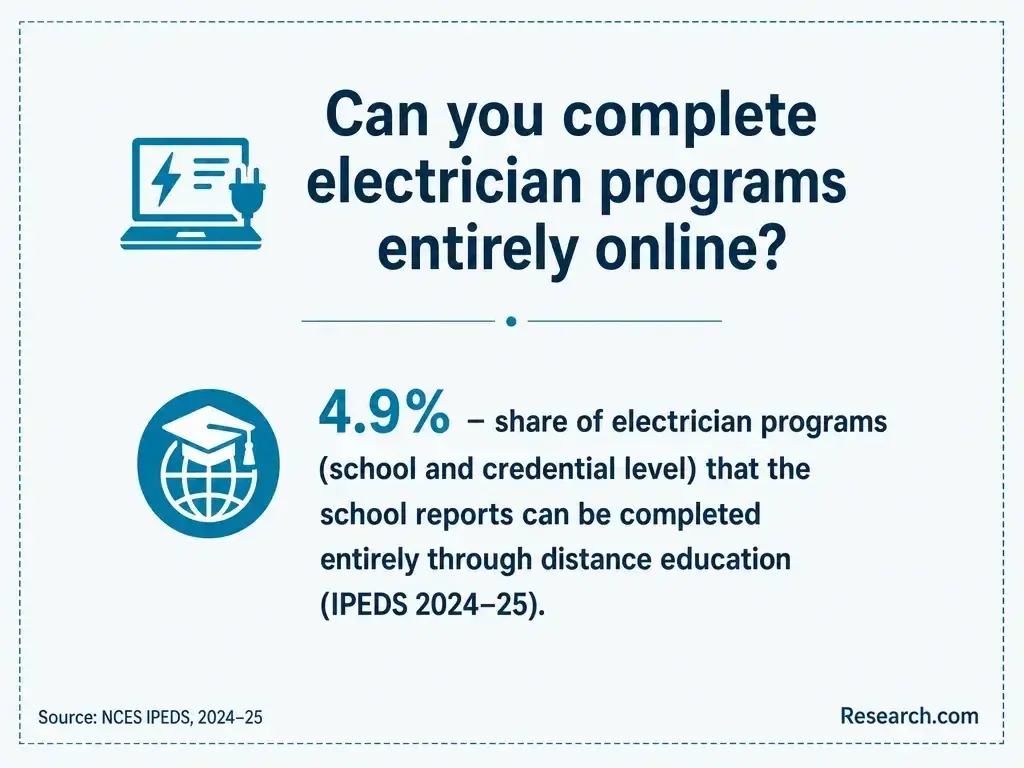
Online instruction can work for electrical theory, calculations, code study, and some safety lessons. Measuring live or simulated circuits, using tools, installing components, and demonstrating safe jobsite practices require supervised in-person training. A hybrid schedule may reduce classroom trips, but it cannot eliminate practical work.
Before choosing a remote offering, get its lab locations, attendance requirements, equipment list, and apprenticeship connections in writing. Listings of accredited online colleges with no application fee may help with an initial search, but a waived application fee says nothing about whether an electrical program provides adequate hands-on preparation. An entirely online credential should not be assumed to meet an employer's or local licensing authority's requirements.
There is no defensible single average for all Illinois electrician pathways: a college certificate, private career-school program, and paid apprenticeship have different pricing structures, and apprenticeship costs are not fully represented in college datasets. Request each provider's total estimated cost to become job-ready, not tuition alone. Check mandatory fees, books, tools, personal protective equipment, consumable materials, transportation, and any applicable testing or local license-application charges. Also count earnings you give up while attending school.
Resident and nonresident college rates may differ, so verify which rate applies to you. A broader explanation of how much is an associate degree can help identify cost categories, but use the Illinois electrical program's current itemized estimate for your decision. Ask its financial-aid office whether that specific credential is eligible for federal aid and Illinois Monetary Award Program assistance; eligibility varies. Illinois workforce offices can also advise whether Workforce Innovation and Opportunity Act funding is available. Paid apprenticeships may offset training costs through wages, but ask about required purchases and how pay progresses.
The award depends on the pathway: a pre-apprenticeship may issue a completion record, a school may award a certificate, diploma, or associate degree, and a registered apprenticeship leads to its own completion credential. None of these should be described as an automatic Illinois electrician license or permission to perform every kind of electrical work independently.
Verify the credential's exact name, the issuing organization, and whether employers or apprenticeship sponsors recognize it. Institutional accreditation evaluates an institution; state authorization permits a school to operate under applicable rules; apprenticeship registration identifies a registered training program. They are not interchangeable with practical experience or local occupational licensing. Even a list of best online universities with national accreditation cannot establish that a particular electrical program offers suitable labs or meets a local employer's requirements.
Requirements differ between schools and apprenticeship sponsors. Schools may ask for a high school credential, placement information, or evidence that an applicant can meet program safety requirements. Apprenticeship sponsors may additionally assess math preparation, require an interview, or set eligibility conditions tied to worksite duties. Check the current application notice rather than assuming one provider's rules apply statewide.
If math or transportation is a barrier, ask whether preparatory instruction is available and whether the training site and potential jobsites are reachable on your schedule. For an apprenticeship, confirm both the application deadline and whether acceptance into a pre-apprenticeship creates any preference or guaranteed place - it may not.
Core instruction commonly covers electrical measurements, circuit theory, wiring methods, blueprint reading, code use, and hazard control. Lab quality matters because a student must do more than recognize a component on a screen: employers need trainees who can select tools, test a circuit, follow instructions, and stop work when conditions are unsafe. The BLS identifies technical knowledge, troubleshooting, and physical jobsite work as central to the occupation.
Ask to see the lab equipment and the sequence of practical assessments. If your goal is industrial maintenance rather than building construction, look for training aligned with motors, controls, and troubleshooting - and ask local employers whether they recognize that preparation. Code lessons should identify the edition taught and explain how students learn to check rules that apply to their work location.
Illinois does not issue a single statewide license for all electricians. Local governments may regulate electrical contractors or particular electrical work through licensing, registration, permits, and inspections; requirements can change across municipal boundaries. Before choosing a program or planning self-employment, ask the building or licensing authority where you intend to work what rules apply to a trainee, employee, or contractor. Do not infer statewide eligibility from a school's claims about one city.
Occupational licensing, apprenticeship registration, and optional industry credentials serve different purposes. A registered apprenticeship documents a structured training arrangement; a safety or industry certificate may help demonstrate specific knowledge; neither automatically replaces a locally required license or permit. Request written confirmation from the relevant authority if a provider says its graduates qualify for a particular examination or credential.
Start with the job you want - construction apprentice, electrical maintenance trainee, or another entry role - then compare programs on the training and access that job requires. The affordability ranking can narrow school options, but its score does not measure lab quality, placement into an apprenticeship, or licensing eligibility. General education searches such as easiest masters to get do not answer whether an electrician pathway provides the practical experience you need.
Use these checks before paying a deposit; each addresses a cost or career-entry mistake that an advertised tuition figure can conceal.
For return on investment, weigh aid and debt against the full cost, training duration, wages forgone, your likelihood of completion, and plausible earnings over several years. A faster or cheaper program is only a better investment if it moves you toward the work you actually intend to do.
Introductory training can lead toward helper or apprentice roles. With supervised experience, an electrician may take on more complex installation, troubleshooting, or maintenance work; later options can include crew leadership, estimating, specialized controls work, or contracting. Advancement depends on demonstrated skills, employer requirements, and any applicable local rules - not simply on holding a school certificate.
A useful distinction is construction versus maintenance. Construction-focused applicants should prioritize installation practice and apprenticeship access. Those targeting industrial facilities should ask how much time a program devotes to diagnosing equipment and controls. Optional industry training can support a specialization, but confirm that local employers value it before paying extra.
The BLS projects 9.2% growth in U.S. electrician employment from 2025 to 2035. This is a national projection, not an Illinois forecast or a promise of placement. It supports considering the trade, but a student's near-term prospects also depend on local construction activity, maintenance hiring, apprenticeship openings, and willingness to travel to worksites.
Use the Illinois Department of Employment Security's current occupational projections and local job postings to test demand where you expect to live. Then ask training providers and apprenticeship sponsors which employers recruit their trainees and where those jobs are located. A program with a workable route to supervised employment may be more valuable than one with a lower price but no clear next step.
Investing in electrician training is a consequential decision, so Research.com designed its ranking to help readers compare programs with other options in the same occupation and location. The team reviews standardized education and cost data for consistency and credibility. Only programs with completions reported to the Integrated Postsecondary Education Data System (IPEDS) are eligible; that boundary means the ranking does not capture every apprenticeship, employer program, or training provider.
Most affordable rankings score costs and debt only: tuition, cost of attendance, median student debt, and federal loan default rate. An entropy-based method assigns more weight to indicators that vary more across eligible programs. Accreditation, student outcomes, and other quality measures are not part of this affordability score. Readers should check those factors separately before enrolling.
For context, Research.com's separate best programs rankings consider completion and retention, earnings one year after completion and relative to annual attendance cost, costs and debt, institutional and relevant programmatic accreditation or industry recognition, and student support. Their current weights are 20% for relevant programmatic accreditation or industry recognition, 10% for institutional accreditation, 10% for student support, and 60% for outcomes, earnings, and costs, with that last group weighted by an entropy-based method. Those are not the weights used for this affordability ranking.
The following sources support Research.com's broader trade-program ranking work. Several health and dental organizations apply to other occupations, not electrician training; listing them does not mean they approve the Illinois programs discussed here.
The ranking offers a cost-focused shortlist, not a guarantee of admission, employment, or licensing eligibility. Readers can review further details on Research.com's methodology.
# 1 position
# 2 position
# 3 position

# 4 position
# 5 position

# 6 position

# 7 position

# 8 position
# 9 position

# 10 position
# 11 position

# 12 position

# 13 position
# 14 position

# 15 position
# 16 position
# 17 position

# 18 position
# 19 position

# 20 position

Not as a universal first step. A registered apprenticeship or employer-supported entry route may be an alternative. Check the requirements of your intended employer, apprenticeship sponsor, and local work jurisdiction.
Do not assume so. A certificate documents school training, while independent work may be subject to local licensing, contractor, and permit rules. Supervised experience may also be necessary for the work you want to perform.
It can reduce the cost of training because apprentices earn wages, but compare required tools, travel, fees, and the time needed to complete it. Entry may be competitive, and the lower upfront cost does not make it the right fit for everyone.
Online lessons can cover theory and code study. Practical electrical skills require in-person supervision, so verify where and how a program provides labs or worksite training before enrolling.
Ask for the total itemized cost, credential awarded, hands-on hours, apprenticeship or employer connections, current completion information, and whether its training is recognized for your intended local work.