# 1 position
Danville Community College - Electrician.
certificate or diploma

Audited and Verified:
Our Editorial and Data Verification Process
Research.com uses government datasets, official education statistics and primary institutional information to support its career and degree guides. Our review process checks factual accuracy, occupational definitions, source dates and the requirements associated with the credentials discussed.
How This Article Was Fact-Checked
Our editorial team verifies salary estimates, employment projections, education requirements and program information against original data providers and official organizations. Salary figures are checked against the relevant occupational definitions and reporting periods. Information about licensure, accreditation and required in-person training is reviewed separately.
Fact-checked and verified on:

Co-Founder and Chief Data Scientist

Reviewed by Karolina Broda
Fact-Checker and Data Verification
Choosing electrician training in Virginia means comparing more than tuition: a short classroom program and a paid apprenticeship may lead to very different levels of work experience. The U.S. Bureau of Labor Statistics projects 9.2% national employment growth for electricians from 2025 to 2035. For new entrants and career changers, this guide explains costs, credentials, licensing, and hands-on requirements. It also accompanies the Best Electrician Trade Schools in Virginia for 2027 ranking, created by the Research.com team of data scientists to help students identify programs worth considering.
Expect instruction in electrical theory, code use, installation, testing, and safety, followed by supervised practice on wiring, circuits, panels, and troubleshooting. The central question is whether that practice happens only in a school lab or also on an employer worksite. A certificate may help you qualify for an entry-level job; an apprenticeship is structured around supervised employment and related instruction. Neither a certificate title nor a school's accreditation establishes how much practical experience DPOR will accept.
The options below serve different starting points. Confirm each provider's current curriculum, shop hours, and work-placement arrangements rather than assuming similarly named programs offer equivalent training.
| Pathway | Typical credential and training | Best fit and main limitation |
| Community-college or career-school program | Certificate or diploma with classroom and lab instruction; an associate program also includes academic coursework | Useful for building fundamentals before employment; ask whether the program connects students to supervised work |
| Registered apprenticeship | Paid, supervised work plus related instruction; completion credential from the apprenticeship system | Strong fit when you can secure a sponsor; entry may depend on openings and selection requirements |
| Direct-entry employer training | Employer-led instruction while working under appropriate supervision | May reduce upfront school costs; verify how experience and classroom training will be documented for licensure |
In Virginia, prospective students can investigate offerings at Danville Community College, Virginia Western Community College, New River Community College, Southside Virginia Community College, and Centura College-Norfolk, as well as registered apprenticeship sponsors. Availability and credentials can change. Searches for an easiest master degree online do not answer the electrician-entry question: documented practical training does.
Electricians install and maintain systems for construction contractors, manufacturing facilities, commercial buildings, utilities, and maintenance operations, according to the U.S. Bureau of Labor Statistics. In Virginia, your location changes which worksite is practical: a program near a rural campus may require travel to an apprenticeship employer, while work around Northern Virginia may involve a longer commute and different project types. Compare an employer's actual service area with your ability to get to jobsites early and reliably.
Entry-level workers generally perform assigned tasks under supervision; school completion does not make someone an independent contractor. Ask a prospective sponsor whether its work emphasizes residential wiring, commercial construction, industrial maintenance, or service calls. That answer may matter more to your first job than a broad "electrician" program label.
The U.S. Bureau of Labor Statistics reports a $63,190 national median annual wage for electricians in May 2025. That is a benchmark for the occupation, not a Virginia wage estimate or a starting-pay promise. Apprentices are generally paid while learning, but their wages differ from those of experienced electricians; employer, location, specialization, and overtime can also change earnings.
For a Virginia decision, request the current wage progression from apprenticeship sponsors or employers serving the area where you intend to work. Compare that progression with school fees, any wages forgone during full-time study, and the time it may take to obtain supervised employment. Do not use the national occupational median as an assumed first-year return on a certificate.
A school-based certificate may take less time than a registered apprenticeship, but finishing classes and qualifying for a journeyman license are separate milestones. Program calendars vary by provider and by full-time or part-time attendance. Virginia DPOR lists a journeyman eligibility route requiring four years of practical experience and 240 hours of formal vocational training; it also provides routes with different combinations of experience and training. Check the current DPOR application instructions before planning around any one route.
Ask each school for its exact contact hours, the portion spent in a supervised shop, and whether scheduling allows you to work while training. Ask an apprenticeship sponsor for its planned work and related-instruction schedule. Even an associate degree in 6 months online accredited search is not a shortcut to the field experience an electrician needs.
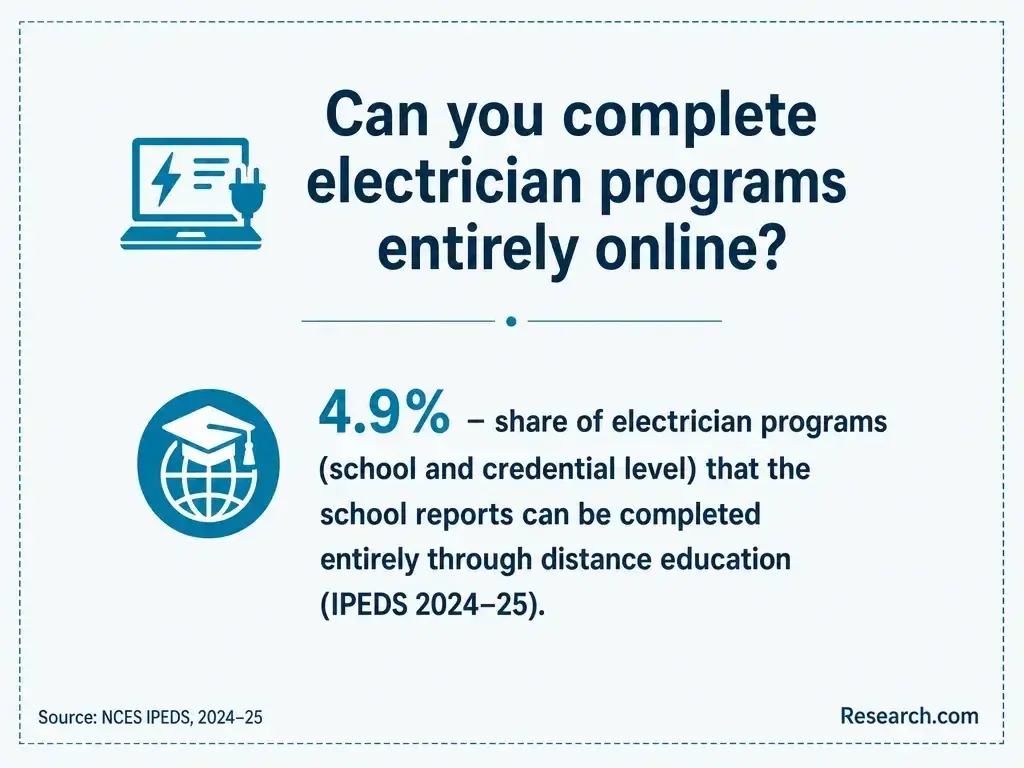
Online instruction can be useful for theory, calculations, and some code-study assignments. It cannot reproduce supervised work with tools, live testing procedures, or installation practice in a lab or at a jobsite. A hybrid option is worth considering if it clearly identifies where practical work occurs and who evaluates it; an entirely online course should not be assumed to satisfy Virginia experience or training requirements.
Before enrolling, get a written breakdown of remote, campus, and worksite hours, including travel obligations. Ask how attendance and competencies are recorded for any licensing application. A search for doctorate degrees without dissertation concerns a different kind of study; for electrician training, the nonnegotiable issue is access to supervised hands-on practice.
There is no single defensible average for all Virginia electrician pathways: public-college tuition, private-school charges, and the net cost of paid apprenticeship training are not directly comparable. A school's published tuition also omits costs that may determine whether you can finish. Request a current, itemized estimate from each provider rather than relying on an unsupported statewide average.
Use this cost comparison to build a job-ready budget, not merely a first-term tuition comparison:
| Cost or offset | What to verify |
| School charges | Resident or nonresident tuition, mandatory fees, books, lab materials, and any repeat-course charges |
| Work-ready expenses | Tools, testing equipment, protective gear, transportation, and any required screening |
| Career-entry charges | Applicable examination and licensing application fees |
| Offsets and opportunity cost | Grants, eligible aid, employer-paid training, apprenticeship wages, debt, and earnings forgone while studying |
Federal aid eligibility depends on the institution and program, not simply on whether training is called a trade program; confirm eligibility with the provider and Federal Student Aid. Ask about Virginia workforce funding and scholarships before borrowing. For readers interested in quick schooling to make good money, the better electrician calculation includes time to supervised employment and eventual license eligibility, not just time to finish classes.
The award depends on the pathway: a school may issue a certificate, diploma, or associate degree; a registered apprenticeship has its own completion credential. These document different training experiences. A school award is not the same thing as apprenticeship registration, an industry credential such as one associated with NCCER training, or a Virginia electrician license.
Ask whether completed coursework can be credited toward a later program or related apprenticeship instruction, and get any agreement in writing. Recognition is not automatic: the receiving provider or sponsor decides what it will accept. Searches about what colleges offer dual degree programs are less useful here than confirming what a specific electrician credential documents and whether the next provider will recognize it.
School and apprenticeship requirements differ. A provider may assess reading and math readiness or require applicants to meet its age, education, or safety prerequisites. An apprenticeship sponsor may also have an application and selection process tied to employer openings. Check current requirements directly; admission to a school program does not secure an apprenticeship position.
Electrical work calls for measurement, algebra-based calculations, careful reading of diagrams and code provisions, and the ability to follow safety procedures. If you need preparation before applying, ask whether the provider offers math support or an introductory pathway. If your plan depends on paid training, apply to sponsors early rather than assuming a certificate will be required first.
Relevant training covers circuits, electrical measurements, blueprint and schematic reading, wiring methods, grounding, overcurrent protection, code interpretation, and troubleshooting. Lab work should let students select materials, make connections, test results, identify faults, and demonstrate safe procedures - not just watch demonstrations. These topics reflect the installation, maintenance, and testing duties described by the U.S. Bureau of Labor Statistics.
Ask to see a course outline and lab schedule. A program geared toward residential installation may be less suitable if your target is industrial controls or maintenance; conversely, advanced controls instruction is not a substitute for basic installation practice. Employers can teach specialized systems later, but a beginner needs a sound safety and electrical foundation first.
Virginia's DPOR regulates journeyman and master electrician licensing. You can enter supervised training before holding a journeyman license, but completing a trade-school program alone does not grant one. DPOR evaluates documented practical experience and formal training under its applicable eligibility routes and requires the relevant licensing examination. Confirm current rules and acceptable documentation directly with DPOR before paying for a program advertised as "license-ready."
Keep the distinctions clear: institutional accreditation concerns a school; state authorization concerns permission to operate; apprenticeship registration concerns a structured training arrangement; and occupational licensure concerns legal recognition under DPOR's rules. An optional industry credential may help show specific skills, but it does not replace a Virginia license. Experience and additional requirements also matter when progressing toward master status, according to DPOR.
Start with the job and location you want, then work backward to the training and documented experience it requires. A public college may suit someone who needs structured labs before seeking an employer; a paid apprenticeship may suit someone ready to compete for an opening and learn predominantly on the job. Neither provider type nor a high ranking alone establishes value.
Use these checks to compare a shortlist and catch costly gaps before enrolling:
Watch for promises of automatic licensure, an "online-only" route to hands-on competence, or salary claims based on experienced workers. For return on investment, compare realistic completion and employment scenarios over a time horizon that includes training duration, baseline earnings, post-training earnings, debt, and the value of future income - not just tuition divided by a headline wage.
A realistic progression begins with supervised installation or maintenance work, followed by documented experience, licensing eligibility, and greater responsibility. Depending on worksite and additional training, an electrician may move toward residential service, commercial construction, industrial maintenance, controls, supervision, or running a contracting business. Those later roles are possibilities, not outcomes conferred by an initial certificate.
Choose early training for the work you want to enter first. If industrial maintenance is the goal, ask whether labs include motor controls and troubleshooting and whether local employers offer relevant worksite experience. If independent work is the goal, plan beyond school for DPOR licensing and any separate contractor-business requirements that may apply.
The U.S. Bureau of Labor Statistics projects 9.2% growth in U.S. electrician employment from 2025 to 2035. That national projection signals demand across the occupation, but it does not predict openings in a particular Virginia county or guarantee an apprenticeship seat. Construction activity, facility maintenance needs, and employer hiring decisions will shape local opportunities.
Use the projection as a reason to investigate, not as the sole reason to enroll. Ask area sponsors and employers about current entry-level openings, travel between jobsites, and the skills they seek. If nearby openings are limited, decide whether commuting or relocating is realistic before committing to a program whose work placements are far from home.
Investing in training is an important decision, so Research.com evaluates electrician programs against other programs in the same occupation and location - not against unrelated fields. The ranking includes only programs with completions reported to the Integrated Postsecondary Education Data System (IPEDS). That makes its comparisons more consistent, but it also means a registered apprenticeship or employer training program can be a strong local option without appearing in the ranking.
For its best-programs rankings, Research.com assesses student outcomes; earnings and return on investment; costs and debt; and quality and recognition. Occupation-relevant programmatic accreditation or industry recognition accounts for 20% of the score, institutional accreditation for 10%, and student support for 10%. Completion, full-time and part-time retention, earnings one year after completion, earnings relative to annual attendance cost, tuition, attendance cost, debt - including debt among students who withdrew - and federal loan default rates make up the remaining 60%. An entropy-based method gives more weight to indicators that distinguish programs more clearly. Most-affordable rankings instead score only costs and debt using entropy-based weights; accreditation and other quality measures are not part of that affordability score.
The Research.com team uses the following sources across its trade-program rankings, applying occupation-relevant recognition where appropriate. Allied-health and dental sources listed here should not be mistaken for electrician-program approvals:
The ranking can narrow a search, not establish whether a particular course satisfies Virginia licensing experience or training rules. Compare the listed programs with local apprenticeships, then confirm current details with each provider and the Virginia Department of Professional and Occupational Regulation (DPOR). More information about the ranking approach appears on the Research.com methodology page.
# 1 position
# 2 position

# 3 position
# 4 position
# 5 position

# 6 position

# 7 position
Electrician
Delivery mode: On Campus (May Include Online Courses)
31.99
/ 100
Final score
Accreditation
The school is listed by NCCER as a training center for this trade. Institutional accreditation from Southern Association of Colleges and Schools Commission on Colleges.
Mountain Empire Community College received a Research.com Trade Program Score of 31.99/100. The school is listed by NCCER as a training center for this trade.
# 8 position
# 9 position
Electrician
Delivery mode: On Campus (May Include Online Courses)
30.80
/ 100
Final score
Accreditation
The school is listed by NCCER as a training center for this trade and listed on Apprenticeship.gov as a Registered Apprenticeship partner. Institutional accreditation from Southern Association of Colleges and Schools Commission on Colleges.
Germanna Community College received a Research.com Trade Program Score of 30.80/100. The school is listed by NCCER as a training center for this trade and listed on Apprenticeship.gov as a Registered Apprenticeship partner.
# 10 position
# 11 position

# 12 position

# 13 position
# 14 position
# 15 position

# 16 position
# 17 position

# 18 position
# 19 position
Yes. A registered apprenticeship or supervised employer training may provide a route into the occupation. For journeyman licensing, verify how your experience and any formal instruction meet a current Virginia DPOR eligibility route.
Not by itself. DPOR requires applicants to meet an applicable combination of documented practical experience and training before licensing examination eligibility. Ask the school what records it supplies and confirm the route with DPOR.
Registered apprenticeships pair paid work with related instruction, according to the U.S. Department of Labor. Ask each sponsor for its current wage schedule, training costs, and entry requirements.
Online coursework may cover theory or code study, but practical installation, testing, and supervised work require in-person participation. Confirm where a hybrid program provides and documents those components.
It can be if it provides needed skills, affordable hands-on training, and a credible path to supervised work. Compare its total cost and likely completion timeline with a paid apprenticeship or direct-entry job before enrolling.