# 1 position
Cuesta College - Electrician.
associate

Audited and Verified:
Our Editorial and Data Verification Process
Research.com uses government datasets, official education statistics and primary institutional information to support its career and degree guides. Our review process checks factual accuracy, occupational definitions, source dates and the requirements associated with the credentials discussed.
How This Article Was Fact-Checked
Our editorial team verifies salary estimates, employment projections, education requirements and program information against original data providers and official organizations. Salary figures are checked against the relevant occupational definitions and reporting periods. Information about licensure, accreditation and required in-person training is reviewed separately.
Fact-checked and verified on:

Co-Founder and Chief Data Scientist

Reviewed by Karolina Broda
Fact-Checker and Data Verification
Choosing electrician training in San Luis Obispo means comparing more than tuition: a low-cost class may not provide the supervised work needed for California certification. The Most Affordable Electrician Trade Schools in San Luis Obispo for 2027 ranking, created by the Research.com team of data scientists, helps students identify programs worth considering. The U.S. Bureau of Labor Statistics projects 9.2% national employment growth for electricians from 2025 to 2035. This guide explains local training routes, full costs, certification rules, and career prospects so you can choose a path that fits your budget and goal.
Expect electrical theory, code instruction, safety practices, and hands-on work with wiring, circuits, testing instruments, and installation methods. The decisive question is whether the program also gives you a workable route to the supervised experience California requires. A school-based program can build skills before employment; a registered apprenticeship integrates instruction with paid work from the outset (California DIR; U.S. Department of Labor).
These pathways serve different needs. Their credentials and work arrangements are not interchangeable.
| Pathway | What you receive | Best fit and principal limitation |
| Community-college certificate or associate degree | School credential, classroom instruction, and any included labs | Useful for structured preparation; confirm whether the specific program is California-approved and how you will obtain qualifying work hours. |
| Private career-school or vocational certificate | Provider-issued credential and practical instruction, depending on the program | May offer a focused schedule; compare the full price and verify state approval rather than relying on the credential's name. |
| Registered apprenticeship | Related instruction, paid supervised work, and an apprenticeship completion credential | Strong fit if you can secure a place and meet its work schedule; openings and entry requirements vary by sponsor. |
| Employer-sponsored entry with approved instruction | Wages and supervised experience, paired with the required training arrangement | Worth exploring if an employer will hire and supervise you; confirm the arrangement meets California trainee rules. |
Ask each provider how many hours are spent in a lab, what equipment you will use, and who arranges worksite training. Two programs awarding "electrical" certificates may offer very different amounts of practice.
Local possibilities include electrical contractors working on homes and commercial buildings, maintenance teams, public facilities, and businesses that service electrical equipment. Construction and maintenance call for different routines: contractors may move between jobsites, while maintenance roles may emphasize troubleshooting at one facility (U.S. Bureau of Labor Statistics, Occupational Outlook Handbook).
San Luis Obispo's location makes travel a practical cost question. An apprenticeship sponsor, classroom site, and assigned jobsites may not all be in the city; ask where work is typically dispatched before committing to a schedule or transportation budget. Training alone does not authorize work beyond what California permits for your trainee or certification status (California DIR).
A verified San Luis Obispo-specific wage figure is not presented here, so the national figure is a benchmark rather than a local pay estimate. Electricians' U.S. median annual wage was $63,190 in May 2025 (U.S. Bureau of Labor Statistics, Occupational Outlook Handbook). The median spans workers at different career stages; an entrant should not use it as an expected first offer.
Compare actual local apprentice or trainee wage offers with the cost of getting to jobsites and the earnings you would give up during school. For a broader view of trade earnings, highest paying trade jobs offers career context, but occupation-wide wages should not determine whether a particular training offer is affordable for you.
A certificate, an associate degree, and an apprenticeship have different timelines; schools and sponsors set their own course schedules. More importantly, finishing classes is not the same as completing California's work-experience requirement. General electrician certification generally calls for 8,000 hours of qualifying on-the-job experience, while other certification classifications have different requirements (California DIR).
If speed matters, compare the time until you can begin paid, supervised electrical work - not just the advertised graduation date. Ask whether a program's classes fit around work and whether prior qualifying experience or instruction can be recognized under the applicable school or apprenticeship rules. Never assume a short course removes the state's experience requirement.
Online instruction can be convenient for theory, code reading, and some assessments. Wiring, measuring, troubleshooting, safe tool use, and supervised jobsite work require in-person practice. A hybrid program may therefore reduce classroom trips without eliminating travel to labs and worksites.
Before paying for a remote course, ask where its practical training occurs and whether it is part of a California-approved trainee-school arrangement if you need that route. "Online" and "accredited" are not answers to either question. A program without accessible hands-on training may suit someone refreshing theory, but it is a poor substitute for an entry pathway into electrical work (California DIR).
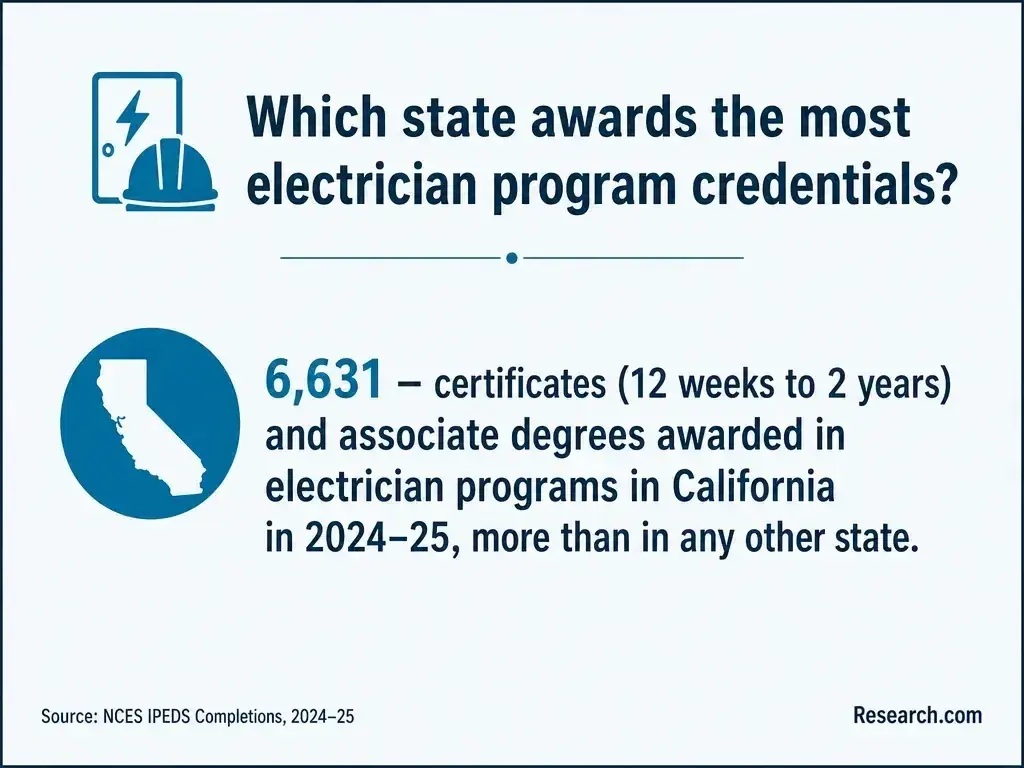
There is no defensible single average here for all local electrician pathways: college tuition, private-school charges, and paid apprenticeships have different cost structures, and verified 2027 program quotes are not available in this guide. The ranking compares reported school cost and debt measures, but those measures do not fully capture what each student must spend to become job-ready.
Request an itemized, current quote for tuition, mandatory fees, books or code materials, tools, testing equipment, safety gear, exam and application charges, and travel to labs or jobsites. Then subtract grants or employer-paid costs and account for wages earned - or wages forgone - during training. Federal or state aid depends on the student and program; paid apprenticeship wages can materially change the comparison (Federal Student Aid; U.S. Department of Labor).
A lower price is worthwhile only if the route still supplies the instruction and experience you need. If two offers have similar prices, compare their schedules, likely debt, completion prospects, and access to supervised work rather than choosing on tuition alone.
Depending on the route, you may earn a school certificate, an associate degree, or a registered-apprenticeship completion credential. These document different training; none should be described as California electrician certification automatically. The state administers electrician certification separately, with requirements tied to classification, qualifying experience, and examination (California DIR).
Before enrolling, get the exact credential name in writing and ask whether the instruction counts toward your intended California pathway. Institutional accreditation concerns the school, state authorization concerns permission to operate, and approval for electrician-trainee instruction concerns a particular regulatory purpose. One does not establish the others or guarantee employment.
School admissions and apprenticeship entry are separate processes. A school may require an application and placement steps; an apprenticeship sponsor may also assess math readiness, availability for work, and its own eligibility criteria. Check the current requirements with the provider rather than assuming acceptance into a class secures an apprenticeship job (program or sponsor requirements; U.S. Department of Labor).
For California electrical work under the trainee route, confirm that the school is state-approved for the relevant instruction, that you can register as an electrician trainee, and that qualifying work will be supervised as required. DIR's rules - not a school's admissions offer - govern trainee registration and later certification eligibility. Ask about these steps before paying a deposit (California DIR).
Entry training should connect electrical fundamentals to tasks you can perform safely: reading plans, calculating loads, installing and identifying conductors, using test instruments, applying the electrical code, and finding faults. The U.S. Bureau of Labor Statistics identifies installation, maintenance, and repair as core electrician duties; the curriculum should give you supervised opportunities to practice, not only watch demonstrations.
For local work, ask whether labs cover both residential and commercial systems and how the provider updates code instruction. If you are interested in controls, solar-related electrical work, or charging equipment, look for relevant instruction - but do not choose a specialty course at the expense of basic safety and a viable certification pathway.
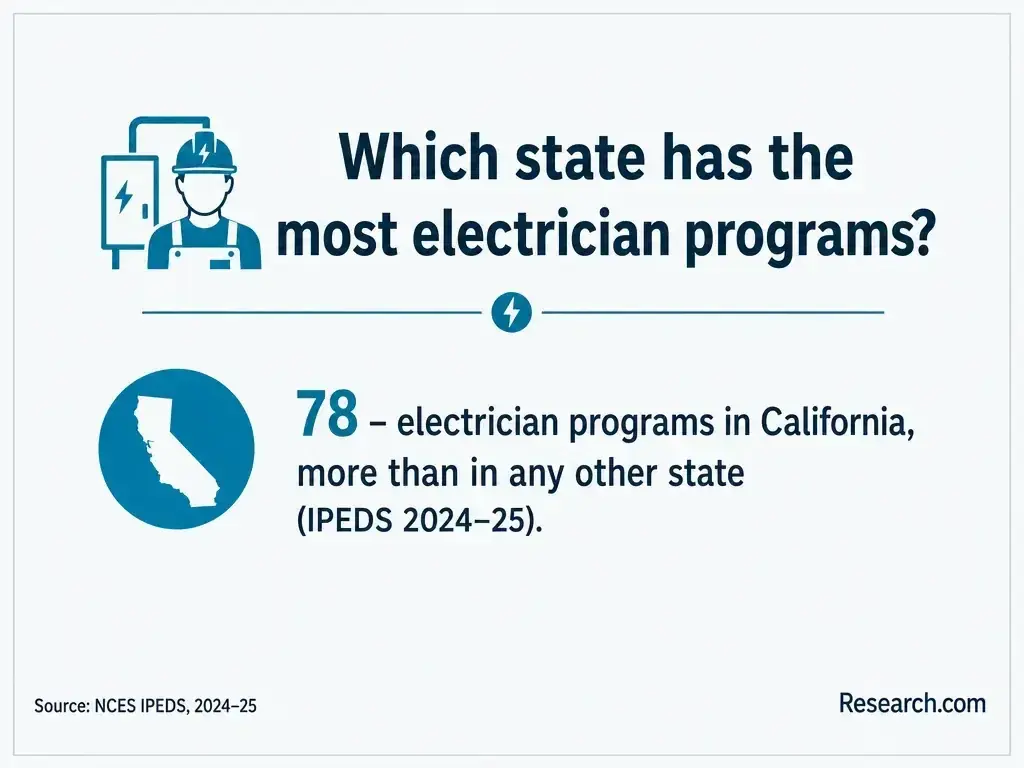
California's rules matter more than a school's credential name. The California DIR administers electrician certification and electrician-trainee registration. A person learning through the trainee route must meet registration, approved-school, and supervision requirements; general electrician certification generally requires qualifying experience and passing the applicable exam. Requirements differ by certification classification, so verify the one matching your intended work before enrolling (California DIR).
Certification as an individual electrician is distinct from a contractor license. If your later goal is to operate an electrical contracting business, the California Contractors State License Board governs the C-10 electrical contractor license and its separate experience, examination, and business requirements. A school certificate, industry credential, or institutional accreditation does not replace either state process (California DIR; California Contractors State License Board).
Start with the job you want and work backward to its California requirements. Cuesta College is one local institution to check for current offerings; also compare any eligible school option with registered apprenticeships and employer-supported training accessible from your home. Availability, approval, schedules, and prices should be verified directly rather than inferred from a ranking.
Use these questions when speaking with a program representative or apprenticeship coordinator:
Common costly mistakes are treating accreditation as state approval, assuming an online certificate replaces fieldwork, or comparing school tuition with a paid apprenticeship without counting wages. If a provider cannot clearly explain the credential, practical training, and California eligibility, keep looking. The best investment is the route you can complete that moves you toward qualifying work without unmanageable cost.
A realistic progression is supervised trainee or apprentice work, followed by the experience and examination required for the applicable California electrician certification. With experience, workers may pursue installation, maintenance, troubleshooting, or supervisory responsibilities; some eventually consider contracting, which has separate state licensing requirements (California DIR; California Contractors State License Board).
Choose early training that matches the work you want to enter. A broad grounding in wiring, testing, and safety keeps more options open than a narrowly marketed specialty course. Additional training can help with particular systems, but employers may also expect demonstrated field competence before assigning independent or supervisory work.
The U.S. Bureau of Labor Statistics projects 9.2% national employment growth for electricians from 2025 to 2035. That supports investigating the trade, but it is not a forecast for San Luis Obispo or a guarantee of a local apprenticeship opening. Hiring depends on employers, construction activity, maintenance needs, and the locations where you are willing to work.
Before choosing a program, check current regional apprenticeship recruitment and entry-level postings. Note whether jobs require trainee registration, certification, a driver's license, or travel beyond the city. Those requirements reveal whether a nearby, inexpensive class actually connects to work you can take.
Education is a significant investment, so Research.com compares electrician programs with other programs serving the same occupation and location. The 2027 most-affordable ranking includes only programs with completions reported to IPEDS. It evaluates tuition, cost of attendance, median student debt, and federal loan default rates; an entropy-based method gives more weight to cost and debt measures that differ more across programs. Accreditation and other quality indicators do not contribute to this affordability score. That makes the ranking a useful cost-screening tool, not a substitute for checking California training approval, practical experience, or job fit.
To support the quality and credibility of its rankings, the Research.com team draws on the following databases and organizations. Some cover other trades and should not be interpreted as electrician-program approvals.
IPEDS and College Scorecard do not cover every union, employer-sponsored, or other trade-training route. Readers can use the ranking to shortlist reported programs, then compare them with paid apprenticeships and verify current prices directly. Research.com explains its broader approach on its methodology page.
# 1 position
# 2 position
No single school credential is required for every route. A registered apprenticeship is an alternative; the electrician-trainee route has approved-school and registration rules. Check your intended certification classification with the California DIR.
No. A school certificate does not replace California's qualifying experience and applicable certification examination (California DIR).
It can be because apprentices earn wages while training, but compare any required expenses, travel, entry wait, and the income you could earn under each option (U.S. Department of Labor).
Online theory can supplement training, but practical electrical skills and qualifying supervised work require in-person participation. Confirm how any online program fits California's rules before enrolling (California DIR).
Confirm the total price, credential, hands-on instruction, state approval relevant to your route, and a realistic way to obtain supervised work. Request each answer in writing.