# 1 position

Audited and Verified:
Our Editorial and Data Verification Process
Research.com uses government datasets, official education statistics and primary institutional information to support its career and degree guides. Our review process checks factual accuracy, occupational definitions, source dates and the requirements associated with the credentials discussed.
How This Article Was Fact-Checked
Our editorial team verifies salary estimates, employment projections, education requirements and program information against original data providers and official organizations. Salary figures are checked against the relevant occupational definitions and reporting periods. Information about licensure, accreditation and required in-person training is reviewed separately.
Fact-checked and verified on:

Co-Founder and Chief Data Scientist

Reviewed by Karolina Broda
Fact-Checker and Data Verification
A low tuition price does not tell you whether an electrician program provides the shop training or California-approved pathway you need to work. The U.S. Bureau of Labor Statistics projects 9.2% national growth in electrician employment from 2025 to 2035, making that distinction worth investigating. This guide is for Los Angeles residents comparing school with paid apprenticeship. It explains costs, credentials, certification rules, and career prospects alongside a Most Affordable Electrician Trade Schools in Los Angeles for 2027 ranking created by the Research.com team of data scientists to help students choose programs worth considering.
Expect instruction in electrical theory, code, wiring methods, blueprint reading, and jobsite safety, paired with lab work using tools, circuits, and testing equipment. A school program can prepare you to seek supervised work; it does not replace the field experience required for California general electrician certification (California Department of Industrial Relations). Ask how many hours are spent in a hands-on lab, what equipment students use, and whether the schedule leaves room for paid work.
The key comparison is school first versus paid training from the start. Los Angeles Trade Technical College offers a public-college option to investigate; registered apprenticeships combine related instruction with supervised, paid work. A short pre-apprenticeship may help someone test the trade or prepare an application, but its completion document is not the same as completing an apprenticeship or obtaining state certification. For someone weighing bachelor's degree accelerated programs against entering a hands-on occupation, electrician training is a distinct, work-based route rather than a faster version of that education.
Electrical contractors employ workers on residential, commercial, and industrial projects; maintenance departments also need people who can troubleshoot building systems. In the Los Angeles area, a student can consider construction, building maintenance, infrastructure, and specialized systems work, but the available role depends on experience and the type of work performed - not simply on a school credential (U.S. Bureau of Labor Statistics; California Department of Industrial Relations).
Ask prospective training providers where students obtain supervised placements and whether those worksites are reachable from home. A low-cost class across the county can become an expensive choice if lab attendance and changing jobsite locations require substantial travel.
The U.S. Bureau of Labor Statistics reports a $63,190 national median annual wage in May 2025 for electricians. That is the midpoint for workers at different experience levels nationwide, not the expected first-year pay of a Los Angeles trainee. Local offers can differ by apprenticeship wage step, employer, specialty, overtime, and applicable collective-bargaining agreements.
For a useful return-on-investment estimate, compare actual local entry-level offers or a sponsor's published apprentice wage schedule with your current earnings. Then account for program completion, time spent training, aid, borrowing, and how long you expect to work in the trade. Do not use the national median as a guaranteed post-school salary.
Length depends on the credential and schedule: a focused introductory course may take much less time than a multi-term certificate or associate degree, while a registered apprenticeship extends across years of classroom instruction and supervised work. Compare published clock or contact hours, lab hours, and terms, not just a brochure's completion date. Part-time attendance may make paid work possible but delay school completion.
California's general electrician certification route requires 8,000 hours of qualifying on-the-job experience and an examination, so finishing a classroom program does not mean reaching independent certified status at graduation (California Department of Industrial Relations). If speed is your priority, ask when you can begin qualifying paid work; an accelerated class is not necessarily the quickest route to certification. Searches such as which bachelor degree is easy answer a different question from how quickly someone can gain verified electrical work experience.
Online instruction can help with theory, calculations, and code study. It cannot, by itself, demonstrate safe installation, tool use, circuit testing, or supervised jobsite performance. On-campus and hybrid options should therefore be compared by their actual lab access and work-placement arrangements - not by how conveniently their lectures are delivered.
Before paying for a hybrid course, get written answers about where practical sessions occur, how attendance is recorded, and whether the school meets California's applicable electrician-trainee education rules. The California Department of Industrial Relations determines trainee-school approval; an online course's advertising does not establish eligibility. Unlike a search for a master degree that pays well, this choice turns immediately on access to physical equipment and supervised electrical work.
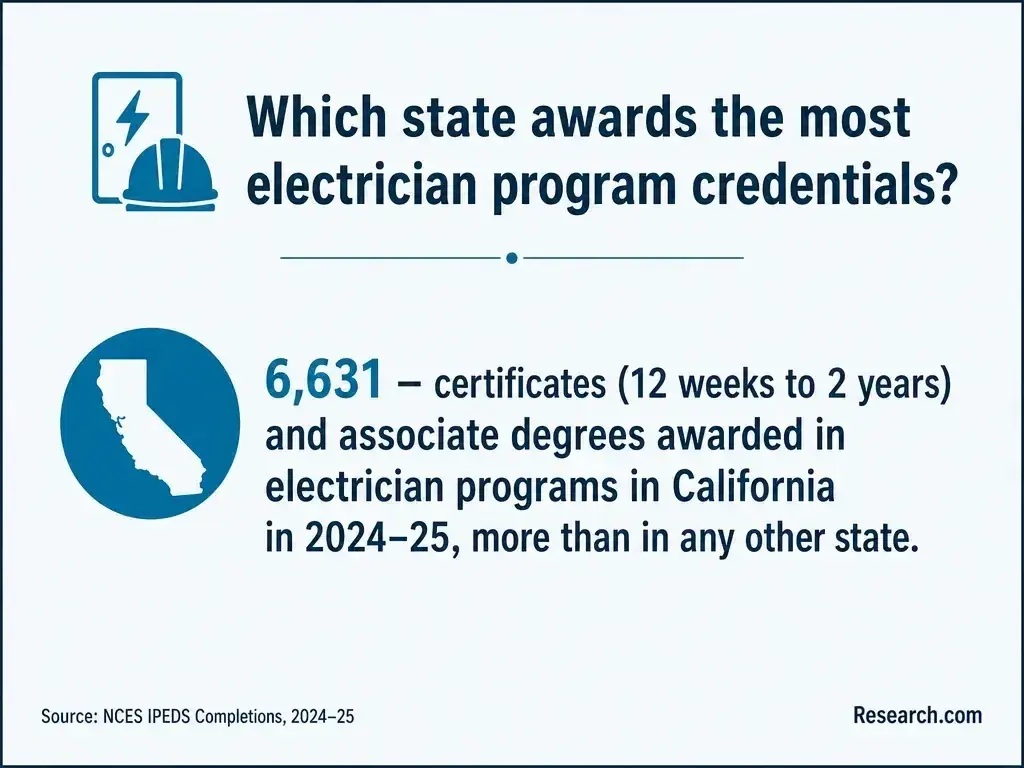
There is no single reliable Los Angeles-wide average that covers public programs, private schools, and paid apprenticeships on comparable terms. As a starting benchmark, the California Community Colleges Chancellor's Office lists $46 per unit for eligible California residents; confirm the rate, residency classification, and additional charges for the term you plan to enter. That figure is not the total price of an electrician program.
Request an itemized estimate before comparing offers. These charges and offsets can change which route is actually most affordable:
Federal aid depends on the student and the eligible institution and program; it should not be assumed for every short course or apprenticeship (Federal Student Aid). Compare what you must pay and what you can earn during training. A longer paid route can cost less out of pocket than a shorter unpaid course, even if its calendar duration is greater.
A school may award a course completion document, certificate, diploma, or associate degree; a registered apprenticeship has its own completion credential. These are different from California electrician certification, which is tied to the state's experience and examination requirements. Ask for the credential's exact name and whether the program supports the California pathway for the electrical work you intend to do (California Department of Industrial Relations).
Institutional accreditation concerns the school, state authorization concerns its permission to operate, and California approval of an electrician-trainee school concerns that training route. Apprenticeship registration concerns a work-based program. None of those labels alone certifies an individual electrician; check each claim with the responsible agency rather than treating similar-sounding credentials as interchangeable.
Requirements vary by provider. Ask about age, prior schooling, math assessment, language proficiency, application deadlines, and whether safety equipment is required before the first lab. Registered apprenticeships may use a separate selection process and require applicants to be able to reach assigned jobsites; a school admission offer does not secure an apprenticeship place (U.S. Department of Labor, Apprenticeship.gov).
Admission is also distinct from permission to perform electrical work. California's electrician-trainee route involves registration and enrollment in a state-approved school, while registered apprentices follow their program's rules; verify the current route that applies before accepting paid electrical work (California Department of Industrial Relations). If you have prior trade training or documented experience, ask whether it can reduce coursework or receive apprenticeship credit - and obtain the decision in writing.
A useful curriculum connects electrical calculations and code interpretation to hands-on tasks: reading plans, identifying components, installing and testing circuits, using meters, and finding faults safely. Ask to see the lab sequence and its assessment criteria. A program heavy on videos but light on supervised practice may be useful for review, yet poorly matched to a beginner who needs tool confidence and jobsite habits (U.S. Bureau of Labor Statistics; California Department of Industrial Relations).
Los Angeles students should also ask how training addresses work in existing buildings as well as new construction. Troubleshooting and safely adapting work to an occupied site can require different practice from assembling a demonstration circuit; the distinction matters when comparing providers serving different employers.
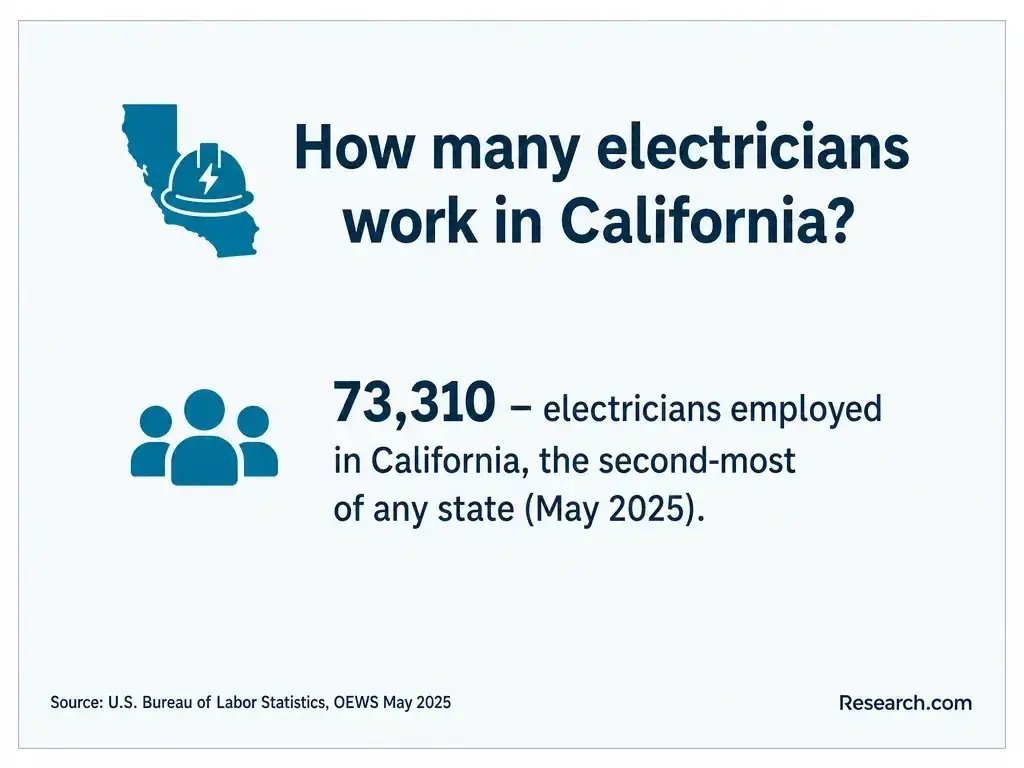
California regulates electrical work through its electrician certification and trainee or apprentice rules. For the general electrician classification, the California Department of Industrial Relations requires documented qualifying experience and a state examination; it does not treat school completion as automatic certification. Requirements can differ for other certification classifications, so match the intended job to the correct state category before choosing coursework.
Do not confuse an individual's electrician certification with a contractor credential. Someone planning to operate an electrical contracting business must separately investigate the California Contractors State License Board's C-10 requirements. A school's accreditation, an industry certificate, or registration as an apprentice does not substitute for whichever state credential the intended work requires (California Department of Industrial Relations; California Contractors State License Board).
Start with your intended job and legal training route, then compare providers that can actually support it. The affordability ranking is a cost-and-debt comparison, not a finding that every listed program offers equivalent labs, placement access, or California eligibility. A useful shortlist includes the school option you can attend and any registered apprenticeship for which you can realistically apply.
Ask each provider for answers you can verify before committing:
Walk away from claims that classroom graduation alone makes you a certified electrician or that a national median wage is typical starting pay. Verify state approval with the California Department of Industrial Relations and accreditation claims with the named accreditor. Broad comparisons such as one year doctorate degree do not resolve this trade-specific decision: eligible experience, practical instruction, and total cost do.
Common progression begins with supervised trainee or apprentice work, followed by eligibility for the relevant California electrician certification after the required experience and examination. With further experience, an electrician may move toward troubleshooting, specialized systems, crew leadership, maintenance, or contracting. Entry credentials, optional specialty training, and a business contractor credential serve different purposes (California Department of Industrial Relations; California Contractors State License Board).
If your goal is to work on installations, prioritize a route that builds documented field hours. If you already work around building systems, a program that strengthens electrical diagnostics may be more useful than repeating introductory material; ask whether prior learning changes your training plan. Even searches for best dual degrees cannot substitute for checking whether this occupational route leads to the specific electrical work you want.
The U.S. Bureau of Labor Statistics projects 9.2% growth in electrician employment nationally from 2025 to 2035. This signals demand across the occupation, not a forecast of openings in your Los Angeles neighborhood or a guarantee of placement. Local construction schedules, maintenance hiring, apprenticeship intake, and the distance to jobsites will shape your actual opportunities.
Use the national projection to assess the trade's broad direction, then test the local market: review current entry-level postings, compare their certification and experience requirements, and ask apprenticeship sponsors when they expect to accept applicants. That evidence is more useful for choosing a start date than a growth percentage alone.
Investing in electrician training is an important decision, particularly when the lowest-priced option may not provide the practical experience or regulatory eligibility a student needs. Research.com created this ranking to help readers compare affordable programs against other programs in the same occupation and location. The team reviews source data for quality, credibility, and accuracy; readers should still confirm current prices and California approval directly before enrolling.
The most affordable ranking scores costs and debt only: tuition, cost of attendance, median student debt, and federal loan default rate. Indicator weights are assigned through an entropy-based method, which gives more weight to measures that vary more across included programs. Accreditation, support services, completion, earnings, and industry recognition are not part of this affordability score. Only programs with completions reported to IPEDS qualify, so a missing apprenticeship or other provider should not be treated as unapproved or inferior. Research.com uses a different framework for its best-program rankings; details appear on its methodology page.
The ranking process draws on the following databases and organizations. Some are relevant to other trades in Research.com's broader ranking work rather than evidence that an electrician program has electrical-industry approval:
# 1 position
# 2 position
Compare an eligible public-college program with registered apprenticeships that pay wages during training. Include fees, tools, travel, and lost earnings; the lowest tuition is not necessarily the lowest total cost.
No. California general electrician certification requires qualifying work experience and a state examination. School can support a training route but does not replace those requirements (California Department of Industrial Relations).
Yes. A registered apprenticeship combines related instruction with supervised paid work. Check its entry requirements, selection schedule, wage progression, and registration status (U.S. Department of Labor, Apprenticeship.gov).
Do not assume so. Online coursework may teach theory, but electrical work requires practical competence and compliance with California's applicable trainee, apprentice, and certification rules (California Department of Industrial Relations).
No. It includes only programs with completions reported to IPEDS. Registered apprenticeships and other training providers can be valid alternatives even when they do not appear in that dataset.