# 1 position


Audited and Verified:
Our Editorial and Data Verification Process
Research.com uses government datasets, official education statistics and primary institutional information to support its career and degree guides. Our review process checks factual accuracy, occupational definitions, source dates and the requirements associated with the credentials discussed.
How This Article Was Fact-Checked
Our editorial team verifies salary estimates, employment projections, education requirements and program information against original data providers and official organizations. Salary figures are checked against the relevant occupational definitions and reporting periods. Information about licensure, accreditation and required in-person training is reviewed separately.
Fact-checked and verified on:

Co-Founder and Chief Data Scientist

Reviewed by Karolina Broda
Fact-Checker and Data Verification
Choosing an affordable electrician program in Orange, California, means looking beyond tuition: you need a route to supervised experience and California certification. The U.S. Bureau of Labor Statistics projects 9.2% growth in electrician employment nationwide from 2025 to 2035, making the choice timely. This guide is for prospective students and career changers comparing school with paid apprenticeship. It explains costs, credentials, training requirements, and career prospects alongside a Most Affordable Electrician Trade Schools in Orange for 2027 ranking created by the Research.com team of data scientists to help students make an informed choice.
Expect instruction in electrical theory and code alongside practice with tools, wiring, conduit, testing, and jobsite safety. The crucial difference between options is whether the training also connects you to supervised electrical work. California's certification requirements make that experience central, not an optional extra (California Department of Industrial Relations).
These pathways lead to different credentials and work arrangements. Compare them by what you can do after completing the classroom portion, not just by the credential's name.
| Pathway | Training and credential | Best fit and limitation |
| Community college or trade-school program | Classes and labs; may award a certificate or, where offered, an associate degree | Fits students seeking structured preparation. Ask how graduates obtain qualifying supervised hours. |
| Registered apprenticeship | Paid supervised work plus related instruction; completion earns an apprenticeship credential | Fits those ready to work and study. Entry depends on sponsor selection and available positions. |
| Approved trainee training with an employer | Approved instruction paired with supervised work as a registered trainee | Fits someone with an employer connection. Verify the school, registration, and work arrangement with the state. |
Santiago Canyon College is one local option to investigate. Ask which electrical offerings are currently available, whether they serve apprentices or other students, and what work placement - if any - is included. A guide to the easiest 2 year degree to get cannot answer the more important electrician question: how you will gain qualifying field experience.
Potential work settings include residential construction, commercial building projects, industrial facilities, and building maintenance throughout Orange County. Contractors may also work on electrical upgrades and equipment installations. The setting matters because its duties determine which supervised experience you can document and which skills you practice; classroom training by itself does not secure a position.
Before accepting trainee work, ask who will supervise you, whether the employer can provide qualifying electrical experience, and how your hours will be recorded. California's electrician certification system distinguishes supervised trainee work from independent certified work (California Department of Industrial Relations).
There is no single reliable wage for a newly trained electrician in Orange. As a benchmark, the national median annual wage for electricians was $63,190 in May 2025 (U.S. Bureau of Labor Statistics). It covers workers at different experience levels across the country, so it should not be used as a local apprentice offer or a graduate earnings promise.
For a useful comparison, request current pay scales from Orange County apprenticeship sponsors and prospective employers. Compare wages while training as well as later pay: a paid apprenticeship may offset costs that a shorter, unpaid school program leaves to the student.
A classroom certificate can end well before an electrician becomes eligible for California certification. The state lists 8,000 hours of qualifying work experience for general electrician certification, followed by an examination; requirements differ for other certification classifications (California Department of Industrial Relations). Ask a provider for its actual calendar length and instructional hours rather than assuming its completion date is your certification date.
Registered apprenticeships combine work and instruction over multiple years. Part-time classes may suit someone already employed, but they do not remove the need to accumulate qualifying field hours. Searches for a best associate degree in 6 months online accredited address a different timeline: electrician preparation requires practical work as well as coursework.
Online coursework can help with electrical theory, calculations, and code study. Campus labs allow an instructor to observe tool use, circuits, troubleshooting, and safe work habits. Supervised jobsite hours require an in-person work arrangement; an entirely online course cannot supply them.
Ask a hybrid provider which activities occur on campus, where labs are held, and whether it helps students find qualifying work in Orange County. Institutional accreditation and occupational eligibility are separate questions: even a guide to nationally accredited universities cannot establish whether an electrical course meets California's trainee-training rules. Confirm approval directly with the California Department of Industrial Relations before paying.
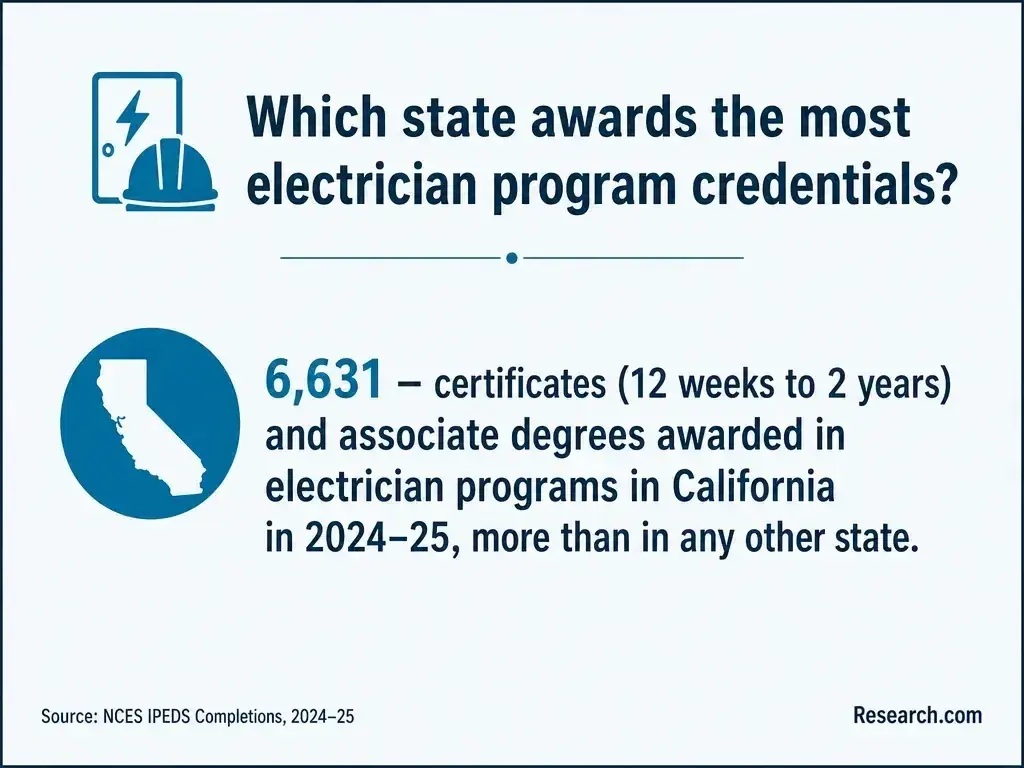
There is no verified Orange-wide average that fairly combines community college programs, private training, and paid apprenticeships. Instead, compare the total cost to become job-ready. Tuition alone can make a program look inexpensive while leaving necessary expenses out of view.
Request an itemized estimate for these cost categories from each provider. The comparison should also show what an employer or apprenticeship sponsor pays on your behalf.
| Cost category | What to check |
| Instruction | Tuition, mandatory fees, books, and online materials |
| Practical work | Tools, testing equipment, PPE, and consumable materials |
| Career entry | Examination or application fees and travel to labs or jobsites |
| Time and financing | Lost earnings, borrowing costs, grants, and wages earned during training |
Eligible community college students can ask about the California College Promise Grant; other aid depends on the student and program (California Community Colleges). Verify federal-aid eligibility before relying on a list of cheap online schools that accept financial aid: aid eligibility and California electrical-training approval are different. A worthwhile investment also depends on completion likelihood, debt, expected earnings, and the time needed to qualify - not institution type alone.
Depending on the offering, a student may earn a school certificate, diploma, or associate degree. A registered apprentice earns a credential through the apprenticeship program. None is automatically the same as California electrician certification. The California Department of Industrial Relations administers that occupational certification and sets experience and examination requirements.
Before enrolling, get the precise credential name in writing. Ask whether courses count toward approved trainee instruction, whether apprenticeship credit or advanced standing is possible, and who decides. Credit awarded by a school, an apprenticeship sponsor, and a state certification authority are distinct decisions.
Requirements vary by provider. Schools may assess reading and math readiness or require program orientation; apprenticeship sponsors may use applications, aptitude assessments, interviews, and employer hiring processes. Ask the provider for its current criteria rather than assuming admission to classes also secures a paid position.
California electrical trainees must follow state registration and approved-training rules while working toward certification (California Department of Industrial Relations). If you plan to work during school, confirm your registration steps, the program's approval status, and the employer's supervision arrangement before your first jobsite assignment.
Useful training connects electrical calculations and code interpretation to hands-on work: reading plans, installing and testing circuits, bending conduit, identifying faults, and using protective equipment. Apprentices then practice under supervision on actual installations. These competencies align with electricians' installation, maintenance, and troubleshooting duties described by the U.S. Bureau of Labor Statistics.
Compare lab access, instructor feedback, and the types of systems students actually handle. Two certificates with similar titles are not equivalent if one includes substantial supervised practice and the other consists mainly of recorded lessons.
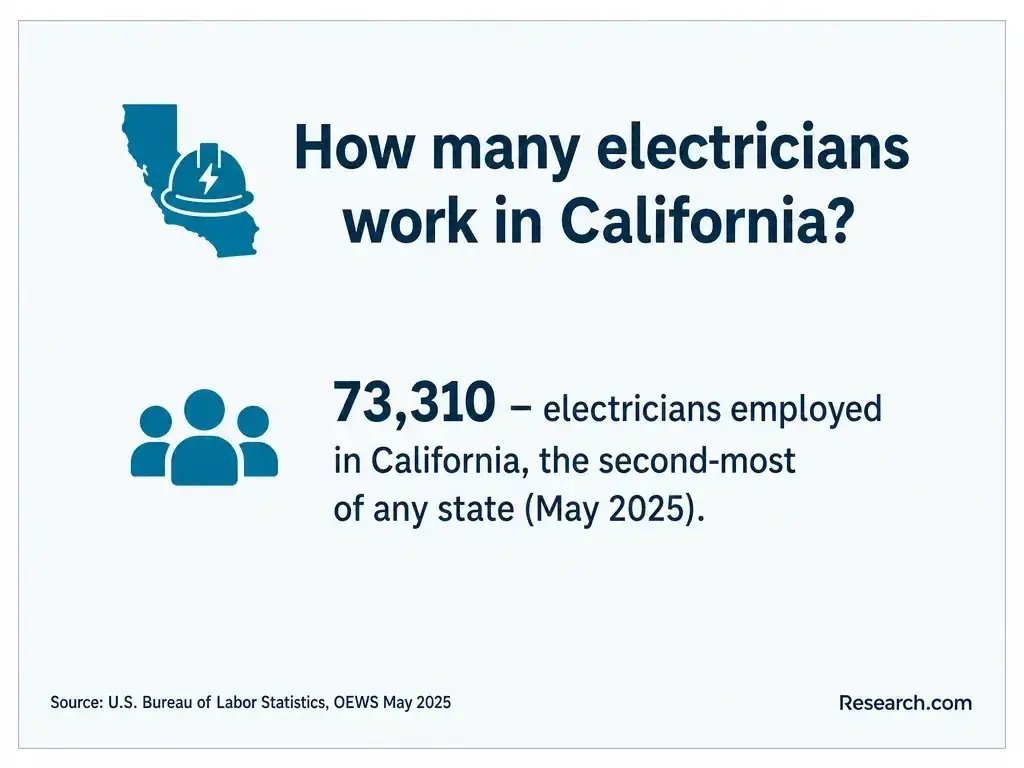
California has an electrician certification system, not a rule that every beginner must already hold a contractor's license. A person can pursue qualifying supervised work through an applicable trainee or apprenticeship route; general electrician certification requires qualifying experience and passing the state examination (California Department of Industrial Relations). The state's C-10 electrical contractor license is a separate credential for contracting businesses, administered by the Contractors State License Board.
Do not mistake school accreditation, state authorization to operate, approval of trainee instruction, apprenticeship registration, or an optional industry certificate for electrician certification. Check the California Department of Industrial Relations requirements for your intended classification and ask how a program supports each step.
Start with your intended role and the route to qualifying experience. The cheapest published tuition is not the best value if you cannot access labs, work supervision, or the instruction your California pathway requires. Conversely, a paid apprenticeship may be attractive even if entry takes longer.
Use these questions when speaking with a school or sponsor; request written answers so you can compare offers on the same basis.
A red flag is a claim that a short or fully online course alone makes you a certified electrician. Another is an earnings claim with no occupation, location, or reference year. Search results for cheap masters programs likewise do not help evaluate this trade pathway; keep your comparison focused on electrical training and California eligibility.
An entrant may begin as a supervised trainee or apprentice, progress toward the relevant California certification, and later pursue specialized installation, maintenance, or supervisory work. Someone who wants to operate an electrical contracting business must investigate separate C-10 licensing requirements (California Department of Industrial Relations; Contractors State License Board).
Choose early training with your likely work setting in mind. For example, ask whether lab equipment and employer placements reflect the residential, commercial, or maintenance work you hope to perform. Additional industry credentials may support a specialty, but they do not replace required state certification.
The U.S. Bureau of Labor Statistics projects 9.2% electrician employment growth nationally from 2025 to 2035. That is evidence of national demand, not a forecast of openings in Orange or a guarantee of placement. Local opportunity will depend on construction activity, maintenance hiring, contractor needs, and the availability of supervised entry positions.
Ask apprenticeship sponsors and prospective employers about current intakes and project locations. For a student without a car or a flexible schedule, the distance to changing Orange County jobsites can affect whether an otherwise affordable training route is practical.
Investing in training is a consequential decision, so Research.com designed this ranking to help readers compare affordable programs with other electrician programs in their location. The team uses reported education and cost data and checks the credibility of its sources. Only programs with completions reported to IPEDS are eligible; an apprenticeship or other provider missing from the ranking may still be a valid choice.
For most affordable rankings, the score considers tuition, cost of attendance, median student debt, and federal loan default rate. An entropy-based method assigns more weight to cost and debt indicators that differ more across programs. Accreditation, employment outcomes, and hands-on training are not part of this affordability score, so readers should verify them separately.
The following databases and recognition sources inform Research.com's trade-program ranking work across occupations. The allied-health and dental organizations listed here do not approve electrician training or determine California electrician certification eligibility.
Use the ranking to narrow your cost comparison, then request program-specific prices and confirm the route to supervised work. Read more about Research.com's ranking methodology.
# 1 position
# 2 position
# 3 position
# 4 position
Not necessarily. California recognizes routes involving approved trainee training, qualifying supervised experience, or registered apprenticeship. Confirm the current route for your intended certification classification with the California Department of Industrial Relations.
It can reduce upfront expense because apprentices earn wages while learning, but entry, schedules, and covered costs vary by sponsor. Compare earnings during training and out-of-pocket costs, not tuition alone.
Theory can be taught online, but practical skills and qualifying supervised jobsite experience require in-person participation. Verify any online provider's California trainee-training approval before enrolling.
No. A school credential is separate from California electrician certification, which has classification-specific experience and examination requirements (California Department of Industrial Relations).
Ask the provider for your full cost of attendance and which aid applies to your specific program. Also compare employer-paid training, apprenticeship wages, and eligible state or federal assistance.