# 1 position

Audited and Verified:
Our Editorial and Data Verification Process
Research.com uses government datasets, official education statistics and primary institutional information to support its career and degree guides. Our review process checks factual accuracy, occupational definitions, source dates and the requirements associated with the credentials discussed.
How This Article Was Fact-Checked
Our editorial team verifies salary estimates, employment projections, education requirements and program information against original data providers and official organizations. Salary figures are checked against the relevant occupational definitions and reporting periods. Information about licensure, accreditation and required in-person training is reviewed separately.
Fact-checked and verified on:

Co-Founder and Chief Data Scientist

Reviewed by Karolina Broda
Fact-Checker and Data Verification
The cheapest electrician program is not necessarily the least expensive route to a paying job. In California, you also need to account for supervised work, training eligibility, tools, and time away from work. The Research.com team of data scientists created its Most Affordable Electrician Trade Schools in Rancho Cucamonga for 2027 ranking to help students identify programs worth considering. With U.S. electrician employment projected to grow 9.2% from 2025 to 2035, this guide helps you compare costs, credentials, apprenticeships, and California's entry rules before enrolling (U.S. Bureau of Labor Statistics).
Expect instruction in electrical theory and code alongside supervised practice: interpreting plans, measuring circuits, installing raceways and conductors, and troubleshooting safely. A classroom program can build those skills, but it does not by itself replace the qualifying job experience required for California electrician certification (California Department of Industrial Relations).
For a local search, compare a current Chaffey College offering - if it matches your electrical goal - with California-approved electrical training schools, registered apprenticeships, and employer-sponsored routes accessible from Rancho Cucamonga. Confirm the exact credential and approval status for the specific program and enrollment term rather than assuming every electrical course serves the same purpose. Searches for online accelerated bachelor degree programs concern a different educational route; they do not substitute for electrical shop work or supervised experience.
Electrical trainees can seek supervised work with contractors serving residential construction, commercial buildings, industrial facilities, or maintenance operations across the Inland Empire. Rancho Cucamonga's position within the Riverside-San Bernardino-Ontario metro area makes the practical search wider than city limits: compare commute time to both a training site and changing job sites before accepting a program or apprenticeship.
School completion can help an applicant demonstrate foundational skills, but employers may also require trainee registration, reliable transportation, safety readiness, or entry into their apprenticeship structure. The California Department of Industrial Relations distinguishes supervised trainee or apprentice work from work performed by a certified electrician; ask a prospective employer how it will document your qualifying hours.
The U.S. median annual wage for electricians was $63,190 in May 2025 (U.S. Bureau of Labor Statistics). This national figure includes experienced workers and should not be treated as an apprentice wage or a Rancho Cucamonga pay quote. For an offer you can actually evaluate, request the apprenticeship's current wage progression or the employer's trainee rate, and check whether travel between Inland Empire job sites is paid.
Pay can change substantially with experience, specialization, overtime, and whether a job is covered by prevailing-wage rules. Compare likely earnings during training as well as after it: paid apprenticeships may improve cash flow even when their path to independent work takes longer than a short classroom program.
A short school certificate, a longer college program, and a registered apprenticeship have different finish lines. Ask each provider for its published calendar duration, classroom or lab hours, and expected weekly schedule. Then distinguish finishing classes from accumulating work experience: California's general electrician certification pathway requires 8,000 hours of qualifying experience before the examination route is complete (California Department of Industrial Relations).
A shorter credential can make sense if it helps you enter supervised work sooner; it is a poor shortcut if you expect it to replace that work. Advice about the fastest way to get an associate's degree addresses a different timeline. For electrical employment, ask when the program enables you to start and document qualifying field hours.
Online lessons can be useful for electrical theory, calculations, and some code study. In-person labs or job sites are needed to demonstrate safe tool use, installation, testing, and troubleshooting. A hybrid program may reduce classroom commuting, but it does not remove its scheduled practical sessions or California's supervised-work requirements.
Before paying for a remote course, ask where hands-on assessments occur, who supervises them, and whether the provider's specific training is accepted for your intended California trainee or apprenticeship pathway. "Online" describes delivery - not state approval, work-hour credit, or certification eligibility (California Department of Industrial Relations).
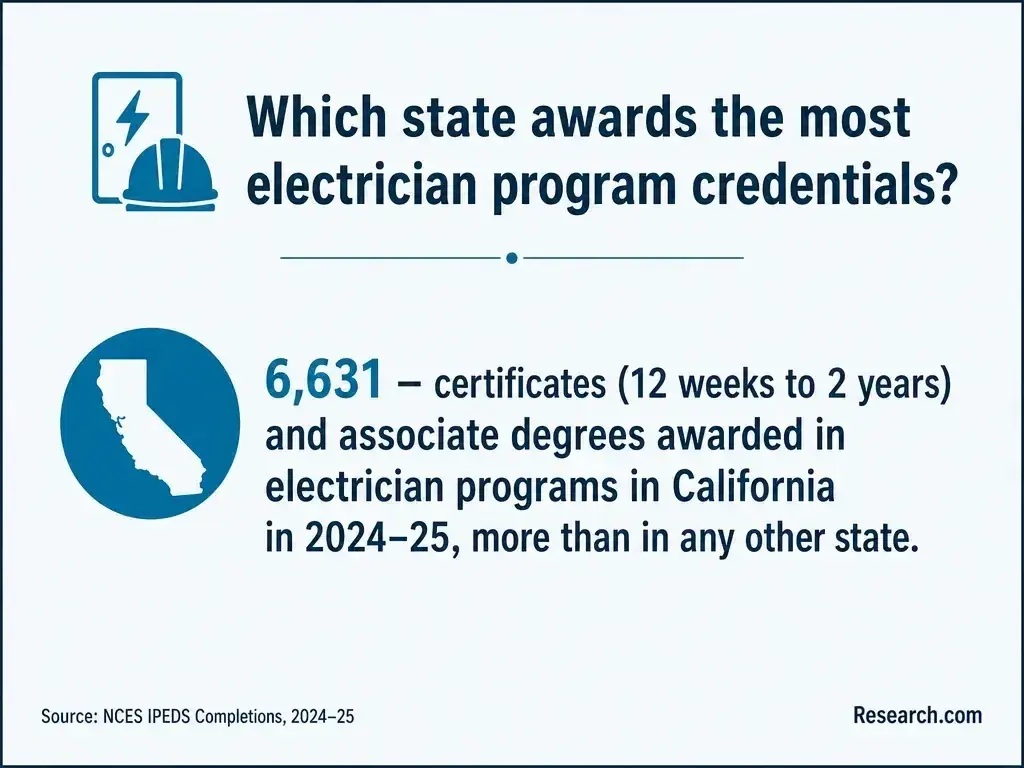
There is no defensible single average for every local route: a college course, career-school program, and paid apprenticeship charge for - and provide - different things. Request a written, current cost sheet from each provider rather than using an advertised tuition figure as your total. No specific Rancho Cucamonga program price is stated here because charges depend on the provider, enrollment term, and supplies.
Use the same cost categories for each quote so a lower sticker price does not hide a higher cost to become job-ready:
Ask Chaffey College or another provider which aid applies to the specific program; federal aid eligibility does not extend automatically to every short course. A search for the fastest degree to get that pays well will not answer the more useful electrician question: how much will you spend, borrow, and earn before completing the required field experience?
The award depends on the route. A school may issue a completion certificate, a college may offer an associate degree if its current catalog lists one, and a registered apprenticeship documents completion of its structured training. None is interchangeable with California electrician certification, which involves qualifying experience and the applicable examination (California Department of Industrial Relations).
Ask whether completed coursework can count toward a later program or apprenticeship; get any advanced-standing agreement in writing before enrolling. Questions such as what is the easiest associate's degree to get are less useful here than confirming the award, the hands-on competencies it demonstrates, and how it connects to supervised electrical employment.
Requirements vary by provider and route. A school may use placement or prerequisite courses; an apprenticeship sponsor may have an application window, aptitude assessment, interview, and conditions for placement with an employer. Ask about age, education, mathematics, identification, and physical or transportation requirements directly rather than assuming that admission to a class guarantees a job-site placement.
California also distinguishes an electrician trainee enrolled through a state-approved school pathway from an apprentice in a registered apprenticeship (California Department of Industrial Relations; California Division of Apprenticeship Standards). Confirm which status applies before starting paid electrical work, who handles registration, and how your supervised hours will be recorded.
A useful entry program connects circuit fundamentals and electrical calculations to code-based installation, blueprint reading, conduit and wiring methods, measurement, and fault-finding. Safety should be practiced, not merely discussed: students need supervised opportunities to select protective equipment, isolate hazards, use meters correctly, and explain their work. These are core electrician tasks identified by the U.S. Bureau of Labor Statistics.
Compare the published lab hours and equipment list, not just course titles. For someone aiming at commercial or industrial work in the Inland Empire, ask whether practice includes the systems and troubleshooting methods that prospective employers use; then ask how the program helps students move into supervised field training.
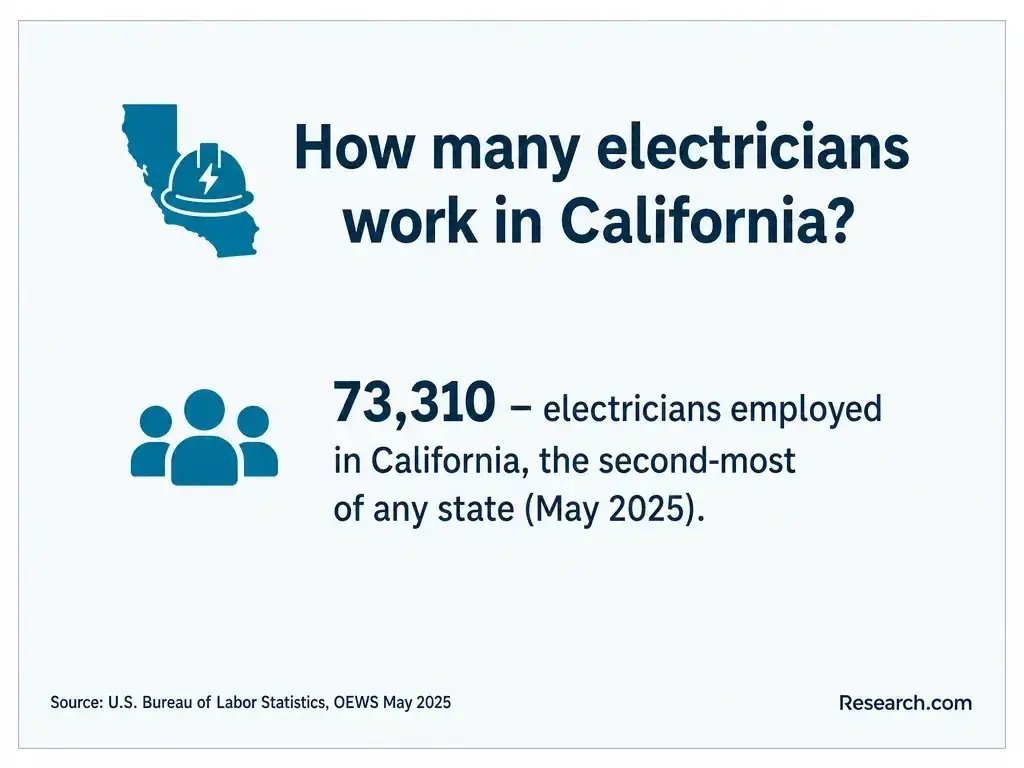
California requires attention to work status and certification. The California Department of Industrial Relations administers electrician certification and sets separate pathways for trainees, registered apprentices, and experienced applicants. General electrician certification involves 8,000 hours of qualifying experience and an examination. Requirements differ for other electrician classifications, so verify the classification matching your intended work before choosing instruction.
Institutional accreditation, state school authorization, approval of an electrical trainee school, apprenticeship registration, and individual electrician certification answer different questions; none automatically grants another. If your long-term goal is to operate an electrical contracting business, California's C-10 contractor licensing is a separate matter administered by the Contractors State License Board. Do not pay for a program based on a vague promise that it will "make you licensed."
Choose the route that moves you toward your intended electrical job at a cost and schedule you can sustain. An affordable school program may suit someone who needs foundational instruction before seeking an employer. A registered apprenticeship may suit someone ready to compete for placement and earn wages while completing structured instruction and supervised work. Neither choice is automatically better for every applicant.
Before enrolling, use these checks to turn a ranking or advertisement into a decision you can defend:
A sensible return-on-investment comparison includes your current earnings, training wages or lost work time, aid, borrowing, completion likelihood, and the time it may take to reach higher pay. If a provider cannot explain its California training status or practical-work component, keep looking.
Entry usually means supervised trainee or apprentice work, followed by increasing responsibility as experience and applicable certification requirements are met. Electricians can then pursue residential, commercial, industrial, maintenance, or specialized systems work; supervisory and contracting ambitions require further experience and, for contracting, separate California licensing (California Department of Industrial Relations; Contractors State License Board).
Match the first program to the work you want rather than collecting unrelated credentials. Searches for dual degree programs usa describe a different educational strategy; for an aspiring electrician, documented field experience and the correct California pathway are more directly relevant.
The U.S. Bureau of Labor Statistics projects 9.2% employment growth for electricians from 2025 to 2035. This is a national projection, not a forecast of Rancho Cucamonga openings or a promise of placement. It does suggest value in training that can adapt across construction, building maintenance, and changing electrical systems rather than preparing for only one narrow task.
For a local decision, compare openings and apprenticeship recruitment across the broader Inland Empire, then weigh their locations against your commute and work schedule. A program's strongest employment claim is one you can verify through its recent placement definitions and its relationships with employers offering supervised work.
Investing in electrical training is a consequential decision, so Research.com built this ranking to compare reported costs against relevant alternatives in the same occupation and location. Only programs with completions reported to the Integrated Postsecondary Education Data System (IPEDS) are eligible. That limitation matters: an apprenticeship or other provider absent from IPEDS may still be a valid, affordable route.
For the most affordable ranking, Research.com scores tuition, cost of attendance, median student debt, and federal loan default rate. An entropy-based method assigns more weight to cost and debt indicators that differ more across eligible programs. Accreditation, outcomes, and other quality measures are not part of this affordability score. The team checks data across the following sources; occupation-specific recognition sources are considered only when relevant, so healthcare accreditors should not be interpreted as electrician-program approvals:
Use the ranking to narrow your cost comparison, then verify each program's current charges and whether its training fits California's rules. Research.com explains its broader approach on its methodology page.
# 1 position
# 2 position
No single school credential is the only route. California recognizes distinct trainee and registered-apprenticeship pathways; the right one depends on your work status and intended certification classification. Verify the route with the California Department of Industrial Relations before enrolling.
Not on the certificate alone. California's general electrician certification pathway requires qualifying experience and an examination; ask how the program connects you to supervised work and documents your hours (California Department of Industrial Relations).
It can be, because apprentices earn wages while training, but compare entry requirements, instruction costs, tools, travel, and time to completion. Request written terms from the sponsor and a full cost sheet from any school.
Online coursework may cover theory, but practical electrical skills and supervised field experience require in-person participation. Confirm whether any remote course meets the requirements of your intended California pathway.
Check its current catalog for the exact award and schedule, then verify whether that specific offering fits your intended California trainee or apprenticeship route. Do not infer regulatory eligibility from the college's name or a course title.