# 1 position


Audited and Verified:
Our Editorial and Data Verification Process
Research.com uses government datasets, official education statistics and primary institutional information to support its career and degree guides. Our review process checks factual accuracy, occupational definitions, source dates and the requirements associated with the credentials discussed.
How This Article Was Fact-Checked
Our editorial team verifies salary estimates, employment projections, education requirements and program information against original data providers and official organizations. Salary figures are checked against the relevant occupational definitions and reporting periods. Information about licensure, accreditation and required in-person training is reviewed separately.
Fact-checked and verified on:

Co-Founder and Chief Data Scientist

Reviewed by Karolina Broda
Fact-Checker and Data Verification
Choosing electrician training in Pennsylvania means deciding whether to pay for a school program, pursue a paid apprenticeship, or combine the two. The Research.com team of data scientists created its Best Electrician Trade Schools in Pennsylvania for 2027 ranking to help students identify programs worth considering. The U.S. Bureau of Labor Statistics projects 9.2% national growth in electrician employment from 2025 to 2035. This guide helps career starters and career changers compare credentials, hands-on training, costs, local requirements, and likely career paths before committing.
Expect a mix of classroom instruction and supervised shop practice: reading plans, selecting wire and protective devices, installing circuits, testing faults, and following electrical and jobsite safety procedures. Before enrolling, ask to see the actual lab schedule and equipment list. A program that teaches electrical theory but offers little supervised installation practice is not equivalent to one with substantial shop or worksite training.
School and apprenticeship routes serve different needs. The comparison below identifies what each typically provides; confirm the details with the individual provider.
| Pathway | Typical credential or outcome | Best fit and principal trade-off |
| Pre-apprenticeship or introductory certificate | School certificate or completion record | Useful for exploring the trade or strengthening an application; does not itself provide the supervised experience of an apprenticeship. |
| Career-school or community-college certificate or diploma | Provider-issued occupational credential | Concentrated instruction and labs; verify cost, employer connections, and whether coursework counts toward an apprenticeship. |
| Associate degree in electrical technology | Academic associate degree | Broader technical study that may suit industrial or advancement goals; usually takes longer and may cost more than a shorter certificate. |
| Registered electrician apprenticeship | Completion credential from a registered apprenticeship | Paid supervised work plus related instruction; entry may be competitive, and applicants must meet sponsor requirements. |
Examples of schools to investigate include Pennsylvania College of Technology, Pennco Tech-Bristol, Delaware County Community College, Community College of Allegheny County, and Reading Area Community College. Compare their current electrician-related offerings rather than assuming each offers the same credential, lab hours, or apprenticeship connection. A direct application to a union, nonunion, or employer-sponsored apprenticeship may make more sense if earning while training is your priority.
Electricians work for electrical contractors on homes and commercial buildings and in industrial maintenance, utilities, and other facilities with electrical systems (U.S. Bureau of Labor Statistics). The choice of program should reflect the setting: residential installation practice may not provide the motor controls or troubleshooting exposure sought by an industrial employer.
Location affects access to both jobs and training. Applicants near Philadelphia or Pittsburgh can investigate multiple contractors and apprenticeship sponsors, while someone farther from a training center should ask how often in-person classes meet and where work assignments occur. A manageable commute to school does not necessarily mean a manageable commute to changing jobsites.
The U.S. Bureau of Labor Statistics reports a national median annual wage of $63,190 for electricians in May 2025. That is the midpoint for workers across experience levels, not a Pennsylvania starting wage or a forecast of what a certificate holder will earn. For a local decision, compare the latest Pennsylvania occupational wage estimates from the Pennsylvania Department of Labor & Industry with actual apprentice wage schedules and entry-level offers in the area where you will work.
Pay can differ by experience, employer, specialization, overtime, and location. If you are comparing school with a paid apprenticeship, account for wages earned during training as well as potential pay afterward. A lower-cost route that starts paid work sooner may be financially preferable even when two pathways ultimately lead to similar jobs.
A short introductory program may take months; a longer certificate, diploma, or associate degree takes more time according to its published schedule. A registered apprenticeship generally spans several years because it pairs related instruction with substantial supervised work. The U.S. Department of Labor describes a common apprenticeship model of roughly 2,000 hours of on-the-job learning and 144 hours of related instruction per year, but the registered sponsor's standards control the actual requirements.
Ask separately for calendar length, classroom hours, lab hours, and supervised work hours. Finishing a short school program sooner does not mean finishing the work experience an employer or local licensing authority may require. Conversely, a part-time schedule may preserve income while extending the time before you can pursue more advanced work.
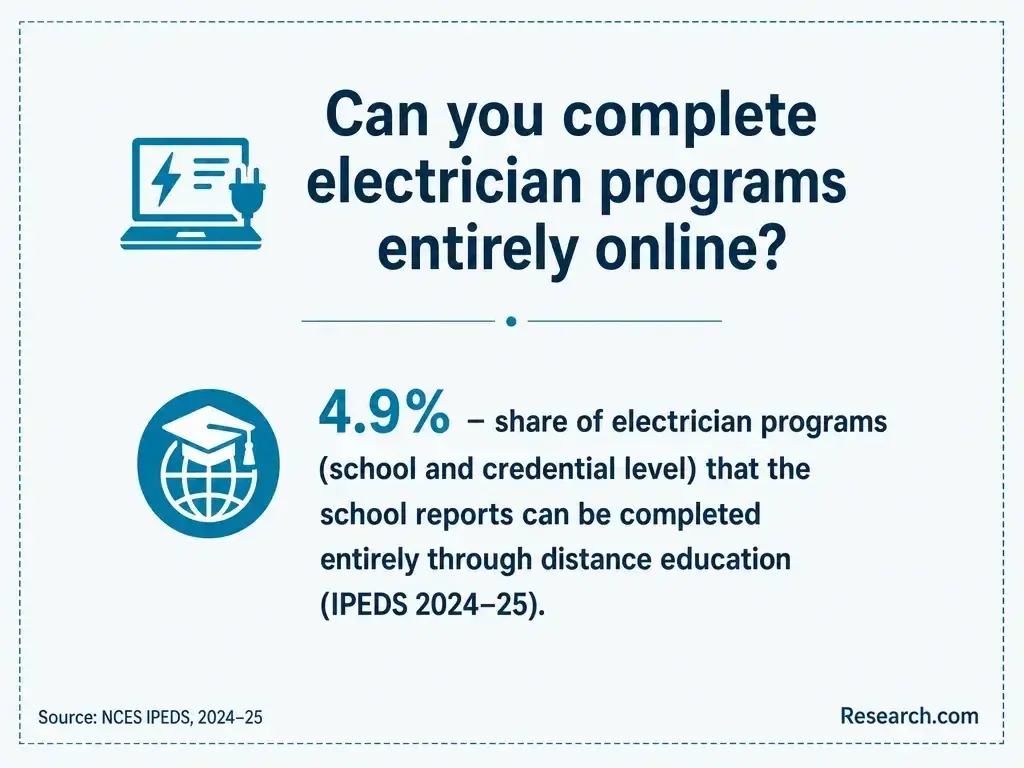
Online instruction can cover electrical theory, code navigation, calculations, and some plan-reading. Wiring, testing, tool use, safe work practices, and troubleshooting on equipment require supervised in-person practice. Hybrid training can be useful for a working adult if its labs and worksite requirements are realistically accessible; an entirely online course should not be treated as a substitute for those competencies.
Check the location and timing of every required lab before choosing a flexible program. Readers comparing short online certificate programs that pay well should be especially careful not to assume that an online certificate alone establishes electrician job readiness or satisfies local rules.
There is no dependable single price for all Pennsylvania electrician training: providers charge differently, programs vary in length, and paid apprenticeships have a different cost structure from tuition-based school programs. Request a written, program-specific estimate rather than using a school's headline tuition as your budget.
The following cost categories show why two advertised prices may not be comparable. Confirm which items are included, required later, or supplied by an employer.
| Cost or offset | What to verify |
| Tuition and mandatory charges | Entire program price, enrollment and lab fees, and any resident-rate eligibility. |
| Job-ready supplies | Tools, meter, PPE, books, software, and consumable materials. |
| Attendance and entry costs | Travel to labs or jobsites and any applicable exam, application, or screening charges. |
| Financial offsets | Grants, scholarships, eligible federal or state aid, employer assistance, and apprentice wages. |
| Opportunity cost | Income forgone or work hours reduced while attending training. |
Federal aid depends on both institutional and program eligibility, not merely on a school advertising accreditation (Federal Student Aid). Ask the provider about aid eligibility and ask Pennsylvania CareerLink whether you qualify for workforce-funded training; check applicable Pennsylvania Higher Education Assistance Agency programs separately. An affordable online degree comparison cannot replace an electrician-specific budget that includes required in-person training.
The credential depends on the pathway: a school may award a certificate, diploma, or associate degree, while a registered apprenticeship awards a completion credential under its sponsor's registered standards. Some providers also offer industry-aligned coursework or assessments, such as NCCER-related training; ask whether assessment and credential fees are included (National Center for Construction Education and Research).
These credentials are not interchangeable with an occupational license. Institutional accreditation concerns the school; state authorization concerns its permission to operate; apprenticeship registration concerns a specific work-based training program; and any local electrical or contractor licensing requirement concerns permission to perform regulated work. A fast-track associate's degree online may sound appealing, but electrical credentials must be judged by their supervised practical training and relevance to the intended job, not speed alone.
Requirements vary by provider and pathway. Schools may ask for an application, proof of prior education, and placement information; apprenticeship sponsors set their own eligibility and selection rules, which may include an aptitude assessment, interview, physical ability to perform the work, or access to transportation. Do not assume admission to a school also means admission to its partner apprenticeship.
Before paying an application or enrollment fee, confirm the credential offered, any prerequisite math, required purchases, and whether training hours can receive advanced standing with a named apprenticeship sponsor. Transfer credit and credit for prior experience are decisions made under the receiving provider's rules, not automatic benefits of completing a certificate.
Core training commonly covers electrical math, circuit principles, drawings and schematics, wiring methods, grounding, testing instruments, and applicable electrical code and safety practices (U.S. Bureau of Labor Statistics; O*NET). A stronger hands-on sequence lets students install and test circuits, diagnose faults, and explain why an installation is safe - not simply identify components on a screen.
Compare the curriculum with your intended work. Someone targeting commercial construction should ask about conduit and plan reading; an industrial candidate should ask about motors, controls, and troubleshooting. Code instruction should address the rules applicable to the jobs and jurisdictions the program prepares students to enter. If a provider cannot specify its lab tasks or how performance is assessed, treat that as a reason to investigate further.
Pennsylvania does not have one statewide electrician license that applies uniformly to every electrician job. Local governments may regulate electrical or contractor work, and requirements can differ by municipality and by whether you are an employee or operating a contracting business (Pennsylvania Department of Labor & Industry; relevant municipal licensing authority). Check the jurisdiction where you expect to work before choosing training based on a promise of "licensing preparation."
Ask that authority which experience, examination, insurance, registration, or permit rules apply to your intended role. Then ask the school or apprenticeship sponsor to document which requirements its training addresses. School accreditation, NCCER credentials, apprenticeship completion, and a local occupational or contractor license each serve different purposes; none should be presented as an automatic substitute for another.
The best choice is the one that gets you to your intended electrical job at a cost and pace you can sustain. A ranking is a useful shortlist, but it cannot tell you whether a specific lab schedule, apprenticeship opening, or local licensing pathway fits your circumstances. Compare finalists using the same questions:
A common mistake is to compare credentials by name while overlooking practical hours or debt. Evaluate the investment against your baseline earnings, likely income while training, completion probability, expected post-training opportunities, and the time it takes to recover costs. For electrician entry, broad lists of colleges with dual degree programs are less useful than documented shop training and a viable route into supervised work.
Introductory training can support applications for helper or apprentice roles; it should not be mistaken for evidence of independent competence. With supervised experience, electricians may move toward commercial installation, industrial maintenance, troubleshooting, or crew leadership (U.S. Bureau of Labor Statistics). Contractor or self-employment plans require separate attention to the rules in the municipality where the business will operate.
Choose early coursework for the next credible step, not an advertised senior-level title. A person who wants to troubleshoot plant equipment should prioritize controls practice and relevant worksites, while someone aiming to run a contracting business also needs to plan for experience, local requirements, estimating, and business costs.
The U.S. Bureau of Labor Statistics projects 9.2% growth in electrician employment nationally from 2025 to 2035. This supports investigating the occupation, but it does not establish the same growth rate for Pennsylvania or guarantee an apprenticeship opening in your county. Consult Pennsylvania Department of Labor & Industry regional projections and current sponsor recruitment before deciding where to train.
Demand for installation, repair, and electrical-system upgrades can create different opportunities for construction and maintenance electricians. For a practical measure of your prospects, look beyond a statewide or national projection: check whether local sponsors are accepting applicants, what employers ask for in entry-level postings, and whether the program can connect you with the required supervised experience.
Investing in training is a consequential decision, so Research.com evaluates programs against other electrician programs in the same location rather than against unrelated schools nationwide. The ranking includes only programs with completions reported to the Integrated Postsecondary Education Data System (IPEDS). This makes the comparison more consistent, but it also means registered apprenticeships and other worthwhile providers without reported IPEDS completions may not appear.
Best-program scores consider student outcomes; earnings and return on investment; costs and debt; and quality and recognition. Program-relevant accreditation or industry recognition accounts for 20%, institutional accreditation for 10%, and student support for 10%. The remaining 60% covers completion, retention, earnings, tuition, attendance costs, debt, and federal loan default measures, with entropy-based weights that give more influence to indicators that vary more across programs. Earnings measures include median earnings one year after completion and earnings relative to annual attendance cost. An affordability ranking, by contrast, scores only tuition, attendance cost, median debt, and loan default rates; its weights are also entropy-based.
The Research.com team draws on the following data sources across its trade-program ranking process. Occupation-specific recognition must still be checked: a health or dental accreditor is not an electrician-program accreditor.
Use the ranking to narrow your search, then verify each program's current curriculum, full price, practical training, completion outcomes, and connection to employers or apprenticeships. More detail about the ranking approach is available on Research.com's methodology page.
# 1 position
# 2 position

# 3 position
# 5 position

# 6 position
# 8 position
Electrician
Delivery mode: On Campus (May Include Online Courses)
54.44
/ 100
Final score
Accreditation
The school is listed by NCCER as a training center for this trade and listed on Apprenticeship.gov as a Registered Apprenticeship partner. Institutional accreditation from Accrediting Commission of Career Schools and Colleges.
Lincoln Technical Institute-Allentown earned a Research.com Trade Program Score of 54.44/100, supported by 62% school graduation rate and 68% full-time student retention rate. The school is listed by NCCER as a training center for this trade and listed on Apprenticeship.gov as a Registered Apprenticeship partner.
# 9 position
# 10 position

# 11 position
# 12 position
# 13 position
# 14 position

# 15 position
# 16 position

# 17 position

# 18 position

# 19 position
# 20 position

It can be if you need foundational skills, accessible labs, or preparation for a competitive application. Compare its full cost and employer connections with a paid registered apprenticeship, which combines instruction and supervised work.
No online coursework alone replaces supervised wiring, testing, and jobsite safety practice. Verify the in-person requirements of any hybrid program and the rules where you intend to work.
No. Pennsylvania has no uniform statewide electrician license, and applicable local requirements may depend on your role and municipality. Confirm them with the local authority.
Choose based on the job and training offered. A certificate may be a shorter route to foundational skills; an associate degree may offer broader technical study. Neither replaces supervised work merely because it awards a credential.
Ask the receiving sponsor whether it awards advanced standing for the specific program, what evidence it requires, and whether the decision affects related instruction, work hours, or both. Do not rely on a school's general claim that credits "transfer."