# 1 position
Lincoln Technical Institute-East Windsor - Electrician.
certificate or diploma

Audited and Verified:
Our Editorial and Data Verification Process
Research.com uses government datasets, official education statistics and primary institutional information to support its career and degree guides. Our review process checks factual accuracy, occupational definitions, source dates and the requirements associated with the credentials discussed.
How This Article Was Fact-Checked
Our editorial team verifies salary estimates, employment projections, education requirements and program information against original data providers and official organizations. Salary figures are checked against the relevant occupational definitions and reporting periods. Information about licensure, accreditation and required in-person training is reviewed separately.
Fact-checked and verified on:

Co-Founder and Chief Data Scientist

Reviewed by Karolina Broda
Fact-Checker and Data Verification
Choosing an electrician program in Connecticut means checking more than its tuition or certificate: you need a route to supervised work and, eventually, state licensure. The U.S. Bureau of Labor Statistics projects 9.2% national employment growth for electricians from 2025 to 2035, making training decisions timely. The Research.com team of data scientists created the Best Electrician Trade Schools in Connecticut for 2027 ranking to help students identify programs worth considering. This guide explains how to compare those programs with apprenticeships, costs, licensing requirements, and career goals.
Expect instruction in electrical theory, code use, installation methods, and safety, followed by practice with tools and wiring in a lab or shop. The decisive question is what happens after that practice: a school credential documents training, but independent electrical work requires the applicable Connecticut occupational license. Ask whether the provider helps students enter a registered apprenticeship or obtain supervised employment, and whether any classroom instruction can count toward that pathway (Connecticut Department of Labor; Connecticut Department of Consumer Protection).
Connecticut students can compare a private career-school program with a public technical or community-college offering, a union-sponsored registered apprenticeship, or employer-sponsored training. School may suit someone who needs introductory skills before applying for work. An available paid apprenticeship may suit someone ready to learn on jobsites while earning wages. Neither route should be assumed to provide automatic credit for training completed through the other.
Electrical training can lead to supervised work with electrical contractors on homes, commercial buildings, and industrial sites, or to facilities-maintenance roles where electrical tasks fall within an employer's licensed and supervised work arrangements. Jobsite conditions differ: residential work emphasizes service and branch circuits, while commercial or industrial projects may involve larger distribution systems, controls, and coordination with other trades (U.S. Bureau of Labor Statistics, Occupational Outlook Handbook).
For a student choosing a program, location matters because lab attendance and apprenticeship jobsites may require separate commutes. Ask a provider where its employer partners operate and whether you can reach those sites consistently - not merely where classes are held. Work involving electrical contracting or independent practice must fit Connecticut's licensing rules, regardless of the employer or job title (Connecticut Department of Consumer Protection).
Connecticut pay depends on experience, license classification, employer, work setting, and hours. The U.S. median annual wage for electricians was $63,190 in May 2025 (U.S. Bureau of Labor Statistics, Occupational Outlook Handbook). That national median covers experienced workers as well as newer entrants; it is neither a state-specific wage nor a realistic salary quote for a newly hired apprentice.
For a useful local comparison, request the current apprentice wage schedule from each apprenticeship sponsor and compare Connecticut electrician wage estimates for the same occupation and reference period through the state labor-market agency. Include expected hours and commuting costs. A higher advertised hourly rate may be less valuable if work is irregular or travel is substantial.
A school-based certificate or diploma can end well before a student has completed the supervised work required for an occupational license. A registered apprenticeship combines substantial on-the-job training with related instruction over multiple years; its exact schedule, credited prior learning, and completion requirements depend on the registered occupation and sponsor (Connecticut Department of Labor; U.S. Department of Labor, Apprenticeship.gov).
Ask for two timelines: time to finish the school credential and time to meet the requirements for your intended Connecticut license. An accelerated class schedule may move up your apprenticeship application, but it does not itself replace required work experience. A search for a fast track undergraduate degree addresses a different credential and should not be mistaken for an accelerated electrician licensing route.
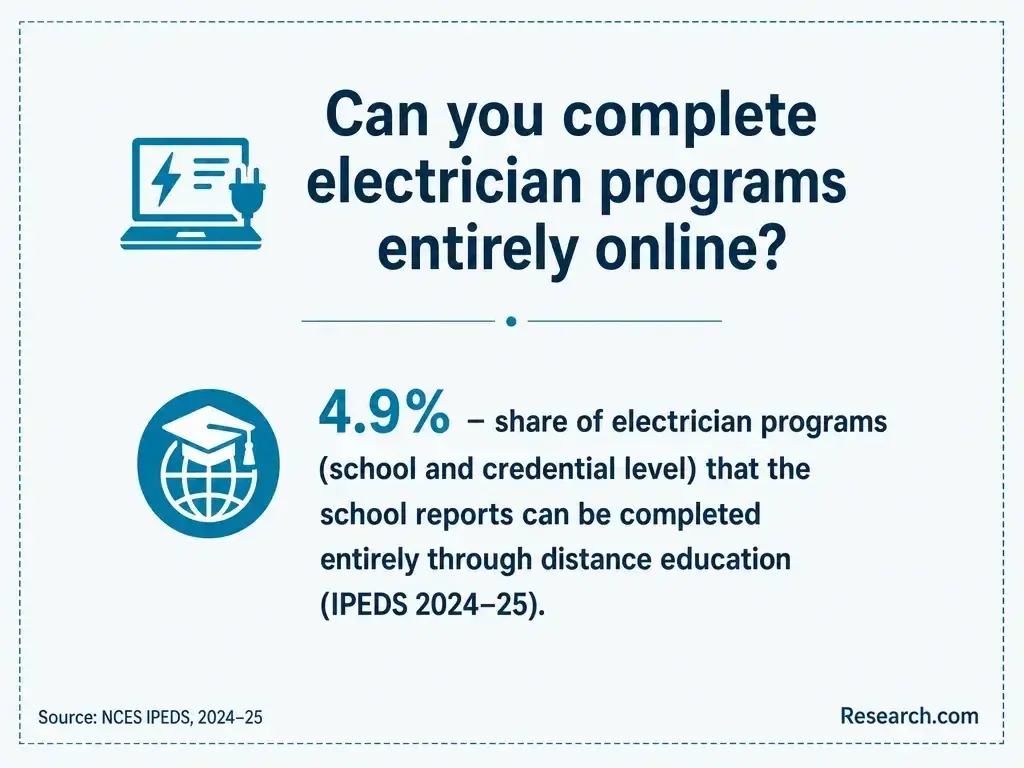
Electrical theory, code reading, and some calculations can be taught remotely. Wiring, testing, tool use, troubleshooting, and safe work practices require supervised practice in a lab or on a jobsite. A fully online completion certificate should not be treated as proof of practical competence or Connecticut licensing eligibility (Connecticut Department of Consumer Protection; U.S. Bureau of Labor Statistics, Occupational Outlook Handbook).
The comparison below shows what each format can reasonably offer. If you are considering vocational schools online, verify where their required in-person electrical practice takes place before paying a deposit.
| Format | Potential advantage | What to verify |
| On-campus | Regular access to instructors, equipment, and supervised labs | Lab time, equipment condition, schedule, and commute |
| Hybrid | Remote theory with scheduled practical sessions | Required lab attendance and how missed sessions are made up |
| Online theory only | Flexible study before or during work-based training | Who provides hands-on practice and whether instruction receives apprenticeship credit |
There is no single dependable statewide price for electrician training: a private school's published charge, a public provider's resident tuition, and a paid apprenticeship describe different expenses and benefits. Compare a written total cost to become job-ready, not an advertised tuition figure. Request an itemized estimate for each option covering tuition and mandatory fees, books, tools, consumables, safety equipment, transportation to labs and jobsites, and any examination or licensing application fees. Include earnings you would forgo while attending classes.
Paid apprenticeships can offset training costs with wages, although related expenses and entry requirements still matter. Ask schools about aid eligibility and payment terms, and ask apprenticeship sponsors about wage progression and who pays for instruction and tools. Federal aid eligibility depends on both the institution and program; it should never be assumed from a school's accreditation alone (Federal Student Aid; U.S. Department of Labor, Apprenticeship.gov).
A school may award a certificate or diploma for completing its electrical training program. A registered apprenticeship documents completion of a structured work-and-instruction pathway. Neither is the same as a Connecticut occupational license, which the Department of Consumer Protection issues under its own requirements. Ask for the exact credential name and what, if anything, its coursework counts toward in a registered apprenticeship (Connecticut Department of Labor; Connecticut Department of Consumer Protection).
An associate-degree search - including searches for easy aa degrees - does not answer the essential electrician question: will the specific training and supervised work advance you toward the license classification you want? Evaluate the documented pathway rather than the credential's title.
School and apprenticeship entry rules are not interchangeable. A school may assess basic math and reading, require enrollment paperwork, and specify attendance or safety rules. An apprenticeship sponsor may separately set application dates, assess applicants, and require an employer placement or other entry steps. Obtain requirements from the specific provider and sponsor rather than assuming admission to school reserves an apprenticeship position (Connecticut Department of Labor; U.S. Department of Labor, Apprenticeship.gov).
Before applying, ask what documentation is required, when practical training begins, and whether you must secure a sponsoring employer yourself. An online-school search such as top-ranked accredited online schools no fee to apply may help compare application policies, but a waived application fee says nothing about electrical labs or apprenticeship access.
A useful entry-level curriculum connects electrical calculations and circuit theory to reading plans, applying electrical codes, installing raceways and conductors, testing circuits, and identifying hazards. Practice should make students explain not only how a circuit works, but how they would verify that it is safe to work on. Electrical workers also need communication and troubleshooting skills when coordinating with supervisors and other trades (U.S. Bureau of Labor Statistics, Occupational Outlook Handbook).
Course lists alone cannot show how well a program teaches those skills. During a visit, ask an instructor to describe a typical lab task, the equipment each student uses, how work is checked, and which tasks students first encounter only after joining an apprenticeship. That distinction helps you compare two similarly named certificates without assuming they provide equivalent hands-on preparation.
Yes, Connecticut regulates electrical occupational work. The Department of Consumer Protection administers electrical license classifications, including the E-2 unlimited electrical journeyperson and E-1 unlimited electrical contractor classifications. Registered apprentices train through a separate supervised pathway administered by the Connecticut Department of Labor. The license you ultimately need depends on the work you intend to perform and whether you will work as a journeyperson or operate as a contractor (Connecticut Department of Consumer Protection; Connecticut Department of Labor).
Before enrolling, identify your intended license classification and confirm its current experience, instruction, examination, and application requirements directly with the state agencies. Then ask the school and apprenticeship sponsor to show how they document qualifying instruction and work hours. Institutional accreditation, state authorization to operate a school, industry certifications, apprenticeship registration, and occupational licensure are distinct; none should be presented as an automatic substitute for another.
Start with the job and license you want, then work backward to the training and supervised experience required. A ranking can identify schools to investigate, but the best investment is the option you can complete and use on a credible path to paid work and licensure. Searches about unrelated credentials, such as are there phd programs without a dissertation, cannot establish that an electrical program meets those requirements.
Use the following checks when speaking with admissions staff and apprenticeship coordinators; request written answers where possible.
Two common mistakes are treating a certificate as a license and comparing tuition without lost wages or travel. For return on investment, also consider your likelihood of completing, available aid, debt, earnings before and after training, and how long it may take for benefits to outweigh costs. A shorter or cheaper program is not automatically the better buy if it leaves you without practical training or a route to qualifying work.
For many entrants, the progression is introductory training, supervised apprentice work, and then eligibility to apply for the appropriate journeyperson license after meeting state requirements. With further experience and the applicable authorization, an electrician may pursue contracting, supervision, or a specialty such as controls or industrial maintenance. These are progression possibilities, not outcomes awarded by a school certificate (Connecticut Department of Consumer Protection; U.S. Bureau of Labor Statistics, Occupational Outlook Handbook).
Choose training to match the work you actually want. Someone drawn to installation jobsites should examine a program's contractor and apprenticeship connections; someone interested in industrial equipment should look closely at motors, controls, troubleshooting practice, and relevant employer placements. Ask whether the credential prepares you for an entry-level opening, an apprenticeship application, or a later specialization - those are different promises.
The U.S. Bureau of Labor Statistics projects 9.2% growth in electrician employment nationally from 2025 to 2035. That indicates demand across the occupation, but it does not predict how many Connecticut apprenticeships will be open when a particular student finishes school. Construction activity, maintenance needs, employer hiring, and access to supervised positions will shape local opportunities.
Use the national projection as context, then test your local prospects: review current Connecticut labor-market information, ask nearby apprenticeship sponsors about application cycles, and check whether a program's employer relationships serve the area where you can work. A promising outlook is most useful when it is paired with a feasible entry route and a manageable commute (U.S. Bureau of Labor Statistics; Connecticut Department of Labor).
Paying for training is an important decision, and a useful ranking should make its scope and limitations clear. Research.com compares programs with other programs in the same occupation and location, using reported student outcomes, costs, earnings, and quality indicators. Its team checks multiple sources to improve the ranking's credibility and accuracy; readers should still confirm current program details directly before enrolling.
Best-program rankings assess four areas: student outcomes, including completion and full-time and part-time retention; earnings and return on investment, including earnings one year after completion relative to annual attendance cost; costs and debt, including tuition, attendance cost, debt for students who withdrew, and federal loan default rates; and quality and recognition, including relevant accreditation or industry recognition and student support. Relevant programmatic accreditation or industry recognition carries 20% of the score, institutional accreditation 10%, and student support 10%. Outcomes, earnings, and costs share the remaining 60% through an entropy-based method that assigns more weight to indicators that vary more across programs.
Most-affordable rankings use only tuition, attendance cost, median student debt, and federal loan default rate, with entropy-based weights; accreditation and other quality measures do not contribute to that score. Only programs with completions reported to IPEDS are included. Consequently, a registered apprenticeship or other training provider absent from the ranking is not necessarily unapproved or unsuitable.
The following databases and organizations were used in creating the ranking. Their relevance to a particular electrician program varies; for example, a healthcare accreditor does not establish electrical licensing eligibility.
Use the ranking to narrow your search, then compare each finalist's electrical labs, apprenticeship connections, total cost, and licensing pathway. Research.com provides further detail on how its rankings are created.
# 1 position
# 2 position

# 3 position
# 4 position

# 5 position

# 6 position

No. Completing school does not itself award an occupational license. Confirm the applicable experience, instruction, examination, and application requirements with the Connecticut Department of Consumer Protection and the apprenticeship pathway with the Connecticut Department of Labor.
It depends on your starting skills and access to a position. A paid apprenticeship combines work and instruction; school can help you develop basics before applying. Compare both options' entry requirements, costs, wages, practical training, and credit toward licensure.
Online study can cover theory, but electrical installation and safe tool use require in-person practice. Verify the location and supervision of labs or work-based training before enrolling.
Do not assume so. Ask the specific registered apprenticeship sponsor whether it accepts the school's coursework or prior training for credit, and obtain its decision in writing.
Request the total program cost, lab schedule, credential name, completion and placement definitions, and a clear explanation of how the training connects to an apprenticeship and your intended Connecticut license.