# 1 position


Audited and Verified:
Our Editorial and Data Verification Process
Research.com uses government datasets, official education statistics and primary institutional information to support its career and degree guides. Our review process checks factual accuracy, occupational definitions, source dates and the requirements associated with the credentials discussed.
How This Article Was Fact-Checked
Our editorial team verifies salary estimates, employment projections, education requirements and program information against original data providers and official organizations. Salary figures are checked against the relevant occupational definitions and reporting periods. Information about licensure, accreditation and required in-person training is reviewed separately.
Fact-checked and verified on:

Co-Founder and Chief Data Scientist

Reviewed by Karolina Broda
Fact-Checker and Data Verification
The cheapest electrician program is not necessarily the least expensive route to paid work: tools, travel, and time away from a job can change the calculation. The U.S. Bureau of Labor Statistics projects 9.2% growth in electrician employment nationally from 2025 to 2035, making training choices consequential. This guide helps Charlotte students and career changers compare school, apprenticeship, and employer-training routes. It also accompanies the Most Affordable Electrician Trade Schools in Charlotte for 2027 ranking, created by the Research.com team of data scientists to help students make an informed choice about programs worth considering.
Expect instruction in electrical theory, code use, blueprint reading, circuits, and safe installation, followed by practical work with wiring, conduit, panels, and test instruments. A program worth paying for should specify where those skills are practiced, how performance is assessed, and whether it helps students reach employers or apprenticeships. Classroom completion alone does not establish the field experience needed for more independent work.
Charlotte-area learners can compare Central Piedmont Community College's current electrical-training offerings with registered apprenticeships and employer training. These routes serve different purposes:
| Route | Typical outcome | Best fit and principal trade-off |
| School certificate or diploma | School-issued credential and supervised lab practice | Useful for building fundamentals before applying to jobs; ask whether employers award any apprenticeship credit. |
| Associate-degree program in electrical systems | Academic degree with broader technical coursework | May suit someone seeking a wider technical foundation; generally requires more time and expense than a shorter credential. |
| Registered apprenticeship | Paid work, related instruction, and a completion credential | Suits someone ready for sustained worksite training; entry depends on sponsor openings and selection. |
| Direct hire with employer training | Employer-defined training and work experience | Can provide an immediate paycheck; verify the training plan and whether experience is documented for later goals. |
For someone exploring other certificate jobs that pay well, the key distinction is that electrical work depends heavily on demonstrated field competence, not merely possession of a short credential.
Potential worksites include residential construction, commercial buildings, industrial facilities, and building-maintenance operations. Contractors may assign new workers to installation and renovation jobs; facility employers may emphasize troubleshooting and preventive maintenance. These jobs call for different preparation: a commercial-installation goal makes conduit, plans, and jobsite safety especially relevant, while maintenance-oriented applicants should look for substantial motor, controls, and diagnostic practice (U.S. Bureau of Labor Statistics, Occupational Outlook Handbook).
Charlotte students should ask where a provider's recent trainees performed their work-based training and which employers interview them. A placement claim is more useful when it identifies the occupation, reporting period, and number of students counted - not merely that graduates found some form of work.
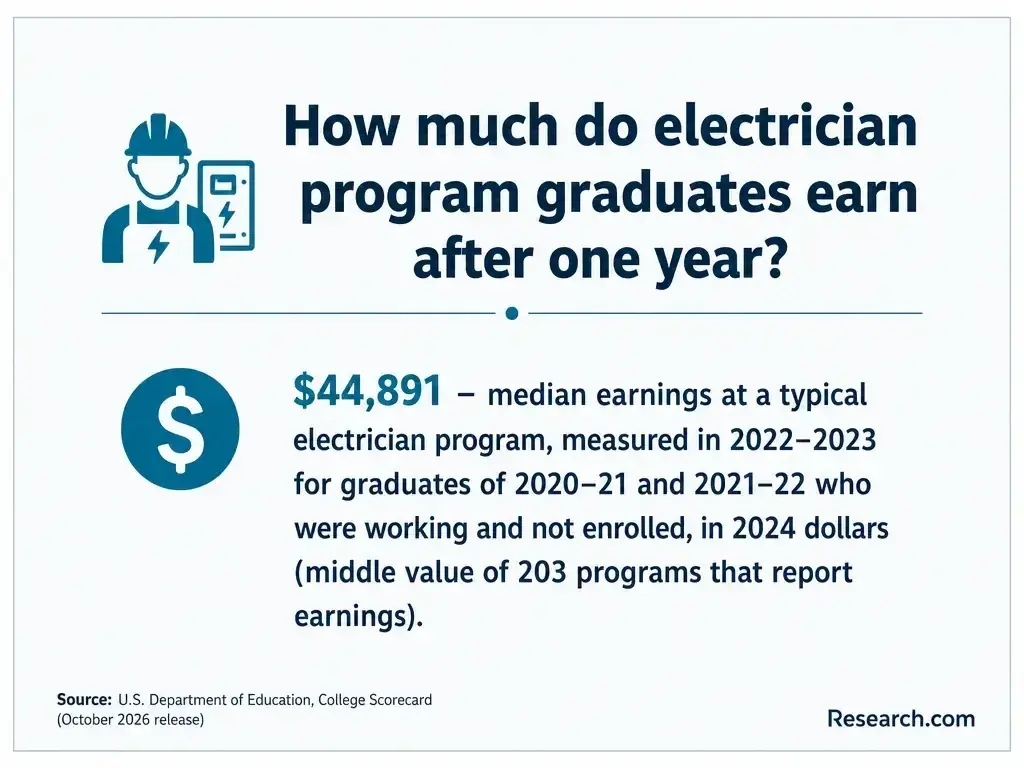
A verified Charlotte-specific electrician median is not established here, so the appropriate benchmark is clearly labeled national: electricians earned a median annual wage of $63,190 in May 2025 (U.S. Bureau of Labor Statistics, Occupational Outlook Handbook). That figure combines workers at different experience levels and should not be used as expected pay immediately after a Charlotte training program.
For a usable local estimate, compare current Charlotte-area postings for entry-level electrical helpers and apprentices with the wage schedule offered by each apprenticeship sponsor. Check whether raises depend on completed work hours, classroom progress, or both. When weighing a school bill against a paid route, compare earnings during training as well as pay after it.
There is no single required length for an electrician school credential. Short certificates, longer diplomas, and associate-degree programs have different course sequences; part-time attendance changes the calendar further. Ask each provider for its current required credit or contact hours, the portion spent in labs, the next available start date, and the expected completion date at your intended pace.
An apprenticeship is a longer work-and-learn commitment rather than a short course. The U.S. Bureau of Labor Statistics describes electrician apprenticeships as commonly lasting four or five years and combining paid on-the-job training with technical instruction. Before choosing a shorter school route for speed, ask whether its coursework gives documented advanced standing with the particular apprenticeship sponsor you hope to join; do not assume credits transfer automatically.
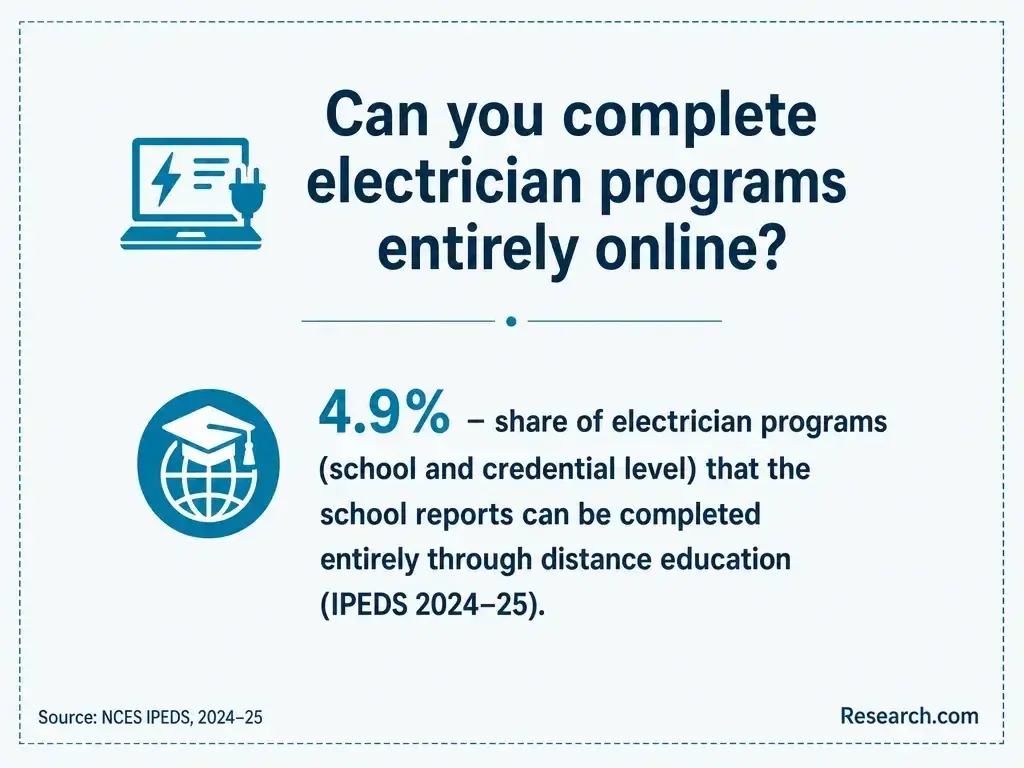
Online delivery can make electrical theory, code reading, calculations, and some assignments easier to schedule around work. It cannot by itself demonstrate that a student can safely terminate conductors, bend conduit, use test equipment, or troubleshoot an energized-work scenario under appropriate supervision. Campus labs and employer worksites provide opportunities to assess those practical skills.
Ask a hybrid provider which tasks require attendance, where the lab is located, and whether its schedule works with your commute or job. A program advertised as fully online deserves particular scrutiny if your goal is hands-on entry into the trade. Lists of best programs for seniors online do not establish that an electrical course supplies local lab access or worksite experience.
There is no verified Charlotte-wide average that fairly combines college programs, career schools, and paid apprenticeships. Their published prices also cover different things. Instead of treating one tuition figure as a market average, request an itemized, current estimate for the specific intake and attendance schedule you would use.
To compare what it takes to become job-ready, account for these costs and offsets:
Federal aid eligibility depends on the school, program, and student - not simply on a low advertised price (Federal Student Aid). A list of cheap online universities that accept financial aid cannot confirm aid eligibility for a particular electrician credential. Request the provider's aid details and compare your net cost with the likely wages you would give up while attending.
The credential depends on the route: a school may award a certificate, diploma, or associate degree; a registered apprenticeship has its own completion credential (U.S. Department of Labor, Apprenticeship.gov). An NCCER training record or credential, where offered, is separate from a school award. Ask precisely what appears on your transcript or completion record and whether a prospective employer or apprenticeship sponsor recognizes it.
None of those credentials is, by itself, a North Carolina electrical contracting license. Institutional accreditation concerns the school; apprenticeship registration concerns a sponsor's training arrangement; occupational licensing concerns legal authority to perform regulated contracting. These are different checks, even when a provider advertises more than one of them.
Requirements vary by provider and route. A school may require an application and placement or prerequisite coursework; an apprenticeship sponsor may use its own education, math, assessment, interview, and hiring criteria. Employers can also set job-related safety and worksite requirements. Obtain the current written requirements before paying an application fee rather than assuming admission to one route qualifies you for another.
For a working adult, scheduling can be as consequential as admission. Confirm whether labs meet during working hours, whether an apprenticeship requires travel among jobsites, and what happens if work obligations interrupt attendance. Ask about credit for prior coursework or documented experience, but get any advanced-standing decision in writing.
Core training generally covers electrical safety, measuring and calculating circuits, interpreting drawings, applying the National Electrical Code, installing wiring methods, and diagnosing faults (U.S. Bureau of Labor Statistics, Occupational Outlook Handbook). The occupational value lies in applying those subjects accurately while using tools and following safe procedures - not simply passing a theory exam.
Compare actual lab assignments before treating similarly named credentials as equivalent. Ask whether students assemble and test circuits, work with conduit and panels, practice troubleshooting, and receive individual feedback. A student targeting industrial maintenance should also check for motors and controls; someone targeting building construction should check for substantial installation practice. Employer work can deepen either route, but a school lab should not be described as a substitute for years of field experience.
North Carolina distinguishes working in the electrical trade from holding an electrical contracting license. The North Carolina State Board of Examiners of Electrical Contractors regulates electrical contractors and sets classification, experience, and examination requirements. Completing a Charlotte school program does not automatically satisfy those requirements or authorize someone to operate as an electrical contractor. State rules for contractor licensure should not be mistaken for a universal requirement that every new employee hold an individual statewide electrician license.
If your goal is eventual independent contracting, review the board's current requirements for the classification you want and ask how your work experience must be documented. If your immediate goal is an employee or apprentice position, ask the hiring employer or sponsor what training, supervision, and credentials it requires. Optional industry credentials may strengthen an application, but they are not substitutes for a required state license.
Start with the job you want, then compare the training that gets you there at the lowest realistic net cost. A low-cost classroom course may be poor value if it offers little supervised practice; a longer program may be unnecessary if a paid apprenticeship already provides the instruction and work experience you need.
Before enrolling, ask each provider or sponsor for answers you can compare directly:
Verify claims with the relevant accreditor, state authority, apprenticeship sponsor, or employer rather than relying on a ranking alone. Avoid using unrelated earnings searches such as highest paid masters degree to judge an electrician credential. For a meaningful return-on-investment comparison, consider your current earnings, completion probability, net cost and debt, wages during training, later earnings, and how long you expect to work in the trade.
Training may lead first to helper, apprentice, or supervised installation work. With substantial field experience, an electrician may move toward more complex troubleshooting, industrial or commercial specialization, lead responsibilities, or - after meeting applicable North Carolina requirements - licensed electrical contracting. Those are progression possibilities, not outcomes conferred by an entry credential (U.S. Bureau of Labor Statistics, Occupational Outlook Handbook; North Carolina State Board of Examiners of Electrical Contractors).
When comparing trade school careers salary figures, match the occupation and experience level to the actual role you can seek after training. A maintenance-focused student, for example, should examine the employer's electrical duties rather than assume every general maintenance job offers the same progression as an electrical apprenticeship.
The U.S. Bureau of Labor Statistics projects 9.2% national growth for electricians from 2025 to 2035. This supports considering the trade, but it is not a Charlotte hiring forecast and does not predict an opening for a particular graduate. Local opportunities also depend on construction activity, facility staffing, contractor workloads, and the number of employers willing to train entrants.
Use that national trend as background, then test the immediate market: review Charlotte-area apprentice and helper postings, ask sponsors when they recruit, and compare the skills requested with each program's labs and coursework. A program is a stronger investment when its training matches jobs you can realistically reach and its schedule lets you complete it.
Investing in training is a significant decision. Research.com created this ranking to help readers compare electrician programs with other options in the same occupation and location, rather than with unrelated trades. Only programs with completions reported to IPEDS are eligible. For a most affordable ranking, the score uses tuition, cost of attendance, median student debt, and federal loan default rate; an entropy-based method gives more weight to measures that differ more across programs. Accreditation and other quality indicators are not part of this affordability score, so readers should check them separately. The team drew on the following sources to assess the available records and verify relevant program information:
College-oriented datasets do not capture every union, employer-sponsored, or other apprenticeship route. The ranking is therefore a starting point for comparing reported school costs, not a complete list of ways to become an electrician or a finding that its lowest-priced option is the best fit. Readers can review Research.com's ranking methodology for more detail.
# 1 position
# 2 position
Not necessarily. Apprenticeship sponsors set their own entry requirements and provide related instruction alongside paid work. Ask a sponsor whether prior school training helps with selection or earns advanced standing before paying for it.
A paid apprenticeship or employer-training position may reduce upfront school expense, but availability and entry requirements vary. Compare net costs, wages during training, and the practical instruction offered - not tuition alone.
Online coursework can teach theory, but electrical installation and troubleshooting require supervised practical experience. Confirm where and how a program provides hands-on training before enrolling.
No. A school certificate does not itself grant a North Carolina electrical contracting license. Check the North Carolina State Board of Examiners of Electrical Contractors' current requirements if independent contracting is your goal.
Choose based on the job and training you need. A shorter credential may help you seek an entry-level position sooner; a broader program may suit a technical goal that calls for more coursework. Compare lab time, employer recognition, total cost, and any apprenticeship credit before deciding.