# 1 position

Audited and Verified:
Our Editorial and Data Verification Process
Research.com uses government datasets, official education statistics and primary institutional information to support its career and degree guides. Our review process checks factual accuracy, occupational definitions, source dates and the requirements associated with the credentials discussed.
How This Article Was Fact-Checked
Our editorial team verifies salary estimates, employment projections, education requirements and program information against original data providers and official organizations. Salary figures are checked against the relevant occupational definitions and reporting periods. Information about licensure, accreditation and required in-person training is reviewed separately.
Fact-checked and verified on:

Co-Founder and Chief Data Scientist

Reviewed by Karolina Broda
Fact-Checker and Data Verification
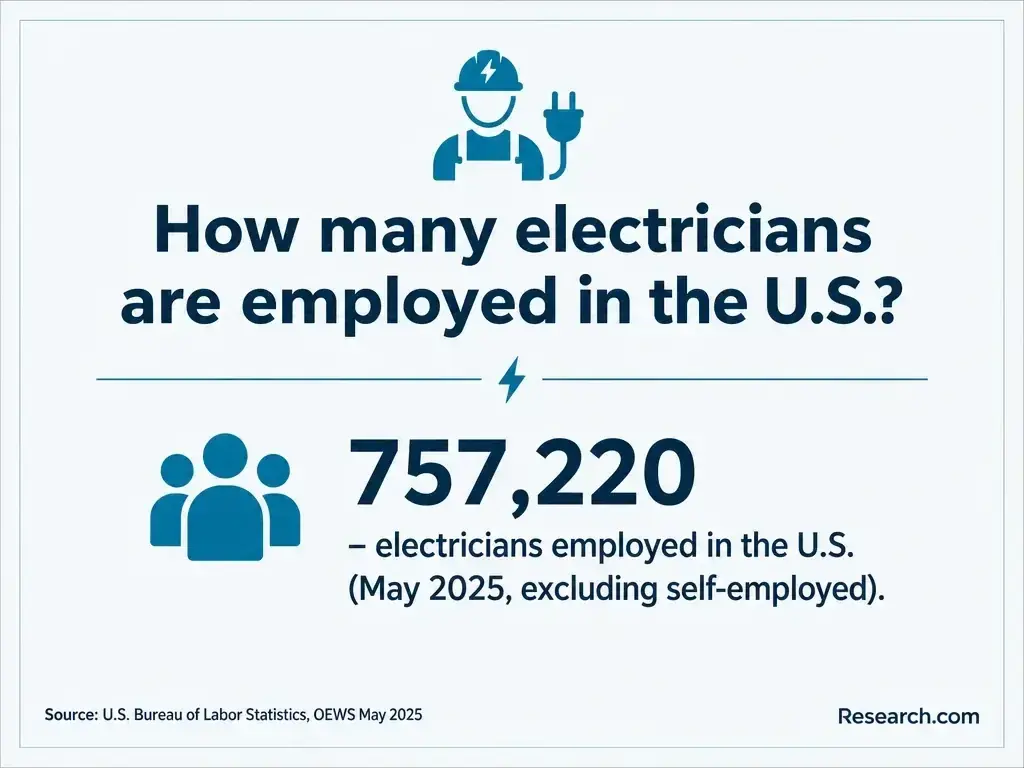
Choosing an electrician training program in Asheboro means weighing more than tuition: you need practical skills, a workable route into paid experience, and a credential that fits your goal. The U.S. Bureau of Labor Statistics projects electrician employment to grow 9.2% nationally from 2025 to 2035. This guide explains local training choices, costs, wages, and North Carolina licensing. It also accompanies the Most Affordable Electrician Trade Schools in Asheboro for 2027 ranking, created by the Research.com team of data scientists to help students identify programs worth considering.
Expect a mix of classroom instruction and supervised practice: interpreting plans, identifying circuits, installing wiring and devices, using test instruments, and applying electrical-code and safety rules. For a prospective student in Asheboro, Randolph Community College is a local starting point for checking current electrical training offerings. Ask which credential is awarded and whether the published schedule includes shop work, an apprenticeship connection, or both.
A school program and a registered apprenticeship are different routes. A certificate can provide focused preparation before a job search; a diploma generally includes a broader course sequence; and an associate degree adds further technical and general education coursework. A registered apprenticeship combines paid, supervised work with related instruction and progresses toward an apprenticeship completion credential. An employer may also hire and train an entry-level helper without requiring trade school first. These routes are not interchangeable: the best fit depends on whether you need immediate wages, structured lab practice, a broader credential, or an employer-sponsored path into the trade. Sources: Randolph Community College; ApprenticeshipNC; U.S. Department of Labor.
Potential workplaces include residential and commercial electrical contractors, construction sites, manufacturing facilities, and building-maintenance operations. Electrical contractors may send workers throughout Randolph County and the wider Piedmont Triad, so access to a vehicle and willingness to reach changing jobsites can matter as much as proximity to a classroom. Manufacturing work may emphasize troubleshooting and equipment maintenance; construction work more often involves installations that change as projects progress. Source: U.S. Bureau of Labor Statistics.
Ask an employer whether an opening is for an electrical helper, apprentice, maintenance worker, or experienced electrician. The title affects the supervision available, the skills you will practice, and whether your work experience could support a later contractor-license application. Keep records of employers, dates, duties, and supervisors rather than assuming all electrical-adjacent work will be counted the same way by a licensing board.
The U.S. Bureau of Labor Statistics reports a May 2025 national median annual wage of $63,190 for electricians. It describes workers across experience levels and locations - not the pay a newly trained person should expect in Asheboro. A local offer may also differ according to whether it is for a helper, apprentice, construction electrician, or maintenance role.
For a useful pay comparison, request the starting wage, scheduled raises, benefits, travel expectations, and likely hours from prospective employers or apprenticeship sponsors. Compare those offers with the earnings you would give up to attend school. A paid apprenticeship may have a stronger near-term cash-flow advantage than a full-time school program, while school may be worthwhile if its labs and schedule help you qualify for a job you could not otherwise obtain.
There is no single electrician-training duration. A focused certificate takes less coursework than a diploma or associate degree, while part-time attendance extends the calendar time for any school credential. A registered apprenticeship takes several years because it combines progressively skilled on-the-job work with related instruction. The exact classroom, lab, and work hours depend on the program or registered apprenticeship standards; do not assume that similarly named credentials require the same practice. Sources: Randolph Community College; U.S. Department of Labor.
Before enrolling, ask for the current catalog's required courses and contact hours, the weekly shop schedule, and the expected time to completion for your attendance plan. If you already work in the field, ask whether prior coursework or documented experience can provide credit or advanced standing. Get any answer in writing: a shorter school schedule does not automatically shorten an apprenticeship or satisfy North Carolina contractor-license experience rules.
Online study can help with theory, calculations, code reading, and scheduling flexibility. It cannot, by itself, show that you can safely install, test, and troubleshoot equipment. Campus labs and supervised jobsites provide the practical feedback that an aspiring electrician needs. A hybrid program can be a sensible compromise if its required in-person sessions are accessible from Asheboro. Source: U.S. Bureau of Labor Statistics.
Before choosing among the most popular accredited online trade schools, confirm exactly where the electrical labs occur, who supervises them, and what credential you receive. Institutional accreditation is a check on the school, not proof that remote coursework supplies hands-on experience or qualifies you for a North Carolina electrical contractor license. A fully online theory course may be useful preparation, but it should not be mistaken for a complete occupational entry route.
A reliable Asheboro-wide average is not available across college programs, employer training, and registered apprenticeships, which report costs in different ways. Instead of relying on a single average, compare current written estimates for the routes you can actually attend. Randolph Community College's published tuition and fees are a starting point for a school estimate; an apprenticeship budget must also account for wages earned during training. Sources: Randolph Community College; ApprenticeshipNC.
The following cost categories show why tuition alone can misstate what you will spend to become job-ready:
| Cost or offset | What to include in your comparison |
| School charges | Tuition, mandatory fees, books, materials, and any separate lab charges |
| Work-ready supplies | Required tools, test equipment, workwear, and personal protective equipment |
| Access and time | Travel to campus and jobsites, schedule changes, and earnings forgone while attending classes |
| Funding and income | Eligible grants or aid, employer-paid training, and apprenticeship wages |
| Later career expenses | Any examination and application costs if you eventually pursue contractor licensure |
Ask the provider for an itemized total, including which tools you must buy before the first class. Check federal-aid eligibility for the specific program, not just the institution; Federal Student Aid notes that eligibility depends on the student and eligible program. Also ask about North Carolina workforce assistance and employer reimbursement. For a return-on-investment decision, weigh net costs and debt against completion likelihood, likely pay progression, foregone earnings, and the time it takes to recover your investment - not a projected salary alone.
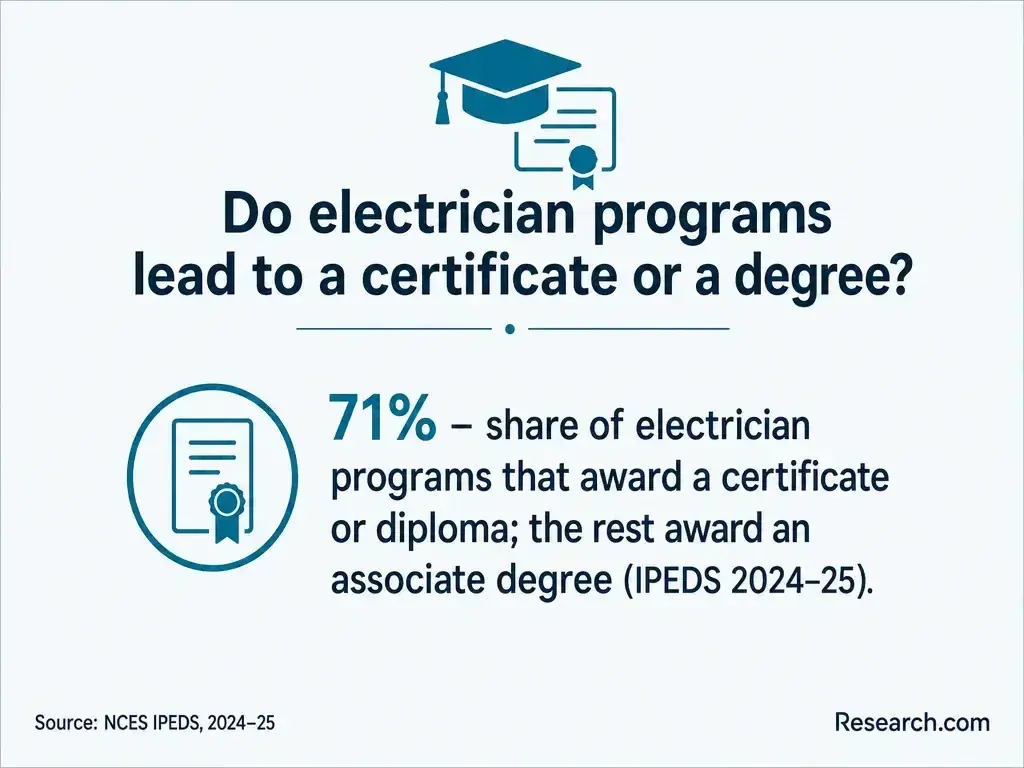
The award depends on the route: a college may award a certificate, diploma, or associate degree, while completion of a registered apprenticeship leads to an apprenticeship credential. An employer training course may document skills without awarding a college credential. Check the exact award on the current program page before applying; the words "electrician training" do not identify one standard credential. Sources: Randolph Community College; U.S. Department of Labor.
Also distinguish credentials from permissions to work. Institutional accreditation concerns a school; industry credentials, such as relevant NCCER training recognition, document particular competencies; registration identifies an apprenticeship meeting applicable standards. None is a North Carolina electrical contractor license. If your longer-term goal is to operate a contracting business, ask how the proposed training helps you develop and document the experience the North Carolina State Board of Examiners of Electrical Contractors requires.
Requirements vary by route and intake. A college applicant should check current admission, placement, course-prerequisite, and program-entry rules with Randolph Community College. A registered apprenticeship applicant should check the sponsor's eligibility and selection requirements, which may include an assessment, interview, and the ability to reach jobsites. An employer hiring a helper may set different entry standards. Sources: Randolph Community College; U.S. Department of Labor.
Preparation matters even where formal prerequisites are limited. Electrical trainees use measurements, basic algebra, diagrams, and written safety instructions. Before paying an application or enrollment charge, confirm the start date, class schedule, required tools, and whether a work placement is included or must be found independently. This prevents a common mismatch: enrolling in classroom training while assuming it automatically comes with a paid apprenticeship.
Core training commonly covers electrical theory, circuit calculations, wiring methods, blueprint reading, the electrical code, testing, troubleshooting, and safe work practices. The practical distinction is how students apply those topics: identifying a fault with a meter, assembling a circuit correctly, and working safely around energized systems demand supervised practice, not just a passing score on a written test. Source: U.S. Bureau of Labor Statistics.
Compare the actual lab and field activities rather than treating course titles as proof of equivalent preparation. If you want industrial maintenance work, ask about motors, controls, and troubleshooting equipment. If you want construction work, ask about installation practice, drawings, and access to a contractor or apprenticeship sponsor. Electrical codes and workplace technology evolve, so learning to use current references and test equipment is more valuable than memorizing one set of examples.
Working for an electrical contractor and contracting for electrical work are different. North Carolina's State Board of Examiners of Electrical Contractors licenses qualifying electrical contractors and sets classifications with experience and examination requirements. Finishing a school program does not itself issue that license. North Carolina does not use one statewide journeyman electrician license as the automatic entry credential for every employed electrician; ask an employer and the appropriate authority about requirements for your specific role and worksite. Source: North Carolina State Board of Examiners of Electrical Contractors.
If you plan to become a contractor, review the board's current classification rules before choosing training, and ask how to document qualifying experience under appropriate supervision. Industry certifications can support a résumé but do not replace board licensure. Likewise, school accreditation, state authorization, apprenticeship registration, and contractor licensing serve different purposes; verify each one that applies rather than accepting a general claim that a program is "approved."
Start with the job you want: entry-level construction work, industrial maintenance, or eventual electrical contracting. Then compare Randolph Community College's current offerings with registered apprenticeships and direct employer entry. A school program can suit someone who needs structured practice before applying for work; a paid apprenticeship may suit someone ready to learn on a jobsite and earn while training. Neither choice is best solely because of its price or credential name.
Use these checks to turn a shortlist into an enrollment decision:
Be wary of a provider that promises a contractor license at graduation, describes an online-only course as a substitute for supervised electrical work, or quotes tuition without mandatory supplies. A ranking is a useful screening tool; the decisive question is whether the particular route gives you affordable, accessible practice and a credible next step into your intended job.
An entry-level helper or apprentice can build toward more independent installation and troubleshooting work as skills and supervised experience increase. From there, a worker might concentrate on residential or commercial construction, industrial electrical maintenance, controls, or supervision. Operating an electrical contracting business is a separate progression that requires meeting North Carolina's applicable licensing rules; it is not a guaranteed outcome of school or apprenticeship completion. Sources: U.S. Bureau of Labor Statistics; North Carolina State Board of Examiners of Electrical Contractors.
Choose training to match that progression. Broad installation and safety practice can help someone seeking a first contractor job, while substantial motors-and-controls work is more pertinent to an industrial target. If your first priority is a paycheck and documented work experience, compare employer and registered-apprenticeship openings before committing to full-time classroom study.
The U.S. Bureau of Labor Statistics projects 9.2% national growth in electrician employment from 2025 to 2035. That signals continuing demand across the occupation, but it is not an Asheboro hiring forecast or a promise that a particular graduate will find work. Local prospects depend on contractor projects, manufacturing needs, commuting range, and the number of employers prepared to supervise new workers.
For a current local read, compare recent helper and apprentice postings with sponsor openings across Randolph County and reachable Piedmont Triad jobsites. Note which positions require experience and which offer supervised entry. That distinction is more useful to a beginner than counting every advertised electrician opening as an attainable first job.
Education is a significant investment, so Research.com designed this ranking to help readers compare electrician programs against other programs serving the same occupation and location. The team checks multiple education and training data sources for credible, consistent information. Only programs with completions reported to IPEDS qualify for the ranking; a registered apprenticeship or employer program can be a good option even if it does not appear.
For a most affordable ranking, the score considers tuition, cost of attendance, median student debt, and the federal loan default rate. An entropy-based method assigns more weight to measures that distinguish programs more clearly. Accreditation, recognition, student support, earnings, completion, and retention do not contribute to this affordability score. A lower-cost ranking position therefore does not establish that a program offers the best practical training or route to employment.
The following sources inform Research.com's trade-program data and verification. Some cover other occupations and may not supply a relevant measure for an electrician program:
Use the ranking to narrow a cost-conscious shortlist, then verify the current price, shop instruction, work opportunities, and credential with each provider. More detail on the ranking approach is available on Research.com's methodology page.
# 1 position
# 2 position
Not necessarily. Entry through an employer or registered apprenticeship is also possible. Compare each route's instruction, supervision, wages, and credential before deciding. Source: U.S. Department of Labor.
No. It is a local school option to investigate, but employer training and registered apprenticeships may also be available. Check current openings and schedules rather than assuming every route starts when you need it.
Online coursework can cover theory, but safe installation, testing, and troubleshooting require supervised in-person practice. Confirm where that practice happens before enrolling.
No. North Carolina electrical contracting requires meeting the applicable State Board of Examiners of Electrical Contractors licensing rules, including experience and examination requirements. A school certificate is a separate credential.
Compare each school program's complete out-of-pocket cost with paid apprenticeship and employer-training offers. Include tools, travel, aid eligibility, wages during training, and the time needed to reach your target job.