# 1 position


Audited and Verified:
Our Editorial and Data Verification Process
Research.com uses government datasets, official education statistics and primary institutional information to support its career and degree guides. Our review process checks factual accuracy, occupational definitions, source dates and the requirements associated with the credentials discussed.
How This Article Was Fact-Checked
Our editorial team verifies salary estimates, employment projections, education requirements and program information against original data providers and official organizations. Salary figures are checked against the relevant occupational definitions and reporting periods. Information about licensure, accreditation and required in-person training is reviewed separately.
Fact-checked and verified on:

Co-Founder and Chief Data Scientist

Reviewed by Karolina Broda
Fact-Checker and Data Verification
Choosing the cheapest electrician program in Durham is not as simple as comparing tuition: paid apprenticeships, tools, commuting, and the experience needed for later licensing can change the calculation. The U.S. Bureau of Labor Statistics projects 9.2% national growth in electrician employment from 2025 to 2035. This guide helps prospective students compare credentials, practical training, costs, and career routes. It also accompanies the Most Affordable Electrician Trade Schools in Durham for 2027 ranking, created by the Research.com team of data scientists to help students make an informed choice about programs worth considering.
Expect electrical theory paired with supervised practice - not simply a credential at the end of classroom study. At a community college such as Durham Technical Community College, the relevant comparison is the specific electrical program and credential currently offered, its lab access, and its connections to employers. A short introductory course may prepare you to seek an entry-level helper position; a longer certificate, diploma, or associate degree can cover more technical material without replacing on-the-job experience.
A registered apprenticeship takes a different approach: the participant works for pay while completing structured technical instruction and supervised job training. Union, nonunion, and employer sponsors may offer routes in the Durham area, but openings and entry requirements depend on the sponsor. If you need income immediately and can secure a place, apprenticeship may be a better investment than full-time study. If you first need foundational skills or a flexible schedule, a college program may be more practical. An accelerated associates degree comparison can inform a discussion about pace, but electrical labs and field practice still need to fit the schedule.
The useful question is not whether two programs share the word "electrical." Ask what wiring, testing, code interpretation, and troubleshooting you will actually perform, who supervises the work, and whether the provider helps students enter paid training.
Potential workplaces include electrical contractors on residential and commercial projects, facilities-maintenance teams, and employers maintaining industrial or building electrical systems. Durham's mix of construction, institutional facilities, and commercial properties makes it worth comparing programs by the work setting they prepare you for: installing branch circuits on a jobsite differs from diagnosing a facility's controls. The U.S. Bureau of Labor Statistics describes electricians as installing, maintaining, and repairing electrical power, communications, lighting, and control systems.
Training alone does not qualify someone to bid independently on electrical contracting jobs. For a first position, ask local employers or apprenticeship sponsors whether they hire helpers, what safety preparation they expect, and whether they provide supervised hours toward advancement. Include travel to worksites across the Triangle in your budget; the jobsite may not be near the classroom.
The U.S. Bureau of Labor Statistics reports a $63,190 national median annual wage for electricians in May 2025. Half of employed electricians nationally earned less and half earned more. It is neither a Durham-specific figure nor a forecast for a new helper or apprentice; experience, employer, specialty, and hours worked affect an individual offer.
For a local decision, compare actual Durham-area helper or apprentice offers with the cost of attending school and the pay you would give up while training. Ask whether an offer includes scheduled raises, benefits, tool allowances, and paid classroom time. A higher eventual occupation-wide median does not by itself justify borrowing for a program.
Duration depends on the credential and the amount of practice included. An introductory course or pre-apprenticeship can be shorter than a college certificate or diploma; an associate degree generally requires a broader sequence of coursework. Request each provider's current calendar, total contact hours, lab hours, and part-time schedule rather than assuming that a credential name indicates equal training.
The U.S. Bureau of Labor Statistics describes electrician apprenticeships as typically lasting four or five years, combining paid on-the-job training with technical instruction. That is a route to sustained supervised experience, not a claim that a preceding school program shortens every apprenticeship. Before paying for school first, ask a prospective sponsor whether prior coursework earns advanced standing and obtain its answer in writing.
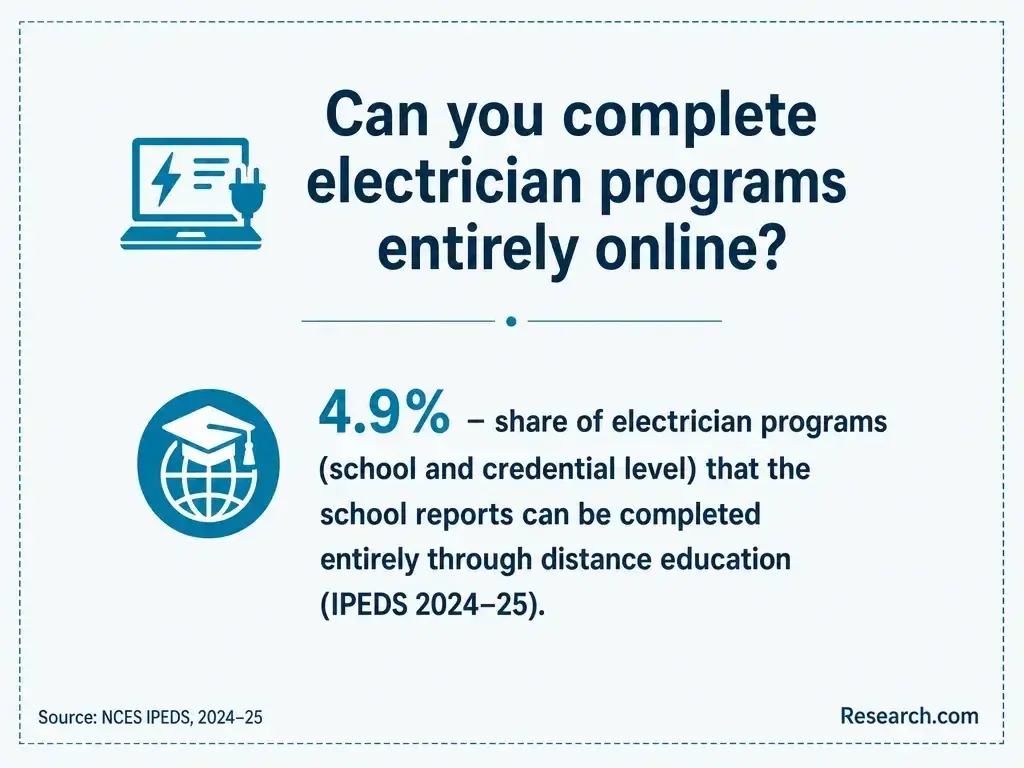
Online study can work for electrical calculations, terminology, and some code-related lessons. It cannot, by itself, demonstrate safe installation, use of test instruments, or troubleshooting on equipment. A hybrid program can be useful for a working adult if its required labs and supervised work are accessible from Durham.
The comparison below separates delivery format from practical preparation. Check actual lab schedules and locations before accepting an advertised "online" completion timeline.
| Format | What it can offer | What to verify |
| On-campus | Scheduled instructor-led shop and lab practice | Equipment access, hands-on hours, and commuting cost |
| Hybrid | Remote theory with scheduled in-person practice | Lab location, required attendance, and worksite placement |
| Online coursework only | Flexible theory or refresher study | Where and how practical skills and supervised experience will be gained |
An "online school" label - or appearance among accredited online schools no fee enrollment - does not establish electrician job readiness or North Carolina contractor-license eligibility. Verify the electrical training component separately.
There is no reliable single Durham average that covers college programs, short courses, and paid apprenticeships on the same basis. Published tuition may also omit costs that determine whether a route is affordable. For 2027 entry, request a current, itemized quote from Durham Technical Community College or any sponsor you are considering; do not treat an earlier catalog price as a 2027 price.
Build a job-ready budget from the charges below. Then subtract aid or paid-training income for which you are actually eligible, rather than comparing sticker tuition alone.
Ask whether the particular program is eligible for federal student aid; a short continuing-education course may not be. Federal Student Aid determines federal eligibility, while NCWorks can help eligible applicants investigate workforce-training support. Apprenticeship wages and employer-paid instruction may reduce borrowing, although a paid route can take longer and require a competitive application. Lists of certificate programs that pay well are not substitutes for a Durham-specific net-cost and employment comparison.
That depends on the route: a college may award a course-completion record, certificate, diploma, or associate degree, while completion of a registered apprenticeship leads to a recognized apprenticeship completion credential. An employer may instead document its own training. Obtain the exact credential title and a curriculum showing what practical work it represents.
Institutional accreditation concerns the school; state authorization concerns permission to operate; an industry training credential documents particular competencies; apprenticeship registration concerns a structured work-and-instruction program. None is interchangeable with a North Carolina electrical contractor license. Ask a college whether credits can stack into another electrical credential, transfer, or count toward a sponsor's instruction requirements; the receiving institution or sponsor decides whether to accept them.
Requirements differ by provider and route. A college may require an application, placement or prerequisite coursework, and enrollment in a particular program; a short workforce course can have different rules. Apprenticeship sponsors commonly assess readiness for math, reliable attendance, and jobsite work, but applicants must check each sponsor's current eligibility and selection process rather than assume that college admission guarantees an apprenticeship place.
Before applying, request the published prerequisites and ask when the next lab or work cohort starts. If you have previous electrical coursework or relevant employment, ask about documented prior-learning credit or advanced standing before paying a deposit. Confirm whether the provider supplies a work placement or merely recommends that students find one.
Relevant training should connect electrical calculations and circuit theory to safe, observable tasks: reading plans, selecting materials, installing wiring and devices, using meters, finding faults, and applying the electrical code used by local authorities. Safety instruction should be practiced in the lab and on worksites, not presented only as an online quiz. The U.S. Bureau of Labor Statistics identifies blueprint reading, testing, and troubleshooting as central electrician duties.
Program depth matters. A basic course can introduce tools and terminology; more substantial shop instruction and supervised employment provide repeated practice under realistic conditions. Ask to see the equipment, the share of instruction spent performing tasks, and how instructors assess safe work. If your aim is industrial maintenance or controls rather than building installation, verify that the curriculum covers that goal instead of assuming all electrical credentials do.
North Carolina's electrical contractor license matters if your goal is to contract for electrical work independently; it is not automatically awarded for finishing trade school. The North Carolina State Board of Examiners of Electrical Contractors sets contractor-license classifications, experience and examination requirements. A person entering supervised employment should ask the employer what work they may perform and who holds responsibility for required licensing and permits.
Before choosing a program, check the Board's current rules for the license classification you eventually want and ask how training and documented work experience may apply. Keep records of employers, duties, and hours. An optional industry certificate can help describe skills to an employer, but it does not replace Board requirements. Likewise, institutional accreditation, school authorization, and registered-apprenticeship status answer different questions; none alone grants permission to operate as an electrical contractor.
Start with the job you want - entry-level installation, maintenance, or eventually independent contracting - and work backward to the practice and experience it requires. An affordability ranking is a useful shortlist, not proof of job placement, licensing eligibility, or the lowest total expense. Comparisons with unrelated education searches, including cheapest phd programs online, cannot answer an electrician-training decision.
Use these checks with each college, employer program, or apprenticeship sponsor. Written answers make unlike pathways easier to compare.
A warning sign is a promise that a short certificate alone will make you a licensed contractor or guarantee a particular wage. The better investment is the route you can finish, afford, and connect to the supervised experience your intended work demands.
A realistic starting point is an electrical helper or apprentice role under appropriate supervision. With sustained work experience, an electrician may move toward more independent installation and troubleshooting, specialize in commercial systems or controls, or pursue supervisory work. Operating an electrical contracting business is a distinct later goal with North Carolina Board requirements; it is not an automatic outcome of a school credential.
Choose training by the next job, not the most impressive-sounding certificate. For someone who wants to earn while learning, a registered apprenticeship may align better than an unpaid full-time program. Someone exploring several occupations can use a broader certified jobs that pay well comparison to clarify their interests, but should evaluate electrical training against actual employer requirements and local opportunities.
The U.S. Bureau of Labor Statistics projects 9.2% growth in U.S. electrician employment from 2025 to 2035. That national projection indicates continuing demand for the occupation, not a guaranteed Durham opening or an estimate of how many local apprentices will be hired.
For a Durham decision, check current openings by experience level and ask apprenticeship sponsors when they recruit. Look closely at whether advertisements seek helpers, experienced electricians, or licensed contractors: counting all three as entry-level opportunities would overstate a new trainee's options. Training that provides real troubleshooting practice and a credible route into supervised work is more useful than selecting a program solely because the national outlook is positive.
Education is a consequential investment, so the Research.com team evaluates reported programs against others in the same occupation and location rather than treating a national list as a Durham comparison. The Most Affordable ranking scores tuition, cost of attendance, median student debt, and federal loan default rate; an entropy-based method gives more weight to measures that distinguish programs. Accreditation and other quality indicators are not part of the affordability score.
The team uses the following databases and organizations to check program, institutional, cost, and occupational information. Some listed organizations concern other trades or allied health fields and should not be mistaken for electrician-program accreditors.
Only programs with completions reported to IPEDS enter the ranking. A registered apprenticeship, employer program, or short course can therefore be a legitimate local option without appearing in it. For context, Research.com's separate best programs rankings also assess outcomes, earnings, and quality: occupation-relevant program recognition carries 20%, institutional accreditation 10%, student support 10%, and outcomes, earnings, and costs share 60% through entropy-based weighting. Those are not the weights used for this affordability ranking. Readers can review the broader approach on the Research.com methodology page, then verify each candidate's current price and hands-on pathway before enrolling.
# 1 position
# 2 position
A paid apprenticeship or employer-sponsored route may have a lower net cost than unpaid study, but admission and available openings vary. Compare wages, fees, tools, travel, and time to completion with a current college quote.
Not necessarily. Sponsors set their own entry rules. Introductory coursework may strengthen an application, but ask whether the sponsor accepts it for advanced standing before paying for it.
Online coursework can teach theory, but electrical installation and troubleshooting require in-person practice and supervised work. Verify where a program provides those components.
No. The North Carolina State Board of Examiners of Electrical Contractors sets separate experience, examination, and licensing requirements for electrical contractors.
It can provide broader instruction, but its value depends on your target job, extra cost and time, lab quality, and whether an employer or apprenticeship sponsor recognizes the coursework. Compare those outcomes rather than credential names alone.