# 1 position


Audited and Verified:
Our Editorial and Data Verification Process
Research.com uses government datasets, official education statistics and primary institutional information to support its career and degree guides. Our review process checks factual accuracy, occupational definitions, source dates and the requirements associated with the credentials discussed.
How This Article Was Fact-Checked
Our editorial team verifies salary estimates, employment projections, education requirements and program information against original data providers and official organizations. Salary figures are checked against the relevant occupational definitions and reporting periods. Information about licensure, accreditation and required in-person training is reviewed separately.
Fact-checked and verified on:

Co-Founder and Chief Data Scientist

Reviewed by Karolina Broda
Fact-Checker and Data Verification
Choosing electrician training in Summit, Mississippi, means looking beyond the lowest tuition: you also need practical skills and a route into supervised work. The U.S. Bureau of Labor Statistics projects 9.2% national growth in electrician employment from 2025 to 2035, making the training decision timely. The Research.com team of data scientists created the Most Affordable Electrician Trade Schools in Summit for 2027 ranking to help students identify programs worth considering. This guide explains costs, credentials, apprenticeships, and licensing questions so you can compare your options with confidence.
Expect instruction in electrical theory, circuits, wiring methods, code use, and jobsite safety, paired with supervised practice. A credible hands-on component should let you work with tools, test equipment, and wiring assemblies - not just watch demonstrations. Ask how much time is spent in labs and whether the provider arranges worksite experience; similarly named credentials can offer very different amounts of practice.
In Summit, Southwest Mississippi Community College is one provider to investigate for current electrical training availability, schedules, and catalog requirements. A community-college certificate or diploma may suit someone who wants structured preparation before seeking an employer. A registered apprenticeship may fit someone ready to compete for a paid position and learn primarily on the job. Direct employer entry can also be possible, but ask who supervises the work and what instruction accompanies it. The U.S. Bureau of Labor Statistics identifies apprenticeship as a common route into the occupation.
School is most worthwhile when its instruction fills a real gap between your present skills and an available job or apprenticeship. A short credential alone should not be valued as though it replaces supervised field experience.
Potential settings include electrical contractors' residential and commercial jobsites, industrial maintenance departments, and facilities teams. The work differs: construction emphasizes installation and code-compliant new work, while maintenance emphasizes troubleshooting and keeping equipment operating. The U.S. Bureau of Labor Statistics describes electricians as installing, maintaining, and repairing electrical power, communications, lighting, and control systems.
Summit's location matters because a student may need to travel beyond town for a suitable employer, apprenticeship sponsor, or specialized worksite. Before enrolling, compare the training schedule with the area in which you can realistically commute for both classes and work. If your goal is industrial work, ask whether the curriculum includes motors and controls; a residential-focused course may be a poor match.
The U.S. Bureau of Labor Statistics reports a $63,190 national median annual wage for electricians in May 2025. That figure describes workers across experience levels and locations. It does not establish a Summit wage, an apprentice rate, or what someone will earn after a short school program.
For a useful local comparison, ask prospective employers or apprenticeship sponsors about the starting rate, scheduled raises, benefits, and travel expectations for the exact role you could enter. Compare take-home prospects with training costs and earnings you would give up while studying. A paid apprenticeship can improve the short-term calculation even if its route to independent work takes longer.
Length depends on the credential and schedule: a focused certificate generally takes less time than a broader diploma or associate degree, while part-time attendance extends the calendar time. Do not infer hours from a program title. Request the current catalog's total clock or credit hours, lab hours, and required attendance schedule from Southwest Mississippi Community College or any other provider you consider.
A registered apprenticeship is a longer work-and-instruction pathway. Apprenticeship.gov describes many programs as combining roughly 2,000 hours of on-the-job learning per year with related instruction, although the approved standards of the specific apprenticeship control its requirements. School coursework may help an applicant qualify or, where a sponsor permits it, receive advanced standing; it does not automatically shorten an apprenticeship. Get any credit decision from the sponsor in writing before paying for preparatory training.
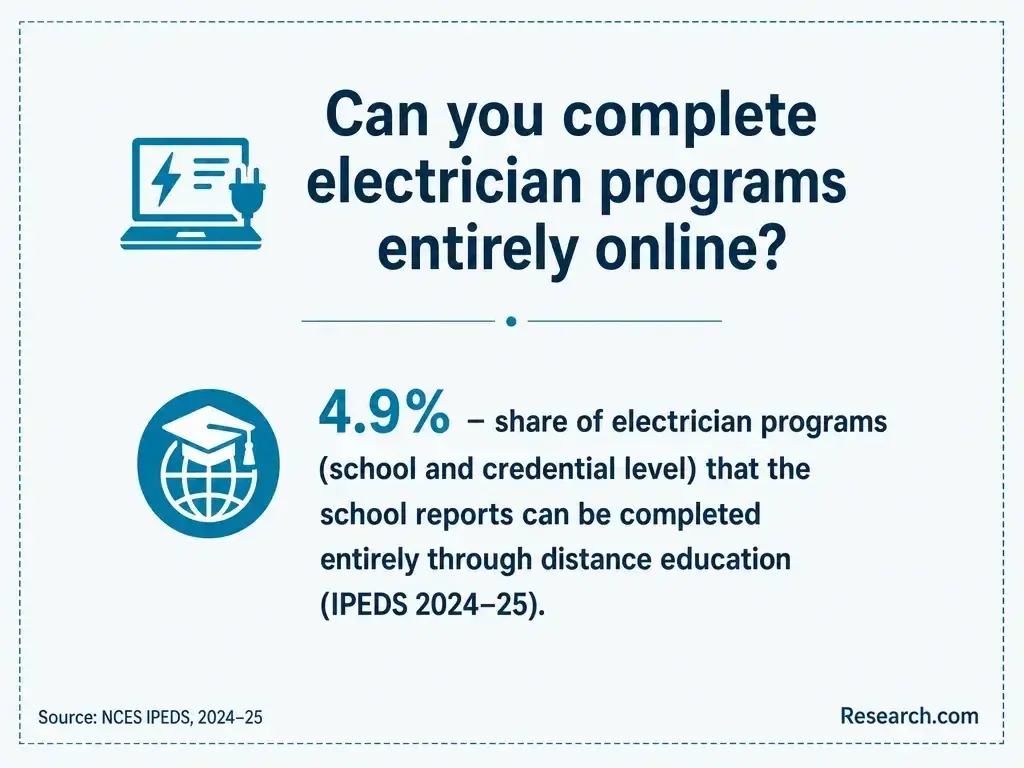
Online delivery can work for theory, code-study exercises, and some calculations. Wiring, safe tool use, testing, troubleshooting, and supervised jobsite performance require physical practice. A hybrid option is useful only if its in-person labs and any required field experience are accessible from Summit.
Before choosing a remote course, ask where practical assessments happen, who supplies equipment, and whether an apprenticeship sponsor or employer recognizes the training. A fully online course should not be assumed to provide sufficient occupational preparation or meet any local licensing condition. Broad lists of the best online colleges with open admissions policy can clarify admissions options, but electrician applicants still need to verify lab access and work-based training.
A reliable Summit-wide average is not available here: published college prices would not capture every apprenticeship, employer program, or applicant-specific aid package. Instead, request an itemized, current quote for each option. Resident tuition, enrollment intensity, and program length can change a college bill, while an apprenticeship may pay wages during training but still have entry expenses.
Use the same cost categories for every route so a low advertised tuition does not hide the price of becoming job-ready:
If you are comparing an associate credential with a shorter trade credential, a guide to the cost of associate degree online may help frame general budget questions, but it cannot replace an electrician program's lab and tool estimate. Ask each provider for its own total, including what you must purchase before the first practical class.
The award depends on the pathway. A college may award a certificate, diploma, or associate degree; a registered apprenticeship leads to a completion credential under its approved standards. Employer training may document skills without awarding a college credential. Confirm the exact award in the current catalog or apprenticeship agreement rather than assuming every "electrician program" ends with the same qualification.
These credentials are not interchangeable with occupational licensure. Institutional accreditation concerns the school, state school authorization concerns permission to operate, and apprenticeship registration concerns the work-based program. Industry credentials can document particular skills, but their value depends on whether local employers or sponsors recognize them. Ask whether completed coursework can transfer, stack toward a later credential, or receive apprenticeship credit - and obtain the applicable policy in writing.
Requirements vary by provider and pathway. A school may set its own application, placement, and safety expectations; an apprenticeship sponsor may also screen for job-readiness and require applicants to meet its stated entry conditions. Review the current school catalog or sponsor notice for any education prerequisites, assessment, driver or transportation expectations, and physical demands. Do not assume open college admission means automatic entry into a particular training cohort or apprenticeship.
If federal aid matters to your decision, confirm that both the institution and the specific program are eligible, and ask the financial aid office what you could actually receive. Federal Student Aid distinguishes institutional participation from eligibility for a particular course of study. Resources on online school financial aid can explain aid questions, but they do not establish eligibility for an electrician program or a paid apprenticeship.
Core preparation covers reading electrical drawings, calculating loads, interpreting applicable electrical code, selecting conductors and protective devices, and measuring voltage and continuity safely. Labs should turn those ideas into wiring and troubleshooting tasks, with an instructor checking both the result and the method. The U.S. Bureau of Labor Statistics and O*NET identify technical reading, problem-solving, and safe use of testing equipment as relevant electrician skills.
Match electives to the work you want. Someone seeking commercial installation should look for conduit and plan-reading practice; someone targeting maintenance should ask about motors, controls, and fault diagnosis. Ask to see the actual lab sequence and equipment list. A syllabus full of electrical terminology is weaker evidence of readiness than assessed practical work and a clear route to supervised field experience.
Do not assume one credential answers every licensing question. In Mississippi, the Mississippi State Board of Contractors regulates applicable contractor licensing, while requirements for individual electrical work and local permits can depend on the jurisdiction and the work being performed. A school certificate, industry certification, or registered-apprenticeship credential does not itself authorize someone to operate as a licensed electrical contractor.
Before enrolling, tell the provider your intended role: supervised apprentice or employee, independent electrician, or contractor. Then check the relevant Mississippi State Board of Contractors rules and the permitting authority where you plan to work. Ask what experience, examination, supervision, and contractor-license conditions apply to that role, and whether the program helps document any required training. This distinction matters especially if you expect to work outside Summit after training.
Start with the job you want, then compare the cheapest credible route to that job - not simply the lowest listed tuition. For Summit-area applicants, travel to labs and worksites can affect both cost and completion. A program is a stronger investment when its schedule, practical training, employer connections, and credential fit the work you can realistically pursue.
Ask each school or apprenticeship sponsor the following before committing money or leaving a job:
Avoid three common mistakes: treating accreditation as a license, treating the national median wage as expected starting pay, and assuming an inexpensive online course replaces field practice. For return on investment, weigh completion likelihood, debt, foregone earnings, likely entry pay, and the time needed to progress - not institution type alone. A list of the cheapest online college for bachelor's degree addresses a different educational goal; it is not an electrician-training comparison.
Foundational training can support applications for supervised electrical work or an apprenticeship. With additional documented experience and whatever examinations or licensing apply to the intended work, an electrician may move toward more independent installation, maintenance, troubleshooting, supervision, or contracting. The steps are not automatic: employers, apprenticeship sponsors, and licensing authorities may each assess different evidence of competence.
For a career changer, compare this route with other certificate careers that pay well only after checking what the credential actually permits you to do. Electrician work is a particularly poor fit for someone who needs training to be entirely remote or cannot access supervised practical work. It may fit someone willing to build skills progressively while working toward greater responsibility.
The U.S. Bureau of Labor Statistics projects 9.2% growth in U.S. electrician employment from 2025 to 2035. This is a national occupational projection, not a forecast of Summit vacancies or a guarantee of an apprenticeship opening. It supports considering the trade, but it cannot tell you which local training route will lead to a job.
Before paying for a program, check current openings and ask area contractors and apprenticeship sponsors what skills they screen for and where worksites are located. A willingness to commute may broaden options beyond Summit; it also adds costs that belong in your training decision. Judge an advertised placement claim by its definition, reporting period, and number of students counted.
Investing in electrician training is an important decision. Research.com created its ranking to make reported costs and debt easier to compare among programs in the same occupation and location. The team draws on multiple datasets and checks the relevance of each measure; a ranking is a starting point, not a substitute for confirming current prices and hands-on training with a provider.
The ranking methodology uses the following data sources. Some cover other trades and are not electrician-specific measures:
For this most-affordable ranking, programs are evaluated on tuition, cost of attendance, median student debt, and federal loan default rate. Weights are assigned using an entropy-based method, which gives more weight to measures that differ more across programs. Accreditation and other quality indicators are not part of the affordability score. Only programs with completions reported to IPEDS are eligible; a missing apprenticeship or training provider is not necessarily unavailable or low quality.
Research.com's separate best-program rankings also consider outcomes, earnings, and quality. In those rankings, occupation-relevant program recognition carries 20%, institutional accreditation 10%, student support 10%, and outcomes, earnings, and costs a combined 60% with entropy-based weighting. Read more about how Research.com creates its rankings. For an electrician decision, use the affordability ranking to shortlist options, then verify what each program actually teaches and whether its credential advances your intended work path.
# 1 position
# 2 position
Not necessarily. A registered apprenticeship or supervised employer route may be available. Trade school can build foundational skills, but confirm what a prospective employer or sponsor requires before paying for it.
It can reduce foregone earnings because apprentices are paid, but compare required supplies, travel, any instruction costs, and the time to your intended role. Ask the sponsor for its actual terms.
No certificate alone establishes permission to work independently or operate as a contractor. Check the applicable Mississippi State Board of Contractors rules and the local permitting authority for your intended work.
Theory may be taught online, but wiring, testing, safety, and field skills need in-person practice. Confirm where a hybrid program delivers and assesses those skills.
Ask which electrical credentials are currently offered, the full program cost, lab and worksite requirements, class schedule, and whether an apprenticeship sponsor accepts the coursework for credit.