# 1 position
Nunez Community College - Electrician.
associate

Audited and Verified:
Our Editorial and Data Verification Process
Research.com uses government datasets, official education statistics and primary institutional information to support its career and degree guides. Our review process checks factual accuracy, occupational definitions, source dates and the requirements associated with the credentials discussed.
How This Article Was Fact-Checked
Our editorial team verifies salary estimates, employment projections, education requirements and program information against original data providers and official organizations. Salary figures are checked against the relevant occupational definitions and reporting periods. Information about licensure, accreditation and required in-person training is reviewed separately.
Fact-checked and verified on:

Co-Founder and Chief Data Scientist

Reviewed by Karolina Broda
Fact-Checker and Data Verification
Choosing electrician training in Chalmette means comparing more than tuition: a low-cost credential is useful only if it builds practical skills and fits your route into paid electrical work. The Research.com team of data scientist created the Most Affordable Electrician Trade Schools in Chalmette for 2027 ranking to help students identify programs worth considering. With U.S. electrician employment projected to grow 9.2% from 2025 to 2035, this guide helps prospective students and career changers compare costs, apprenticeships, credentials, and local work requirements before enrolling (U.S. Bureau of Labor Statistics).
Expect a choice between school-based preparation and work-based training, not one standardized "electrician degree." A certificate or diploma can introduce wiring, circuits, code use, and safe tool handling. An electrical associate program, where offered, usually adds broader technical coursework. A registered apprenticeship combines related classroom instruction with supervised, paid work and is a more direct route to substantial field experience (U.S. Bureau of Labor Statistics; U.S. Department of Labor).
Nunez Community College is the local institution to ask about current electrical offerings, lab access, schedules, and whether coursework can count toward an apprenticeship. Confirm the specific program and credential available for your start term rather than assuming that any electrical course leads directly to an electrician job. If comparing a technical associate pathway with best affordable online associate degrees, remember that electrical installation and testing still require supervised, in-person practice.
For someone who needs income immediately, a paid apprenticeship or employer-sponsored helper position may fit better than full-time school. School-based training can be worthwhile when it provides substantial lab time, employer connections, and a documented route into supervised work.
Chalmette's location makes both St. Bernard Parish jobs and commutes into the broader New Orleans labor market relevant. Potential settings include residential and commercial construction, building maintenance, industrial facilities, and marine or port-related operations. These settings use different skills: a maintenance role may emphasize troubleshooting existing equipment, while a construction role may emphasize new installations and reading plans (U.S. Bureau of Labor Statistics).
Training alone does not establish eligibility to work independently. Ask prospective employers whether they hire entry-level helpers, require entry into an apprenticeship, or expect experience with particular systems. Before accepting work across parish lines, check the rules that apply where the job will actually be performed; local permit and worker-credential requirements can differ from the rules governing a Louisiana electrical contractor (Louisiana State Licensing Board for Contractors).
A verified Chalmette-specific electrician median is not available here, so a national figure should not be relabeled as local pay. The U.S. median annual wage for electricians was $63,190 in May 2025 (U.S. Bureau of Labor Statistics). That figure covers experienced workers as well as newer ones; it is not a forecast of what a new graduate or apprentice will earn.
For a usable local estimate, compare current St. Bernard Parish and New Orleans-area postings for the same stage of training, then ask apprenticeship sponsors for their starting wage, progression schedule, and benefits. Compare hourly rates alongside expected hours, commuting costs, and any unpaid classroom time. This is more informative than comparing an entry-level offer with the national median.
A school certificate may take substantially less time than an apprenticeship, but its duration depends on the published course sequence and whether you attend full time. Electrician apprenticeships typically last four or five years, with classroom learning and paid supervised work (U.S. Bureau of Labor Statistics). Completing a short course can help you apply for work; it does not erase the experience needed for more independent responsibilities.
Ask Nunez Community College for the current program's clock or credit hours, required lab hours, course rotation, and expected completion time for part-time students. Ask an apprenticeship sponsor whether prior coursework earns advanced standing; do not assume it will. A search for a 1 year master program describes a different educational route and should not be used to estimate the time needed to become an electrician.
Online delivery can work for portions of electrical theory, calculations, or code study. It cannot by itself demonstrate safe installation, testing, troubleshooting, or worksite practices. Campus labs and supervised jobs provide opportunities to handle equipment and receive feedback; a hybrid program should specify exactly where and when those activities occur.
Ask for a breakdown of remote coursework, mandatory lab attendance, and employer-supervised hours before paying a deposit. A listing of best accredited universities online with no application fee does not answer whether an electrical credential includes the practical training an employer or apprenticeship sponsor expects. For a Chalmette resident, travel to labs or jobs around the New Orleans area can also change the real cost of a seemingly convenient hybrid option.
There is no defensible single Chalmette average that covers college programs, private training, and paid apprenticeships on the same basis. Request a current, itemized estimate from Nunez Community College and each sponsor you are considering. The comparison below shows why the lowest tuition quote may not be the lowest-cost path to employment.
| Cost or offset | What to verify |
| School charges | Tuition by residency status, mandatory fees, and required materials |
| Job-ready supplies | Tools, meters, protective equipment, and replacement costs |
| Career-entry expenses | Any required examination, application, or work-related charges |
| Time and travel | Trips to labs and worksites, schedule limits, and earnings forgone |
| Offsets | Grants, eligible student aid, employer support, and apprentice wages |
Apprentices earn wages while training, but entry can be competitive and classroom costs or tool purchases may still apply (U.S. Department of Labor). For school-based training, confirm federal-aid eligibility with the institution and check Louisiana workforce-training assistance through the relevant workforce office; eligibility is program- and student-specific (Federal Student Aid; Louisiana Workforce Commission). To assess return on investment, weigh your likely completion, debt, earnings during training, expected post-training pay, and the time it takes to recoup costs - not just the sticker price.
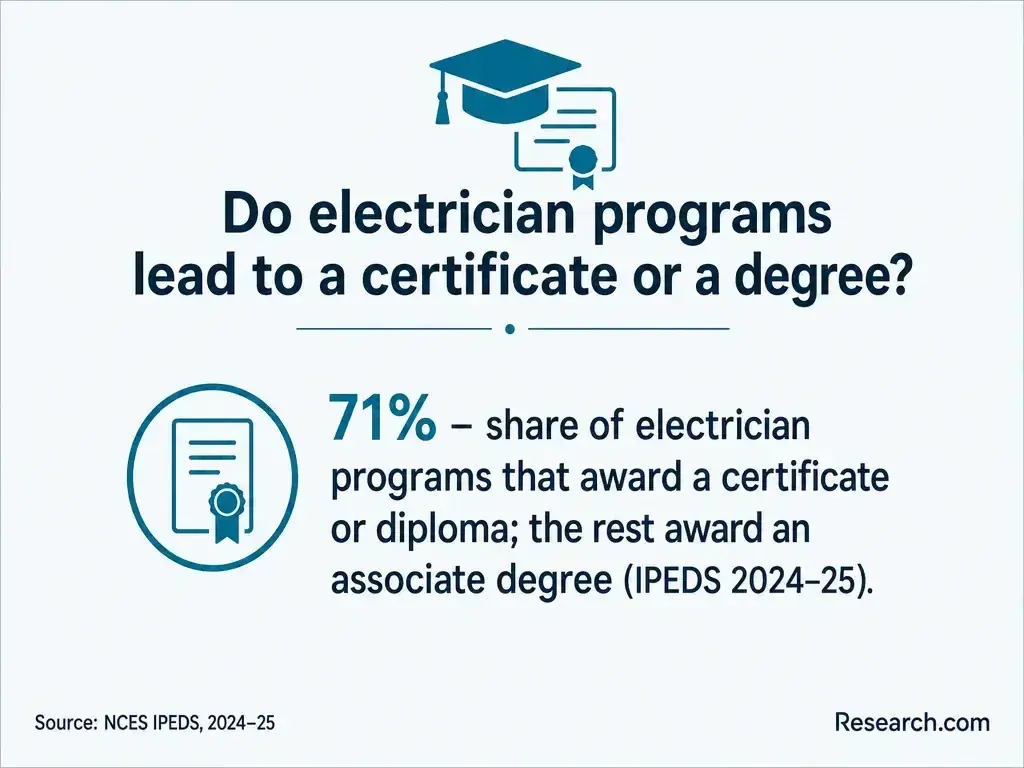
The answer depends on the pathway: a school may award a certificate, diploma, or associate degree; a registered apprenticeship leads to an apprenticeship completion credential after its requirements are met (U.S. Department of Labor). A course completion document, an industry certification, apprenticeship registration, and permission to perform regulated work are different things.
Ask the provider for the exact credential title and whether employers or apprenticeship sponsors recognize it for hiring or advanced standing. Institutional accreditation concerns the school; relevant industry recognition concerns training content; neither automatically grants an occupational license. Searches such as what is the easiest bachelor's degree to get online address a different credential decision and should not determine whether electrical training prepares you for supervised fieldwork.
School and apprenticeship entry rules differ. Ask the school about its application, placement or prerequisite courses, age requirements, and any documents needed for enrollment. Ask an apprenticeship sponsor about its current eligibility rules, assessment or interview, ability to reach assigned jobsites, and whether openings are available. Requirements are set by the particular provider or sponsor, not by the program title alone.
Before applying, check whether you can meet the physical and scheduling demands of supervised electrical work and attend the required labs or classes. If you already have related construction experience, request a written evaluation of possible credit or advanced standing. Do not budget on receiving that credit until the provider confirms it.
Useful entry-level training connects electrical theory to safe, observable tasks: interpreting diagrams, measuring circuits, selecting materials, installing wiring methods, and diagnosing faults. Code navigation and workplace safety matter because electricians must apply requirements to the job at hand, not merely memorize terms (U.S. Bureau of Labor Statistics; National Center for Construction Education and Research).
Ask to see the course outline and lab schedule. How many tasks will you perform with tools under supervision, rather than only watch or simulate? Does the program address the residential, commercial, or industrial work you want? For someone targeting industrial maintenance near the regional port and industrial economy, motor controls and troubleshooting may be more relevant than a curriculum concentrated solely on household wiring.
Do not assume that graduating from trade school authorizes independent electrical work. Louisiana regulates electrical contracting through the Louisiana State Licensing Board for Contractors, while requirements for permits or worker credentials can depend on the jurisdiction where a job is performed (Louisiana State Licensing Board for Contractors). Whether you are entering as a supervised helper, progressing through an apprenticeship, or planning to contract for jobs changes which rules matter.
Before enrolling, tell the provider your intended role and ask which training, work experience, examinations, and applications - if any - apply to that goal. Verify contracting requirements with the state board and jobsite-specific requirements with the appropriate local authority, particularly if you expect to work beyond St. Bernard Parish. An optional training certification may strengthen an application, but it is not a substitute for a required license or permit.
Start with your intended first job, then compare each program against the training and experience that job requires. The most affordable ranked option is worth considering only if its schedule, practical instruction, and route into supervised work fit your circumstances. Use these checks before committing:
Watch for claims that a short online course alone makes you a licensed electrician, or that a national median wage is typical starting pay. A provider should be able to explain what its credential does and does not qualify you to do.
An initial path may be electrical helper or apprentice, followed by more complex installation, service, maintenance, or troubleshooting as supervised experience grows. Later options can include specializing in industrial controls, leading crews, or pursuing contracting - subject to the experience and regulatory requirements of the role (U.S. Bureau of Labor Statistics; Louisiana State Licensing Board for Contractors).
Choose training to match that progression. Someone seeking industrial work should ask about controls and equipment labs; someone seeking residential service should prioritize installation, troubleshooting, customer communication, and a route into that type of work. For readers exploring best jobs for introverts, electrical work can involve focused technical tasks, but it also requires clear communication with coworkers, supervisors, and customers.
U.S. electrician employment is projected to grow 9.2% from 2025 to 2035 (U.S. Bureau of Labor Statistics, Employment Projections). This is a national projection, not a forecast of openings in Chalmette or a guarantee of placement. Local demand will depend on construction schedules, maintenance hiring, and employers' willingness to take on trainees.
Check current postings across St. Bernard Parish and commutable New Orleans-area locations before choosing a specialty. Separate apprentice and helper openings from jobs requiring substantial experience: a market with many experienced-worker vacancies may still be difficult to enter without a sponsor. Ask programs for recent employer connections and outcomes, including how those outcomes were measured, rather than treating the national growth rate as proof of local placement.
Investing in training is an important decision, so Research.com uses comparable program-level evidence rather than treating a low advertised tuition price as the whole answer. The affordability ranking compares electrician programs with other programs in the same occupation and location. Only programs with completions reported to IPEDS are eligible; a missing apprenticeship or other provider should not be interpreted as low quality or lack of approval.
Most affordable programs are scored on tuition, cost of attendance, median student debt, and federal loan default rate. An entropy-based method assigns more weight to indicators that vary more across eligible programs. Accreditation and other quality measures are not part of this affordability score. Research.com's separate best-programs rankings also consider outcomes, earnings, accreditation or relevant industry recognition, and student support. Readers should therefore use the affordability ranking as a cost comparison, then independently check hands-on training and career-entry requirements. More detail is available in Research.com's ranking methodology.
The following databases and organizations informed the ranking process. Trade-specific recognition is considered where relevant; healthcare and dental organizations listed here do not constitute electrician-program approval.
# 1 position
# 2 position
Not necessarily. A registered apprenticeship or employer-sponsored entry route may combine classroom instruction with paid supervised work. Compare each route's entry requirements, practical training, and credential before choosing (U.S. Bureau of Labor Statistics; U.S. Department of Labor).
Online lessons can cover theory, but installation, testing, and worksite safety require hands-on practice. Ask where a program's required labs and supervised work take place.
Do not assume so. A school certificate documents completed training; independent work or contracting may involve additional experience and applicable state or local requirements (Louisiana State Licensing Board for Contractors).
It depends on the full cost. Compare school fees and lost earnings with apprenticeship wages, tools, transportation, and any classroom charges. Request current written figures from both providers.
Confirm which electrical program is offered for your start term, its credential and total cost, required lab hours, schedule, aid eligibility, and whether apprenticeship sponsors recognize the coursework.