# 1 position


Audited and Verified:
Our Editorial and Data Verification Process
Research.com uses government datasets, official education statistics and primary institutional information to support its career and degree guides. Our review process checks factual accuracy, occupational definitions, source dates and the requirements associated with the credentials discussed.
How This Article Was Fact-Checked
Our editorial team verifies salary estimates, employment projections, education requirements and program information against original data providers and official organizations. Salary figures are checked against the relevant occupational definitions and reporting periods. Information about licensure, accreditation and required in-person training is reviewed separately.
Fact-checked and verified on:

Co-Founder and Chief Data Scientist

Reviewed by Karolina Broda
Fact-Checker and Data Verification
Choosing electrician training in Indiana means comparing more than tuition: a short certificate, an associate degree, and a paid apprenticeship offer different routes to job-ready experience. The U.S. Bureau of Labor Statistics projects 9.2% national growth in electrician employment from 2025 to 2035. For prospective students and career changers, the Best Electrician Trade Schools in Indiana for 2027 ranking, created by the Research.com team of data scientists, identifies programs worth considering. This guide explains how to compare their costs, practical training, credentials, and routes into work.
Expect instruction in electrical safety, circuits, wiring methods, blueprint reading, testing, and applicable code, followed by practical work with tools and equipment. The central question is whether that practice leads to the supervised jobsite experience your target employer or local licensing authority expects. A classroom credential alone is not the same as completing an apprenticeship.
These pathways differ in how students obtain that experience. Durations vary by provider, schedule, and apprenticeship standard; confirm the published hours for the specific option you are considering (U.S. Department of Labor; institution and apprenticeship sponsor program descriptions).
| Pathway | Typical structure and credential | Best fit |
| Certificate or diploma | Focused classroom and shop training; school-issued credential | Someone seeking fundamentals before applying for helper jobs or apprenticeships |
| Associate degree | Electrical coursework and labs alongside additional college coursework; academic degree | Someone who values broader technical study and can justify the additional time and cost |
| Registered apprenticeship | Paid, supervised work plus related instruction; apprenticeship completion credential | Someone ready to learn primarily on the job while earning wages |
| Employer-sponsored entry route | Worksite training that varies by employer; credential, if any, varies | Someone with an available trainee job who will verify its instruction and progression |
For a school pathway, ask to see the lab syllabus and whether an apprenticeship sponsor accepts its coursework for credit or advanced standing. Do not assume that an accelerated online associate degree program can replace electrical shop work: speed is valuable only if the credential and practical training fit the intended job.
Electrical contractors working on homes and commercial buildings, industrial facilities, and maintenance employers offer different kinds of entry-level work. An aspiring construction electrician should prioritize wiring, installation, and code-based jobsite practice. Someone targeting plant maintenance should also examine motor controls, troubleshooting, and industrial equipment in the curriculum (U.S. Bureau of Labor Statistics, Occupational Outlook Handbook).
Location affects access to training as well as jobs. Indianapolis-area applicants may be able to compare more nearby employers and training schedules, while applicants elsewhere may face longer drives to a shop, classroom, or changing jobsites. Before accepting a place, ask where labs meet, where apprentices are dispatched, and whether transportation between worksites is required.
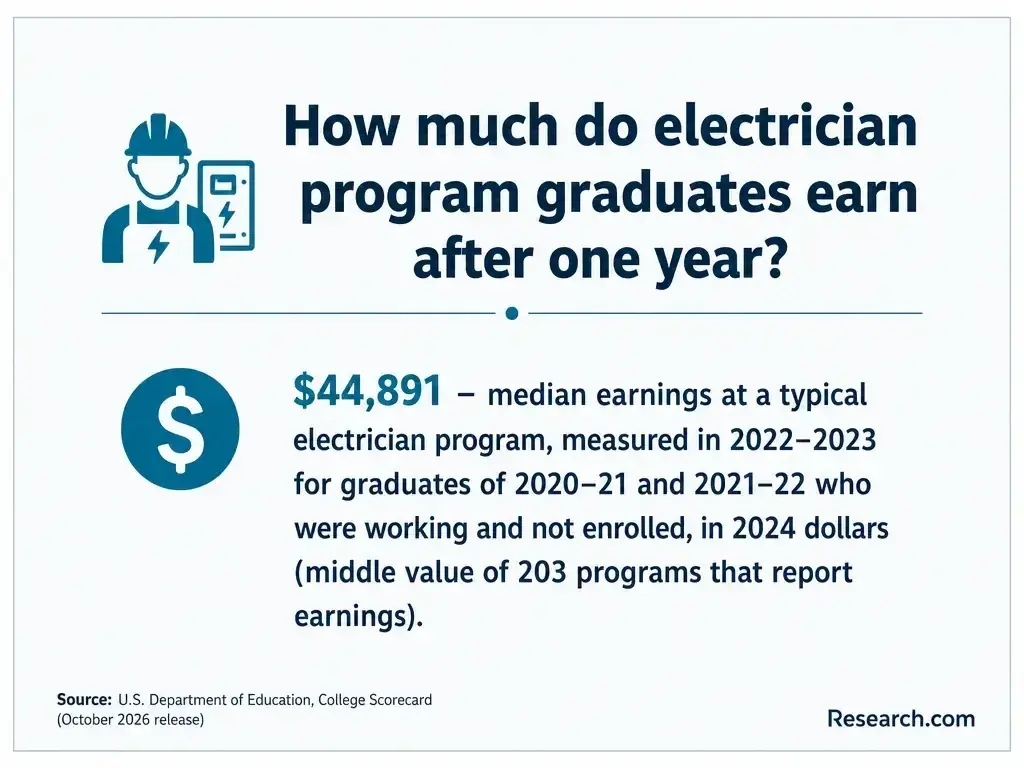
The latest national median annual wage supplied for electricians is $63,190 for May 2025 (U.S. Bureau of Labor Statistics, Occupational Outlook Handbook). It describes workers across experience levels and locations - not starting wages, an Indiana median, or earnings guaranteed by a particular program. Use it as a career benchmark, not as the income figure in a first-year budget.
For a decision grounded in Indiana, compare written local apprentice wage schedules and actual entry-level offers in the area where you can work. Ask when pay steps increase and whether the quoted rate assumes travel, overtime, or work at a particular jobsite. A paid apprenticeship may improve cash flow during training even if a school program is shorter.
A focused school certificate generally takes less time than an associate degree, but the exact calendar and clock hours depend on the published program and whether you attend full-time. A registered electrician apprenticeship typically spans several years because it combines related instruction with substantial supervised work; U.S. Department of Labor apprenticeship guidance commonly uses 2,000 hours of on-the-job learning and at least 144 hours of related instruction per year as a model, while the sponsor's registered standards determine its actual requirements.
Faster school completion does not necessarily mean faster progression to independent electrical work. Get the program's required lab hours, likely completion date, and any documented apprenticeship credit in writing. If comparing fast associate degree programs online, check whether electrical labs are local and scheduled often enough to avoid delaying completion.
Online instruction can suit code concepts, electrical theory, calculations, and some blueprint exercises. It cannot, by itself, demonstrate safe installation, use of test instruments, lockout procedures, or work under supervision. On-campus and hybrid options should provide accessible labs; apprenticeship and employer routes add real worksites (U.S. Bureau of Labor Statistics, Occupational Outlook Handbook; U.S. Department of Labor).
Ask a hybrid provider which activities require attendance, where they happen, who assesses practical skills, and whether you must arrange your own placement. A fully online certificate may help with theory or advancement, but do not treat it as proof of jobsite competence or local licensing eligibility. The better format is the one you can actually attend and use to complete the practical work your goal requires.
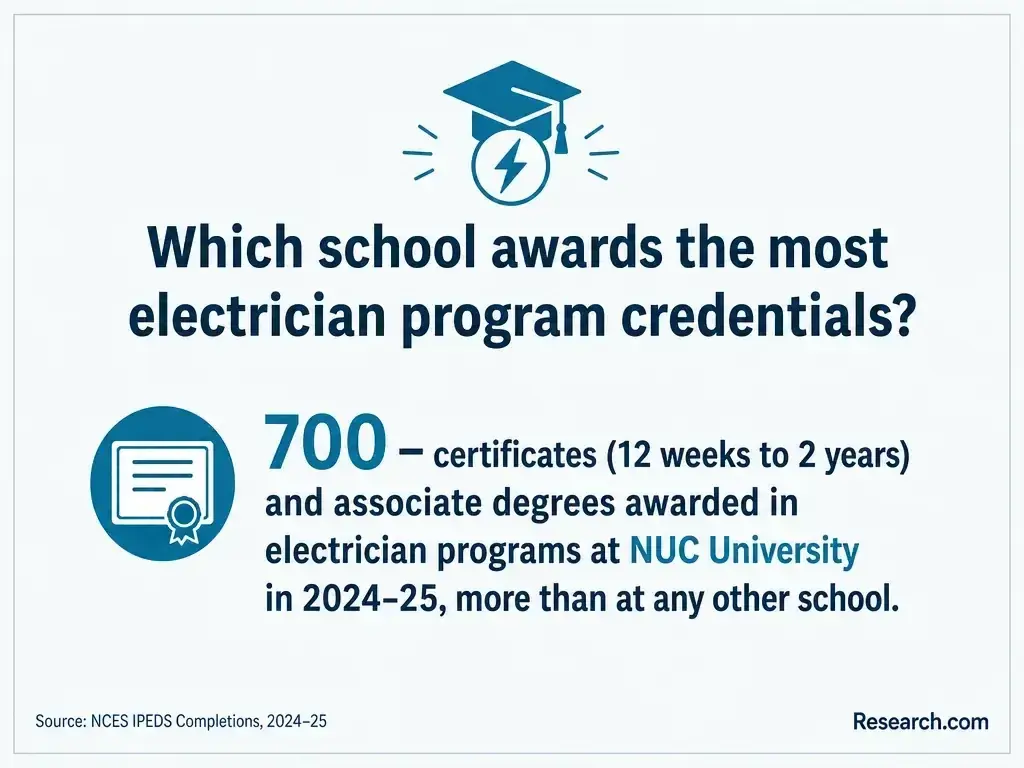
There is no single reliable statewide price that covers Indiana college programs, private career schools, and paid apprenticeships on the same basis. Request a current, itemized estimate from each provider instead of treating advertised tuition as the total cost. Public-college resident status, program length, and attendance schedule can materially change the bill (institution-published tuition and program disclosures).
For a fair comparison, build a job-ready budget covering tuition and mandatory fees; books and software; tools, consumables, and personal protective equipment; any examination or local application charges; and travel to labs and jobsites. Include wages you might forgo while studying, then subtract aid you are actually eligible to receive. A registered apprenticeship's pay can offset costs, but ask about tool purchases, dues where applicable, and unpaid travel (U.S. Department of Labor; Federal Student Aid).
Check federal-aid eligibility at the program level, not merely the school level, and ask Indiana workforce staff whether you qualify for training assistance. Lists of affordable online college programs can inform a price search, but they are not a substitute for an electrical program's full in-person training budget.
Depending on the route, you may receive a school certificate, diploma, associate degree, or registered-apprenticeship completion credential. These document different learning and experience; similarly named credentials need not include the same lab time or supervised work. NCCER-related credentials may document particular construction skills where an employer recognizes them, but they are not a statewide electrician license (National Center for Construction Education and Research; U.S. Department of Labor).
Ask for the exact credential title, issuing organization, transcript or completion record, and written policy on credit toward an apprenticeship. An online academic credential in an unrelated field - even one presented in a list of online doctoral degrees without dissertation - does not replace electrical trade training. Choose the credential for its documented connection to the electrical work you want to perform.
Schools and apprenticeship sponsors set their own entry rules. Expect to check minimum age, prior schooling or equivalent preparation, math readiness, application deadlines, and any sponsor-specific assessments. Employers or sponsors may also require a driver's license, work authorization, a drug screen, or the ability to travel to jobsites; verify which conditions apply before paying an application fee (institution and apprenticeship sponsor admission policies).
Returning adults should compare evening availability and recognition of prior learning rather than assume a daytime schedule will work. Guides to top online degree programs for seniors may raise useful scheduling questions, but an electrician applicant still needs a workable plan for labs or supervised field training.
A useful entry program connects electrical calculations and circuit theory to hands-on installation and troubleshooting. Look for practice reading drawings, selecting and installing wiring methods, testing circuits, identifying faults, and following the electrical code and workplace safety procedures. Construction-oriented programs should address jobsite coordination; industrially oriented programs should give appropriate attention to controls and equipment maintenance (U.S. Bureau of Labor Statistics, Occupational Outlook Handbook; provider curricula).
Compare assessed practice, not just course titles. Ask how many students share a training station, which tasks each student must perform independently, and whether instructors record practical competency. A program that teaches code terminology but offers little supervised tool use may be a sensible theory supplement - not a complete job-entry plan.
Indiana does not issue one statewide journeyman electrician license through the Indiana Professional Licensing Agency. Local governments may impose their own requirements on electrical workers or contractors, so the rules depend on where and in what capacity you plan to work. Before enrolling, ask the licensing office for your intended work location whether it requires registration, documented experience, an examination, or a contractor license (Indiana Professional Licensing Agency; applicable local licensing authority).
Keep the distinctions clear: a school's institutional accreditation concerns the institution; state school authorization concerns its permission to operate; apprenticeship registration concerns the training arrangement; optional industry certification documents specified skills; and an occupational or contractor license is issued under the applicable government's rules. None automatically substitutes for another. Do not rely on a school's statement that graduates are "license-ready" without checking the local authority's requirements yourself.
Start with the job you want and the locality where you expect to work. Then compare a school route with a registered apprenticeship or an employer trainee position. Ivy Tech Community College, Vincennes University, and Lincoln College of Technology-Indianapolis are examples of institutions to investigate, but confirm each current electrical offering, campus, credential, and schedule directly; a school's name alone does not establish a program's fit.
Use this sequence to test whether a program is a worthwhile investment:
Accreditation directories - including lists of best nationally accredited online colleges - answer a narrower question than whether an electrical program supplies required practice. A red flag is pressure to enroll before the provider explains hands-on access, total charges, or how its credential connects to work in your locality.
A school graduate might seek an electrical helper or apprentice opening; a registered apprentice builds toward more independent work through supervised experience and related instruction. With further experience, electricians may specialize in construction, industrial troubleshooting, or maintenance, or move into crew leadership. Contracting or self-employment brings business and applicable local licensing obligations beyond trade competency (U.S. Bureau of Labor Statistics, Occupational Outlook Handbook; applicable local licensing authority).
Match the first credential to the next realistic step. If your aim is an apprenticeship, prioritize an application route and documented credit over an expensive certificate with no sponsor connection. If you already work around industrial equipment, targeted electrical instruction may be more useful than repeating introductory material - but ask the provider and employer whether prior learning earns formal credit.
The U.S. Bureau of Labor Statistics projects 9.2% growth in electrician employment nationally from 2025 to 2035. This indicates demand across the occupation, but it is not an Indiana-specific forecast or a guarantee that openings will be convenient to a particular student. Construction schedules, industrial hiring, and access to apprentice placements can differ substantially by locality.
Before committing to training, look at current apprentice and helper openings within a practical commute, then ask sponsors how frequently they recruit and where they dispatch trainees. That check turns a favorable national outlook into a more useful local decision: whether your chosen route can get you supervised experience where you can actually work.
Investing in training is a consequential decision. Research.com created its ranking to help readers compare electrician programs with other options in the same occupation and location, rather than with unrelated schools nationwide. Only programs reporting completions to the Integrated Postsecondary Education Data System (IPEDS) are eligible; the ranking therefore does not cover every apprenticeship, employer program, or training provider.
Best-program scores consider student outcomes; earnings and return on investment; costs and debt; and quality and recognition. Occupation-relevant programmatic accreditation or industry recognition receives 20%, institutional accreditation 10%, and student support services 10%. The remaining 60% covers outcomes, earnings, and costs, with entropy-based weights that give more weight to indicators that differ more across programs. Separate most-affordable rankings score only tuition, attendance cost, student debt, and federal loan default rates, using entropy-based weights; accreditation and other quality indicators are not part of that score.
The team uses the following source set to check program information and support credible comparisons. Some sources cover other trades and healthcare fields; their inclusion in the broader source set does not make a healthcare or dental credential relevant to electrician training.
These checks make the ranking a useful shortlist, not a substitute for verifying current prices, available lab seats, apprenticeship connections, and local work requirements. Readers can find further detail on Research.com's methodology.
# 1 position
# 2 position
# 3 position
# 4 position

# 5 position
# 6 position

Not necessarily. A registered apprenticeship or employer training route may provide an alternative. Check the requirements of the employer and the local authority where you intend to work.
An apprenticeship combines paid work with instruction, making it attractive if you can secure a place and meet its schedule. A certificate may help you build fundamentals or qualify for entry-level opportunities, but ask whether an apprenticeship sponsor awards it any credit.
You can study some theory online, but electrical installation, testing, and supervised work require in-person practice. Ask where and how a hybrid program assesses those skills.
No. Indiana has no single statewide journeyman electrician license, and local rules may apply. A certificate does not automatically satisfy local experience, examination, or contractor requirements (Indiana Professional Licensing Agency; applicable local licensing authority).
Request the complete cost, required tools and travel, lab schedule, exact credential, completion information, and any written apprenticeship-credit agreement. Confirm the cancellation and refund policy as well.