
Best Electrical Technician Training Programs & Trade Schools in West Virginia for 2027
Audited and Verified:
Our Editorial and Data Verification Process
Research.com uses government datasets, official education statistics and primary institutional information to support its career and degree guides. Our review process checks factual accuracy, occupational definitions, source dates and the requirements associated with the credentials discussed.
How This Article Was Fact-Checked
Our editorial team verifies salary estimates, employment projections, education requirements and program information against original data providers and official organizations. Salary figures are checked against the relevant occupational definitions and reporting periods. Information about licensure, accreditation and required in-person training is reviewed separately.
Fact-checked and verified on:

Co-Founder and Chief Data Scientist

Reviewed by Karolina Broda
Fact-Checker and Data Verification
Choosing electrician training in West Virginia means comparing more than schools: a short certificate, an associate degree, and a paid apprenticeship can lead to very different costs and amounts of supervised experience. The U.S. Bureau of Labor Statistics projects 9.2% national growth in electrician employment from 2025 to 2035, making this a timely career decision - not a promise of local jobs. The Research.com team of data scientists created its Best Electrician Trade Schools in West Virginia for 2027 ranking to help students identify programs worth considering. This guide explains how to compare them against licensing, cost, and career goals.
Key findings about electrician degrees in West Virginia
- A school credential is not an electrician license. Before enrolling, confirm how its instruction and supervised work fit the West Virginia State Fire Marshal's current apprentice, journeyman, or master requirements.
- For electricians nationally, the May 2025 median annual wage was $63,190; that is neither a West Virginia wage nor an expected starting wage for a new trainee (U.S. Bureau of Labor Statistics).
- Compare the full cost and time to become job-ready: a school program may require separate paid or unpaid field experience, while a registered apprenticeship combines instruction with paid, supervised work (U.S. Department of Labor).
Table of Contents
- Best Electrical Technician Training Programs & Trade Schools in West Virginia for 2027
- What can I expect from an electrician trade school program in West Virginia?
- Where can I work with an electrician trade school training in West Virginia?
What can I expect from an electrician trade school program in West Virginia?
Expect a mix of electrical theory, code use, safety, and supervised practice - not simply lessons on wiring. The most important distinction is whether a program provides hands-on work itself, helps you enter an apprenticeship, or expects you to arrange subsequent employment. A similarly named credential can conceal a different amount of practical training.
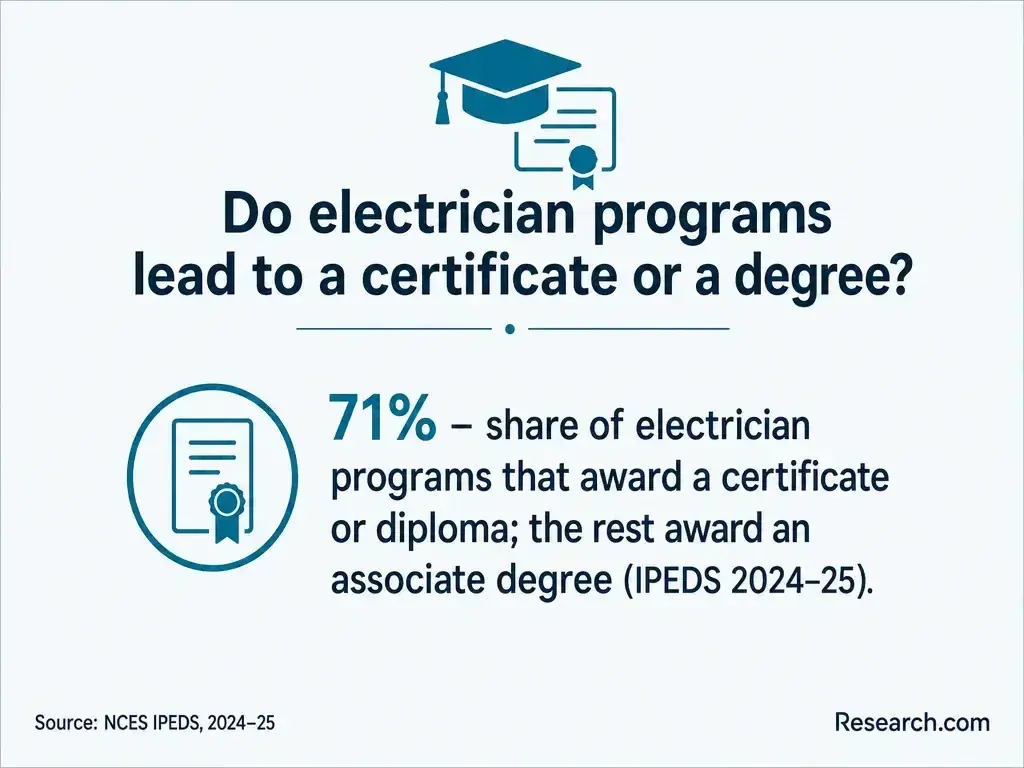
These pathways serve different goals. Confirm the specific credential and work-experience arrangement with each provider before treating options as interchangeable.
| Pathway | What it generally provides | Best fit and main limitation |
| Certificate or diploma | Focused classroom and shop instruction; a school-issued credential | Useful for building fundamentals before applying for electrical work; does not by itself establish licensing eligibility. |
| Associate degree in an electrical field | A broader academic program with technical coursework and, where offered, labs | May suit students who want wider technical preparation; check whether its added time and courses advance the intended electrical career. |
| Registered apprenticeship | Structured instruction plus paid, supervised work and an apprenticeship completion credential | Fits learners ready to earn while training; entry depends on sponsor openings and selection requirements. |
| Employer-sponsored entry route | Training and supervision arranged through an employer | Can reduce upfront school costs; verify what experience is documented and whether instruction meets the intended progression. |
West Virginia students may compare current offerings at providers such as Pierpont Community and Technical College, James Rumsey Technical Institute, Blue Ridge Community and Technical College, Carver Career Center, and Fred W Eberle Technical Center. Ask each provider what electrician training is currently offered, how much time is spent in a shop, and whether it has an active apprenticeship or employer connection. Do not assume that a school's general technical reputation verifies a particular program.
Where can I work with an electrician trade school training in West Virginia?
Electrical contractors are a common route into residential and commercial installation; industrial facilities, utilities, and maintenance employers offer different equipment and work schedules. The U.S. Bureau of Labor Statistics describes electricians as installing and maintaining power, lighting, communications, and control systems. In West Virginia, the distinction matters because an industrial maintenance opening and a construction apprenticeship may require different experience even when both involve electrical work.
Search for employers and apprenticeship sponsors within a realistic commuting radius, especially if shop classes and job sites are in different communities. Compare the actual duties before using a list of high paying trade school jobs to choose a pathway: wages associated with experienced or specialized workers do not describe a new entrant's offer.
The U.S. Bureau of Labor Statistics reports a May 2025 national median annual wage of $63,190 for electricians. This is the midpoint for employed electricians across experience levels nationwide, not a West Virginia salary or a likely apprentice wage. Use it as career context, then compare current local job postings or apprenticeship wage schedules for the places where you could work.
When weighing offers, distinguish the starting rate from wage increases tied to documented progress, licensing, overtime, travel, and benefits. A higher posted rate may be less attractive if reaching the job site requires substantial unpaid travel; conversely, paid training can improve the economics of a longer pathway.
A school certificate may take less time than an associate degree, but finishing classes is not necessarily the same as completing the supervised experience needed for independent electrical work. Apprenticeships commonly take several years because they combine technical instruction with progressive work experience; the U.S. Bureau of Labor Statistics describes electrician apprenticeships as typically lasting four or five years. Ask for each school's scheduled clock or credit hours and its documented hands-on hours rather than assuming every "electrician program" has a standard length.
A search for a 6 month associate online degree should not set your timeline for this trade. The relevant comparison is time until you have both the instruction and supervised work required for your intended role, including any wait for an apprenticeship opening.
Online delivery can be useful for theory, calculations, and some code study. It cannot, on its own, demonstrate safe tool use, conduit installation, testing, or troubleshooting on physical equipment. A hybrid program is worth considering if it clearly identifies where required shop sessions occur, how skills are assessed, and how students obtain supervised work.
Even a student accustomed to comparing best online universities needs a different checklist for electrician training: travel to labs and worksites is part of the commitment. Ask whether practical sessions are offered near home and whether missed sessions delay completion. Do not assume remote coursework satisfies West Virginia licensing or an apprenticeship sponsor's requirements; confirm directly with the West Virginia State Fire Marshal and the sponsor.
There is no single defensible statewide price for electrician training: tuition differs by provider, residency, program length, and whether training is school-based or paid through an employer. Published institution-wide tuition can also differ from the price of a particular electrical program. Request a current, itemized estimate rather than relying on an advertised tuition figure.
For a meaningful comparison, include mandatory fees, books or code materials, tools, meters, personal protective equipment, exam and license application fees when applicable, transportation to shops and job sites, and earnings forgone while attending classes. Subtract only aid you are actually eligible to receive. Federal student aid depends on the student, institution, and eligible program (Federal Student Aid); ask the provider about eligibility and the local workforce office about potential training assistance. Paid apprenticeship wages can offset costs, but compare the full training period - not just the first bill.
The award depends on the route: a school might issue a certificate, diploma, or associate degree; a registered apprenticeship has its own completion credential. An industry training credential, where offered, is another distinct item. None should be described as a West Virginia electrician license without confirmation from the West Virginia State Fire Marshal. Institutional accreditation concerns the school; apprenticeship registration concerns the training sponsor; occupational licensure concerns authority to perform regulated electrical work.
If you arrived through a broad search such as what's the easiest online degree to get, ask a narrower question here: what documented instruction and practical experience will this credential contribute toward your intended electrical role? Request the credential's exact name and a transcript or record of completed training.
Requirements vary by provider and route. A school may assess reading and math readiness or require safety-related documentation; an apprenticeship sponsor may also use an application, aptitude assessment, interview, and employer selection process. Obtain the current requirements from the specific provider or sponsor rather than assuming admission to a school guarantees an apprenticeship placement.
Before applying, ask whether you need to buy tools, meet minimum age or other job-site conditions, arrange transportation, or obtain the appropriate apprentice authorization before performing electrical work. If you have previous electrical training or documented work experience, ask whether the provider offers prior-learning credit or advanced standing - and separately whether the licensing authority or apprenticeship sponsor will recognize it.
Useful electrician training connects electrical calculations and circuit principles to reading plans, applying the electrical code, selecting materials, installing wiring and equipment, testing circuits, and diagnosing faults. Safety must be practiced rather than merely read about: students should use protective equipment and learn procedures for working around electrical hazards. The U.S. Bureau of Labor Statistics identifies technical knowledge, troubleshooting, and physical work as central to the occupation.
Ask to see the shop and a recent course outline. A program aimed at residential installation may not offer the same exposure to motor controls or industrial equipment as one designed for maintenance work. Compare its practical assessments with the duties in local openings you would actually accept.
West Virginia regulates electrician work through the State Fire Marshal. Its licensing framework distinguishes apprentice, journeyman, and master levels, with requirements that depend on the level sought (West Virginia State Fire Marshal). School completion alone does not confer a license. Before paying for training, confirm the current rules for the work you intend to perform, including apprentice status, documented experience, examination, and any applicable application requirements.
Ask the school or sponsor who verifies your supervised hours and retains the records. If you plan to work across state lines, check the destination state's rules separately; a West Virginia credential should not be assumed to transfer automatically. An optional industry certificate may demonstrate particular skills, but it does not replace a required occupational license.
Start with the job you want - construction electrician, industrial maintenance worker, or another electrical role - then work backward from its practical and licensing requirements. A ranking can narrow the field, but the best investment is the option whose training and documented experience match that goal at a manageable total cost.
Use the following checks when speaking with schools and apprenticeship sponsors; they expose differences a program title or tuition quote may hide.
- Ask for the exact credential, curriculum, scheduled hours, supervised shop hours, and any guaranteed versus merely possible work placement.
- Confirm institutional accreditation or school authorization separately from apprenticeship registration, industry recognition, and West Virginia licensing eligibility.
- Obtain an itemized cost and funding estimate; compare school time, expected debt, paid-training wages, travel, and lost earnings.
- Ask how many students complete the specific program and what evidence supports claimed employment outcomes; clarify the reporting period and population.
- Verify current licensing requirements with the West Virginia State Fire Marshal and ask who documents experience for your next step.
Be wary of guaranteed-license or guaranteed-salary claims, an online-only practical curriculum, or a provider that cannot explain where supervised experience comes from. Even a search for cheapest phd programs in usa illustrates why a low advertised price in an unrelated education category cannot answer this trade-specific investment question. For electrician training, assess completion probability, aid, debt, baseline and potential later earnings, time to qualification, and the value of earnings received sooner rather than treating institution type as a return-on-investment shortcut.
A common progression is supervised entry-level work, documented experience, and eligibility to seek a higher electrician license under current West Virginia rules. With suitable experience, electricians may move toward complex commercial work, industrial troubleshooting, crew leadership, or running a business. Each move can bring additional employer, licensing, or business requirements; an introductory school credential does not qualify someone for every stage (West Virginia State Fire Marshal; U.S. Bureau of Labor Statistics).
Choose early training for the environment you want to enter. Construction work builds installation experience, while industrial maintenance often emphasizes diagnosing equipment and controls. Ask local employers whether they prefer a particular apprenticeship, documented field experience, or specific technical skills before paying for extra coursework.
The U.S. Bureau of Labor Statistics projects 9.2% growth in U.S. electrician employment from 2025 to 2035. That national projection signals potential demand across the occupation, but it is not a West Virginia forecast or a guarantee of an opening near home. Construction activity, industrial employers, and the availability of apprenticeship positions can make local opportunities differ.
Before enrolling, check current openings and registered-apprenticeship sponsors within your commuting area, then ask providers where recent students found supervised work. If opportunities are sparse locally, the ability to travel to job sites or relocate may matter more than a small difference in tuition. Compare any state labor-market projection you find with the national figure only when its occupation and projection period are clearly identified.
Best Electrical Technician Training Programs & Trade Schools in West Virginia for 2027
Education is a substantial investment, so the Research.com team designed this ranking to help readers compare electrician programs with other options in the same occupation and location. Only programs with completions reported to IPEDS are eligible. That makes the ranking useful for comparing covered schools, but it does not mean an unlisted apprenticeship, employer program, or other training provider is unavailable or inferior.
Best-program scores consider student outcomes, earnings and return on investment, costs and debt, and quality and recognition. Programmatic accreditation or relevant industry recognition accounts for 20% of the score, institutional accreditation for 10%, and student support services for 10%. The remaining 60% covers completion and retention, earnings, tuition and attendance costs, debt, and loan default measures; an entropy-based method gives more weight to indicators that vary more across programs. Most-affordable rankings use only cost and debt measures, weighted through that method - not accreditation or other quality indicators. Readers can find further details on the Research.com methodology page.
The team uses the following sources to check program, institution, outcome, and occupation-related information. Some are relevant to other trades or healthcare occupations; their inclusion as ranking sources does not imply that a healthcare accreditor approves electrician training.
- IPEDS database - reported program completions and institutional measures.
- National Center for Education Statistics - federal education data and definitions.
- College Scorecard database - available cost, debt, and earnings measures.
- Peterson's database - supplementary institution and program information.
- Commission on Accreditation of Allied Health Education Programs (CAAHEP) - occupation-specific accreditation information where applicable.
- Accrediting Bureau of Health Education Schools (ABHES) - occupation-specific accreditation information where applicable.
- Commission on Dental Accreditation (CODA) - occupation-specific accreditation information where applicable.
- Dental Assisting National Board (DANB) - occupation-specific credential information where applicable.
- National Center for Construction Education and Research (NCCER) - construction-training credentials and industry recognition.
- Apprenticeship.gov Partner Finder - registered-apprenticeship sponsor information.
Use the ranking as a shortlist, then confirm each current program's electrical labs, work-placement arrangements, total price, and relationship to West Virginia licensing. College-oriented datasets do not capture every viable route into the trade.

# 2 position
James Rumsey Technical Institute - Electrician.
certificate or diploma
# 4 position
Carver Career Center - Electrical and Power Transmission Installation/Installer, General.
certificate or diploma# 5 position
Fred W Eberle Technical Center - Electrician.
certificate or diploma
# 6 position
Fayette Institute of Technology - Electrician.
certificate or diploma# 7 position
Mercer County Technical Education Center - Electrician.
certificate or diploma
# 8 position
Cabell County Career Technology Center - Electrician.
certificate or diploma
Frequently asked questions about electrician programs in West Virginia
Is trade school required to become an electrician in West Virginia?
Do not assume it is the only route. A registered apprenticeship or appropriately supervised employer training may be an alternative. Check the West Virginia State Fire Marshal's current requirements for your intended license and ask how each route documents experience.
Does an electrician certificate let me work independently?
No. A school certificate documents training, not independent-work authority. Licensing and supervised-experience requirements are separate (West Virginia State Fire Marshal).
Can I complete electrician training entirely online?
Online theory may supplement training, but installation, testing, safety practice, and supervised electrical work require in-person participation. Confirm where a hybrid program provides those components.
Is a paid apprenticeship better than trade school?
It may be if you can secure a position and want wages during training. School may help you develop fundamentals first or access employers, but compare its cost, practical hours, and placement support rather than assuming either route is always better.
What should I ask about before paying a deposit?
Request the complete cost, exact credential, shop hours, work-placement terms, and written explanation of how the training relates to West Virginia licensing. Verify licensing details with the State Fire Marshal, not solely with admissions staff.
- U.S. Bureau of Labor Statistics - Electricians
Used to verify salary, employment outlook, and typical education requirements.
https://www.bls.gov/ooh/construction-and-extraction/electricians.htm - Apprenticeship.gov - Partner Finder
Used to verify programmatic accreditation or industry recognition of programs.
https://www.apprenticeship.gov/partner-finder - O*NET OnLine - Electricians
Used to verify common responsibilities, skills, work settings, and education expectations.
https://www.onetonline.org/link/summary/47-2111.00 - Pierpont Community and Technical College - official website
Official school website (programs, tuition, admissions).
https://www.pierpont.edu/ - James Rumsey Technical Institute - official website
Official school website (programs, tuition, admissions).
https://www.jamesrumsey.com/ - Blue Ridge Community and Technical College - official website
Official school website (programs, tuition, admissions).
https://www.blueridgectc.edu/ - Carver Career Center - official website
Official school website (programs, tuition, admissions).
https://www.carvercareercenter.edu/ - Fred W Eberle Technical Center - official website
Official school website (programs, tuition, admissions).
https://fetc.edu/