# 1 position


Audited and Verified:
Our Editorial and Data Verification Process
Research.com uses government datasets, official education statistics and primary institutional information to support its career and degree guides. Our review process checks factual accuracy, occupational definitions, source dates and the requirements associated with the credentials discussed.
How This Article Was Fact-Checked
Our editorial team verifies salary estimates, employment projections, education requirements and program information against original data providers and official organizations. Salary figures are checked against the relevant occupational definitions and reporting periods. Information about licensure, accreditation and required in-person training is reviewed separately.
Fact-checked and verified on:

Co-Founder and Chief Data Scientist

Reviewed by Karolina Broda
Fact-Checker and Data Verification
Choosing electrician training in Bowling Green means comparing more than tuition: a short certificate, a paid apprenticeship, and a longer college program can lead to different costs and amounts of supervised experience. The U.S. Bureau of Labor Statistics projects 9.2% national growth in electrician employment from 2025 to 2035. This guide explains Kentucky licensing, practical training, wages, and total costs. It accompanies the Most Affordable Electrician Trade Schools in Bowling Green for 2027 ranking, created by the Research.com team of data scientists to help students identify programs worth considering.
Expect a combination of electrical theory, safety instruction, and practice installing, testing, or troubleshooting circuits. Before paying, distinguish school-based training from a registered apprenticeship: the former awards an educational credential; the latter combines structured instruction with paid, supervised work and records progress toward an occupational credential (U.S. Department of Labor, Apprenticeship.gov).
Southcentral Kentucky Community and Technical College is a local public-college option to investigate. Ask which electrical credentials are currently offered, at which site, and whether the schedule accommodates work. Also compare registered apprenticeships and employer-sponsored training serving the area. A short program can be useful preparation for an entry-level job, but its classroom and lab time should not be mistaken for the full work experience needed for independent electrical practice.
Potential workplaces include electrical contractors' residential and commercial jobsites, industrial facilities, and building-maintenance operations. The distinction affects training choice: contractor work calls for installation, plan-reading, and changing jobsites, while industrial work may place greater emphasis on motors, controls, and troubleshooting. Electricians work across construction, manufacturing, and other industries, according to the U.S. Bureau of Labor Statistics.
Ask local employers and apprenticeship sponsors whether they hire trainees, what they expect a new hire to do safely, and whether they provide documented supervision. A program's employer contacts are more useful than a broad promise of "job placement" if your aim is to accumulate qualifying electrical experience in or around Bowling Green.
A reliable Bowling Green-specific electrician wage should come from a clearly identified local occupational dataset, not from a school's advertised graduate earnings. As a national benchmark, electricians had a $63,190 median annual wage in May 2025 (U.S. Bureau of Labor Statistics, Occupational Outlook Handbook). This is the midpoint for employed electricians across experience levels nationwide - not expected apprentice pay or a forecast of what a local graduate will earn.
When comparing offers, request the starting hourly rate, scheduled raises, benefits, overtime expectations, and travel requirements. Those details matter especially when a paid apprenticeship is the alternative to paying for full-time school: earnings while learning can substantially change the investment calculation, even if initial wages are below those of experienced electricians.
There is no single electrician-training timeline. A short certificate may prepare someone for a helper or apprentice application; a diploma or associate-level electrical program generally takes longer and may offer broader technical coursework. A registered apprenticeship spans multiple years because it combines related instruction with substantial, supervised on-the-job learning (U.S. Department of Labor, Apprenticeship.gov). Completion of a school program and qualification for a Kentucky license are separate milestones.
Request the program's actual calendar length, required classroom and lab hours, and part-time schedule. Then ask Kentucky's licensing authority whether - and under what conditions - its coursework counts toward an applicable licensing route. Do not assume a similarly named credential elsewhere has the same hours or that an accelerated academic schedule accelerates required work experience.
Online instruction can suit electrical theory, calculations, and code-study assignments. It cannot, by itself, demonstrate safe tool use, wiring, testing, or troubleshooting on equipment. Campus labs provide supervised practice; apprenticeships add supervised work on actual jobsites. A hybrid program is worth considering only if its required practical sessions are accessible from Bowling Green and its schedule fits your job.
Listings of best and affordable online colleges can help with general cost research, but they do not establish that an electrician program supplies hands-on training or meets Kentucky licensing rules. Ask who supervises practical work, where it occurs, and how performance is assessed before choosing a remote option.
A defensible Bowling Green average requires current, comparable prices for the same credential and attendance period; there is no single verified figure that covers college programs, private training, and paid apprenticeships. Instead, compare each option's total cost to become job-ready. The categories below prevent a low advertised tuition from obscuring necessary expenses.
| Cost or offset | What to verify |
| School charges | Tuition by residency status, mandatory fees, and charges for repeated courses. |
| Practical training | Tools, meter, safety gear, materials, books, and required software. |
| Career entry | Examination or application fees when applicable, plus travel to labs and worksites. |
| Offsets and time | Grants, eligible aid, employer-paid costs, apprentice wages, and earnings forgone while studying. |
Ask Southcentral Kentucky Community and Technical College for a current, credential-specific cost sheet and aid eligibility; ask apprenticeship sponsors what trainees purchase and what they earn. Kentucky Career Center staff can advise on eligibility for workforce-training assistance, while Federal Student Aid can clarify federal-aid rules. A cheapest online college for associate's degree comparison is not a substitute for pricing the required electrical labs and work experience.
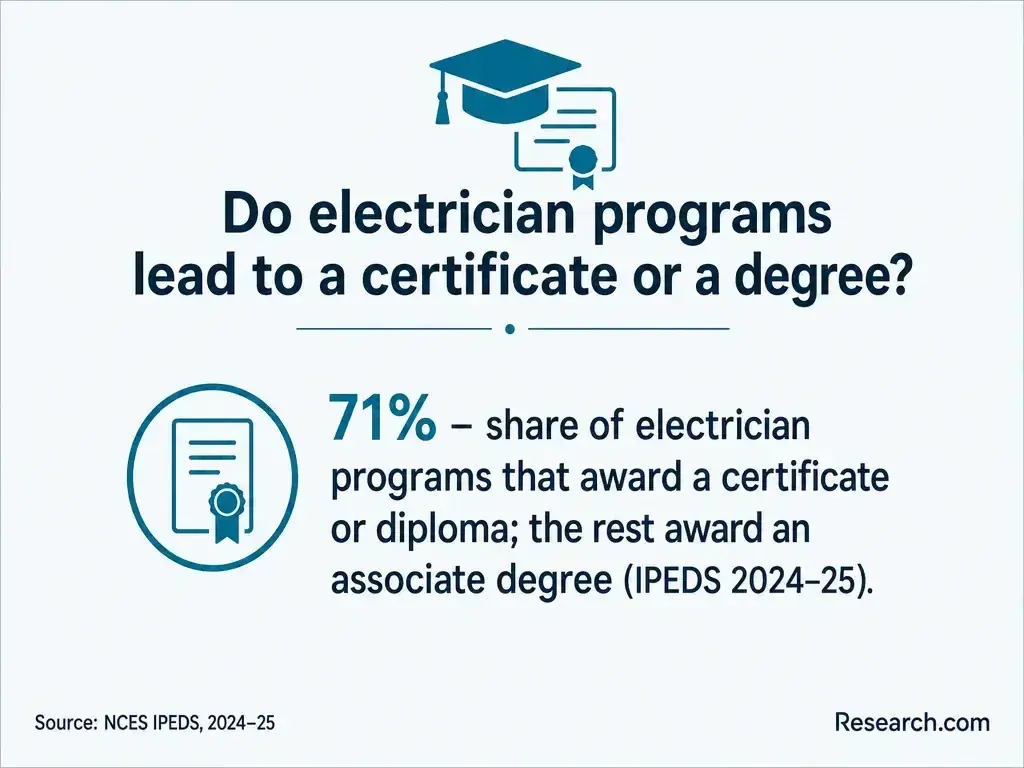
The answer depends on the pathway. A college may award a certificate, diploma, or electrical-technology associate degree; a registered apprenticeship documents completion of its approved work-and-instruction program. Employer training may provide a company-recognized record without an academic credential. None is automatically a Kentucky journeyman or master electrician license.
If you want to build toward a longer college credential, ask whether certificate courses stack into a diploma or associate program and whether prior electrical coursework or documented apprenticeship learning receives credit. Treat claims about transfer or advanced standing as institution-specific until you receive a written evaluation. Broad listings of top associate degrees in 6 months online do not establish the duration or practical requirements of an electrical credential.
Requirements differ between a college program, a private training provider, and an apprenticeship sponsor. Check each provider's current application for education prerequisites, placement or math assessment, age and work-eligibility rules, and any employer-required screening. An apprenticeship may also require an interview or aptitude assessment and access to jobsites; admission to a classroom program does not secure an apprenticeship position.
Before applying, ask whether you need a driver's license or reliable transport to reach rotating worksites. That can be a more consequential entry barrier than classroom admission for someone who can attend training in Bowling Green but cannot travel to supervised work.
Relevant instruction includes electrical safety, circuits, measurements, blueprint reading, electrical-code use, installation methods, and testing. More advanced coursework may address motors or controls. The U.S. Bureau of Labor Statistics describes electricians as installing, maintaining, and repairing electrical power, communications, lighting, and control systems; a program's curriculum should match the part of that work you intend to enter.
Compare what students actually perform, not just course titles. Ask to see the lab tasks, equipment, supervision arrangements, and assessment methods. For an industrial goal, meaningful troubleshooting practice may matter more than an extra general survey course; for construction entry, safe installation and plan interpretation may be more immediately useful.
Kentucky regulates electrical licensing through its Department of Housing, Buildings and Construction, including journeyman, master, and electrical-contractor licensing. The applicable license depends on the work and level of responsibility. The state's routes involve documented qualifications and examinations; finishing a training program alone does not confer a license (Kentucky Department of Housing, Buildings and Construction).
Before enrolling, confirm the current journeyman eligibility rules directly with the department and ask the provider how it documents classroom instruction and supervised electrical experience. Institutional accreditation concerns the school; state school authorization concerns permission to operate; apprenticeship registration concerns a structured training program; and an optional industry credential, such as one associated with NCCER, is not state occupational licensure. None should be presented as a substitute for another (U.S. Department of Education; U.S. Department of Labor; Kentucky Department of Housing, Buildings and Construction).
Start with the job you want, then compare school and apprenticeship routes against that goal. The cheapest listed program is not necessarily the best investment if it lacks accessible practical training or leaves you unable to secure qualifying supervised work. Conversely, a longer credential may cost more time than you need if an employer will train and pay you while you learn.
Use these questions with each provider so that price, training, and Kentucky eligibility can be checked together:
For a return-on-investment comparison, consider completion likelihood, debt, earnings you would otherwise receive, expected pay after training, and the time needed to qualify for the work you want. Treat unverifiable placement guarantees, an "entirely online" practical-training claim, or a promise that graduation automatically grants licensure as red flags.
An initial pathway may lead to electrical helper or apprentice work under supervision. With qualifying experience and the appropriate Kentucky license, electricians may progress toward more independent installation and troubleshooting work; further experience can support master-level or contracting goals, subject to separate state requirements (Kentucky Department of Housing, Buildings and Construction). Industrial maintenance and controls-focused work are other possibilities when training and employer expectations align.
Choose a program for the next attainable step, not its most senior advertised career. A construction-focused apprenticeship may fit someone seeking paid field experience, while a program with strong motors and controls labs may better fit someone targeting industrial work. Ask employers which competencies they expect at entry and which they teach after hiring.
The U.S. Bureau of Labor Statistics projects 9.2% growth in electrician employment nationally from 2025 to 2035. That supports investigating the trade, but it is not a Bowling Green hiring forecast or a guarantee of an apprenticeship opening. Local demand can differ by contractor workload, industrial hiring, and the availability of supervisors willing to train new workers.
Check current openings and apprenticeship intake schedules before committing to tuition. In each listing, distinguish genuine trainee roles from positions requiring a Kentucky license or prior experience. That simple check connects the national outlook to the local question that matters most: whether your chosen training will help you qualify for jobs you can apply for when you finish.
Investing in electrician training is an important decision, so Research.com designed this ranking to compare programs against other programs in the same occupation and location. Only programs with completions reported to IPEDS are eligible. That boundary matters: a registered apprenticeship or employer training program may be a strong local option even if it does not appear in a college-oriented ranking.
The most affordable ranking scores tuition, cost of attendance, median student debt, and federal loan default rate. Indicator weights are assigned using an entropy-based method, which gives more weight to measures that vary more across eligible programs. Accreditation, support services, and other quality measures are not part of this affordability score. Readers should assess those separately before enrolling.
Research.com consulted the following data sources in developing its trade-program ranking framework. The occupation-specific relevance of each source differs; health-profession accreditors and certifiers, for example, are not electrician-program approvals.
The ranking can narrow a cost comparison, but it cannot establish that a program meets a particular student's licensing goals or has an available apprenticeship place. Research.com provides further detail about its approach on its methodology page.
# 1 position
# 2 position
Not necessarily. A registered apprenticeship or qualifying supervised work and instruction may provide another route. Check current licensing eligibility with the Kentucky Department of Housing, Buildings and Construction before choosing a pathway.
It can be because apprentices earn wages while training. Compare take-home pay and employer-paid costs against school tuition, tools, travel, aid, and time out of the workforce.
Online coursework may cover theory, but wiring, testing, and supervised jobsite skills require in-person practice. Verify how a program provides and documents that experience.
No. A school certificate and a state license are different credentials. Confirm the applicable experience, documentation, and examination requirements with Kentucky's licensing authority.
Request a full cost sheet, lab and work-hour breakdown, credential name, apprenticeship or employer-placement terms, and a written explanation of how the training relates to Kentucky licensing requirements.