# 1 position


Audited and Verified:
Our Editorial and Data Verification Process
Research.com uses government datasets, official education statistics and primary institutional information to support its career and degree guides. Our review process checks factual accuracy, occupational definitions, source dates and the requirements associated with the credentials discussed.
How This Article Was Fact-Checked
Our editorial team verifies salary estimates, employment projections, education requirements and program information against original data providers and official organizations. Salary figures are checked against the relevant occupational definitions and reporting periods. Information about licensure, accreditation and required in-person training is reviewed separately.
Fact-checked and verified on:

Co-Founder and Chief Data Scientist

Reviewed by Karolina Broda
Fact-Checker and Data Verification
Choosing electrician training in Fulton, Mississippi, means deciding whether a school program, a paid apprenticeship, or both will get you the skills and experience employers expect. The U.S. Bureau of Labor Statistics projects 9.2% national growth in electrician employment from 2025 to 2035, making the choice timely - but growth does not guarantee a local job. The Research.com team of data scientists created the Best Electrician Trade Schools in Fulton for 2027 ranking to help students identify programs worth considering. This guide explains how to compare their cost, practical training, credentials, and career-entry value.
Expect instruction in electrical theory, wiring methods, the National Electrical Code, blueprint reading, testing, and jobsite safety, followed by practice with tools and circuits. The decisive question is how much supervised work you will perform - not simply whether a brochure says "hands-on." Ask to see the current lab schedule, equipment, and any documented employer placement arrangement.
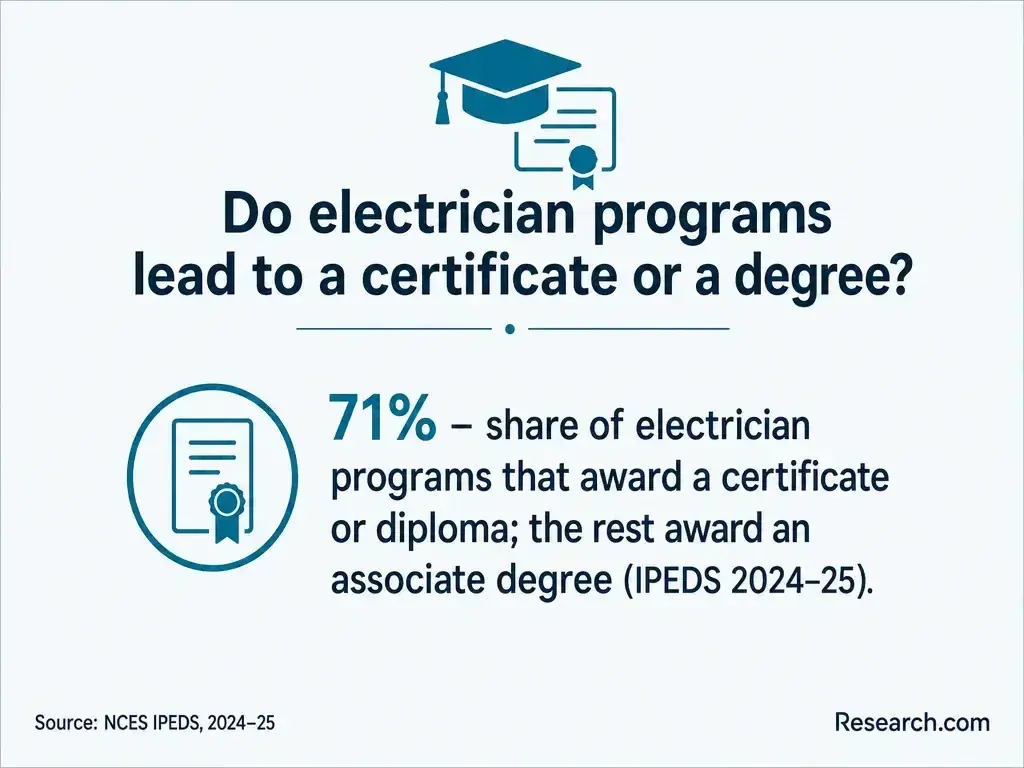
Fulton applicants can investigate Itawamba Community College's current electrical-training offerings and confirm the teaching location, credential, schedule, and availability for their intended start term. A college certificate or diploma can prepare someone to seek entry-level work; an associate degree adds broader coursework. A registered apprenticeship instead combines paid work with related instruction and a structured route to increasing responsibility (U.S. Department of Labor). School training may help an applicant compete for an apprenticeship, but credit toward its required experience depends on the sponsor's rules.
Electrical contractors, building-maintenance teams, industrial facilities, and utilities employ people with electrical skills, although job titles and entry requirements differ (U.S. Bureau of Labor Statistics). In Fulton, compare openings across the surrounding northeast Mississippi labor market rather than assuming every suitable position will be in town. A job that requires a longer commute or rotating industrial shifts may change whether a low-cost training option is practical.
Construction work can offer exposure to installations across multiple sites; industrial maintenance may emphasize motors, controls, and troubleshooting. Ask employers whether they hire trainees, provide supervised hours, sponsor apprenticeships, and require a particular credential. Training in electrical technology does not, by itself, qualify someone for every utility or industrial role.
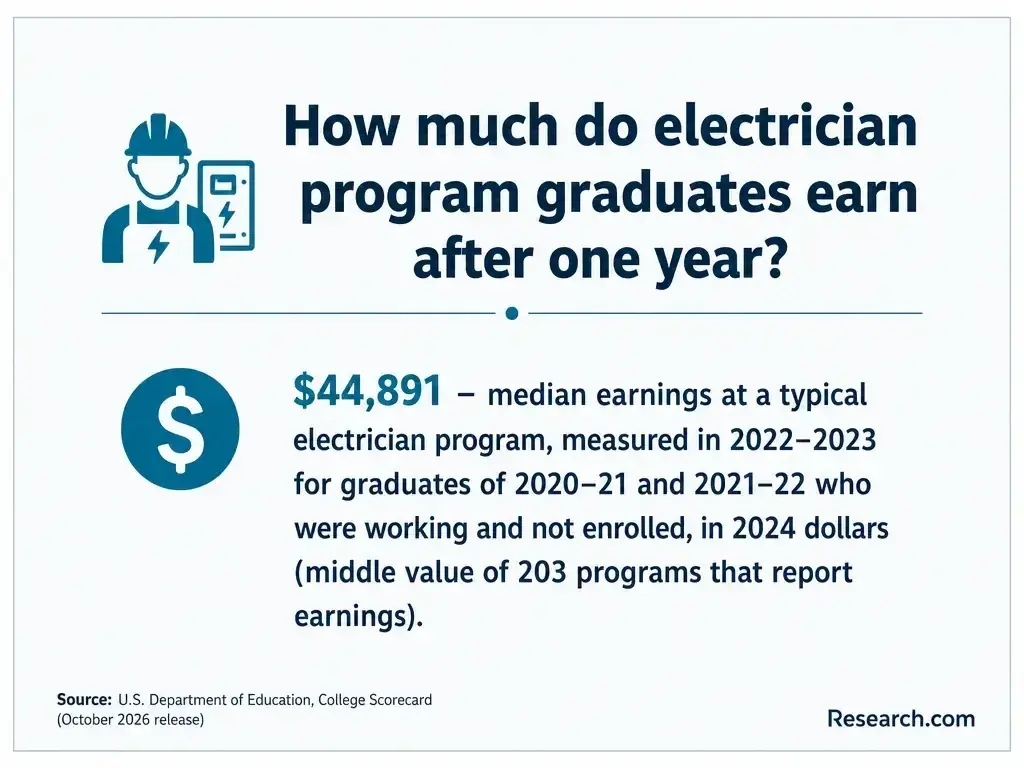
The U.S. median annual wage for electricians was $63,190 in May 2025 (U.S. Bureau of Labor Statistics). That national figure covers workers at different experience levels and is not a verified wage for Fulton, Mississippi, or a newly trained electrician. Before borrowing for school, compare actual trainee offers from employers within commuting distance, including paid hours, overtime policies, benefits, and wage increases tied to demonstrated skills.
Pay also depends on the work: construction schedules can vary by project, while maintenance jobs may involve shifts or on-call duties. Use a written local offer or an apprenticeship sponsor's published wage progression for budgeting, not the national median as a promised first-year income.
Program length depends on the credential and schedule. A short certificate emphasizes entry skills; a longer diploma or associate degree may provide more lab time and related coursework. Ask Itawamba Community College for the current catalog's required credits, lab hours, and full-time and part-time completion schedules rather than assuming a particular finishing date.
A registered electrician apprenticeship typically lasts four or five years and pairs on-the-job training with classroom instruction (U.S. Bureau of Labor Statistics). It is a different timeline from finishing school: a graduate may still need substantial supervised experience to reach an employer's or locality's requirements. Claims about an associate degree in 6 months accredited should not be used to estimate the time needed to develop electrician field competence.
Online instruction can be useful for electrical theory, calculations, code study, and scheduling flexibility. It cannot replace supervised wiring, safe tool use, testing, and troubleshooting on real equipment. A hybrid option is worthwhile only if its in-person labs or employer worksites are accessible from Fulton and its practical assessments match the work you want to do.
Ask where, when, and by whom practical skills are assessed before paying an online provider. Even if you are comparing top-ranked accredited online schools no fee to apply, an application-fee waiver and institutional accreditation do not establish that an electrician program supplies adequate hands-on training or meets a local employer's requirements.
There is no reliable Fulton-wide average covering school programs, employer training, and paid apprenticeships. Request a current, itemized quote for each option instead. The comparison below shows which costs can change what appears to be the cheapest route.
| Cost or offset | What to verify before committing |
| Tuition and mandatory fees | Total for the credential; residency rules and payment deadlines. |
| Tools, PPE, and materials | Required purchases, whether they are included, and whether tools remain yours. |
| Travel and lost earnings | Trips to labs or worksites and work hours forgone while studying. |
| Testing and applications | Any relevant credential, examination, or local licensing charges. |
| Aid and paid work | Confirmed grants, eligible federal aid, employer contributions, or apprentice wages. |
Federal aid depends on the institution, program, and student's eligibility; an apprenticeship may pay wages but still involve tool and travel costs (Federal Student Aid; U.S. Department of Labor). For a fair return-on-investment comparison, consider completion likelihood, borrowing, current earnings, expected post-training earnings, and how long it may take to recover costs. Do not choose solely by advertised tuition.
The award depends on the route: a school may offer a certificate, diploma, or associate degree; a registered apprenticeship leads to a completion credential issued through its registered program (U.S. Department of Labor). None is automatically the same as occupational licensure. Ask for the exact credential title and whether its coursework or documented work experience receives credit from any apprenticeship sponsor you hope to join.
An associate degree can make sense if its added coursework and cost serve your goals, but choosing what is an easy associate's degree to get is the wrong test for electrical training. Compare the required labs, technical content, and employer recognition instead.
School and apprenticeship entry rules are not identical. Confirm each provider's current education prerequisite, placement or math requirements, application dates, and any required safety equipment. Apprenticeship sponsors may also assess applicants for jobsite readiness and their ability to travel to worksites; requirements vary by sponsor (U.S. Department of Labor).
Before applying, ask whether prior electrical coursework, military training, or documented work experience can earn credit or advanced standing. Get any answer in writing: a school's transfer-credit decision does not bind an apprenticeship sponsor or licensing authority.
A useful curriculum connects electrical calculations and circuit principles to installation, testing, fault diagnosis, and safe work practices. Look for practice reading plans, using meters, selecting wiring methods, and applying the electrical code - not just watching demonstrations. Electricians also need to communicate hazards, follow instructions, and document work accurately (U.S. Bureau of Labor Statistics; O*NET).
Match the shop to the target job. Someone seeking industrial maintenance should ask about motors and controls; someone seeking construction work should ask about installation labs and supervised site exposure. A similarly named credential with fewer relevant practical exercises may be a poor substitute.
Do not assume a single statewide journeyman electrician license governs every job in Mississippi. Requirements can depend on the work, the locality, and whether someone is working for a contractor or seeking to operate a contracting business. Mississippi's State Board of Contractors regulates applicable contractor licensing; local authorities may impose their own electrical-work requirements (Mississippi State Board of Contractors). Confirm the rules for Fulton and for any other municipality where you expect to work before treating a school credential as an employment or licensing qualification.
Institutional accreditation evaluates a school; state authorization concerns its permission to operate; industry credentials document particular training; apprenticeship registration establishes a structured training program; and an occupational or contractor license is a separate legal authorization. None automatically substitutes for another. Ask the relevant authority which supervised experience, examinations, and applications apply to your intended role.
Start with the job you want, then compare a school credential with direct entry into a paid apprenticeship. A school program can suit someone who needs foundational lab practice or a structured class schedule. An apprenticeship can suit someone ready for supervised paid work and a longer training commitment. Neither is automatically the better investment.
Use these questions with admissions staff and apprenticeship coordinators; request specific, current answers rather than relying on a ranking alone.
Be cautious of guaranteed-job claims, unclear practical-hour totals, or suggestions that an online credential alone authorizes electrical work. Broad lists of top paying bachelor degrees address a different education decision; they cannot establish the value of a Fulton electrician program.
Entry-level helpers and trainees can progress through supervised work toward greater responsibility in construction installation, maintenance, or industrial electrical work. Later options may include specialized controls work, crew supervision, or contracting, subject to experience and applicable licensing rules (U.S. Bureau of Labor Statistics; Mississippi State Board of Contractors). A school credential is a starting point, not automatic advancement.
Electrical work combines focused troubleshooting with team communication and jobsite coordination. If you are weighing the best job for introverts, ask to observe the kind of electrical workplace you want: a maintenance role and a busy construction crew can have notably different daily interactions.
The U.S. Bureau of Labor Statistics projects 9.2% growth in electrician employment from 2025 to 2035. This national projection signals opportunity but does not measure openings in Fulton or guarantee placement after training. For a local decision, check current vacancies across northeast Mississippi, ask sponsors about apprentice intake, and compare job requirements with the labs and fieldwork each program actually provides.
Demand can differ across construction, maintenance, and industrial employers, and a willingness to commute may widen the available market. Treat the national outlook as context; use local hiring evidence to choose a specialization and training schedule.
Investing in training is a consequential decision, so the Research.com team designed the ranking to compare electrician programs with other programs serving the same occupation and location - not with unrelated schools nationwide. Only programs reporting completions to IPEDS qualify. That makes the ranking useful for comparing documented school options, but it does not capture every apprenticeship, union training center, or employer-sponsored route.
Best-program rankings consider student outcomes; earnings and return on investment; costs and debt; and quality and recognition. Program-relevant accreditation or industry recognition receives 20% of the score, institutional accreditation 10%, and student support services 10%. The remaining 60% covers outcomes, earnings, and costs, with weights distributed through an entropy-based method that gives more weight to indicators that vary more across programs. Separate most-affordable rankings use only tuition, attendance costs, debt, and federal loan default rates; they do not score accreditation or other quality indicators. Readers can use these measures to narrow a shortlist, then verify the electrician-specific training and local employment pathway themselves.
The team drew on the following databases and organizations to check program, institution, outcome, and occupation-relevant information. Some listed health-care organizations are cross-occupation methodology sources, not electrician accreditors or evidence that an electrical program has their approval.
For further detail on the ranking approach, see Research.com's methodology. A ranking is a starting point: confirm current program details, worksite access, and costs directly before enrolling.
# 1 position
# 2 position
Not necessarily. A paid apprenticeship or employer-supervised entry route may be available. Compare each route's instruction, work experience, and applicable local requirements before enrolling.
It depends on your goal. Apprenticeships combine wages, related instruction, and supervised work; a school program may help you build foundational skills before seeking a job or apprenticeship.
Online lessons can cover theory and code study, but electrical installation and testing require in-person practice. Verify where a hybrid program delivers and assesses those skills.
No. A school credential, apprenticeship completion, and any required local or contractor license are distinct. Check the requirements for the work and location you intend to pursue.
Confirm its current electrical offering, teaching location, lab hours, total cost, credential, schedule, and whether an apprenticeship sponsor will recognize any coursework.