# 1 position


Audited and Verified:
Our Editorial and Data Verification Process
Research.com uses government datasets, official education statistics and primary institutional information to support its career and degree guides. Our review process checks factual accuracy, occupational definitions, source dates and the requirements associated with the credentials discussed.
How This Article Was Fact-Checked
Our editorial team verifies salary estimates, employment projections, education requirements and program information against original data providers and official organizations. Salary figures are checked against the relevant occupational definitions and reporting periods. Information about licensure, accreditation and required in-person training is reviewed separately.
Fact-checked and verified on:

Co-Founder and Chief Data Scientist

Reviewed by Karolina Broda
Fact-Checker and Data Verification
Choosing electrician training in McAllen means comparing more than schools: you need a path to supervised work, Texas licensure, and a manageable total cost. The U.S. Bureau of Labor Statistics projects 9.2% national electrician employment growth from 2025 to 2035, but a classroom credential alone does not make someone a licensed electrician. This guide explains the local training routes, costs, wages, and requirements. It also accompanies the Best Electrician Trade Schools in Mcallen for 2027 ranking, created by the Research.com team of data scientists to help students identify programs worth considering.
Expect instruction in electrical safety, circuits, wiring methods, prints, and code, paired with supervised shop practice. A useful program lets you handle tools, make connections, troubleshoot faults, and receive feedback - not merely watch demonstrations. Confirm its actual lab hours, equipment, and opportunities to meet local contractors before committing.
Electrician training is a route toward employment, not a substitute for Texas work experience. A South Texas College offering may suit someone who wants structured preparation before seeking an apprentice position. A registered apprenticeship may suit someone ready to compete for a paid position and learn through scheduled classroom instruction and jobsite work. Program names do not establish that two options provide equivalent practical experience.
For this occupation, searching for what's the easiest degree misses the key comparison: whether training develops safe, demonstrable electrical skills and leads to qualifying supervised work.
Potential worksites include residential construction, commercial buildings, industrial facilities, and maintenance operations across the McAllen-Edinburg-Mission area. These settings emphasize different skills: residential crews may focus on service panels and branch circuits, while commercial projects may demand conduit work, larger drawings, and coordinated jobsite schedules (U.S. Bureau of Labor Statistics, Occupational Outlook Handbook).
Ask a prospective training provider which area employers take its students and whether those jobs provide qualifying supervised experience. An offer for general maintenance work is not automatically an electrician apprenticeship. The distinction matters more than a broad list of possible trade school jobs salary figures, because the job's duties and supervision determine how useful it is for your Texas licensing goal.
The U.S. Bureau of Labor Statistics reports a $63,190 national median annual wage for electricians in May 2025. A median covers experienced workers as well as newer ones; it is neither an apprentice starting wage nor a verified McAllen wage. Use current McAllen-Edinburg-Mission occupation data from the U.S. Bureau of Labor Statistics or Texas labor-market sources when available, then compare it with actual local apprentice offers.
For a useful pay comparison, ask whether an offer states hourly wages, raises as skills progress, expected hours, benefits, travel between jobsites, and who pays for tools. A higher advertised hourly rate can be less attractive if hours are inconsistent or commuting and equipment costs are substantial. Never calculate a school's return on investment from the national median alone.
School-program length depends on the credential, course load, and schedule. Ask for the current catalog's total contact hours and a term-by-term plan; "accelerated" is useful only if the schedule leaves enough time to practice. Part-time study can preserve income but may delay the point when you are ready to apply for electrical work.
Separate time to finish school from time to become a journeyman. Texas requires 8,000 hours of qualifying supervised work experience for journeyman licensure, followed by the required examination (TDLR). A school's clock hours should not be assumed to replace those work hours. A search for a master's program online 1 year describes a different kind of timeline; electrician advancement depends on documented field experience and licensing requirements.
Online coursework can help with electrical theory, calculations, code study, and scheduling around a job. In-person instruction is needed to assess tool use, wiring, testing, troubleshooting, and safe work habits. Neither online lessons nor a school lab alone replaces the supervised work required for Texas journeyman licensure (TDLR).
A hybrid option makes sense if its practical sessions are reachable and frequent enough to build proficiency. Before choosing one, obtain the exact lab schedule, location, equipment access, and assessment method. For a McAllen student, a nominally flexible program with distant mandatory labs may cost more in travel and missed shifts than a nearby campus option.
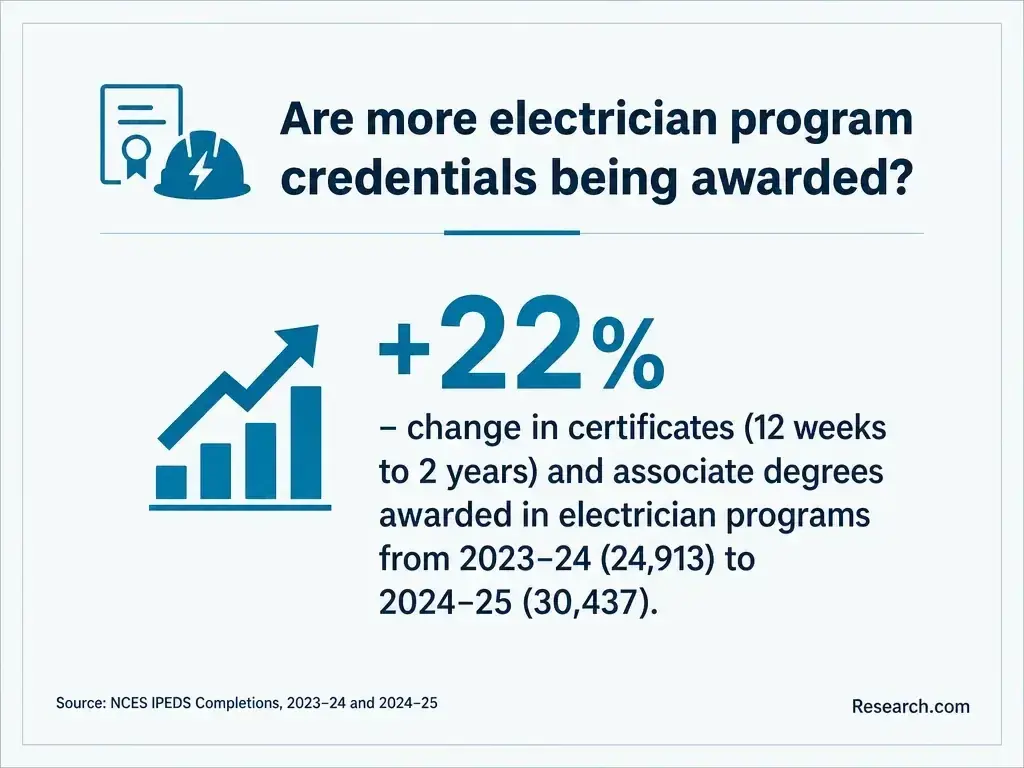
There is no reliable single "average" that covers local school credentials, private training, and paid apprenticeships on the same basis. Request a current, itemized quote from each school or sponsor. Compare the cost to become job-ready: tuition and required fees, books, tools, test instruments, PPE, supplies, transportation to labs or jobsites, and any applicable licensing or examination charges.
A registered apprenticeship may pay wages during training but still involve travel, equipment, or other expenses. A school option may have financial aid that lowers its net price. Check eligibility with the provider and Federal Student Aid rather than assuming every trade program qualifies; even lists of online schools accepting financial aid cannot establish that a specific electrician credential is aid-eligible.
To judge value, compare net cost and likely debt with program length, earnings you give up while attending, your chance of completing, and the time until you can start paid electrical work. Those factors can outweigh a small difference in advertised tuition.
A school may award a certificate or other occupational credential; a registered apprenticeship documents completion of its own structured training. Request the exact credential name and a curriculum showing shop hours and assessed competencies. An industry training credential, where offered, can signal skills to an employer but is not a Texas occupational license (TDLR; National Center for Construction Education and Research).
Texas apprentice registration permits work under the supervision required by TDLR; journeyman licensure is a later step with separate experience and examination requirements. An unrelated search such as phd program without dissertation does not help evaluate that progression: what matters is whether the credential supports entry into qualifying electrical work.
Requirements vary by provider. Check the current application for education prerequisites, placement testing, math readiness, age or identification rules, and any required supplies. Apprenticeship sponsors and employers may also assess work readiness, transportation, and the ability to follow jobsite safety rules; admission to a school does not guarantee an apprenticeship position.
Texas apprentice electrician registration is a separate TDLR process from school admission. Before accepting a job, confirm the registration requirements and the supervision arrangement with TDLR and the employer. If you have prior construction experience, ask the school about credit or advanced placement, but ask TDLR whether any experience qualifies toward a license rather than assuming a school waiver changes state requirements.
Core subjects typically include electrical theory and calculations, reading plans, identifying components, wiring and conduit methods, using meters, troubleshooting, and jobsite safety (U.S. Bureau of Labor Statistics, Occupational Outlook Handbook). Code instruction is important, but being able to locate a rule is different from installing and testing work safely under supervision.
Compare how programs assess practical work: Are students required to build and test circuits individually? Do instructors correct faults and unsafe technique? Is there exposure to the residential, commercial, or industrial tasks you intend to pursue? Ask to see a skills checklist and current lab schedule. A short program with little hands-on practice may be a poor match for someone who has never used electrical tools.
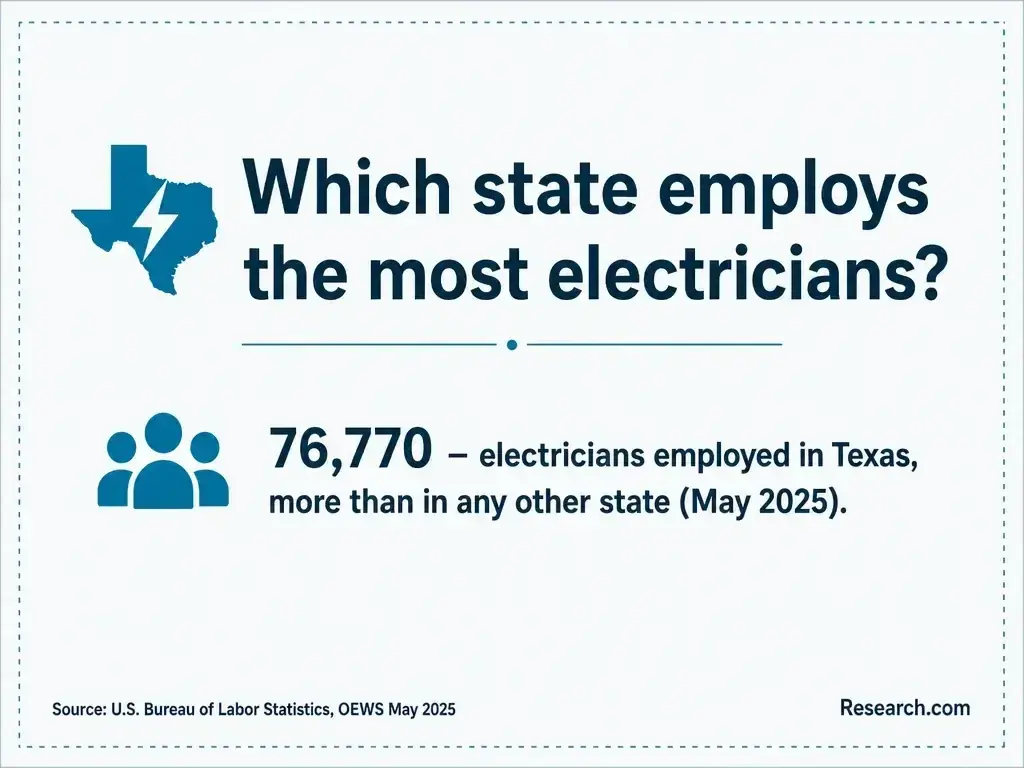
Yes, plan around Texas licensing. TDLR regulates electrician work and provides an apprentice registration route for supervised entry. Journeyman licensure requires 8,000 hours of qualifying supervised experience and passing the required examination; other license classes have different scopes and requirements (TDLR). Do not treat a school completion certificate, industry credential, or apprenticeship registration as interchangeable with a journeyman license.
Institutional accreditation concerns the school; state school authorization concerns permission to operate; apprenticeship registration concerns a training arrangement; and TDLR licensure concerns legal authority to perform regulated work. Verify each claim with the relevant organization. Before enrolling, ask how work hours are documented, who supervises apprentices, and whether the intended job falls within the license category you are pursuing. Confirm current rules directly with TDLR because requirements can change.
Start with the work you want: residential installation, commercial construction, or maintenance. Then compare a school program with direct apprentice entry and registered apprenticeship openings on the same basis. A ranking can identify programs to investigate, but IPEDS-based rankings do not capture every paid training opportunity.
Use these questions with each provider or sponsor; request written answers where costs or experience claims affect your decision.
Be wary of promised licensure upon graduation, guaranteed wages, unexplained placement figures, or pressure to enroll before receiving a cost breakdown. If you can secure suitable paid training now, compare the value of starting work immediately with any additional skills and employer connections a school program would provide.
An entry path is supervised apprentice work. With documented experience and the required examination, a worker may pursue Texas journeyman licensure; further experience and state requirements apply to advanced license categories (TDLR). Depending on an employer's work, electricians can develop expertise in residential service, commercial installations, controls, or industrial maintenance.
Match the first job to the intended path. A commercial-construction apprentice may gain different practice from a residential service apprentice, even if both aim toward broader electrical competence. Supervisory work or operating an electrical business brings additional responsibilities and applicable Texas licensing rules; completing an entry-level school credential alone does not authorize either.
National electrician employment is projected to grow 9.2% from 2025 to 2035 (U.S. Bureau of Labor Statistics, Employment Projections). That supports investigating the trade, but it is not a McAllen job forecast or a guarantee of an opening after school. Local demand depends on projects, maintenance hiring, and contractors' capacity to supervise new apprentices.
For a practical local check, compare recent McAllen-area apprentice postings with the schedules and skills taught by a program, and ask sponsors about their next intake. If openings require travel across the Rio Grande Valley, include commuting in your cost and availability assessment. Consider training that develops adaptable troubleshooting and safety skills alongside any specialized equipment instruction.
Education is a consequential investment, so Research.com designed this ranking to help readers compare electrician programs with other programs serving the same occupation and location - not with unrelated trades. The team checks multiple education, outcomes, recognition, and apprenticeship sources to support the ranking's quality and credibility. Only programs reporting completions to IPEDS are eligible; an apprenticeship or employer training route absent from that database may still be a strong option.
Best-program scores cover student outcomes; earnings and return on investment; costs and debt; and quality and recognition. Occupation-relevant programmatic accreditation or industry recognition accounts for 20%, institutional accreditation for 10%, and student support services for 10%. The remaining 60% covers outcomes, earnings, and costs, with entropy-based weighting that gives more weight to indicators that distinguish programs. Most-affordable rankings instead score tuition, attendance cost, median debt, and federal loan default rate using entropy-based weights; accreditation and other quality measures are not part of that affordability score.
The following sources inform the ranking. Some cover colleges broadly, while others help assess occupation-specific recognition or training alternatives; none should be mistaken for proof of Texas licensing eligibility.
This approach helps narrow a school comparison, not settle the entire career decision. Check current program details and Texas Department of Licensing and Regulation (TDLR) rules before enrolling. More information about the ranking approach appears on Research.com's methodology page.
# 1 position
# 2 position
Yes. Texas apprentice registration and qualifying supervised work provide an entry route; a registered apprenticeship can combine paid work with instruction (TDLR; U.S. Department of Labor). School can help build skills and contacts, but it is not the only route.
No. Texas licensing has separate requirements. For journeyman licensure, TDLR requires qualifying supervised experience and an examination; a school certificate does not replace them.
Online lessons can cover theory, but practical electrical skills need in-person assessment, and Texas journeyman licensure requires supervised work experience (TDLR). Confirm where a hybrid program's labs take place.
It depends on whether you can obtain an appropriate paid position, how much practical preparation you need, each route's net cost, and its connection to qualifying work. Compare actual offers and schedules rather than credential names alone.
Get the full cost and lab schedule in writing, confirm the credential awarded, ask about employer connections, and check current apprentice and licensing rules with TDLR. Do not rely on a promised starting wage.