# 1 position


Audited and Verified:
Our Editorial and Data Verification Process
Research.com uses government datasets, official education statistics and primary institutional information to support its career and degree guides. Our review process checks factual accuracy, occupational definitions, source dates and the requirements associated with the credentials discussed.
How This Article Was Fact-Checked
Our editorial team verifies salary estimates, employment projections, education requirements and program information against original data providers and official organizations. Salary figures are checked against the relevant occupational definitions and reporting periods. Information about licensure, accreditation and required in-person training is reviewed separately.
Fact-checked and verified on:

Co-Founder and Chief Data Scientist

Reviewed by Karolina Broda
Fact-Checker and Data Verification
Choosing an affordable electrician program in Marion, North Carolina, means looking beyond tuition: a low-cost course may not provide the hands-on experience or work pathway you need. The U.S. Bureau of Labor Statistics projects electrician employment to grow 9.2% nationally from 2025 to 2035, making training choices timely. This guide compares costs, credentials, apprenticeships, and North Carolina rules. It accompanies the Most Affordable Electrician Trade Schools in Marion for 2027 ranking, created by the Research.com team of data scientists to help students make an informed choice about programs worth considering.
An electrician trade-school program typically combines electrical theory with shop practice: reading plans, installing circuits, using test instruments, and following safety procedures. It can prepare you to seek entry-level work, but employers and apprenticeship sponsors may still require substantial supervised work-based training. The decisive question is what practical experience and next step the credential actually provides.
These pathways differ in when you earn wages and how you gain field experience; similarly named credentials do not make their training equivalent.
| Pathway | What you receive | Best fit and limitation |
| Short certificate or pre-apprenticeship | Foundational instruction and, where offered, lab practice | Useful before applying for helper work; verify whether an apprenticeship sponsor recognizes it. |
| Diploma or associate-degree program | Broader technical coursework and a school credential | May suit students seeking more theory; additional study does not itself replace field experience. |
| Registered apprenticeship | Paid supervised work plus related instruction | Direct work-and-learn route; openings, entry criteria, and schedules depend on the sponsor. |
| Employer-sponsored entry | Paid helper work and employer-directed training | Can reduce up-front school costs; ask how instruction and advancement are documented. |
For a Marion applicant, proximity matters: an affordable classroom option is less useful if required labs or worksites create an impractical commute. Ask McDowell Technical Community College and any apprenticeship sponsor for their current electrician-training offerings, lab schedule, placement arrangements, and published costs rather than assuming every pathway is offered each term.
Electricians work for electrical contractors and employers maintaining buildings, industrial equipment, or facilities, according to the U.S. Bureau of Labor Statistics. Training in residential wiring points toward different daily work than training focused on motors, controls, or industrial maintenance. Around Marion, ask prospective employers whether openings are primarily installation, service, or maintenance roles before choosing electives or specialized equipment training.
Some jobs require travel between worksites, early starts, or work at heights. If commuting is a constraint, compare the location of both classes and supervised work: a nearby classroom does not guarantee a nearby apprenticeship assignment.
The U.S. Bureau of Labor Statistics reports a $63,190 national median annual wage for electricians in May 2025. That figure covers experienced workers as well as newer ones and should not be used as an apprentice-pay quote or a Marion wage estimate. Request the actual starting pay, wage progression, and expected hours from local employers or apprenticeship sponsors when evaluating whether training costs are manageable.
Return on investment also depends on what you would otherwise earn, whether training is paid, your chance of completing it, debt and interest, and how long you expect to work after training. A higher-priced program is not automatically poor value; a shorter low-cost course is not automatically good value if it leaves you unable to secure supervised work.
A school certificate may take substantially less time than an apprenticeship, but it usually represents a different milestone: preparation for entry-level work rather than completion of supervised occupational training. Program calendars vary, so obtain the current catalog's required clock or credit hours, lab hours, full- and part-time schedules, and expected completion date. Ask an apprenticeship sponsor separately about its related-instruction and on-the-job requirements; do not assume school hours transfer.
Some readers comparing high paying 6 month certificate programs may prefer a short electrical certificate. Choose it only if its skills and employer connections suit your intended entry job - not because a short completion date implies readiness for independent electrical work.
Online instruction can cover topics such as electrical theory, calculations, code concepts, and plan reading. It cannot by itself demonstrate safe installation, testing, troubleshooting, or performance on a live worksite. An on-campus or hybrid option is stronger when it provides accessible labs and a clear route to supervised fieldwork; an online course can be useful preparation when you already have an employer arranging practical training.
Searches for the easiest degree to get online answer a different question from electrician career entry. Before paying for remote coursework, ask where practical assessments occur, who evaluates them, and whether local employers or apprenticeship sponsors recognize the training. Do not assume an online credential satisfies North Carolina contracting requirements.
There is no reliable single average price for an electrician pathway in Marion: tuition-based school programs and paid apprenticeships have different cost structures, and a 2027 price must come from a current provider quote. Compare the total cost to become job-ready, not just an advertised tuition figure. Include mandatory fees, books, tools, meters, personal protective equipment, materials, transportation to labs and worksites, and any relevant application or examination fees. Also account for earnings forgone during unpaid classes.
A search for cheap online colleges may help identify low advertised tuition, but electrician training also requires a workable hands-on plan. Ask for an itemized 2027 estimate and what equipment you must buy yourself. Then ask whether eligible federal aid, grants, workforce funding, employer support, or paid apprenticeship wages reduce your out-of-pocket cost; Federal Student Aid eligibility depends on the institution and program, not merely on an electrician course's name.
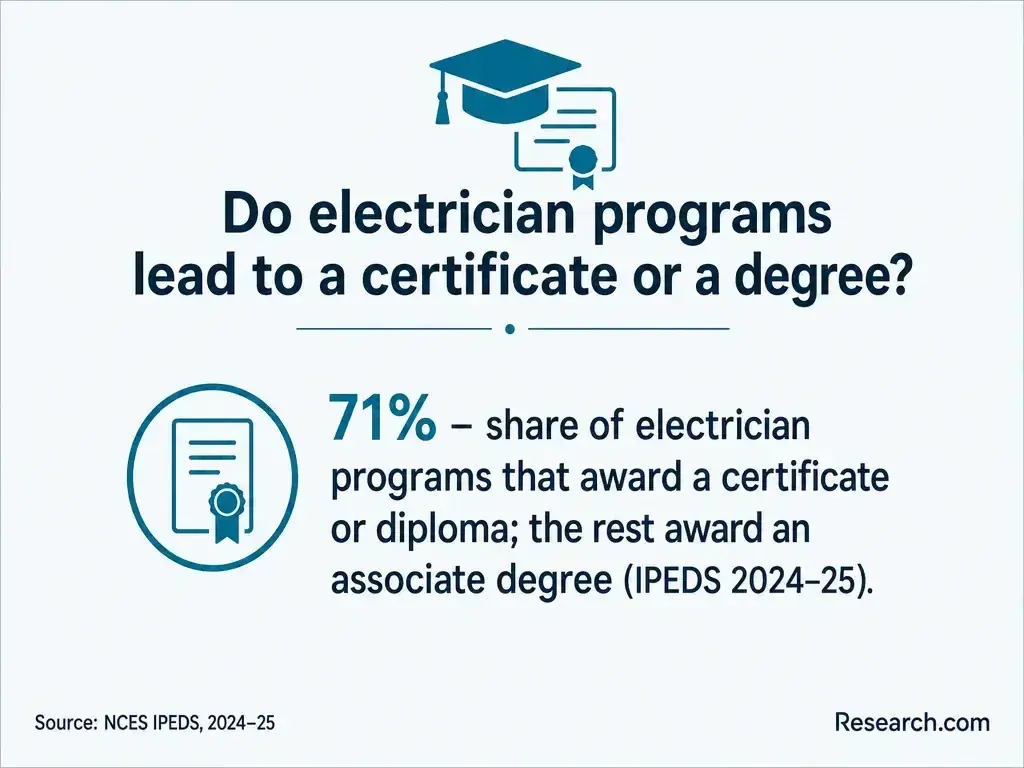
The credential depends on the pathway: a school may award a certificate, diploma, or associate degree; a registered apprenticeship documents completion of its work-and-instruction program. An industry credential can signal particular competencies, but it is distinct from school accreditation, apprenticeship registration, and permission to perform regulated contracting work.
When comparing credentials, look past the title. Ask whether coursework earns credit toward a longer program, whether an apprenticeship sponsor grants advanced standing, and whether prior work experience can be assessed. Get any transfer or advanced-standing decision in writing before relying on it. A search for a dual graduate degree is not a substitute for checking which electrical trade credential and supervised experience your intended job requires.
Entry rules vary among schools, employers, and apprenticeship sponsors. Applicants may be asked for evidence of prior schooling, basic math and reading skills, identification, an interview, or an aptitude assessment; worksite positions may also have safety and hiring requirements. Confirm the current requirements directly instead of treating one provider's checklist as a Marion-wide rule.
If you need income immediately, apply to paid helper or apprenticeship openings while comparing school options. If math or tool familiarity is the obstacle, a foundational course may be worthwhile - but ask whether completing it improves eligibility for a specific opening before paying.
Core instruction should connect electrical theory to safe work: calculations, circuits, wiring methods, blueprint reading, testing, troubleshooting, and applicable code concepts. Shop practice matters because knowing a diagram is different from selecting materials, making connections, and diagnosing a fault under supervision. The U.S. Bureau of Labor Statistics identifies technical, troubleshooting, and safety skills as central to electrician work.
Compare the actual lab tasks and equipment, not only course titles. If you want industrial maintenance, look for relevant motors and controls practice; if you want residential installation, prioritize wiring, service, and inspection-related practice. Ask what work students perform themselves and what remains demonstration-only.
Finishing trade school does not itself grant an electrical contractor license in North Carolina. The North Carolina State Board of Examiners of Electrical Contractors regulates electrical contracting and sets licensing rules, including applicable examination and experience requirements. Working for a licensed contractor and independently undertaking contracting are different situations. Before enrolling, check the board's current rules for your intended role and ask the provider exactly which requirements its training addresses.
Keep the categories separate: institutional accreditation concerns a school; state school authorization concerns its operation; apprenticeship registration concerns a work-and-instruction program; an industry certificate records a specified credential; and occupational licensing concerns regulated practice. None automatically substitutes for the others. Requirements can change, so verify the applicable rules again before applying for an examination or offering services independently.
The best-value choice is the least costly viable path to your intended job, not simply the lowest tuition on a list. Start with the role you want, then compare published 2027 costs, required practical training, completion schedule, and access to paid supervised work. The ranking is a useful shortlist, but its affordability score does not measure every aspect of training quality.
Before committing, ask each provider for evidence that answers these decision-critical questions:
Be wary of a provider that cannot show where hands-on training happens, quotes tuition without required extras, or suggests graduation alone permits independent contracting. Searches for affordable phd programs illustrate why a low price in an unrelated education category says nothing about electrician career readiness.
Training can lead first to helper or apprentice work and, with experience, toward installation, service, industrial maintenance, or supervisory responsibilities. Moving between these paths may require different equipment knowledge and employer training; a residential-focused course does not automatically prepare someone for industrial controls work.
For someone planning to run a contracting business, the decision is longer-term: build supervised experience and check the North Carolina State Board of Examiners of Electrical Contractors' licensing rules before treating self-employment as an immediate outcome of a school credential. If your immediate goal is steady paid training, an apprenticeship or employer-sponsored route may fit better than a longer unpaid school program.
The U.S. Bureau of Labor Statistics projects 9.2% growth in U.S. electrician employment from 2025 to 2035. That national projection supports considering the occupation, but it does not predict openings in Marion or guarantee an apprenticeship place. Local opportunity depends on employers' projects, replacement hiring, and whether you can travel to available worksites.
Use the outlook as a reason to investigate - not as the final enrollment decision. Check current local postings for the work you want, note the experience and technical skills requested, and compare those requirements with the program's labs and employer connections.
Investing in training is an important decision, especially when tuition is only part of the cost of becoming job-ready. Research.com developed this ranking to help readers compare electrician programs with other programs serving the same occupation and location. The team checks multiple sources for credible, consistent information; readers should still confirm current prices and requirements directly before enrolling.
The most affordable ranking scores costs and debt only: tuition, cost of attendance, median student debt, and federal loan default rate. Indicator weights are assigned using an entropy-based method, which gives more weight to measures that vary more across programs. Accreditation and other quality measures are not part of this affordability score. Only programs with completions reported to IPEDS are eligible, so an absent apprenticeship, employer program, or other provider is not necessarily unavailable or unsuitable.
Research.com also produces separate best programs rankings. Those assess completion and full- and part-time retention; earnings one year after completion and earnings relative to annual attendance cost; tuition, attendance cost, debt - including debt held by students who withdrew - and loan default; plus accreditation, relevant industry recognition, and student support. In that separate model, relevant programmatic recognition accounts for 20%, institutional accreditation for 10%, support services for 10%, and outcomes, earnings, and costs for 60%, with entropy-based weights within the last group. Those quality weights should not be mistaken for this affordability ranking's method.
The following data sources inform ranking research. Some cover other trades and do not establish electrician-program approval or licensing eligibility.
Use the ranking to identify programs to investigate, not as proof that the cheapest option meets your work goals. Research.com explains its broader process on its methodology page.
# 1 position
# 2 position
Compare paid apprenticeship and helper openings with public-college training before deciding. A paid route may lower your up-front cost, but admission, work availability, and required instruction vary.
No. A school credential is separate from North Carolina's electrical contracting rules. Check the North Carolina State Board of Examiners of Electrical Contractors for requirements relevant to your intended work.
You can study some theory online, but practical electrical skills require in-person assessment and supervised work. Confirm where those components occur before enrolling.
A certificate may help you build fundamentals before seeking work; an apprenticeship combines paid work with instruction. Ask whether a sponsor recognizes the certificate before paying for it.
No. The U.S. Bureau of Labor Statistics' May 2025 median includes workers at different experience levels. Obtain local entry-pay and wage-progression details from prospective employers or sponsors.