# 1 position


Audited and Verified:
Our Editorial and Data Verification Process
Research.com uses government datasets, official education statistics and primary institutional information to support its career and degree guides. Our review process checks factual accuracy, occupational definitions, source dates and the requirements associated with the credentials discussed.
How This Article Was Fact-Checked
Our editorial team verifies salary estimates, employment projections, education requirements and program information against original data providers and official organizations. Salary figures are checked against the relevant occupational definitions and reporting periods. Information about licensure, accreditation and required in-person training is reviewed separately.
Fact-checked and verified on:

Co-Founder and Chief Data Scientist

Reviewed by Karolina Broda
Fact-Checker and Data Verification
Choosing electrician training in Galveston means deciding whether to pay for classroom preparation, pursue paid apprenticeship training, or combine both. The stakes are practical: the U.S. Bureau of Labor Statistics projects electrician employment to grow 9.2% nationally from 2025 to 2035, but a school credential alone does not replace Texas licensing requirements. This guide explains local training choices, costs, work experience, and career prospects. It also introduces the Best Electrician Trade Schools in Galveston for 2027 ranking, created by the Research.com team of data scientists to help students identify programs worth considering.
Expect a mix of electrical theory, code reading, safety, and physical practice with tools and circuits. Before enrolling, ask to see the actual lab schedule: demonstrations and simulations are useful, but they are not the same as wiring, testing, troubleshooting, and working safely under supervision. The U.S. Bureau of Labor Statistics (BLS) describes apprenticeship as the usual route into electrician work, combining technical instruction with on-the-job training.
The pathways below lead to different outcomes. Compare the credential with the supervised experience you still need, not just the name printed on a certificate.
| Pathway | What it provides | Best fit and principal limitation |
| School certificate or diploma | Structured coursework and labs; the award and contact hours vary by provider | Useful for building fundamentals before seeking work; does not itself confer a Texas electrician license |
| Associate degree in an electrical field | Technical training plus broader coursework, if the specific program is offered | May suit someone seeking a wider technical foundation; confirm whether the added time and cost serve the intended job |
| Registered apprenticeship | Paid, supervised work with related instruction and a completion credential | Strong fit for earning while gaining experience; entry depends on an available sponsor and selection requirements |
| Employer-sponsored entry | Jobsite training that may be paired with formal instruction | Can provide a direct start; verify supervision, apprentice registration, and how hours are documented |
For someone based on the island, the availability of a lab, jobsite, or sponsor within a manageable commute matters as much as the course format. Check Galveston College's current catalog directly for any relevant offering rather than assuming that a general electrical course constitutes a licensing pathway.
Electrical training can support applications to residential and commercial contractors, maintenance employers, industrial facilities, and construction projects. Around Galveston, work may also be connected to port operations, healthcare facilities, hospitality properties, and the broader Houston-area labor market. These settings do not all use the same equipment: building-wiring experience is not automatically industrial controls experience.
The practical question is where you can obtain supervised electrical work that an employer and TDLR can document toward your intended license. A willingness to commute off-island may widen the pool of apprenticeship and entry-level opportunities, but transportation time and costs should enter the training decision. Ask a prospective employer who supervises apprentices and how it records their hours (TDLR).
A verified Galveston-specific electrician wage is not provided here, so the national figure is a benchmark, not a local estimate. Electricians had a $63,190 national median annual wage in May 2025 (BLS Occupational Outlook Handbook). Half of employed electricians earned less and half earned more; this measure includes experienced workers and should not be used as expected first-year pay.
For an offer in Galveston, compare the apprentice wage progression, paid hours, benefits, travel to jobsites, and expected raises after licensing. Contractor work, facility maintenance, and industrial work can involve different schedules and skill requirements. Request current wage information from prospective sponsors or employers before using projected earnings to justify tuition or borrowing.
There is no single required school-program length for Texas electrician entry. A provider determines its certificate or diploma schedule, while apprenticeships combine instruction and work over a longer period. Ask for the program's published clock or credit hours, weekly lab time, start dates, and time to completion at your intended pace; a short course should not be confused with time to independent practice.
For a Texas journeyman electrician license, TDLR requires 8,000 hours of on-the-job training under a master electrician's supervision and an examination. TDLR permits an applicant to take the journeyman examination after documenting 7,000 hours, but the remaining experience is still needed for licensing. This distinction is especially important when comparing an accelerated classroom program with an apprenticeship: faster school completion does not eliminate the supervised-work requirement.
Online instruction can cover electrical calculations, code concepts, and theory. On-campus labs and employer jobsites allow an instructor or supervisor to observe whether a trainee can install, measure, troubleshoot, and work safely with equipment. A hybrid option may reduce classroom travel, but it should identify exactly where practical training occurs.
The comparison below separates convenient coursework from competencies that require physical practice. Use it to check a program's schedule before paying a deposit.
| Format | Potential advantage | What to verify |
| Online coursework | Flexible theory study | Whether local labs or supervised work must be arranged separately |
| Hybrid training | Less travel for lectures while retaining scheduled practice | Lab location, attendance requirements, equipment access, and travel cost |
| On-campus training | Regular access to tools and instructor-observed practice | Actual hands-on time, class size, and fit with a work schedule |
No online course should be assumed to satisfy Texas supervised-experience requirements. If you live on the island and a hybrid program holds labs elsewhere, calculate that commute before treating its flexibility as a cost saving (TDLR).
A defensible Galveston-wide average is not available here: providers may publish different credentials, schedules, and included supplies, while paid apprenticeships use a different cost structure. Get a written, itemized quote for each option rather than comparing advertised tuition alone. Account for mandatory fees, books, tools, testing equipment, safety gear, consumables, transportation, licensing applications, and income you may give up while attending labs.
A paid apprenticeship may reduce the need to forgo wages, though work hours, instruction costs, and commuting still matter. Ask Galveston College or any training provider whether a particular program is eligible for federal aid; institutional eligibility does not mean every course qualifies. The FAFSA-approved online colleges guide explains aid concepts, but eligibility for a specific electrician program must be checked with its financial aid office and Federal Student Aid. Also ask about scholarships, employer payment, and Texas workforce-training assistance before borrowing.
To judge return on investment, compare the full cost and likely debt with paid-training alternatives, your current earnings, the probability you can finish, expected post-training wages, and how long those gains might last. A lower tuition quote is not necessarily better value if it omits essential labs or leaves you without a route to supervised work.
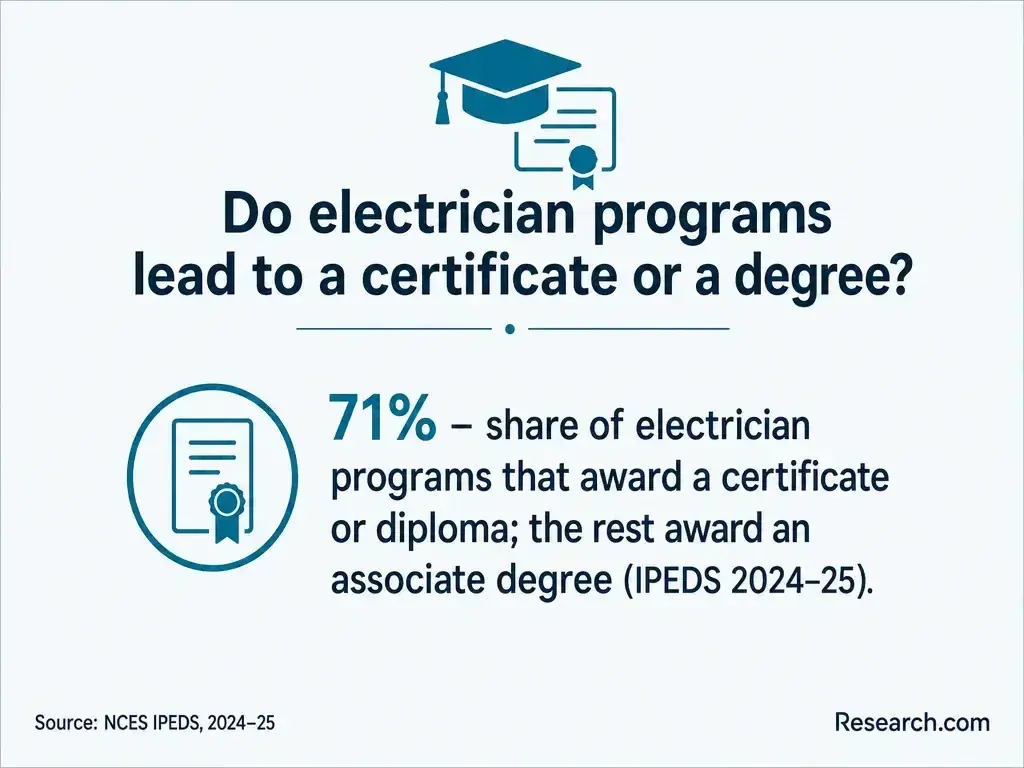
The award depends on the provider: it may be a certificate, diploma, or, for a qualifying college program, an associate degree. A registered apprenticeship issues its own completion credential. Industry training certificates can document particular skills, but none of these awards is interchangeable with a Texas occupational license (TDLR; U.S. Department of Labor).
Ask whether the specific credential documents completed lab hours, prepares you for an apprenticeship selection process, or can receive credit from a sponsor. If you already have related work or training, ask whether prior-learning credit or advanced standing is available and whether TDLR would recognize your documented work experience. A school's award of academic credit does not, by itself, establish licensing credit.
Schools set their own admissions rules, which may include an application, proof of prior schooling, placement measures, and program-specific safety requirements. Apprenticeship sponsors and employers select entrants separately and may assess math readiness, availability for jobsite schedules, and ability to travel. Request the current written requirements for the exact program or opening you want; admission to a school is not admission to an apprenticeship.
Texas also regulates electrical work after entry. People performing electrical work as apprentices generally need a TDLR apprentice electrician license and must work under required supervision. Before accepting a placement, confirm which license applies, when to apply, who provides supervision, and how hours will be recorded (TDLR). This is a better safeguard than relying on a recruiter's broad claim that a program is "license-ready."
Useful electrician training connects circuit theory and calculations to the work of reading plans, interpreting electrical code, selecting materials, installing wiring, measuring circuits, and finding faults. Safety practice should address de-energizing equipment, testing before contact, protective equipment, and jobsite communication. BLS identifies technical knowledge, troubleshooting, and physical work as central to the occupation.
Ask to observe a lab or review a skills checklist. A program oriented mainly toward residential wiring may not offer much practice with commercial systems or industrial controls; choose according to the work you intend to pursue. Because codes and equipment change, look for instruction using current materials and opportunities to practice - not merely a promise of exam preparation.
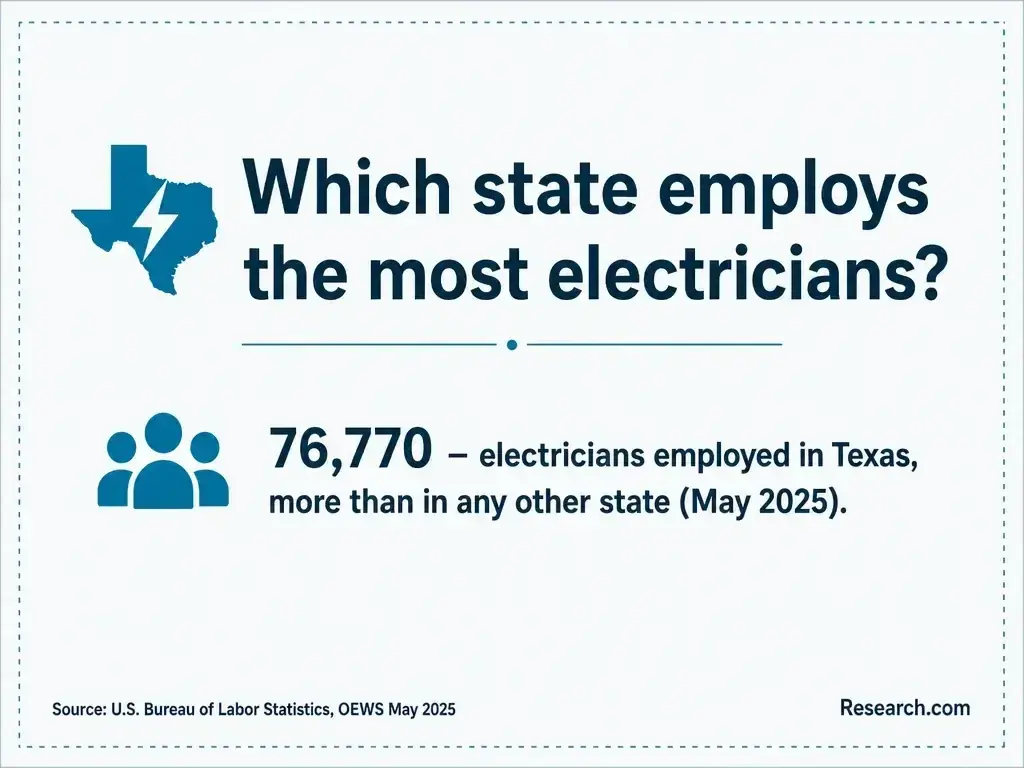
Yes - Texas licenses electrical workers, including apprentices. The relevant license depends on the work performed and level of experience. A prospective apprentice should arrange the appropriate TDLR registration and supervision rather than assume a school certificate authorizes unsupervised electrical work (TDLR).
For progression, Texas has distinct license categories. A residential wireman license requires documented supervised experience and an examination; a journeyman electrician license requires 8,000 supervised on-the-job hours and an examination. Confirm the current category-specific rules, application evidence, and exam eligibility with TDLR before choosing training. Voluntary industry certifications may help demonstrate a specialty, but they do not replace state licensure. Likewise, institutional accreditation, state school authorization, and apprenticeship registration answer different questions; none alone grants an electrician license.
The best option is the one that produces the skills and documented experience needed for your intended work at a cost you can sustain. A school program may suit someone who needs structured fundamentals before seeking an employer; a paid apprenticeship may be the stronger choice for someone ready to learn while working. Do not assume that the fastest program offers the fastest route to a Texas journeyman license.
Use the following checks when speaking with admissions staff, employers, and apprenticeship coordinators. They expose the most costly mismatch: paying for instruction that does not connect to practical training or a realistic licensing path.
A red flag is a promise that a short, fully online course automatically makes you a licensed electrician. Another is a price quote that excludes required equipment or a job-placement claim without a clear definition. Use the ranking to identify candidates, then verify these points directly with the provider and TDLR.
A common progression is apprentice electrician, licensed worker after meeting the applicable Texas requirements, and then more specialized or supervisory work with additional experience. Residential installation, commercial construction, maintenance, and industrial electrical work can require different equipment knowledge and employer training. TDLR sets separate requirements for its license categories; a title earned at school should not be treated as automatic advancement.
If your goal is independent contracting or supervision, investigate the additional licensing, experience, and business requirements before committing to an entry program. If your goal is facility maintenance or industrial controls, prioritize a curriculum and job placement that actually exposes you to those systems. The most valuable first opportunity may be the one that provides safe, well-documented supervised experience - not simply the most impressive-sounding school credential.
BLS projects 9.2% growth in U.S. electrician employment from 2025 to 2035. That national projection supports considering the trade, but it does not measure Galveston vacancies, guarantee an apprenticeship opening, or predict an individual's hiring prospects. Construction cycles, maintenance needs, and employer demand can differ between island jobs and the wider Houston-area commuting market (BLS Employment Projections).
For a local decision, ask sponsors and employers whether they are currently taking apprentices, where jobsites are located, and what skills they screen for. Compare those answers with the program's lab content and your ability to travel. Strong national demand is more useful when you can identify a reachable route from training into supervised work.
Investing in electrical training is a consequential decision, so Research.com evaluates programs against others in the same occupation and location rather than against unrelated schools. The Best Electrician Trade Schools in Galveston for 2027 ranking includes only programs with completions reported to IPEDS. That makes the comparison more consistent, but it also means a registered apprenticeship or employer training program may be absent without being inferior or unapproved.
Best-program rankings assess student outcomes; earnings and return on investment; costs and debt; and quality and recognition. Programmatic accreditation or relevant industry recognition accounts for 20% of the score, institutional accreditation for 10%, and student support for 10%. The remaining 60% covers outcomes, earnings, and costs, with indicator weights distributed through an entropy-based method. An affordability ranking uses only cost and debt measures; accreditation and other quality measures do not contribute to that score. These distinctions help readers use a ranking as a starting point, then verify hands-on training and Texas licensing fit for themselves.
The Research.com team used the following data sources in developing its trade-program rankings. Some sources cover other occupations and should not be mistaken for electrician-specific approval or licensing authorities:
Readers can find further details on the Research.com methodology page. Neither a ranking position nor institutional accreditation establishes that training hours count toward a Texas electrician license; confirm that question with the Texas Department of Licensing and Regulation (TDLR).
# 1 position
# 2 position
No. A supervised work pathway, including apprenticeship, is an alternative to attending trade school. You still need the license appropriate to your work and must meet TDLR's requirements for advancement.
No. Texas requires documented supervised on-the-job experience and an examination for a journeyman license. A certificate may teach useful skills but does not replace those requirements (TDLR).
You may study some theory online, but wiring practice and supervised electrical work require in-person participation. Verify where a hybrid program holds labs and how you will obtain work experience.
Choose structured school training if you need foundational instruction and can justify its cost; consider an apprenticeship if you are ready for supervised work and want to earn while learning. Compare admission availability, instruction, wages, travel, and the route to documented hours.
Ask for an itemized total cost, actual lab hours, the credential awarded, current completion information, and a written explanation of any apprenticeship relationship. Confirm licensing claims with TDLR rather than relying on advertising.