# 1 position
Western Texas College - Electrical and Power Transmission Installation/Installer, General.
certificate or diploma

Audited and Verified:
Our Editorial and Data Verification Process
Research.com uses government datasets, official education statistics and primary institutional information to support its career and degree guides. Our review process checks factual accuracy, occupational definitions, source dates and the requirements associated with the credentials discussed.
How This Article Was Fact-Checked
Our editorial team verifies salary estimates, employment projections, education requirements and program information against original data providers and official organizations. Salary figures are checked against the relevant occupational definitions and reporting periods. Information about licensure, accreditation and required in-person training is reviewed separately.
Fact-checked and verified on:

Co-Founder and Chief Data Scientist

Reviewed by Karolina Broda
Fact-Checker and Data Verification
Choosing electrician training in Texas means comparing more than classrooms: you need a route to supervised work, a state license, and manageable costs. The U.S. Bureau of Labor Statistics (BLS) projects 9.2% national growth in electrician employment from 2025 to 2035, making the choice timely without guaranteeing a job. This guide explains programs, apprenticeships, licensing, costs, and career prospects. It also features a Best Electrician Trade Schools in Texas for 2027 ranking created by the Research.com team of data scientists to help students make an informed choice about programs worth considering.
Expect safety instruction, electrical theory, code reading, and practice with wiring and test equipment. A school program can prepare you to seek an apprentice position, but it does not substitute for the supervised work experience Texas requires for journeyman licensure (TDLR). Ask how many hours take place in a lab, what students actually install or troubleshoot, and whether the provider helps them enter paid work.
These routes differ most in when you begin earning and how supervised experience is arranged:
| Route | What it provides | Best fit and limitation |
| Public college or technical-school certificate | Structured classes and labs; may be part of a longer credential sequence | Useful for building fundamentals before employment; verify job-placement support and whether costs continue during apprenticeship. |
| Private career-school program | Often a focused training schedule and shop practice | May suit someone seeking a specific timetable; compare total price and lab access rather than assuming a faster route to licensure. |
| Registered apprenticeship | Paid supervised work paired with related instruction | Strong fit if you can secure a position and want to earn while learning; entry may depend on sponsor hiring and work availability. |
| Employer-sponsored entry | Paid work and employer-directed training, sometimes with separate classes | Can reduce upfront school costs; confirm who supervises the work and how experience is documented for TDLR. |
A registered apprenticeship is a formally registered training arrangement; a school certificate is an educational credential. Neither label alone proves that every hour will qualify toward a particular license. Request the sponsor's or employer's written training plan (U.S. Department of Labor; TDLR).
Electricians work for electrical contractors, building and industrial facilities, utilities, and maintenance employers. Texas construction across major metropolitan areas creates different opportunities from industrial work along the Gulf Coast or jobs serving more dispersed rural communities. That difference matters when choosing training: commercial construction, plant maintenance, and service calls use overlapping fundamentals but can involve different equipment, schedules, and employers (BLS; Texas Workforce Commission).
Before enrolling, look at apprentice openings within a realistic commute. A nearby lab is less useful if the paid work you need requires daily travel to another market. Ask a program where its recent students obtained supervised positions, rather than treating a statewide job figure as evidence of local placement.
Pay depends on location, experience, license level, industry, and overtime. For a consistent benchmark, the BLS reports a $63,190 national median annual wage for electricians in May 2025. That figure combines workers at different career stages and should not be used as a forecast of Texas apprentice or first-job pay.
For a Texas decision, compare current apprentice wage steps offered by nearby sponsors with electrician wage estimates for your intended metropolitan or nonmetropolitan area from the Texas Workforce Commission or BLS. Ask whether quoted pay assumes overtime, travel, or a journeyman license. A paid apprenticeship can improve cash flow during training even if its initial hourly rate is below an experienced electrician's wage.
A school certificate may take months, while an associate-degree program generally involves a longer course of study; exact schedules and clock or credit hours depend on the provider. Neither duration tells you when you can work independently. TDLR generally requires 8,000 hours of qualifying on-the-job training under a master electrician for journeyman licensure. TDLR permits an applicant to take the journeyman examination after documenting 7,000 hours, but the license still requires the full experience requirement.
Apprenticeships combine instruction with work over multiple years rather than postponing all employment until classes end (BLS; U.S. Department of Labor). If speed matters, compare the date you can start paid, documented electrical work - not just the graduation date. Resources on fast online degree programs for working adults describe a different kind of timeline and cannot shorten Texas's supervised-experience requirement.
Online or hybrid delivery can make electrical theory, calculations, and some code coursework easier to fit around a job. Wiring, safe tool use, testing, troubleshooting, and supervised jobsite work require physical practice. Compare formats by the practical training you can reach, not by how much coursework a provider advertises as remote.
Ask where labs occur, how often attendance is mandatory, who supplies materials, and whether instructors assess hands-on work. A fully online course may teach useful concepts, but do not assume it produces qualifying Texas work hours or makes you eligible for a license (TDLR). Lists of top universities online are not substitutes for confirming a local electrical lab and a supervised-work route.
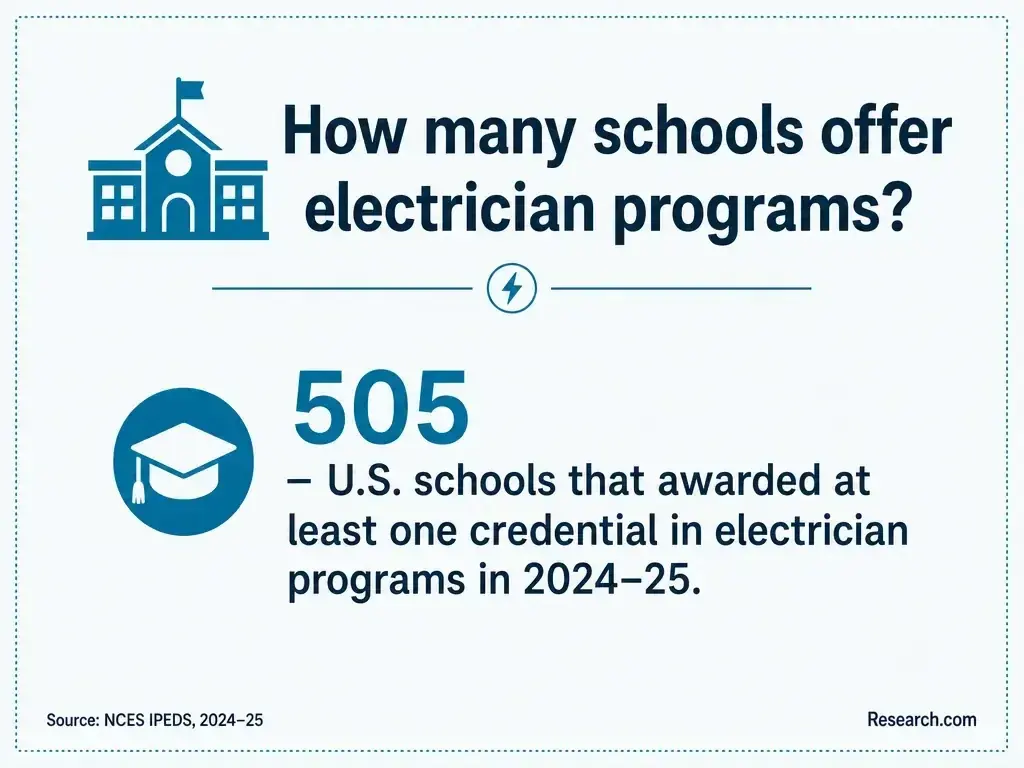
There is no single defensible statewide average covering public college programs, private schools, employer training, and paid apprenticeships: they charge and compensate students differently. Published tuition is only a starting point. Request a current, itemized estimate from each provider and compare the cost to become job-ready, not just the price of classes.
The following costs belong in that comparison; some may be supplied by a school or employer rather than paid separately.
| Cost or offset | What to verify |
| Tuition and mandatory fees | Full program price, residency rate if applicable, payment schedule, and refund policy |
| Tools and learning materials | Required tool kit, PPE, textbooks, software, and consumables |
| Career-entry expenses | TDLR application and examination charges where applicable, plus travel to labs and jobsites |
| Income and aid | Lost work hours, paid-apprentice wages, employer support, grants, and aid for which the specific program is eligible |
Federal aid eligibility depends on both the institution and program; Texas workforce assistance and other funding also have eligibility rules (Federal Student Aid; Texas Workforce Commission). Get a written aid and debt estimate before committing. Comparisons aimed at cheap phd online options do not provide a meaningful electrician-training price benchmark.
Depending on the provider, you might earn a certificate, diploma, or associate degree. A registered apprenticeship can lead to a completion credential, while an employer may document training without awarding a school credential (U.S. Department of Labor). Ask exactly what appears on your record and whether completed courses can transfer or count toward another program; do not assume school credits convert into TDLR work hours.
Keep four forms of recognition separate: institutional accreditation concerns the school; state school authorization concerns permission to operate; industry credentials, such as applicable NCCER training recognition, document particular learning; and TDLR licensure governs electrical work under Texas rules. None automatically replaces another (U.S. Department of Education; Texas Workforce Commission; NCCER; TDLR). If your goal is licensed electrical work, a guide to what's the easiest degree to get online cannot tell you whether a credential supplies practical training or qualifying experience.
School admissions and apprenticeship hiring are separate decisions. A provider may request prior academic records, placement results, or evidence that you can meet shop-safety requirements; requirements vary by program. An apprenticeship sponsor or employer may also assess math readiness, availability for work, transportation, and ability to perform essential job duties. Check the actual application rather than assuming every pathway has the same entry rules.
Texas also requires people performing electrical work as apprentices to hold the appropriate TDLR apprentice license and work under required supervision; enrollment alone is not that license (TDLR). Ask a prospective employer when to apply, who will supervise you, and how your work hours will be recorded. A program's admissions office should be able to explain its role in connecting students to that process without promising a job.
Core instruction typically covers electrical calculations, circuits, blueprint and schematic reading, wiring methods, testing instruments, and electrical-code application. Safety is not a stand-alone topic: students should practice identifying hazards, selecting protective equipment, and verifying that a circuit is safe before work begins (BLS; Occupational Safety and Health Administration).
Good labs require students to install, measure, diagnose, and correct - not merely watch demonstrations. Ask for a sample syllabus and practical assessment: does it cover the residential, commercial, or industrial equipment relevant to your target employer? Coursework in controls or troubleshooting can be valuable for industrial work, but it does not remove the need for supervised field experience.
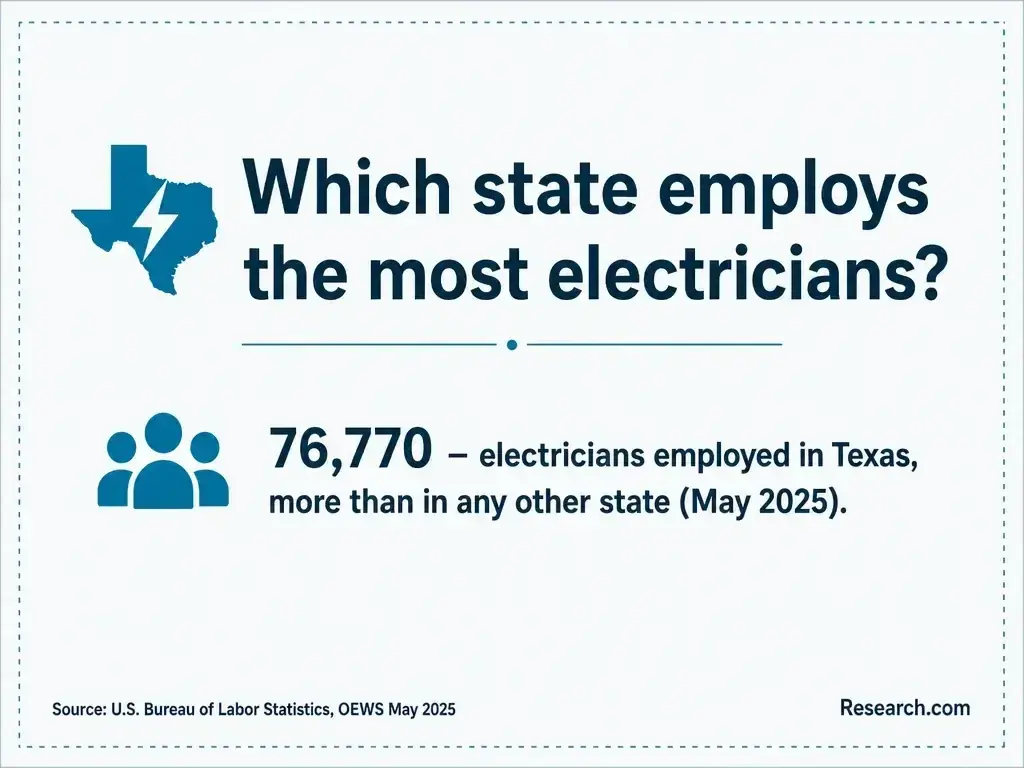
Yes, Texas regulates electrical work through TDLR licenses. An apprentice license permits supervised entry; a journeyman electrician license requires qualifying experience and an examination. TDLR generally requires 8,000 supervised on-the-job hours for journeyman eligibility, with examination access possible after 7,000 documented hours. Other license classifications, including residential wireman and master electrician, have distinct scopes and requirements (TDLR).
A school certificate, NCCER credential, or registered-apprenticeship completion record may help demonstrate training, but none is itself a Texas electrician license. Before paying for training, match your intended work to the TDLR classification and confirm the current application, supervision, experience-documentation, and examination rules. If you may later work in another state, check that state's licensing authority rather than assuming your Texas license or school credential transfers.
Start with the job you want and work backward to the training and TDLR license it requires. A ranking can identify programs worth investigating, but the best investment is the option you can complete, afford, and connect to qualifying paid experience.
Use these checks when speaking with schools and apprenticeship sponsors:
Watch for claims that graduation automatically confers a journeyman license, that a wholly online course replaces fieldwork, or that a high occupational median is a starting salary. To judge return on investment, consider completion probability, aid and debt, paid training, expected earnings relative to your current pay, and how long benefits would take to outweigh costs. A short, inexpensive program with no practical-work connection may be a worse fit than a longer paid apprenticeship.
One route begins with licensed apprentice work and progresses, after the required supervised experience and examination, toward journeyman status. Further experience and licensing can support master-electrician or supervisory work; specialization in building systems, industrial maintenance, or troubleshooting depends on the work and training you obtain (TDLR; BLS). Self-employment and contracting involve additional business and licensing considerations, not just technical skill.
Choose early training for the work you hope to do next. Someone targeting industrial controls should ask about control-circuit labs and access to industrial employers; someone aiming for residential service should prioritize relevant troubleshooting practice and local supervised openings. Electrician work is among trade careers that pay well, but progression - not a certificate by itself - shapes the pay and responsibilities available to you.
The BLS projects 9.2% growth in U.S. electrician employment from 2025 to 2035. This is a national projection, not a Texas placement rate or a promise of openings near a particular campus. Construction, maintenance, and electrical-system work give graduates several potential markets, but hiring varies with projects, industry, and location (BLS; Texas Workforce Commission).
Use that outlook alongside current local evidence: search for licensed-apprentice openings, identify employers within commuting range, and ask sponsors when they next accept applicants. A program connected to work you can realistically reach may be more valuable than one near a larger labor market where you cannot live or commute.
Investing in electrician training is a consequential decision. Research.com created its ranking to help readers compare programs against other electrician programs in the same location, rather than against unrelated trades or distant schools. The team evaluates reported outcomes, costs, recognition, and student support, while recognizing that a ranking cannot replace a check of hands-on training and Texas licensing requirements.
Only programs with completions reported to the Integrated Postsecondary Education Data System (IPEDS) are eligible. Best-program rankings consider student completion and full-time and part-time retention; median earnings one year after completion and earnings relative to annual attendance cost; tuition, attendance cost, median debt including debt held by students who withdrew, and federal loan default rates; plus accreditation, occupation-relevant recognition, and student support. Occupation-relevant programmatic accreditation or industry recognition accounts for 20% of the score, institutional accreditation for 10%, and student support for 10%. An entropy-based method distributes the remaining 60% among outcomes, earnings, and cost indicators, giving more weight to indicators that differ more across programs. Most-affordable-program rankings instead score only tuition, attendance cost, median debt, and federal loan default rates, with entropy-based weights; accreditation and other quality measures do not enter that score.
The team used the following data sources in developing the ranking. Occupation-specific recognition is considered where relevant; a health or dental accreditor is not an electrician-program accreditor.
IPEDS and college-oriented outcome databases do not capture every union, employer-sponsored, or registered apprenticeship route. An unranked provider is not necessarily unavailable or inferior. Use the ranking to build a shortlist, then verify each option's current price, practical training, employer connections, and licensing fit. Research.com explains its approach further on its methodology page.
# 1 position
# 3 position
# 4 position
# 5 position

# 6 position
# 7 position

# 8 position

# 9 position
# 11 position

# 12 position
# 13 position

# 14 position
# 15 position
Electrical and Power Transmission Installation/Installer, General
Delivery mode: On Campus (May Include Online Courses)
31.74
/ 100
Final score
Accreditation
The school is listed by NCCER as a training center for this trade. Institutional accreditation from Southern Association of Colleges and Schools Commission on Colleges.
Del Mar College received a Research.com Trade Program Score of 31.74/100. The school is listed by NCCER as a training center for this trade.
# 16 position
Electrical and Power Transmission Installation/Installer, General
Delivery mode: On Campus (May Include Online Courses)
31.74
/ 100
Final score
Accreditation
The school is listed by NCCER as a training center for this trade. Institutional accreditation from Southern Association of Colleges and Schools Commission on Colleges.
Del Mar College received a Research.com Trade Program Score of 31.74/100. The school is listed by NCCER as a training center for this trade.
# 17 position
# 18 position

# 19 position
# 20 position
Yes. A supervised employer route or registered apprenticeship may provide paid work and instruction without a separate trade-school program. You still need the applicable TDLR license and must meet its requirements for advancement (TDLR; U.S. Department of Labor).
No. A certificate documents school training. Texas journeyman licensure generally requires 8,000 qualifying supervised work hours and an examination; TDLR allows examination access after 7,000 documented hours (TDLR).
Registered apprenticeships combine paid employment with instruction, but wages, hiring schedules, and entry criteria vary by sponsor. Confirm the current pay steps and training agreement before accepting an offer (U.S. Department of Labor).
You can study some theory remotely, but safe installation, testing, and qualifying supervised work require in-person practice. An online course alone does not establish Texas licensing eligibility (TDLR).
It may be if its labs, schedule, and employment connections help you obtain qualifying paid work at a manageable total cost. Compare that result with an apprenticeship or employer-sponsored route, including wages during training, debt, and time to completion.