# 1 position


Audited and Verified:
Our Editorial and Data Verification Process
Research.com uses government datasets, official education statistics and primary institutional information to support its career and degree guides. Our review process checks factual accuracy, occupational definitions, source dates and the requirements associated with the credentials discussed.
How This Article Was Fact-Checked
Our editorial team verifies salary estimates, employment projections, education requirements and program information against original data providers and official organizations. Salary figures are checked against the relevant occupational definitions and reporting periods. Information about licensure, accreditation and required in-person training is reviewed separately.
Fact-checked and verified on:

Co-Founder and Chief Data Scientist

Reviewed by Karolina Broda
Fact-Checker and Data Verification
Choosing electrician training in Jasper, Alabama, means deciding whether to pay for classroom instruction, seek a paid apprenticeship, or combine the two. The U.S. Bureau of Labor Statistics projects 9.2% national employment growth for electricians from 2025 to 2035, but that does not tell you which local pathway is worth its cost. The Research.com team of data scientists created the Best Electrician Trade Schools in Jasper for 2027 ranking to help students identify programs worth considering. This guide explains the credentials, costs, practical training, and licensing questions to check before enrolling.
Expect instruction in electrical theory, circuit testing, wiring methods, blueprint reading, and safe use of tools, followed by supervised practice. A prospective student should ask to see the actual schedule: demonstrations alone are not a substitute for wiring, troubleshooting, and testing circuits in a lab or at a worksite. The U.S. Bureau of Labor Statistics describes apprenticeship as a common route into electrician work, combining technical instruction with paid on-the-job training.
Jasper-area students can compare a college-based electrical program, a registered apprenticeship, and direct employer entry with supervised training. Bevill State Community College is a school option to investigate, but confirm the current campus, credential, course availability, and lab schedule directly before planning a commute. A school program may help someone prepare for an apprenticeship; a registered apprenticeship more directly combines wages, instruction, and documented work experience. Neither should be judged solely by whether its classes appear among online programs that pay well: electrical competence requires work with real equipment.
Potential settings include residential and commercial construction, industrial facilities, building maintenance, and contractors serving communities beyond Jasper. Those settings call for different experience: a maintenance role may emphasize diagnosing existing equipment, while new construction emphasizes installation from plans. The U.S. Bureau of Labor Statistics identifies electrical contractors and other construction businesses as major electrician employers nationally; that occupational pattern is not a verified count of Jasper vacancies.
Ask prospective apprenticeship sponsors or employers where trainees actually report to work. A position advertised near Jasper may require travel among jobsites, so transport costs, work hours, and the range of tasks should influence your training choice. If you want industrial rather than residential work, favor instruction and placements that expose you to motors, controls, and troubleshooting instead of assuming every electrical program covers them equally.
The U.S. Bureau of Labor Statistics reports a $63,190 national median annual wage for electricians in May 2025. Half of employed electricians nationally earned more and half earned less. This is not a Jasper wage or a forecast of what a new trainee will earn; experience, employer, overtime, and type of electrical work can change pay substantially.
For a local decision, request an apprenticeship wage schedule or written entry-level pay range from each prospective sponsor or employer, including when raises occur. Compare that with the time you would spend in unpaid classes and travel. A paid pathway with slower classroom progress may be financially preferable to a shorter program that requires you to leave work, while a school program may be worthwhile if it improves access to the work you want.
There is no single electrician-training timeline. A school certificate or diploma ends when its required courses and labs are complete; an apprenticeship continues through its prescribed instruction and supervised work. The U.S. Bureau of Labor Statistics describes electrician apprenticeships as typically lasting four or five years. A shorter school credential does not compress those work-experience requirements or itself make someone an independent electrician.
Before enrolling, obtain the provider's written number of classroom, lab, and work-based hours, its part-time schedule, and any credit it grants for prior learning. Ask an apprenticeship sponsor and the Alabama Electrical Contractors Board whether and how particular coursework may count toward the experience relevant to your goal. Do not assume hours transfer merely because two providers teach similar topics.
Online instruction can suit electrical math, code study, and introductory theory. Installing, testing, and troubleshooting equipment requires supervised access to tools, circuits, and safe work practices. A hybrid option is useful only if its required labs and worksites are reachable from Jasper and scheduled around your job.
The comparison below separates convenient coursework from the practical experience needed to evaluate a training offer:
| Format | What it can offer | What to verify before enrolling |
| On-campus | Scheduled instruction and equipment-based labs | Actual lab hours, campus location, and commute |
| Hybrid | Remote theory with in-person practice | Where and when labs and supervised work occur |
| Fully online coursework | Flexible theory or exam preparation | How required practical skills and work experience will be obtained separately |
Listings of online colleges accepting fafsa can help explain federal-aid questions, but neither online delivery nor aid eligibility establishes that electrician training supplies the practical experience an employer or licensing authority expects. Verify each issue separately.
A reliable Jasper-wide average for electrician training is not established here. A school price, an employer-sponsored course, and a paid apprenticeship measure different expenses and wage offsets; averaging them would conceal the decision you need to make. Request a current, itemized quote for each route rather than treating advertised tuition as the cost of becoming job-ready.
For an apples-to-apples comparison, account for these costs and offsets:
Ask Bevill State Community College about current program charges and aid eligibility, and ask apprenticeship sponsors who pays for instruction and tools. Federal Student Aid notes that eligibility for federal aid depends on both the student and the eligible school and program. Cost comparisons built for cheapest doctoral programs are not electrician-training benchmarks; use an electrician-specific, itemized budget instead.
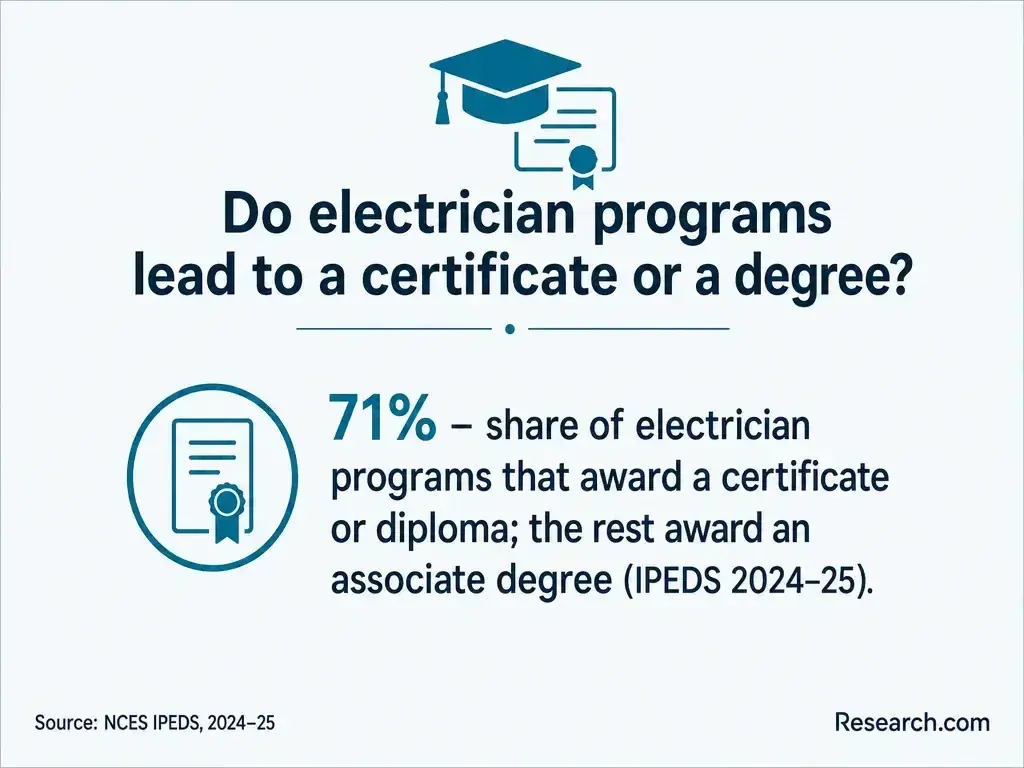
The credential depends on the route: a school may award a certificate, diploma, or associate degree for its stated curriculum, while a registered apprenticeship leads to an apprenticeship completion credential after its required instruction and work experience. Employer training may document skills without awarding an academic credential. Confirm the exact award in writing; similarly named electrical programs may offer very different amounts of lab time.
Institutional accreditation concerns the school, state authorization concerns permission to operate, and industry recognition concerns particular training or credentials. None is the same as registration of an apprenticeship or an Alabama occupational license. Ask whether a provider documents completed hours in a form an apprenticeship sponsor or the Alabama Electrical Contractors Board will accept.
Requirements vary by provider and pathway. A school may assess reading and math or require placement steps; an apprenticeship sponsor may also set eligibility, selection, and employer-related conditions. Ask for the current written requirements rather than assuming admission to classes also secures an apprenticeship position or job.
Electrical math, reliable transportation, and the ability to follow safety procedures matter from the start. Before paying an application fee, confirm the program's start date, any prerequisite coursework, required equipment, and whether its timetable is compatible with work. For an apprenticeship, ask how applicants are selected and whether prior school instruction changes placement or credit; the sponsor, not the school brochure, should confirm that decision.
Core training usually connects electrical theory to practical tasks: interpreting plans, measuring circuits, selecting materials, installing wiring and devices, finding faults, and applying electrical-code and jobsite-safety practices. The U.S. Bureau of Labor Statistics identifies blueprint reading, testing, installation, and repair among electricians' duties. Good instruction lets students perform and explain those tasks, not merely watch them.
Compare the equipment and assignments against the work you intend to pursue. Someone targeting industrial maintenance should ask about motors and controls; someone targeting construction should ask about installation practice and reading plans. Request the share of instruction spent in labs or supervised worksites, because a credential title alone does not reveal how much hands-on preparation it provides.
Alabama regulates electrical contracting and journeyman electrician licensing through the Alabama Electrical Contractors Board. Its rules for experience, examination, and the work a license holder may perform are separate from a school's graduation requirements. A beginner should not assume a certificate permits independent electrical work; supervised employment and progression toward the relevant license are different stages. Confirm current requirements directly with the board before selecting training on the promise that it "qualifies" you.
A registered apprenticeship documents a structured training route, while voluntary industry credentials may demonstrate particular skills. Neither institutional accreditation nor a voluntary certificate replaces an occupational license when one is required. If you plan to work outside Alabama, check that jurisdiction's rules separately rather than assuming Alabama training or licensure transfers automatically.
Start with the job you want and work backward. For a beginner seeking paid field experience, compare registered apprenticeships and employers offering supervised entry alongside school programs. For someone needing foundational math and lab practice before applying, a school credential may be a sensible first step. A ranking can identify options, but it cannot decide whether a particular schedule or apprenticeship connection fits your circumstances.
Use these checks when speaking with a provider and a prospective apprenticeship sponsor:
For return on investment, consider what you earn now, possible post-training earnings, completion probability, lost work time, debt, and how long benefits may last - not just a headline price. Comparisons aimed at 1 year online masters programs answer a different education question and should not stand in for those electrician-specific checks. A red flag is any promise of licensure, employment, or a particular wage without an explanation of the required experience and evidence.
An entry-level helper or apprentice can develop toward more independent installation and repair work as supervised experience grows. With the applicable experience and Alabama licensing steps, an electrician may pursue journeyman work, specialize in construction or industrial systems, move into supervision, or consider contracting. Those are progression possibilities, not automatic outcomes of completing a short course; the Alabama Electrical Contractors Board determines the applicable licensing requirements.
Think about the daily work as well as advancement. Troubleshooting can involve focused, independent problem-solving, but electrical jobs also require coordination with customers, coworkers, and supervisors and strict safety communication. If you are weighing work preferences through guides such as what is the best career for introverts, ask to observe a worksite or speak with an electrician before choosing a training route.
The U.S. Bureau of Labor Statistics projects 9.2% growth in electrician employment nationwide from 2025 to 2035. That indicates national demand over the projection period, not a guaranteed opening in Jasper. Construction schedules, local employers, and the availability of supervised positions will matter more to your first job search than a national growth figure alone.
Ask providers and apprenticeship sponsors which employers have recently taken their trainees and where those worksites are located. A willingness to travel beyond Jasper may expand practical options, but it also changes commuting costs. Evaluate a program by its credible connections to supervised work, not by an unsupported claim that growth ensures placement.
Education is a consequential investment, so the Research.com team compares electrician programs with other programs serving the same occupation and location rather than with unrelated trades. Only programs reporting completions to IPEDS can appear in the ranking. That makes the ranking useful for comparing eligible schools, but it is not a complete inventory of Jasper-area apprenticeships, employer training, or programs absent from IPEDS.
Best-program scores consider student outcomes; earnings and return on investment; costs and debt; and quality and recognition. Measures include full-time and part-time retention, completion, median earnings one year after completion, earnings relative to annual attendance cost, tuition, attendance cost, median debt including withdrawals, federal loan default, student support, and relevant accreditation or industry recognition. Programmatic accreditation or industry recognition receives 20% of the score, institutional accreditation 10%, and student support 10%. Outcomes, earnings, and costs account for the remaining 60%, allocated through an entropy-based method that gives more weight to indicators that vary more across programs. A separate most-affordable ranking uses only tuition, attendance cost, median debt, and federal loan default, with entropy-based weights; accreditation and other quality measures are not scored there.
The team uses the following sources to check reported education, outcome, and recognition information. Some health-profession sources support the broader trade-school methodology but do not establish whether an electrician program meets Alabama licensing requirements:
The ranking can narrow a school search; it cannot replace checking current program availability, apprenticeship credit, or licensing eligibility with the provider and Alabama Electrical Contractors Board. Read more about the approach on the Research.com methodology page.
# 1 position
# 2 position
Do not assume it is the only route. Paid, supervised training and apprenticeships are important alternatives. Check the Alabama Electrical Contractors Board's current requirements for the license you eventually seek.
No. A school credential records completion of its program; Alabama licensing has separate requirements. Ask the board and any apprenticeship sponsor how your coursework and experience will be documented.
You can study some theory remotely, but practical wiring, testing, and supervised work require in-person participation. Confirm where a hybrid program conducts its labs before enrolling.
Choose based on your readiness, access to an apprenticeship opening, schedule, and total costs. School may strengthen foundational skills; a registered apprenticeship combines instruction with paid, documented work experience.
Confirm the current electrical program, campus and lab location, credential, total charges, aid eligibility, hands-on hours, and whether an apprenticeship sponsor will recognize any coursework.