# 1 position


Audited and Verified:
Our Editorial and Data Verification Process
Research.com uses government datasets, official education statistics and primary institutional information to support its career and degree guides. Our review process checks factual accuracy, occupational definitions, source dates and the requirements associated with the credentials discussed.
How This Article Was Fact-Checked
Our editorial team verifies salary estimates, employment projections, education requirements and program information against original data providers and official organizations. Salary figures are checked against the relevant occupational definitions and reporting periods. Information about licensure, accreditation and required in-person training is reviewed separately.
Fact-checked and verified on:

Co-Founder and Chief Data Scientist

Reviewed by Karolina Broda
Fact-Checker and Data Verification
Choosing an affordable electrician program in Dayton means looking beyond tuition: the least expensive classroom option may not provide the paid experience or hands-on training you need. The U.S. Bureau of Labor Statistics (BLS) projects electrician employment to grow 9.2% nationally from 2025 to 2035. For career starters and working adults, this guide compares costs, credentials, apprenticeships, wages, and Ohio licensing rules. It accompanies the Most Affordable Electrician Trade Schools in Dayton for 2027 ranking, created by the Research.com team of data scientists to help students make an informed choice about programs worth considering.
Expect instruction in electrical theory, code use, safe work practices, and installation methods, followed by practice with circuits, conduit, testing equipment, and troubleshooting. A useful program lets you demonstrate those skills in a supervised lab or worksite - not merely pass written quizzes. Ask for the scheduled lab hours and whether instructors assess practical tasks.
The main choice is between school-first training and earning while learning. A certificate can help someone test the field or compete for an entry-level position, but an employer may still require substantial supervised training. A registered apprenticeship combines related instruction with paid work and leads to an apprenticeship completion credential. Union-sponsored, nonunion, and employer-sponsored routes may differ in entry process, work assignments, and wages; compare actual offers rather than assuming one model is always cheaper (U.S. Department of Labor; Apprenticeship.gov).
For a local school comparison, ask Sinclair Community College which current electrical offerings award a certificate or associate degree, which include labs, and whether completed coursework can receive apprenticeship credit. Get any credit agreement in writing: similar course titles do not establish advanced standing.
Potential workplaces in the Dayton area include residential construction and renovation sites, commercial building projects, industrial facilities, and electrical service companies. Each setting calls for a different mix of skills: service work emphasizes diagnosis and customer communication; construction emphasizes plans, conduit, and installation; industrial work may require stronger motor-control and troubleshooting skills (BLS Occupational Outlook Handbook; O*NET).
Training alone does not determine which jobs you can accept. Ask prospective employers whether they hire program completers as helpers, sponsor apprentices, and provide the supervised work needed to advance. If you are comparing electrician work with other in-demand vocation jobs, compare the cost and time to become employable - not just the occupation's eventual wage.
A reliable Dayton-specific wage should come from a clearly dated local occupational release or an actual employer offer. The national median for electricians was $63,190 in May 2025 (BLS Occupational Outlook Handbook). That figure covers experienced workers as well as newer entrants; it is not a forecast of what a Dayton graduate or first-year apprentice will earn.
For a useful personal estimate, request the starting wage, scheduled increases, expected hours, benefits, and travel expectations from local apprenticeship sponsors and employers. Compare offers for the same stage of training. Overtime-dependent earnings are less dependable than the stated base rate, and a paid apprenticeship can improve your finances during training even if a classroom program has lower published tuition.
There is no single electrician-training length. A short certificate teaches a narrower set of introductory skills; a more extensive school program takes longer; and a registered apprenticeship typically spans several years because classroom instruction runs alongside supervised employment (BLS Occupational Outlook Handbook; U.S. Department of Labor). An associate degree is an academic credential, not a substitute for required job experience.
Before enrolling, request the program's total clock or credit hours, lab hours, schedule, and expected completion time for part-time students. For an apprenticeship, request its registered standards: they specify the work-based and related-instruction requirements for that program. Do not assume a school's hours automatically reduce an apprenticeship's duration; the sponsor must accept them.
Electrical theory, code reading, and some calculations can be taught remotely. Wiring, tool use, testing, fault-finding, and safe work around equipment require supervised practice in person. A hybrid schedule may help a working adult, but an entirely online curriculum should not be treated as equivalent to a lab-based program or apprenticeship (BLS Occupational Outlook Handbook).
Ask where practical assessments occur, who supplies equipment, and whether you must travel to a campus or employer site. This matters especially if an online price looks attractive but repeated trips to a distant lab erase the savings. Older career changers comparing online learning options for seniors should apply the same test: remote convenience does not replace electrical worksite experience.
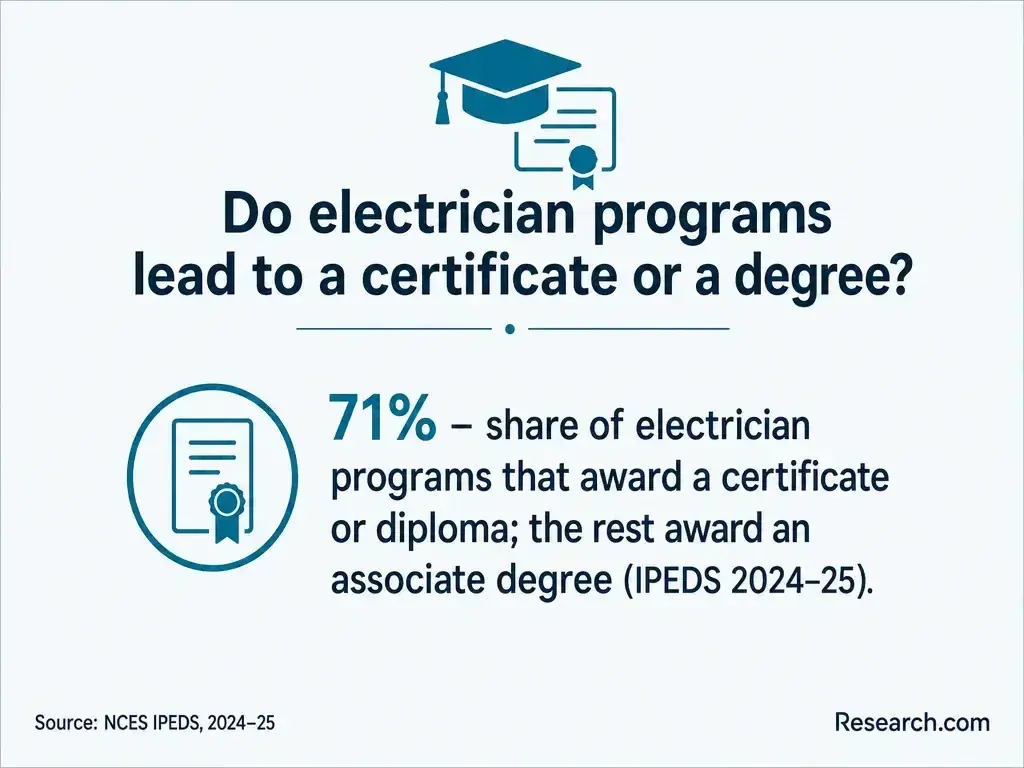
There is no defensible single Dayton average that covers certificates, associate degrees, private training, and paid apprenticeships: they charge and pay students in different ways. Treat any quoted tuition as a starting point, not the price of becoming job-ready. Request an itemized estimate from each provider before comparing options.
The comparison should include these costs and offsets because they can change which route is genuinely affordable:
Federal aid eligibility depends on the specific institution and program, not on an electrician course's name (Federal Student Aid). A list of online schools that accept financial aid can explain broader aid comparisons, but verify electrician-program eligibility and your own award directly. To judge value, compare likely debt and forgone earnings with the wages you can reasonably expect during and after training; account for completion risk rather than assuming you will finish on schedule.
The credential depends on the route: a school may award a certificate or associate degree, while a registered apprenticeship awards a completion credential under its registered standards (institution or program; U.S. Department of Labor). An employer's internal training may produce documented skills without either school credential. Ask what appears on your final record and which local employers or apprenticeship sponsors recognize it.
These distinctions matter when comparing programs with similar names:
| Pathway | Credential or record | Best fit when |
| School certificate | Certificate documenting completed coursework | You need foundational instruction before seeking supervised work |
| Associate degree program | Academic degree and course record | You want a broader curriculum and can justify the added time and cost |
| Registered apprenticeship | Apprenticeship completion credential | You can secure a position and want paid, supervised training |
No credential in this table, by itself, grants an Ohio electrical contractor license. Institutional accreditation, state authorization, industry curriculum recognition, apprenticeship registration, and occupational licensure answer different questions; verify each one that matters to your intended job.
Requirements vary by provider and route. Ask a school for its current application, placement, prerequisite, and safety requirements; ask an apprenticeship sponsor about its eligibility rules, selection process, and next opening. Employers may also set requirements for jobsite access. Do not assume admission to a classroom program includes admission to an apprenticeship or a job.
Before applying, confirm whether the schedule and physical work environment suit you. Electricians may work on ladders, handle tools, and travel between jobsites (BLS Occupational Outlook Handbook). If you need to keep working while training, compare evening or part-time classes with paid apprenticeship schedules - and check whether transportation to worksites is realistic.
Core instruction generally covers reading diagrams, electrical calculations, circuits, installation methods, code interpretation, testing, and safety (BLS Occupational Outlook Handbook; O*NET). Strong practical training also asks students to assemble and test installations, identify faults, and explain how they made a circuit safe before working on it.
Curriculum depth should match the job you want. Someone seeking residential installation needs relevant wiring and service practice; someone targeting industrial maintenance should ask about motors, controls, and troubleshooting. Request a course outline and a lab tour. A program that emphasizes theory but cannot show how students demonstrate hands-on competence may be a poor stand-alone entry route.
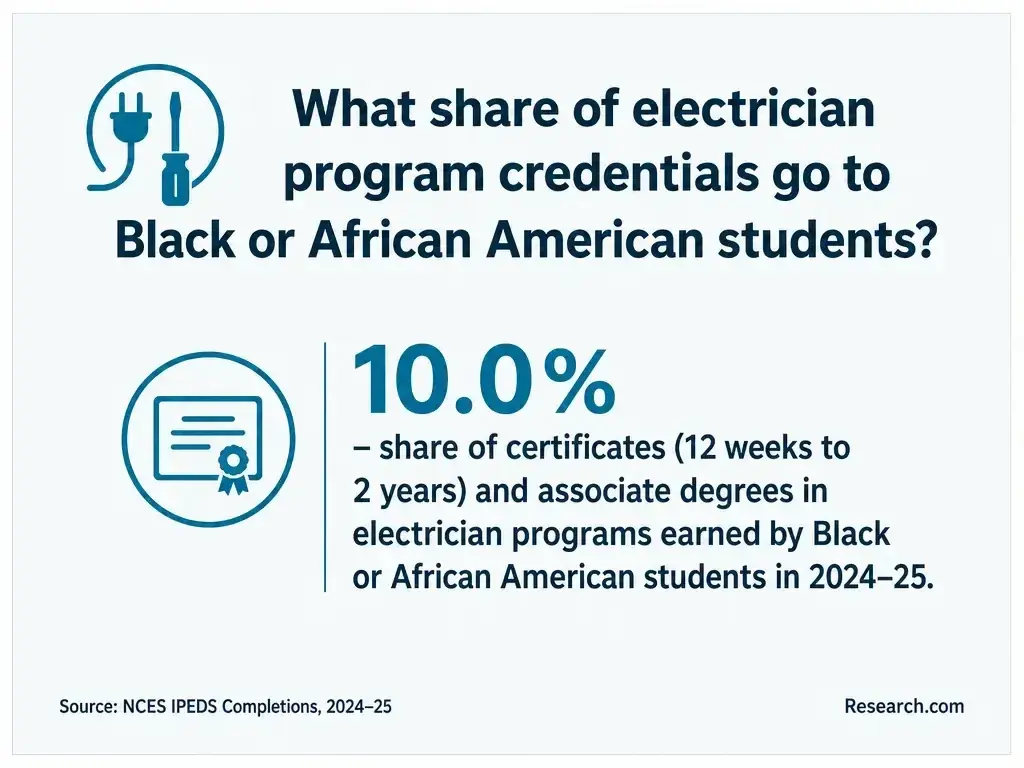
Ohio's Construction Industry Licensing Board licenses electrical contractors for regulated commercial contracting work; a school certificate does not confer that license (Ohio Construction Industry Licensing Board). Ohio does not issue one statewide individual journeyman electrician license that every entry-level employee must obtain. Local permitting rules, employer requirements, and the scope of work still matter, so check the authority governing the work you intend to do.
If your goal is to run an electrical contracting business, review the board's current experience, examination, application, and insurance requirements before choosing a program. If your immediate goal is supervised employment, ask employers what training they accept and who supervises new workers. Optional industry certificates may demonstrate particular skills, but they are not substitutes for contractor licensure or registered apprenticeship completion.
Start with the job you want, then test whether each option provides the instruction, practical experience, and recognized record needed to reach it. An affordability ranking narrows the search; it cannot tell you whether a low-cost program has sufficient lab access or a workable route into paid training. Broader career comparisons, including a college majors list, may help clarify your interests, but compare electrician routes on their own employment requirements.
Use these questions when speaking with a school or apprenticeship sponsor:
Be cautious if a provider quotes only tuition, calls online theory "complete electrician training," or implies graduation automatically brings licensure or a particular salary. Choose the route whose documented costs and outcomes fit your goal, not simply the shortest course.
A realistic starting point may be electrical helper or apprentice work under supervision. With experience, electricians can move toward service troubleshooting, construction leadership, or specialized industrial work; running a regulated contracting business is a separate step with Ohio licensing requirements (BLS Occupational Outlook Handbook; Ohio Construction Industry Licensing Board).
Choose early training for the environment you want to enter. A program with substantial motor-control practice may fit industrial work better than one focused on residential installations, even if the latter costs less. If you are comparing long-term pay across career fields, use earnings comparisons across other career paths as context - not as an estimate of electrician starting pay. For this trade, supervised experience and the timing of wage increases can matter as much as the initial school credential.
BLS projects 9.2% growth in U.S. electrician employment from 2025 to 2035 (BLS Employment Projections). That supports considering the occupation, but it is a national projection - not a Dayton hiring forecast or a guarantee of an apprenticeship opening. Local opportunity depends on contractors' workloads, industrial hiring, and whether employers can provide supervised positions.
Before committing to tuition, check current Dayton-area apprentice and helper postings and speak with sponsors about application timing. Note which skills recur in postings, then compare those requirements with each program's labs and work-based training. This is more useful for an entry decision than assuming national growth will translate directly into a local job offer.
Investing in electrician training is an important decision, so Research.com evaluates affordability using comparable cost and debt measures rather than advertised tuition alone. Programs are compared with other electrician programs in the same location; only programs with completions reported to the Integrated Postsecondary Education Data System (IPEDS) are eligible. That means registered apprenticeships and other training providers absent from IPEDS may still be worthwhile options.
The most affordable ranking scores tuition, cost of attendance, median student debt, and federal loan default rate. Its weights use an entropy-based method, which assigns more weight to measures that differ more across eligible programs. Accreditation and other quality indicators are not part of this affordability score. Research.com separately evaluates best-program rankings using student outcomes, earnings and return on investment, costs and debt, and quality and recognition; those are different rankings.
To check coverage and improve the ranking's credibility and accuracy, the Research.com team draws on the following data sources. Several serve other trade occupations and should not be interpreted as electrician-specific approvals:
Use the ranking to shortlist programs, then confirm current prices, practical training, and employer connections directly. Research.com explains its broader approach on its methodology page.
# 1 position
# 2 position
Not necessarily. A registered apprenticeship or employer-sponsored route may combine instruction with paid, supervised work. Ask employers and sponsors whether they require prior classroom training.
It can reduce forgone earnings because you are paid while training, but compare wages, required purchases, travel, and any instruction costs. Entry may also depend on available positions.
Online coursework can cover theory, but electrical installation and troubleshooting require in-person practice. Verify where practical training and assessment occur before enrolling.
No. Ohio contractor licensure is a separate process administered by the Ohio Construction Industry Licensing Board. Check its current requirements if contracting is your goal.
Request the full cost of tuition, fees, tools, safety gear, materials, and travel, then ask which costs aid or an employer will cover. Compare that amount with any wages you can earn during training.