# 1 position
Marion Technical College - Electrician.
associate

Audited and Verified:
Our Editorial and Data Verification Process
Research.com uses government datasets, official education statistics and primary institutional information to support its career and degree guides. Our review process checks factual accuracy, occupational definitions, source dates and the requirements associated with the credentials discussed.
How This Article Was Fact-Checked
Our editorial team verifies salary estimates, employment projections, education requirements and program information against original data providers and official organizations. Salary figures are checked against the relevant occupational definitions and reporting periods. Information about licensure, accreditation and required in-person training is reviewed separately.
Fact-checked and verified on:

Co-Founder and Chief Data Scientist

Reviewed by Karolina Broda
Fact-Checker and Data Verification
The cheapest electrician program is not necessarily the least expensive way to become job-ready: tools, travel, and unpaid training time can change the calculation. This guide accompanies the Most Affordable Electrician Trade Schools in Marion for 2027 ranking, created by the Research.com team of data scientists to help students identify programs worth considering. Electrician employment is projected to grow 9.2% nationally from 2025 to 2035, according to the U.S. Bureau of Labor Statistics (BLS). You'll learn how to compare Marion, Ohio, training costs, practical experience, credentials, and apprenticeship alternatives before committing.
Expect instruction that connects electrical theory to safe installation and troubleshooting - not a classroom credential that substitutes for supervised work. Depending on the provider, a program may cover circuits, wiring methods, blueprint reading, electrical-code use, testing instruments, and shop practice. Ask for the current syllabus and the number of instructor-supervised lab hours; similarly named credentials can have very different practical content.
Marion residents should compare any available Marion Technical College offering with registered apprenticeships and employer-sponsored entry. Confirm the college's current catalog before assuming it offers a particular electrician certificate. A short school program may suit someone seeking foundational skills before applying to contractors. An apprenticeship may better suit someone ready to compete for an employer position and learn through paid work plus related instruction. Neither route guarantees placement.
Potential settings include electrical contractors' residential and commercial jobsites, industrial maintenance departments, and facilities-maintenance teams. The duties differ: construction work emphasizes installing systems to plans and code; maintenance work often emphasizes diagnosing and repairing existing equipment. The BLS Occupational Outlook Handbook describes these as common electrician work settings.
A Marion student should ask prospective training providers which employers actually recruit their trainees and where work takes place. A job or apprenticeship outside the city may expand the options, but commuting distance, jobsite changes, and transportation costs affect whether that opportunity is practical. Do not treat a school's list of industry contacts as evidence of a job offer.
A reliable, comparable Marion-specific electrician wage is not established here, so use the $63,190 national median annual wage for electricians in May 2025 as context, not a local pay estimate (BLS Occupational Outlook Handbook). The median includes experienced workers and should not be presented as what a new trainee will earn.
For a usable local comparison, request the starting wage, scheduled raises, benefits, and expected paid hours from each apprenticeship sponsor or employer. Compare those terms with your likely earnings while attending school and with any debt payments afterward. Overtime, travel, and the kind of electrical work can change take-home pay; a higher posted hourly rate is not automatically the better financial choice.
There is no single electrician trade-school duration: a foundational certificate, a longer diploma or associate-degree program, and a registered apprenticeship have different endpoints. The BLS Occupational Outlook Handbook describes electrician apprenticeships as typically lasting four to five years, combining paid on-the-job learning with technical instruction. A shorter school program can help someone qualify for an entry-level opportunity sooner, but finishing it is not the same as completing an apprenticeship.
Ask a school for its required clock or contact hours, lab hours, schedule, and completion time for part-time students. Ask an apprenticeship sponsor how it documents related instruction and supervised work, and whether prior coursework can count. Those answers matter more than an advertised "accelerated" finish date. For a working adult considering accelerated online undergraduate degrees for working adults, electrician training presents a different scheduling constraint: its practical work cannot simply be compressed into remote study.
Online study can be useful for electrical theory, code concepts, and some assignments. It cannot replace supervised practice installing wiring, using test instruments, following jobsite safety procedures, or working under an experienced electrician. A hybrid option is only practical if its required labs or worksites are reachable from Marion.
Before paying for an online offering, obtain its written lab and work-placement requirements. Ask who arranges the placement, where it occurs, and whether an intended apprenticeship sponsor accepts the coursework. An "online electrician certificate" is not, by itself, evidence of occupational competence or licensing eligibility. A search for the easiest college degree addresses a different question; for electrical work, access to supervised practice is the decisive format test.
No verified Marion-wide average for electrician trade-school programs is available here. Providers do not all publish comparable program-level prices, and an apprenticeship's paid training cannot be compared fairly with school tuition alone. Request a written 2027 total-cost estimate for each option rather than treating a quoted tuition figure as the full price.
Use the same cost categories for every school quote. This makes differences in included equipment and fees visible before you commit.
Federal aid depends on the institution's and program's eligibility; do not assume every short course qualifies (Federal Student Aid). Ask about Ohio workforce assistance through the relevant local workforce office, and confirm eligibility before subtracting aid from your estimate. A paid apprenticeship may reduce borrowing, but compare its starting wage, available hours, and entry requirements. Tuition comparisons drawn from shortest doctorate programs would not account for electrician tools, worksites, or paid training.
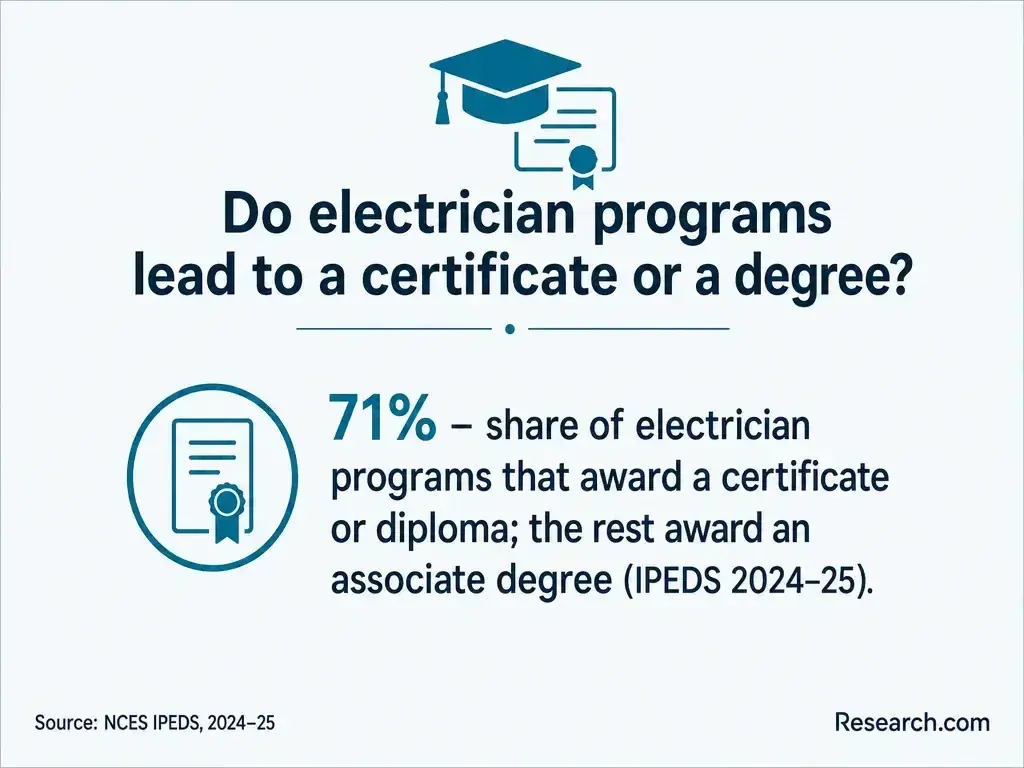
The credential depends on the route. A school may award a certificate, diploma, or associate degree; a registered apprenticeship has its own completion credential and documented work-based training. An employer may also train a new hire without awarding a school credential. Ask for the exact credential name in writing and whether the program offers credit that transfers or counts toward an apprenticeship.
These are training credentials, not interchangeable licenses. Institutional accreditation concerns the school. State authorization concerns permission to operate. Industry credentials, such as those associated with NCCER, document particular training or assessments. Apprenticeship registration concerns the work-and-instruction program. None, on its own, establishes that a person holds an Ohio electrical-contractor license (U.S. Department of Education; Apprenticeship.gov; Ohio Construction Industry Licensing Board).
Requirements vary by program. A school may ask for an application and evidence of academic readiness; an apprenticeship sponsor may also screen for work readiness and require an employer selection process. Do not assume that admission to a class includes admission to paid apprenticeship work.
Before applying, request the provider's current written entry criteria, prerequisite courses, physical job demands, transportation expectations, and any required tools. If your goal is an apprenticeship, ask its sponsor - not only a school counselor - whether the course gives applicants credit, advanced standing, or merely useful preparation. This prevents paying for a credential that does not move you closer to the position you want.
Strong introductory training links circuit calculations and code interpretation to tasks a beginner can demonstrate safely: selecting materials, reading plans, making connections, testing circuits, and diagnosing faults under supervision. Instruction should also address lockout and other electrical-safety practices, communication with a crew, and accurate documentation (BLS Occupational Outlook Handbook; Occupational Safety and Health Administration).
Ask to see a lab skills checklist, not just a course-title list. A program focused mainly on theory could be valuable preparation for apprenticeship entry, but it should not be marketed as equivalent to extensive jobsite experience. If your goal is industrial maintenance rather than building construction, check that equipment, controls, and troubleshooting receive enough practical attention to match that goal.
Do not assume one rule applies to every electrical job. Ohio's Construction Industry Licensing Board regulates electrical contractors for commercial contracting; qualifying for that contractor license involves requirements beyond finishing a school program, including experience and examination (Ohio Construction Industry Licensing Board). Local rules and the nature of the work can also matter. An apprentice working for a contractor, an employee doing maintenance, and someone seeking to contract independently should not assume they need identical credentials.
Before enrolling, describe your intended role to the relevant Ohio board and local building authority, then ask which license, registration, examination, and documented experience apply. Ask the school or apprenticeship sponsor how its training helps satisfy those specific requirements. An optional industry certificate may strengthen an application, but it is not a substitute for a required occupational license.
Start with the job you want, then compare routes that can actually get you there. An affordable certificate can be worthwhile if it teaches skills employers want, offers accessible lab time, and avoids unnecessary debt. If you can secure paid supervised work immediately, an apprenticeship may offer a stronger earnings-and-experience combination. Neither choice should rest on a ranking alone.
Use these checks when speaking with a school and an apprenticeship sponsor; request written answers where possible.
Compare your likely earnings before and during training, completion risk, borrowing, and expected earnings over a reasonable time horizon - not just the lowest tuition. If you are exploring best careers for introverts, also assess the day-to-day fit: electrical work can require independent troubleshooting as well as close crew and customer communication.
A common progression is foundational training or direct entry, supervised work, greater responsibility as experience grows, and possible specialization in construction, maintenance, or controls. Experienced electricians may move into lead or supervisory work; independent contracting raises a separate Ohio licensing question (BLS Occupational Outlook Handbook; Ohio Construction Industry Licensing Board). Progression depends on documented skills and opportunities, not simply the name of an entry credential.
Choose training to match the first job you can realistically pursue. A construction-focused apprenticeship offers sustained jobsite learning; someone targeting facility maintenance should ask about troubleshooting and equipment exposure. Comparisons with highest paying jobs master's degree do not predict electrician earnings: this trade has its own paid-training, experience, and licensing pathway.
The BLS projects 9.2% national growth in electrician employment from 2025 to 2035. That indicates broader demand, but it is not a Marion forecast or a promise that a new trainee will find work nearby. Local hiring depends on contractors' projects, maintenance staffing, and the number of available apprenticeship positions.
Use the national projection to justify investigating the trade, then test the local market: ask sponsors whether they are accepting applicants, ask providers where recent trainees found supervised work, and check whether commuting expands your options. This is more useful for an entry decision than comparing outlook figures from shortest doctorate programs, which describe a different training and employment route.
Investing in electrician training is a consequential financial decision. Research.com's team uses standardized data and checks program information to make its ranking more credible and useful. Programs are compared with other programs in the same occupation and location; only those reporting completions to the Integrated Postsecondary Education Data System (IPEDS) can appear. That means the ranking does not cover every registered apprenticeship or employer training route.
For the most affordable ranking, the score considers tuition, cost of attendance, median student debt, and federal loan default rate. An entropy-based method gives more weight to measures that distinguish programs. Accreditation and other quality indicators are not part of this affordability score. Research.com's separate best-program rankings also consider completion, retention, earnings, support services, accreditation, and occupation-relevant recognition. See the Research.com methodology for further details.
The following sources contribute to Research.com's ranking data and provider checks. Some cover other health or trade occupations; their inclusion as data sources does not mean their approvals apply to electrician programs.
Use the ranking to narrow your search, not as a substitute for a current program quote or a conversation with an apprenticeship sponsor. A low affordability score cannot establish that a program offers the hands-on experience or regulatory eligibility your intended job requires.
# 1 position
# 2 position
Not necessarily. A registered apprenticeship or employer-sponsored supervised training may be a viable entry route. Ask the employer or sponsor what classroom instruction and prior preparation it requires.
No. A school certificate documents completion of its curriculum; a registered apprenticeship combines related instruction with substantial paid, supervised work. Ask whether certificate coursework counts toward a specific apprenticeship before enrolling.
Online coursework may cover theory, but electrical installation, testing, and supervised jobsite practice require in-person work. Confirm exactly where and how a hybrid program provides that experience.
No. Ohio contractor licensing has separate requirements, including experience and examination. Check the Ohio Construction Industry Licensing Board and relevant local authority for rules affecting your intended work.
There is no universal answer. Compare the complete school price and forgone earnings with an apprenticeship's wages, required purchases, and time commitment. Obtain current written terms before deciding.