
Most Affordable Electrical Technician Schools & Training in The Woodlands for 2027
Audited and Verified:
Our Editorial and Data Verification Process
Research.com uses government datasets, official education statistics and primary institutional information to support its career and degree guides. Our review process checks factual accuracy, occupational definitions, source dates and the requirements associated with the credentials discussed.
How This Article Was Fact-Checked
Our editorial team verifies salary estimates, employment projections, education requirements and program information against original data providers and official organizations. Salary figures are checked against the relevant occupational definitions and reporting periods. Information about licensure, accreditation and required in-person training is reviewed separately.
Fact-checked and verified on:

Co-Founder and Chief Data Scientist

Reviewed by Karolina Broda
Fact-Checker and Data Verification
The cheapest electrician program is not necessarily the least expensive route to a Texas license. Tuition is only one cost; supervised work experience matters, too. The U.S. Bureau of Labor Statistics projects 9.2% growth in electrician employment nationwide from 2025 to 2035. For prospective students and career changers, this guide compares training routes, costs, credentials, and licensing rules. It also accompanies the Most Affordable Electrician Trade Schools in The Woodlands for 2027 ranking, created by the Research.com team of data scientists to help students make an informed choice about programs worth considering.
Key findings about electrician degrees in The Woodlands
- Texas does not require trade-school graduation to register as an apprentice electrician; paid, supervised training can be a lower-upfront-cost alternative to school (Texas Department of Licensing and Regulation, TDLR).
- A Texas journeyman electrician license generally requires 8,000 hours of on-the-job training under a master electrician and an examination. Ask whether a program helps you obtain qualifying employment, not just a certificate (TDLR).
- The national median annual wage for electricians was $63,190 in May 2025, not an expected starting wage in The Woodlands. Compare total training costs and likely apprentice pay before borrowing (U.S. Bureau of Labor Statistics, BLS).
Table of Contents
- Most Affordable Electrical Technician Schools & Training in The Woodlands for 2027
- What can I expect from an electrician trade school program in The Woodlands?
- Where can I work with an electrician trade school training in The Woodlands?
What can I expect from an electrician trade school program in The Woodlands?
Expect instruction in electrical safety, circuitry, blueprint reading, the National Electrical Code, conduit, and testing, paired with supervised practice. A school lab can build confidence before a first job, but completing a program is different from accumulating the supervised work hours Texas requires for a journeyman license (TDLR).
For someone in The Woodlands, the practical comparison is between a nearby school-based program and an apprenticeship or employer-sponsored route across the greater Houston area. A certificate may suit someone who wants structured preparation before applying for work; a paid apprenticeship may suit someone ready to learn on a jobsite. Before enrolling, ask where labs take place, whether the schedule accommodates work, and whether the provider helps students find supervised employment.
Where can I work with an electrician trade school training in The Woodlands?
Electrical contractors serving homes and commercial properties are a direct route into supervised work. The wider Houston labor market also includes construction, building maintenance, and industrial facilities, although a particular job's tasks and licensing rules may differ (BLS; TDLR). Searching beyond The Woodlands can widen the pool of potential supervisors, but commuting time and costs belong in the training budget.
Ask prospective employers whether the position provides documented hours under a Texas master electrician. A job involving electrical equipment is not automatically the supervised electrician experience needed for the license you want (TDLR).
BLS reports a $63,190 national median annual wage for electricians in May 2025. That figure covers experienced workers as well as newer ones; it is neither a Woodlands-specific wage nor a forecast of first-year earnings. Pay can vary with experience, specialty, employer, and overtime (BLS).
For a useful local comparison, ask apprenticeship sponsors and employers for their current starting rate, scheduled increases, benefits, and typical travel area. Compare those written terms with tuition and the wages you would give up while attending school. Readers weighing electrical work against other occupations can use most profitable bachelor's degrees as broader earnings context, but an electrician training decision should rest on electrician-specific costs and pay.
Program length depends on the credential and schedule; request each provider's published calendar and required lab hours rather than assuming similarly named certificates take the same time. Texas's journeyman requirement is a separate milestone: generally 8,000 hours of supervised on-the-job training under a master electrician, followed by the required examination (TDLR). School completion alone does not replace those hours.
A short program can get you ready to seek work sooner, while a longer one may cover more shop practice. Neither is automatically faster to independent practice if graduates cannot secure qualifying supervised employment. Workers comparing compressed schedules may find accelerated online degree programs for working adults useful for schedule context, but electrician lab and jobsite competencies still require in-person work.
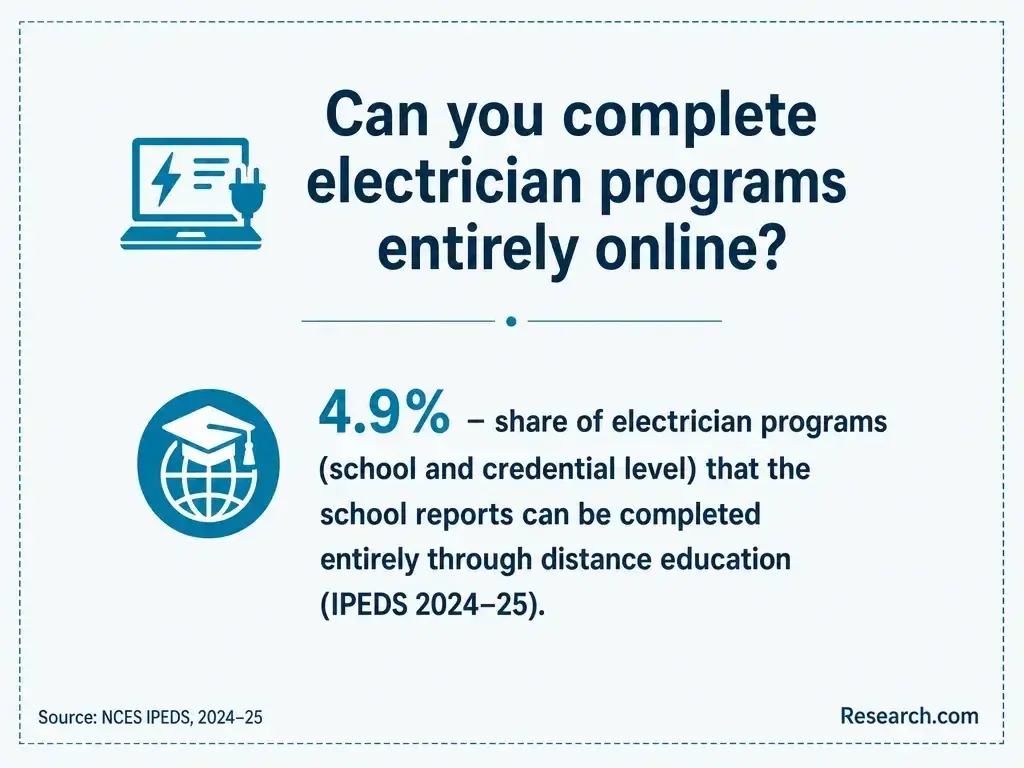
Code theory, calculations, and some safety lessons can be taught online. Bending conduit, making connections, testing circuits, and working safely around equipment call for supervised physical practice. A hybrid program can reduce classroom trips, but it does not eliminate labs or the jobsite experience required on the Texas licensing path (TDLR).
Choose a campus or hybrid option by checking where and when practical sessions occur. An online-only course may be useful preparation, but do not assume it provides the hands-on competence, supervised hours, or licensing eligibility you need. Students comparing online colleges that take financial aid should also verify that the specific program accepts federal aid; an institution's participation does not establish every course's eligibility (Federal Student Aid).
There is no reliable single average that covers local college programs, career schools, and paid apprenticeships on the same basis. Published tuition is only part of the amount needed to become job-ready. Request an itemized, current quote for each option rather than using an unverified 2027 price estimate.
Compare tuition and mandatory fees with books, tools, protective equipment, consumables, licensing and examination charges, and transportation to labs or jobsites. Include lost earnings if attendance reduces your work hours; subtract grants, eligible aid, or apprenticeship wages when comparing the routes. Paid training may lower upfront expense, but its pay, benefits, and progression should be confirmed with the sponsor. Federal aid depends on both student and program eligibility, not simply on the school's name (Federal Student Aid).
A useful affordability test is whether the additional cost of school buys you practical instruction or access to employment you would otherwise struggle to obtain. If you expect to finance training, account for completion probability, debt payments, current earnings, expected post-training earnings, and how long it may take for the investment to pay off.
The award depends on the route: a school may offer a certificate or associate degree, while a registered apprenticeship leads to an apprenticeship completion credential. Neither a school award nor apprenticeship registration is itself a Texas journeyman electrician license. Confirm the exact award in writing before paying a deposit (TDLR; U.S. Department of Labor).
Ask Lone Star College System about its currently available electrical offerings, campus location, credential, and whether prior learning or related apprenticeship training can count toward a school credential. Credit policies and licensing experience rules are separate: receiving academic credit does not establish that TDLR will count those activities as supervised work hours. If you are comparing credentials, universities with double majors addresses a different educational route; it should not be mistaken for a shortcut through electrician licensing.
Schools set their own admission, placement, and course prerequisites. Apprenticeship sponsors and employers set separate hiring or selection requirements. Texas apprentice electrician registration is a licensing step rather than admission to a school; check TDLR's current application requirements before starting covered electrical work (TDLR).
If you need an accessible starting point, ask a provider about placement support, required math preparation, physical attendance, and any tool purchases due before the first class. Open college admission can explain one admissions model, but admission to an institution does not guarantee a place in a particular electrician training program or apprenticeship.
A useful curriculum connects electrical theory to work a beginner may actually perform: reading plans, identifying components, measuring circuits, installing raceways and wiring, troubleshooting faults, and following code and safety procedures (BLS). Look for supervised opportunities to use meters and tools, not just demonstrations or exam-preparation videos.
Ask how much instruction occurs in a lab, what equipment students use individually, and how instructors assess safe performance. Also ask which code edition the course teaches and how updates are handled. Those details matter more than a broad claim that a program offers "hands-on" learning.
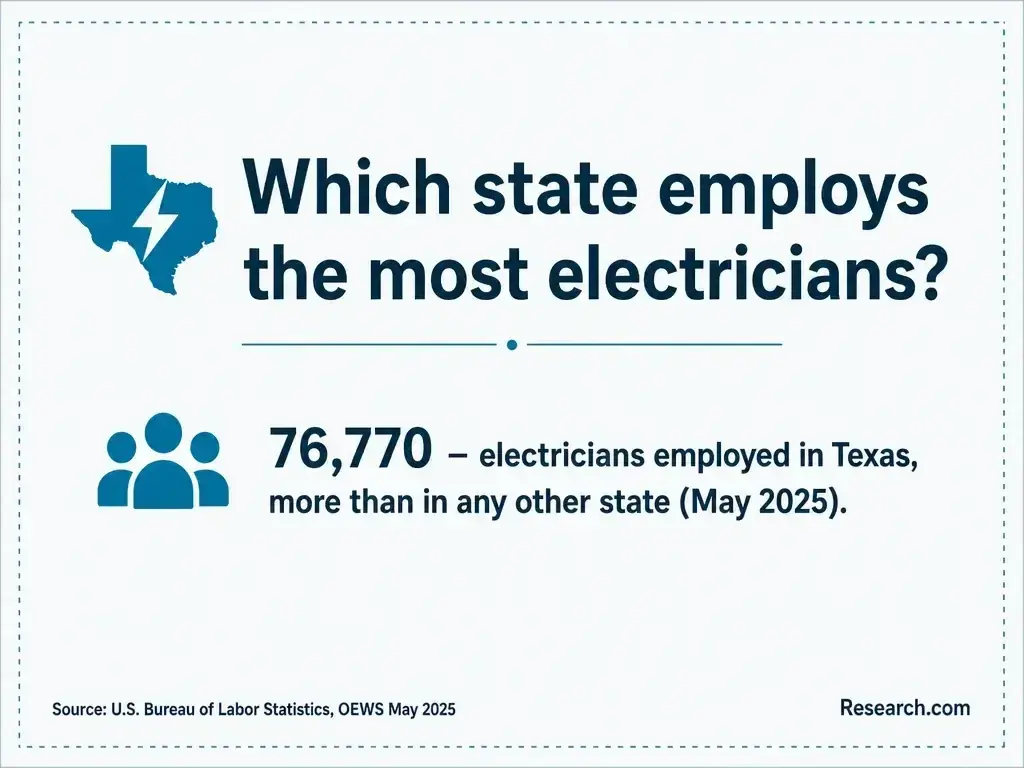
Texas regulates covered electrical work through TDLR. A person starting through the electrician trade commonly registers as an apprentice and works under the required supervision; qualifying for a journeyman license generally requires 8,000 supervised on-the-job hours under a master electrician and passing the examination. Texas also has other license categories, including residential wireman, with different scopes and requirements. Check the category that matches the work you intend to do (TDLR).
Institutional accreditation concerns the school; state authorization concerns its permission to operate; industry certificates document particular training; and apprenticeship registration concerns the training arrangement. None substitutes for a TDLR occupational license. Before enrolling, ask the provider and TDLR how supervised hours will be documented, who can supervise them, and whether the proposed training supports your intended license.
Start with your intended job and Texas license category, then compare the routes that could realistically get you there. The lowest-priced program is not the best value if its schedule prevents paid work or it offers too little practical preparation. Conversely, a costly course may add little value if you can obtain suitable supervised training directly through an employer.
Use the same questions with each school or apprenticeship sponsor so the answers are comparable:
- What credential will I receive, and what are the published calendar, lab hours, and attendance requirements?
- What is my complete out-of-pocket cost, including tools, fees, travel, and financing?
- How will you help me find qualifying supervised work, and how are hours documented for TDLR?
- What are the program's current completion and job-placement definitions, and can you provide the underlying reporting period?
Verify school accreditation or authorization with the relevant agency, and verify licensing requirements with TDLR; do not treat either check as a substitute for the other. Be wary of claims that an entirely online certificate makes you a licensed electrician or that a national median wage is typical starting pay. A ranking can help form a shortlist, but these checks determine whether a route fits your goal.
An entry route is supervised apprentice work with a contractor. With qualifying experience and the applicable Texas examination, a worker may pursue a journeyman or another relevant license category; later responsibilities can include complex troubleshooting, supervision, or running a contracting business, subject to additional licensing requirements (TDLR). Residential and commercial work can differ in equipment, scheduling, and travel, so ask employers which tasks apprentices actually perform.
School training is most worthwhile when it helps you enter that progression: building safe practical skills, strengthening an apprenticeship application, or fitting study around a current job. Someone who already has an offer of well-supported, supervised paid training should compare that offer before purchasing a separate course.
BLS projects 9.2% growth in U.S. electrician employment from 2025 to 2035. That national projection signals continuing demand for the occupation but does not predict openings in The Woodlands or guarantee an apprenticeship placement (BLS). Because residents can seek work across the greater Houston area, commute range and access to a qualified supervisor may matter as much as the location of the classroom.
Before committing to a schedule or loan, review current local postings and speak with sponsors about apprentice intake, starting pay, and work locations. That gives you a more decision-ready picture than applying a national growth rate directly to one community.
Most Affordable Electrical Technician Schools & Training in The Woodlands for 2027
Research.com created the ranking to help readers compare the cost of electrician training with options available in their area. Investing in education is consequential, so the team evaluates programs in the same occupation and location using reported data rather than treating a low advertised tuition price as the full cost.
Only programs with completions reported to IPEDS are eligible. For the most affordable ranking, the score uses tuition, cost of attendance, median student debt, and federal loan default rate; an entropy-based method gives more weight to measures that vary more across programs. Accreditation and other quality indicators do not enter this affordability score. Readers should verify licensing relevance and practical training separately. IPEDS coverage also excludes some apprenticeships and employer-sponsored routes, so an unranked provider is not necessarily an inferior option.
The Research.com team draws on the following sources to check program, cost, outcome, recognition, and apprenticeship information. Some recognition sources apply to other trades in Research.com's broader ranking process rather than to electrician licensure specifically:
- IPEDS database
- National Center for Education Statistics
- College Scorecard database
- Peterson's database
- Commission on Accreditation of Allied Health Education Programs (CAAHEP)
- Accrediting Bureau of Health Education Schools (ABHES)
- Commission on Dental Accreditation (CODA)
- Dental Assisting National Board (DANB)
- National Center for Construction Education and Research (NCCER)
- Apprenticeship.gov Partner Finder
The ranking provides a starting point for a shortlist, not a finding that every listed program leads to a Texas electrician license. More detail on the evaluation process is available in Research.com's methodology.
# 2 position

Frequently asked questions about electrician programs in The Woodlands
Do I have to attend trade school to become an electrician in Texas?
No. Texas provides an apprentice electrician route based on registered, supervised work. School can supply structured preparation, but it does not replace the experience and examination required for a journeyman license (TDLR).
Is a paid apprenticeship cheaper than trade school?
It may have lower upfront costs and provide wages while you train. Compare pay, tools, travel, classroom obligations, benefits, and the availability of a placement before deciding.
Can I complete electrician training entirely online?
You can study some theory online, but practical electrical work and supervised jobsite experience require in-person participation. An online course alone should not be assumed to satisfy Texas licensing requirements (TDLR).
Does a school certificate make me a licensed electrician?
No. A certificate documents completion of a program. Texas occupational licensing has separate registration, experience, and examination requirements depending on the license category (TDLR).
What should I verify before paying tuition?
Get the complete cost, credential name, lab schedule, and employment-support details in writing. Then check the school's accreditation or authorization independently and confirm your intended licensing route with TDLR.
- U.S. Bureau of Labor Statistics - Electricians
Used to verify salary, employment outlook, and typical education requirements.
https://www.bls.gov/ooh/construction-and-extraction/electricians.htm - NCCER - Accredited Training
Used to verify programmatic accreditation or industry recognition of programs.
https://www.nccer.org/ - O*NET OnLine - Electricians
Used to verify common responsibilities, skills, work settings, and education expectations.
https://www.onetonline.org/link/summary/47-2111.00 - Lone Star College System - official website
Official school website (programs, tuition, admissions).
https://www.lonestar.edu/