# 1 position


Audited and Verified:
Our Editorial and Data Verification Process
Research.com uses government datasets, official education statistics and primary institutional information to support its career and degree guides. Our review process checks factual accuracy, occupational definitions, source dates and the requirements associated with the credentials discussed.
How This Article Was Fact-Checked
Our editorial team verifies salary estimates, employment projections, education requirements and program information against original data providers and official organizations. Salary figures are checked against the relevant occupational definitions and reporting periods. Information about licensure, accreditation and required in-person training is reviewed separately.
Fact-checked and verified on:

Co-Founder and Chief Data Scientist

Reviewed by Karolina Broda
Fact-Checker and Data Verification
Choosing an affordable electrician program in Galveston means looking beyond tuition: a short course may teach valuable skills without replacing the supervised experience needed for a Texas license. The U.S. Bureau of Labor Statistics projects electrician employment to grow 9.2% nationally from 2025 to 2035. This guide compares training routes, costs, licensing steps, and career prospects. It also accompanies the Most Affordable Electrician Trade Schools in Galveston for 2027 ranking, created by the Research.com team of data scientists to help students make an informed choice about programs worth considering.
Expect instruction in electrical safety, circuits, wiring methods, code use, and troubleshooting, paired with practical work on equipment or training boards. The decisive question is what happens after class: Texas licensure depends on documented supervised work experience, not merely on finishing a certificate (Texas Department of Licensing and Regulation, or TDLR).
These pathways serve different goals. Ask each provider which credential it awards, how much work is hands-on, and whether it helps students connect with supervised employment.
| Pathway | What it provides | Best fit and limitation |
| College certificate or diploma | Structured introductory coursework and labs; a school-issued credential | Useful for exploring the trade or building entry-level skills; confirm its relationship to supervised work and employment. |
| Electrical associate degree | Technical coursework, labs, and broader academic study | May suit students who want a longer college credential; extra coursework does not itself substitute for licensing experience. |
| Registered apprenticeship | Paid, supervised work with related classroom instruction | Strong fit for learners ready to earn while training; openings and entry requirements depend on the sponsor. |
| Direct employment or employer-sponsored training | Work-based learning under appropriate supervision | Can reduce upfront school costs; check the employer's training plan and how hours will be documented. |
Galveston College is a local starting point for checking current course and credential availability. Compare any offering with registered apprenticeships and employers accessible from Galveston; a commute can change both the training you can obtain and its real cost.
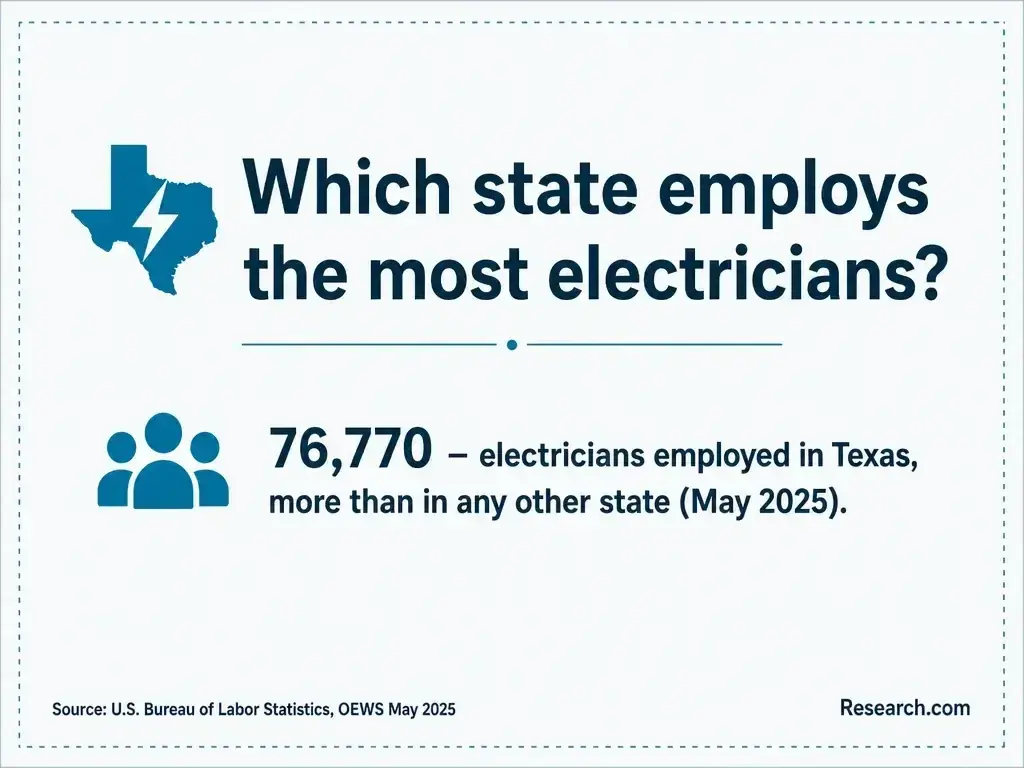
Possible settings include residential and commercial contractors, building maintenance, industrial facilities, and port-related operations around Galveston and the wider Houston-Galveston labor market. The work differs: construction emphasizes installation and code-compliant wiring, while industrial maintenance can emphasize motors, controls, and fault-finding (U.S. Bureau of Labor Statistics; O*NET).
A school credential may help someone compete for an entry-level role, but employers must still assign electrical work consistent with Texas licensing and supervision rules (TDLR). Before choosing a program, ask whether its labs match the setting you want and whether its employer connections are reachable from home. A lower-cost course may be less useful if the available supervised jobs require a commute you cannot sustain.
The U.S. Bureau of Labor Statistics reports a $63,190 national median annual wage for electricians in May 2025. That figure covers experienced workers as well as newer electricians; it is neither a Galveston wage estimate nor a likely apprentice starting salary. Use it to understand the occupation's longer-term earning potential, not to calculate a guaranteed return on a course.
For a realistic local comparison, request current apprentice or entry-level pay ranges from prospective employers and apprenticeship sponsors, then compare take-home earnings against tuition, debt payments, and commuting costs. Check whether a quoted wage is for an apprentice, licensed journeyman, or industrial specialist before using it in a budget.
Program length depends on the credential, course schedule, and whether training is combined with a job. A short introductory certificate and an associate degree do not require the same time commitment; ask for the current catalog's calendar, instructional hours, and lab hours rather than relying on the credential name.
School completion and time to independent practice are separate clocks. TDLR generally requires 8,000 hours of on-the-job training under a master electrician for a journeyman electrician license. Texas also has a residential wireman route with a different scope and experience requirement; check TDLR's current rules before planning around either license. An apprenticeship can put paid work and classroom learning on the same timeline, while school taken before employment may delay the start of documented work hours.
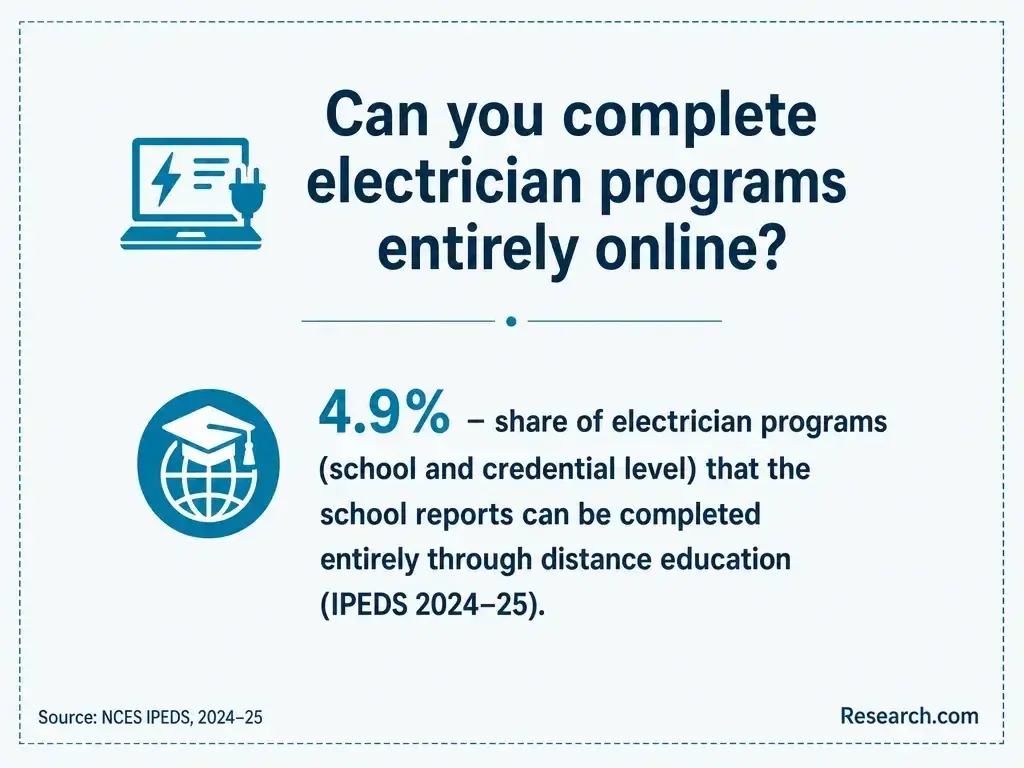
Online study can be practical for electrical theory, calculations, and some code instruction. It cannot, by itself, demonstrate safe tool use, wiring, testing, and troubleshooting on physical equipment - or supply supervised job experience. Campus and hybrid programs are worth comparing by their actual lab access, not just by how much coursework appears online.
A student balancing work may find a hybrid schedule useful if required labs are reachable. When reviewing online trade colleges, confirm where practical sessions take place and whether an employer or apprenticeship sponsor will provide supervised work. Do not assume an entirely online certificate meets Texas licensing requirements.
There is no single reliable Galveston-wide average that covers college courses, employer training, and paid apprenticeships on the same basis. Published tuition also leaves out costs that can determine whether a program is affordable. Request a written, program-specific estimate before comparing options.
Build the same cost picture for each route so a low advertised price does not conceal a higher cost to become job-ready:
Ask Galveston College whether the specific program qualifies for federal aid; school eligibility does not make every short course aid-eligible (Federal Student Aid). Texas Workforce Commission workforce funding may be another possibility for eligible applicants. Listings of affordable online colleges that accept financial aid can help frame aid questions, but an online price is not a substitute for pricing required electrical labs and field experience. For return on investment, weigh completion likelihood, debt, paid training, expected earnings over time, and the income you would otherwise earn - not institution type or tuition alone.
That depends on the route: a school may award a certificate, diploma, or associate degree; a registered apprenticeship has its own completion credential. An industry training credential may document particular skills. None should be described as a Texas journeyman electrician license.
Before enrolling, obtain the exact credential title and ask whether coursework can count toward another program or an apprenticeship's classroom component. Credit or advanced standing is determined by the receiving provider or sponsor, not guaranteed by the school that issued the credential. Readers comparing cheapest online associate's degree options should pay particular attention to where electrical labs occur and whether a local apprenticeship will recognize any prior study.
Requirements vary by provider and pathway. A college may assess reading and math readiness and ask for prior education records; an apprenticeship sponsor may use its own application, assessment, interview, and work-availability criteria. Employers may set additional hiring requirements. Verify the current rules with the specific program rather than assuming admission to a school also secures an apprenticeship or job.
Texas has a separate regulatory step for people working as apprentice electricians: check TDLR's current apprentice-license instructions before beginning electrical work. A school application, an apprenticeship registration, and a TDLR occupational license are different things (TDLR; U.S. Department of Labor). If you need evening study or will commute from the island, confirm the attendance schedule and job-site expectations before accepting a place.
Relevant instruction typically connects electrical theory to safe installation and diagnosis: reading plans, calculating loads, selecting wiring methods, using meters, identifying faults, and applying electrical code. Hands-on practice matters because knowing a circuit diagram is different from making and testing a safe connection (U.S. Bureau of Labor Statistics; O*NET).
Compare course descriptions and equipment lists against the work you want. Someone aiming for industrial maintenance should ask about motors and controls; someone interested in construction should ask about installation practice and code exercises. For either route, find out what students actually build or troubleshoot, how instructors assess safety, and which competencies must later be learned on a supervised job.
Yes - Texas regulates electrical work through TDLR. The appropriate license depends on the work and level of responsibility. An apprentice works under required supervision; progression to journeyman involves documented experience and an examination. TDLR generally requires 8,000 supervised work hours for a journeyman license. A course certificate, industry certification, institutional accreditation, or registered-apprenticeship credential does not independently grant that license (TDLR).
Before paying for training, check TDLR's current license categories, experience documentation, and exam rules for your intended work. Separately verify a college's institutional accreditation, any claimed industry recognition, and whether an apprenticeship is registered with the U.S. Department of Labor. These checks answer different questions; none should be used as a shortcut for the others.
Start with your target job and licensing route, then compare the total cost of reaching it. An affordable certificate can be a sensible entry point if its labs build useful skills and it helps you move into supervised work. A paid apprenticeship may make more financial sense if you are ready to work and can obtain a place. Neither option is automatically better for every applicant.
Use these questions with admissions staff, employers, and apprenticeship coordinators before committing:
Be wary of claims that a quick online course makes you a licensed electrician, that a national median wage is a graduate's expected starting pay, or that a ranking alone establishes program quality. Searches for a best accelerated bachelor's degree online do not answer the licensing and supervised-work questions that govern this trade.
Training can support a move into supervised residential, commercial, or industrial electrical work. With documented experience and the appropriate Texas license, an electrician may pursue broader responsibilities; further experience can support progression toward master electrician eligibility under TDLR rules. Maintenance, controls, and supervisory work may call for additional employer training or specialized skills rather than a different entry-level school credential.
Choose an initial route that matches the first job you can realistically obtain. A Galveston applicant drawn to industrial work may need to consider employers across the wider Houston-Galveston area, while someone seeking construction experience should ask about reachable contractor job sites. An easiest doctoral program search, by contrast, does not help establish the supervised hours or practical competence required for electrician progression.
The U.S. Bureau of Labor Statistics projects 9.2% national employment growth for electricians from 2025 to 2035. That supports considering the trade, but it is not a forecast of openings in Galveston or a promise of employment after a course.
For a local decision, compare current apprenticeship openings and employer postings by work type, pay level, and commute. Construction, maintenance, and industrial employers may want different skills, so the most useful program is one that prepares you for accessible supervised work - not simply the occupation's national outlook.
Investing in electrician training is a consequential decision. Research.com's team built the accompanying affordability ranking to help readers compare programs against other options in the same occupation and location, using reported data and checking source quality. Only programs with completions reported to the Integrated Postsecondary Education Data System (IPEDS) are eligible; an apprenticeship or training provider absent from the ranking may still be a worthwhile option.
The most affordable ranking scores tuition, cost of attendance, median student debt, and federal loan default rate. Indicator weights are assigned through an entropy-based method. Unlike a best-programs ranking, its score does not include accreditation, student support, completion, earnings, or industry recognition. Readers should verify those factors separately before enrolling.
The ranking process draws on the following data sources. Some are cross-occupation reference sources; healthcare-specific organizations, for example, should not be mistaken for authorities on electrician licensing or a quality score for an electrical program.
The ranking can narrow a cost-conscious shortlist, but it cannot establish whether a particular course supplies the lab work, supervised employment, or Texas licensing eligibility you need. See Research.com's methodology for more on how rankings are created.
# 1 position
# 2 position
Trade school is not the only route. Supervised employment and registered apprenticeships can provide work-based training. Check TDLR's license requirements and confirm how your experience will be documented.
No. A school certificate does not replace the supervised work experience and examination required for a Texas journeyman electrician license (TDLR).
It may lower upfront costs because apprentices earn wages, but compare required fees, tools, travel, and the time needed to secure a position. Ask sponsors for their current pay and cost terms.
You may study some theory online, but practical electrical skills and supervised work require in-person participation. Verify any program's lab arrangements before enrolling.
Ask which electrical courses and credentials are currently offered, their complete cost and lab schedule, whether the specific program is aid-eligible, and what support exists for finding supervised work.