# 1 position
Lee College - Electrician.
associate

Audited and Verified:
Our Editorial and Data Verification Process
Research.com uses government datasets, official education statistics and primary institutional information to support its career and degree guides. Our review process checks factual accuracy, occupational definitions, source dates and the requirements associated with the credentials discussed.
How This Article Was Fact-Checked
Our editorial team verifies salary estimates, employment projections, education requirements and program information against original data providers and official organizations. Salary figures are checked against the relevant occupational definitions and reporting periods. Information about licensure, accreditation and required in-person training is reviewed separately.
Fact-checked and verified on:

Co-Founder and Chief Data Scientist

Reviewed by Karolina Broda
Fact-Checker and Data Verification
Choosing the cheapest electrician program is risky if it does not help you gain the supervised experience Texas requires for licensure. The U.S. Bureau of Labor Statistics projects electrician employment to grow 9.2% nationally from 2025 to 2035, making the training decision timely. This guide is for Baytown residents comparing school, apprenticeship, and employer-sponsored routes. It explains costs, credentials, work requirements, and career prospects. The Research.com team of data scientists created the Most Affordable Electrician Trade Schools in Baytown for 2027 ranking to help students make an informed choice about which programs are worth considering.
Expect electrical theory and supervised practice, not an immediate journeyman license. A school-based program may teach circuits, blueprint reading, conduit bending, wiring methods, and safe tool use in a lab. Ask how much instruction involves working with equipment rather than watching demonstrations, and whether the program connects students with employers who can provide qualifying supervised work.
Baytown's location near Houston-area construction and industrial facilities makes the intended job especially important. Residential wiring, commercial construction, and industrial maintenance use overlapping fundamentals but different equipment and worksites. Check whether the training emphasizes the setting where you want to work; a short introductory credential and a paid apprenticeship are not interchangeable.
Potential settings include residential and commercial electrical contractors, construction projects, and industrial facilities in the Baytown-Houston area. Industrial work may involve motors, controls, and troubleshooting around operating equipment; construction work more often involves installing systems to plans and code. The distinction matters when choosing labs, an apprenticeship sponsor, and a commute.
School training can help a candidate seek an entry-level position, but employers determine hiring requirements and Texas regulates electrical work. Before enrolling, ask whether the program has current employer connections in your preferred setting and whether available jobs offer supervision that counts toward your intended license (Texas Department of Licensing and Regulation).
The latest national median annual wage supplied by the U.S. Bureau of Labor Statistics is $63,190 for electricians in May 2025. That is the midpoint for employed electricians across experience levels and locations - not a Baytown wage, apprentice rate, or expected first-year salary. Before accepting a training offer, compare current Baytown-area apprentice job postings or sponsor pay schedules with the program's full cost.
Pay can change substantially with experience, licensure, overtime, and the type of work. If earnings are the main reason you are considering training, compare electrician work with other top vocational degree careers while checking each occupation's entry requirements, not just its reported median wage.
There is no single Baytown program length: an introductory certificate, an associate-degree program, and a registered apprenticeship follow different schedules. Request each provider's published calendar, classroom or lab contact hours, and part-time options. A faster school program may get you ready to apply for work sooner, but it does not compress Texas's supervised-experience requirement for journeyman licensure.
The Texas Department of Licensing and Regulation requires 8,000 hours of on-the-job experience under the supervision of a master electrician for a journeyman electrician license, along with an examination. Ask a prospective employer or apprenticeship sponsor how hours are documented and what work and instruction occur during that period. Paid work can make a longer route financially preferable to an accelerated program that leaves you searching for supervision afterward.
Online instruction can cover electrical calculations, code concepts, and blueprint interpretation. It cannot, by itself, demonstrate safe installation, tool handling, conduit work, or troubleshooting on physical equipment. A hybrid option may suit a working adult if its in-person labs are accessible from Baytown and scheduled around work; an on-campus option may be better for someone who needs regular coached practice.
Ask exactly where and when practical sessions occur and who evaluates them. An online credential should not be advertised or understood as a substitute for supervised jobsite experience or a Texas license. If flexible study is your priority, compare the practical requirements first rather than assuming that courses that pay well can all be completed remotely.
There is no reliable single Baytown-wide average that covers college programs, private training, and paid apprenticeships on the same basis. For a school option, request a current, itemized quote from Lee College or any provider you are evaluating. Compare the cost to become job-ready, not only advertised tuition.
The largest cost categories can vary by route. This comparison shows what to include before deciding which offer is genuinely more affordable:
| Cost factor | School-based program | Paid apprenticeship or employer route |
| Instruction | Tuition and mandatory fees; ask about resident-rate eligibility | Ask about required class fees and any employer-paid instruction |
| Work preparation | Tools, PPE, books or software, and consumable materials | Tools, PPE, and any sponsor-provided equipment |
| Other costs and offsets | Travel, licensing costs, lost work time, and eligible aid | Travel, licensing costs, wages earned while training, and benefits |
Federal aid depends on both the student's eligibility and the program's eligibility; do not assume every short course qualifies (Federal Student Aid). Ask about grants, workforce funding, and tool assistance before taking a loan. For a return-on-investment comparison, consider debt, completion likelihood, wages you could earn during training, expected pay afterward, and how long you expect to work - not institutional type alone. Readers comparing highest paid certificate programs should apply the same total-cost test.
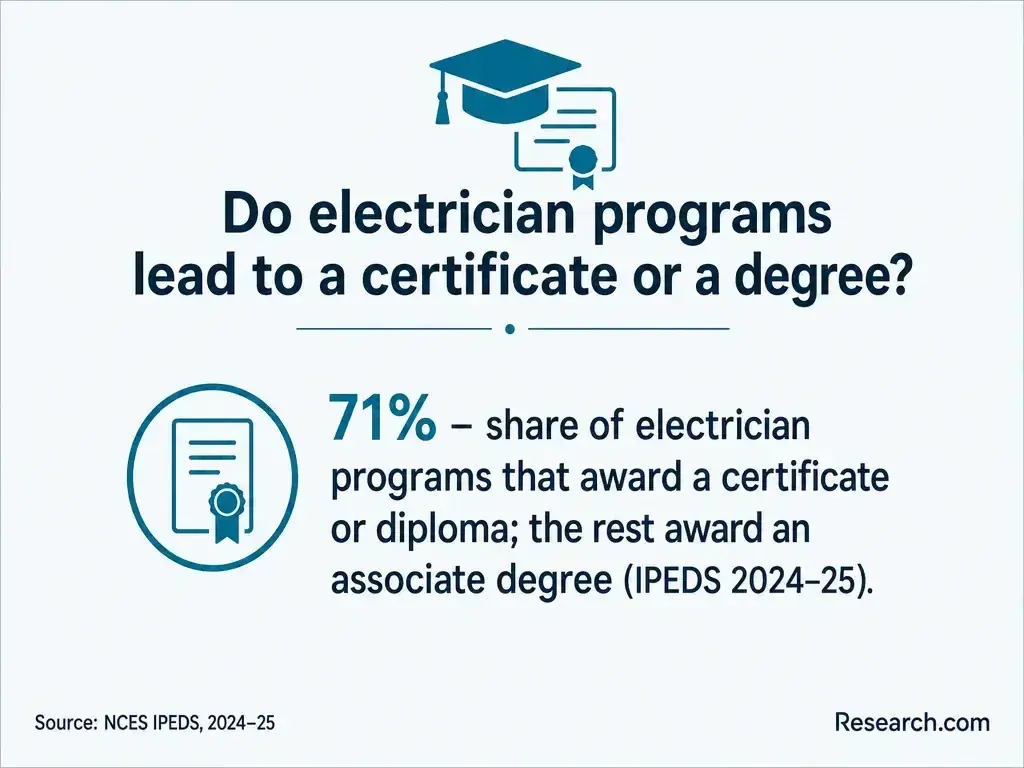
That depends on the route. A school may award a certificate or associate degree; an apprenticeship provides structured work-based training and its own completion credential. Neither is the same as a Texas occupational license. Ask for the exact credential name, the skills assessed, and whether the provider can document training for employers or an apprenticeship sponsor.
Institutional accreditation concerns the school, while state school authorization concerns its permission to operate. Industry credentials, such as those associated with NCCER training, assess different things; apprenticeship registration concerns the training arrangement. None automatically grants Texas journeyman status. If you may later continue your training, ask Lee College or a prospective sponsor whether prior coursework or documented work earns credit or advanced standing, and obtain the answer in writing.
Admissions rules vary by school and sponsor. Request the current requirements for academic preparation, placement, application deadlines, physical work, and any employer screening before paying an application fee. A registered apprenticeship can have a separate selection process from college enrollment; admission to one does not guarantee entry to the other.
To perform electrical work as an apprentice in Texas, a person generally must be at least 16 and hold the appropriate apprentice electrician license while working under required supervision (Texas Department of Licensing and Regulation). Confirm current application and supervision rules with the regulator and prospective employer. A useful admissions question is: "What specific step can I take after completing this program, and who will supervise my next qualifying work hours?"
A useful entry-level curriculum links circuit theory and electrical calculations to code-based installation, reading plans, selecting materials, testing, and finding faults. Safety should be practiced throughout lab work, including recognizing energized hazards and using appropriate protective equipment - not treated as a stand-alone lecture. These skills reflect the installation, maintenance, and troubleshooting duties described by the U.S. Bureau of Labor Statistics.
For Baytown students interested in industrial facilities, ask whether labs include motors or controls as well as building wiring. For construction work, ask how much time is spent installing conduit and interpreting drawings. A similarly named certificate elsewhere may offer a very different balance of hands-on practice and theory; compare published course descriptions and lab access.
Yes, Texas electrical work is licensed. The appropriate license depends on the work and level of responsibility. An apprentice works under required supervision; a journeyman applicant must meet the Texas Department of Licensing and Regulation's experience requirement and pass an examination. Other license categories have different scopes and requirements. Graduating from trade school does not itself authorize independent electrical work (Texas Department of Licensing and Regulation).
Verify the current license category for your intended job before choosing training. If your goal is eventually to operate an electrical contracting business, ask about the separate contractor requirements rather than assuming a journeyman license covers business operations. Optional industry training certificates can strengthen an application, but they do not replace state occupational licensure.
Start with the job you want, then compare a school route with a registered apprenticeship or employer-sponsored opening. A school program may suit someone who wants structured preparation before applying for electrical work. A paid route may suit someone ready for supervised work and seeking to limit lost earnings. Neither choice is worthwhile if its schedule or practical training prevents you from progressing toward your goal.
Use these checks when speaking with Lee College, another eligible provider, or an apprenticeship coordinator; request written answers where costs or credit are involved:
Common red flags include promises that a short certificate makes you a journeyman, an "online-only" practical qualification, or a low tuition figure that omits required equipment. A ranking helps narrow choices, but these checks determine whether a program fits your intended occupation. The same caution applies when comparing a list of accredited online colleges with no application fee: convenient admission and accreditation do not establish hands-on electrical training or licensing eligibility.
An entry-level worker may begin as a supervised apprentice with a contractor or industrial employer, develop experience toward a Texas journeyman license, and later pursue specialized, supervisory, or master-level work if the applicable requirements are met. Residential, commercial, and industrial settings offer different skill development; ask where an employer's apprentices actually spend their time (Texas Department of Licensing and Regulation; U.S. Bureau of Labor Statistics).
For someone considering other skilled trades, the key comparison is the work itself and the time until qualified employment - not a headline wage. Explore lucrative majors only as a broader earnings comparison; it does not replace checking the costs, supervised hours, and licensing steps specific to an electrician career.
The U.S. Bureau of Labor Statistics projects 9.2% national growth in electrician employment from 2025 to 2035. That indicates demand across the occupation, but it is not a forecast of Baytown vacancies or a promise of work after training. For a local decision, check current openings by work setting and ask apprenticeship sponsors and employers when they expect to take new entrants.
Baytown residents can search beyond the city because training sites and jobsites may be spread across the Houston area. That broader market can expand options, but commuting time and vehicle costs may change which offer is affordable. Favor a program or sponsor whose practical training and likely work locations you can reliably reach.
Investing in electrician training is an important decision, so the Research.com team evaluates programs against others in the same occupation and location rather than against unrelated schools. Only programs with completions reported to IPEDS qualify for the ranking. That means a registered apprenticeship or employer training route may be a sound option even if it does not appear.
The most affordable ranking scores tuition, cost of attendance, median student debt, and federal loan default rate. An entropy-based method gives more weight to cost and debt measures that differ more across eligible programs. Unlike a best-programs ranking, its score does not include accreditation, student outcomes, earnings, or support services. Readers should therefore use the ranking to shortlist options, then verify practical training and Texas licensing alignment themselves.
To check the quality and credibility of the underlying information, the team drew on these data sources; some also provide occupation-specific context rather than an electrician-specific score:
The allied-health and dental sources do not establish electrician-program approval. For more on how Research.com constructs its rankings, see its ranking methodology.
# 1 position
# 2 position
# 3 position
No. School can build foundational skills, but supervised employment and registered apprenticeships are also training routes. Choose a route that lets you meet the requirements for the Texas license you intend to pursue (Texas Department of Licensing and Regulation).
Do not assume it does. Texas's journeyman requirement concerns qualifying supervised on-the-job experience. Ask the Texas Department of Licensing and Regulation how your specific work will be documented before relying on a program's claim.
You can study some theory online, but practical installation and supervised work require in-person participation. Check where a hybrid program holds its labs and how it connects students to qualifying work.
It may be after wages and employer-paid training are considered, but compare required fees, tools, travel, and the time needed to secure a place. Request an itemized school quote and an apprentice pay schedule before deciding.
Ask what credential it awards, how much hands-on practice it provides, its full cost, and how students obtain supervised work. Those answers reveal more about its value than tuition alone.