# 1 position


Audited and Verified:
Our Editorial and Data Verification Process
Research.com uses government datasets, official education statistics and primary institutional information to support its career and degree guides. Our review process checks factual accuracy, occupational definitions, source dates and the requirements associated with the credentials discussed.
How This Article Was Fact-Checked
Our editorial team verifies salary estimates, employment projections, education requirements and program information against original data providers and official organizations. Salary figures are checked against the relevant occupational definitions and reporting periods. Information about licensure, accreditation and required in-person training is reviewed separately.
Fact-checked and verified on:

Co-Founder and Chief Data Scientist

Reviewed by Karolina Broda
Fact-Checker and Data Verification
The cheapest electrician program is not necessarily the least expensive route to a job: tools, travel, unpaid training time, and apprenticeship access can change the calculation. The U.S. Bureau of Labor Statistics projects 9.2% national growth in electrician employment from 2025 to 2035, making the training choice timely. For prospective students and career changers, this guide compares Indianapolis pathways, costs, credentials, and entry requirements. It also accompanies the Most Affordable Electrician Trade Schools in Indianapolis for 2027 ranking, created by the Research.com team of data scientists to help students identify programs worth considering.
An Indianapolis electrician training program should teach electrical theory alongside supervised practice: reading plans, installing wiring and raceways, making connections, testing circuits, and applying electrical-code and jobsite-safety rules. The important distinction is preparation versus occupational experience. A classroom-and-lab certificate can help someone qualify for an entry-level position, but it should not be mistaken for the work experience gained through an apprenticeship.
These pathways serve different budgets and schedules. Confirm the exact credential, practical hours, and employer connection rather than treating similarly named programs as interchangeable.
| Pathway | What it provides | Best fit and main trade-off |
| Pre-apprenticeship or short certificate | Foundational instruction and labs; usually a school or training-provider credential | A way to test the trade or strengthen an application, but not a substitute for sustained supervised work |
| Community-college or career-school program | Structured coursework and shop practice; a certificate, diploma, or, where offered, an associate degree | Useful when substantial preparation is needed before applying for work; compare tuition and whether employers credit the training |
| Registered apprenticeship | Paid, supervised work with related instruction and an apprenticeship completion credential | Strong fit for learning while earning; entry may be competitive and completion takes longer |
| Employer-sponsored entry | Job-based training that varies by employer | Potentially lower upfront cost; verify who provides instruction and whether experience is documented and portable |
If a search for the easiest associate degree to obtain led you toward electrical work, focus instead on the program's shop training and route into supervised employment. Ivy Tech Community College and Lincoln College of Technology-Indianapolis are two providers to investigate; ask each for its current electrician-specific offerings rather than assuming every campus credential leads to the same job.
Electricians work for electrical contractors on residential and commercial construction, in building maintenance, and in industrial facilities (U.S. Bureau of Labor Statistics). In Indianapolis, that variety matters: a student seeking construction work should ask about installation practice and contractor connections, while someone targeting facility maintenance should look for troubleshooting, motors, and controls. The first job may require traveling between worksites rather than reporting to one fixed location.
Ask providers which local employers hire their trainees, whether placements are paid, and what share of hands-on learning occurs on an actual worksite. Treat a list of employer contacts as a starting point for verification, not a placement guarantee.
The national median annual wage for electricians was $63,190 in May 2025 (U.S. Bureau of Labor Statistics, Occupational Outlook Handbook). That figure covers experienced workers as well as newer electricians and is not an Indianapolis starting-pay estimate. Apprentices generally earn wages while training, with pay that varies by sponsor and progression; a short school credential alone does not justify using the national median as an expected first salary.
For a local earnings decision, request current apprentice and entry-level pay schedules from Indianapolis employers or apprenticeship sponsors. Compare those figures with your present earnings, expected training time, and likely commuting costs before deciding how much tuition or debt is reasonable.
A short pre-apprenticeship or school certificate may take far less time than becoming an experienced electrician, but published program lengths vary. A registered electrician apprenticeship commonly takes four to five years and combines paid on-the-job learning with technical instruction (U.S. Bureau of Labor Statistics, Occupational Outlook Handbook). Federal registered-apprenticeship standards use a typical benchmark of at least 2,000 hours of on-the-job learning per year and recommend at least 144 hours of related instruction annually; confirm the actual schedule with the sponsor (U.S. Department of Labor, apprenticeship regulations).
When comparing a full-time school program with part-time study, ask for its required classroom, lab, and field hours - not just the number of months advertised. Also ask whether a subsequent apprenticeship grants documented credit for prior training. Finishing school sooner may get you to an entry-level interview sooner without shortening the supervised experience an employer expects.
Online coursework can cover electrical theory, calculations, blueprint reading, and code concepts. It cannot by itself demonstrate safe use of tools, wiring installation, testing, or supervised performance on a jobsite. For that reason, compare where and how practical skills are assessed, not simply whether a program calls itself online or hybrid.
If you are comparing electrician training with a fast paced bachelor degree online, the scheduling question is different: electrical labs and field learning still require physical access. Ask a hybrid provider where labs take place, how often attendance is mandatory, and whether you must arrange your own local work placement. Do not assume remote coursework satisfies an employer's apprenticeship or a locality's licensing rules.
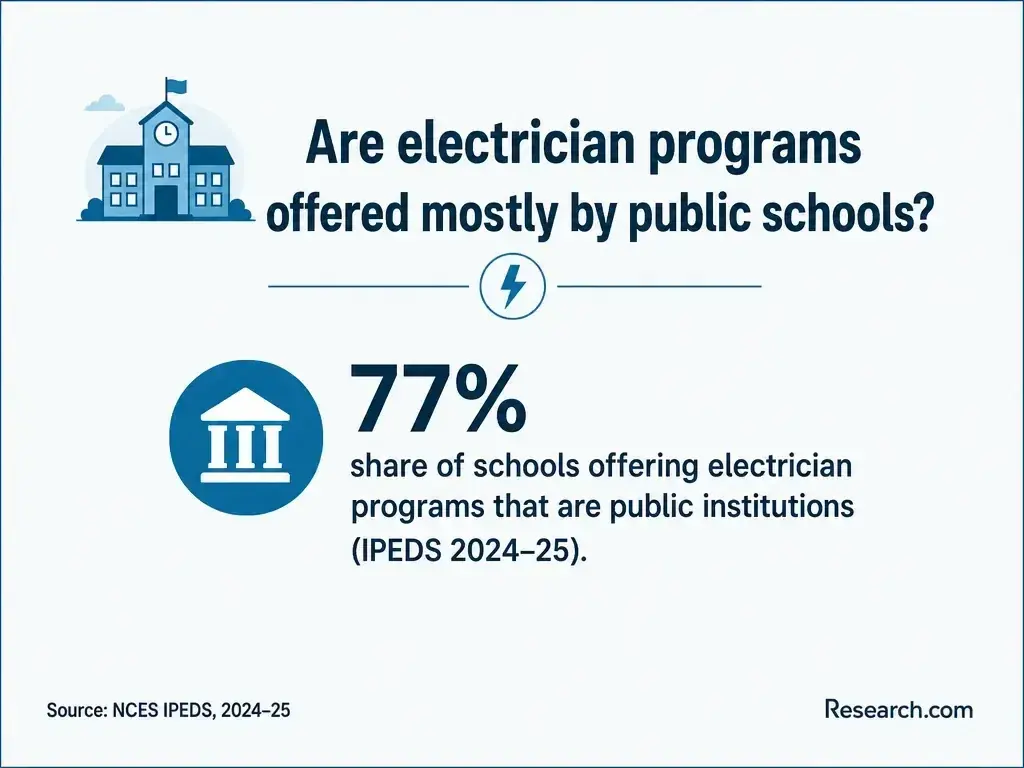
There is no dependable single average price for all Indianapolis electrician pathways: tuition-charging programs and paid apprenticeships have different cost structures, and published prices may omit job-readiness expenses. For a 2027 decision, obtain a current written estimate from each provider rather than treating an earlier advertised tuition figure as your final bill.
Compare these cost categories side by side, including expenses that remain even if instruction is funded:
Ask whether a program participates in federal student aid and whether the particular credential qualifies; eligibility is not automatic for every trade course (Federal Student Aid). Indiana's Next Level Jobs initiatives may also be worth checking for eligible workforce training, but verify current program and student eligibility with the administering agency (Indiana Next Level Jobs). A search for the most affordable online master's will not answer the electrician-cost question: the relevant comparison is total cost through job entry, net of any paid training.
The credential depends on the pathway. A school may award a certificate, diploma, or associate degree; a registered apprenticeship documents completion of its structured work-and-instruction program (U.S. Department of Labor, Apprenticeship.gov). An industry training credential, where offered, is different from both a school award and an occupational license. Ask employers which credentials they recognize and whether completed coursework can count toward further training.
Do not treat a school's institutional accreditation, a program's industry recognition, state authorization to operate, apprenticeship registration, and local permission to perform regulated work as interchangeable. If a listing of the highest paying online certifications appeals to you, verify what hands-on assessment and work experience the intended electrical role actually requires before paying for a credential.
Entry requirements vary by provider and employer. School programs commonly ask for an application and evidence of prior schooling, while apprenticeships may assess math preparation, aptitude, interview performance, and ability to reach worksites. Employers may have additional hiring and safety requirements. Obtain the current written criteria from each school or sponsor rather than assuming acceptance into one route means eligibility for another.
Before applying, ask whether math support is available, when lab sessions meet, what tools you must supply, and whether you need reliable transportation to changing Indianapolis-area job locations. If you already have electrical coursework or related work experience, request a written evaluation of possible prior-learning credit or apprenticeship advanced standing; neither should be assumed.
Effective instruction connects electrical fundamentals to tasks an entry-level worker will perform: measuring voltage safely, interpreting diagrams, selecting materials, installing and terminating conductors, finding faults, and following applicable electrical-code requirements. Jobsite communication, documentation, and coordination with other trades matter because electrical work is performed within larger construction and maintenance teams (U.S. Bureau of Labor Statistics, Occupational Outlook Handbook).
Look closely at the training environment. Ask how many hours students spend in supervised labs or shops, what equipment they use, how instructors check safe technique, and whether the program provides field experience. A syllabus that lists code topics but gives little opportunity to build and test circuits may not meet your goal of qualifying for hands-on work.
Indiana does not issue one statewide journeyman electrician license that a trade-school graduate automatically receives. Electrical licensing and contractor requirements can be local, so the rules relevant to work in Indianapolis depend on the role and jurisdiction (Indiana Professional Licensing Agency; Indianapolis Department of Business and Neighborhood Services). In particular, training as an employee should not be confused with qualifying to contract for electrical work independently.
Before enrolling, describe your intended job to the Indianapolis licensing authority and ask what, if any, examination, experience, application, or contractor requirements apply. Then ask the provider to show how its instruction and documented practical experience support that route. Institutional accreditation or apprenticeship registration does not replace a locally required license.
Start with the job you want, then compare each program's route to that job. An affordable certificate can be a sensible investment if it supplies needed lab practice and access to entry-level hiring. A paid apprenticeship may be preferable if you can secure a place and need to earn while learning. Neither choice is automatically better: duration, completion likelihood, aid, debt, current earnings, future earnings, and the time over which you expect a return all affect value.
Use the following checks before paying a deposit; they expose gaps that a price ranking alone cannot show:
A list of the best universities answers a different question. For electrician training, a red flag is any provider that cannot explain its hands-on component or implies that graduation alone authorizes independent electrical work.
Training can lead toward construction electrical work, maintenance, or an apprenticeship, depending on the credential and the employer's hiring standards. With additional supervised experience, workers may move into more complex troubleshooting, industrial systems, crew leadership, or contracting where locally permitted (U.S. Bureau of Labor Statistics, Occupational Outlook Handbook). Those later roles should not be presented as immediate outcomes of a short certificate.
If you want commercial installation, prioritize programs with plan reading and installation labs. If your goal is maintenance, ask about motors, controls, and diagnostic practice. Someone considering self-employment should investigate Indianapolis contractor requirements early, because school completion and the ability to bid or contract for work are separate questions.
U.S. electrician employment is projected to grow 9.2% from 2025 to 2035 (U.S. Bureau of Labor Statistics, Employment Projections). That national outlook supports investigating the trade, but it does not measure Indianapolis openings or guarantee a position after training. Local demand can differ by construction activity, facility hiring, and the availability of apprenticeship placements.
Use the outlook as context, then test the immediate market: compare current local job postings with the skills taught, ask sponsors about intake dates, and check whether employers seek helpers, apprentices, or experienced electricians. This is especially important before paying for an accelerated program that does not itself provide documented work experience.
Investing in training is a consequential decision. To make the accompanying ranking useful for local comparisons, the Research.com team evaluates electrician programs against other programs in the same occupation and location and checks multiple education data sources. Only programs with completions reported to IPEDS are included; an apprenticeship or employer program missing from the ranking may still be a strong option.
The most affordable ranking scores costs and debt: tuition, cost of attendance, median student debt, and federal loan default rate. Indicator weights are assigned using an entropy-based method, which gives more weight to measures that differ more across programs. Accreditation and other quality indicators are not part of this affordability score. Research.com's separate best-programs methodology considers student outcomes, earnings and return on investment, costs and debt, and quality and recognition; those are not the same as the affordability ranking. Readers can review more detail on Research.com's methodology.
The ranking draws on the following sources. Some cover education broadly or occupations other than electrical work; their inclusion as data sources does not mean they establish electrician licensing eligibility.
Use the ranking to narrow a shortlist, then request each program's current, itemized price and confirm its practical training and employment pathway. A low affordability score cannot tell you whether a particular credential meets an employer's requirements.
# 1 position
# 2 position
# 3 position
# 4 position

# 5 position
Not necessarily. A registered apprenticeship or employer-sponsored route may combine work and instruction without a separate tuition-funded school program. Check the hiring and local licensing requirements for your intended role (U.S. Department of Labor; Indianapolis Department of Business and Neighborhood Services).
It may reduce tuition costs and provide wages, but tools, transportation, and the time required still matter. Compare written offers and expenses rather than assuming either pathway always costs less.
Theory may be taught remotely, but wiring, testing, safe tool use, and supervised jobsite skills require in-person practice. Verify where those activities occur before enrolling.
No. A school certificate documents training, not automatic permission to perform locally regulated work. Confirm applicable Indianapolis requirements with the licensing authority (Indianapolis Department of Business and Neighborhood Services).
Ask for the current total price, required lab and field hours, exact credential, apprenticeship or employer connections, and evidence of how graduates enter electrical work.