# 1 position
HVAC Technical Institute - Electrician.
certificate or diploma

Audited and Verified:
Our Editorial and Data Verification Process
Research.com uses government datasets, official education statistics and primary institutional information to support its career and degree guides. Our review process checks factual accuracy, occupational definitions, source dates and the requirements associated with the credentials discussed.
How This Article Was Fact-Checked
Our editorial team verifies salary estimates, employment projections, education requirements and program information against original data providers and official organizations. Salary figures are checked against the relevant occupational definitions and reporting periods. Information about licensure, accreditation and required in-person training is reviewed separately.
Fact-checked and verified on:

Co-Founder and Chief Data Scientist

Reviewed by Karolina Broda
Fact-Checker and Data Verification
Choosing electrician training in Illinois means comparing more than tuition: a short certificate, a paid apprenticeship, and an associate degree can lead to very different levels of job-site experience. The U.S. Bureau of Labor Statistics projects 9.2% national growth in electrician employment from 2025 to 2035. For prospective students and career changers, this guide explains costs, credentials, local rules, and career prospects. It also features a Best Electrician Trade Schools in Illinois for 2027 ranking created by the Research.com team of data scientists to help you identify programs worth considering.
Expect a mix of classroom instruction and physical practice: reading plans, applying electrical code, installing and testing circuits, and working safely with tools. The decisive difference among programs is whether practice happens mainly in a school lab or continues through supervised work on real job sites. Before enrolling, ask for the lab schedule, equipment list, instructor qualifications, and any documented placement arrangement with an apprenticeship sponsor or employer.
Illinois students can pursue community college or career-school certificates, an electrical-technology associate degree, a pre-apprenticeship, or a registered apprenticeship. A pre-apprenticeship prepares applicants for entry but is not itself a registered apprenticeship. A registered apprenticeship has a sponsor, structured on-the-job learning, related instruction, and wages while training (U.S. Department of Labor). Some students can enter an apprenticeship or employer training without first paying for trade school; others benefit from school-based fundamentals before competing for an opening.
If you are comparing the named programs in the ranking, check the current electrician-specific offering at Southwestern Illinois College, Kaskaskia College, or College of Lake County rather than assuming similarly titled technical programs teach the same skills. Confirm any electrical curriculum at HVAC Technical Institute or Lincoln College of Technology-Melrose Park as well: related HVAC or maintenance training is not automatically a route into electrician work.
Electricians work for electrical contractors on residential, commercial, and industrial projects and for organizations maintaining facilities and equipment (U.S. Bureau of Labor Statistics). In Illinois, a student considering the Chicago area should compare contractor and apprenticeship opportunities with commute time and applicable municipal rules. Someone in a smaller market may find that travel to a job site or training center materially changes the cost of an otherwise affordable program.
Match your training to the work you want. Building construction emphasizes installation and code-compliant wiring; industrial maintenance can place greater weight on motors, controls, and troubleshooting. Ask prospective employers whether they hire graduates directly into supervised roles, require entry through an apprenticeship, or expect previous job-site hours. A school's employer relationships matter more when they lead to an identifiable next step, not merely a list of companies that might hire electricians.
Pay depends on location, employer, experience, specialization, and hours worked. The latest national BLS Occupational Outlook Handbook figure supplied for electricians is a May 2025 median annual wage of $63,190. That is the midpoint for employed electricians nationwide - not an Illinois starting wage, an apprentice wage, or a prediction of what a certificate holder will earn.
For an Illinois decision, compare current area-specific electrician wages in the U.S. Bureau of Labor Statistics Occupational Employment and Wage Statistics with actual apprentice wage schedules from sponsors you could join. Ask whether an advertised wage assumes overtime, a completed apprenticeship, or travel between sites. The useful comparison is your likely pay during and after training against what you could earn without enrolling, not the national median alone.
A school certificate may take less time than an associate degree, but its calendar length does not tell you how much supervised electrical work it provides. A registered apprenticeship typically takes several years because related instruction runs alongside progressively skilled, paid job-site work; the sponsor's approved standards determine its actual schedule and hours (U.S. Department of Labor). Ask each provider for required classroom, lab, and work-site hours and whether evening or part-time attendance extends completion.
Acceleration is useful only if it preserves the practice needed for your intended role. Even a quickest online associates degree comparison cannot establish how soon you could work independently as an electrician: electrical labs and supervised field experience follow a different timetable. If you already have related experience, ask whether a sponsor grants documented advanced standing or whether a college awards prior-learning credit; obtain the decision in writing before budgeting for a shorter path.
Online delivery can make code study, electrical theory, calculations, and some assignments easier to fit around work. It cannot by itself demonstrate safe installation, tool use, testing, or troubleshooting on physical equipment. A hybrid program makes sense when its in-person labs are accessible and its work-site component is clear; an entirely online course is better treated as theory or exam preparation until a provider documents how practical competencies are assessed.
When reviewing top vocational colleges online, look past the delivery label. Ask where labs take place, how often attendance is required, who arranges supervised experience, and whether the resulting credential is recognized by an employer or apprenticeship sponsor. For a student far from a training center, required trips may outweigh the convenience of remote coursework.
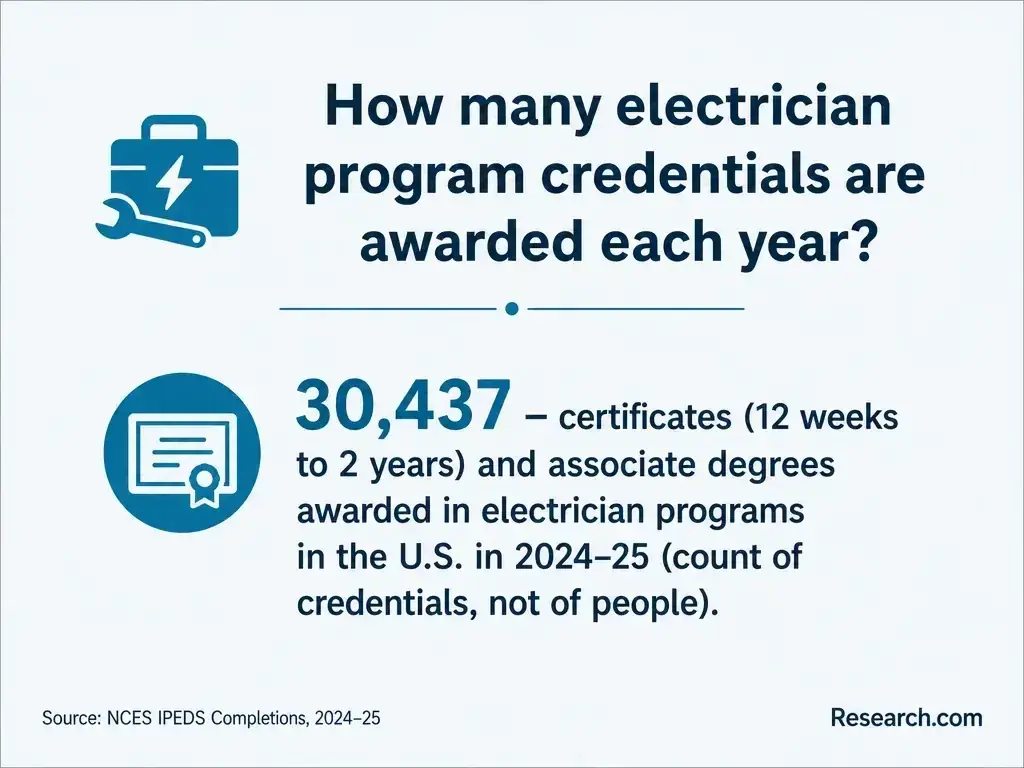
There is no single defensible statewide average that captures Illinois community college certificates, private career-school programs, and paid apprenticeships on the same basis. Published tuition can omit charges that determine what you must spend to become job-ready. Request a written, program-specific estimate and compare the total cost to your next employment step, not just the advertised tuition.
Use these categories to build that estimate; ask which costs are included, optional, reimbursed, or paid separately.
Federal aid depends on the institution and program's eligibility, not simply its trade-school label (Federal Student Aid). Ask a college about its aid eligibility and Illinois student assistance; ask an apprenticeship sponsor about wage progression, tool costs, and related-instruction charges. For return on investment, consider completion probability, debt, earnings before and after training, the time needed to reach higher pay, and the value of money over that time. A cheaper program that leaves you without a viable work-entry route may cost more in the long run.
The award depends on the pathway. A school may award a certificate or diploma; an associate degree is an academic credential with a broader course load. A registered apprenticeship leads to a completion credential issued through its registered program, after the sponsor's required instruction and work-based training are completed (U.S. Department of Labor). These awards are not interchangeable evidence of job-site proficiency.
Ask exactly what appears on the transcript or completion record and whether an apprenticeship sponsor will recognize any school coursework. Institutional accreditation concerns the school; state authorization concerns permission to operate; apprenticeship registration concerns the sponsor's training structure; and occupational licensing concerns legal permission to perform regulated work. None automatically substitutes for another. For an electrical program, relevant industry-aligned training - such as an applicable NCCER curriculum - may be useful, but verify what an employer actually recognizes (National Center for Construction Education and Research).
Requirements vary by provider and pathway. A school may ask for a high school credential, placement assessment, or prerequisite coursework; an apprenticeship sponsor may also assess math, require an interview, and set conditions for job-site work. Confirm the current requirements with the specific program or sponsor rather than assuming school admission also secures an apprenticeship position.
Before applying, ask whether you must obtain tools, meet transportation or work-schedule expectations, or complete any employer-required screening. If you are comparing admission guides such as easiest master's programs to get into, do not apply their selectivity assumptions to this trade: an electrician pathway must be judged by both entry requirements and access to supervised electrical work.
A useful entry-level curriculum combines electrical theory with measurement, wiring methods, blueprint reading, circuit installation, testing, troubleshooting, and safety. Instruction should show students how to find and apply the electrical code adopted by the authority having jurisdiction rather than treating one classroom code exercise as permission to perform unsupervised work. Motor controls or industrial systems may matter more if your target is plant maintenance; residential installation may matter more if your target is a housing contractor (U.S. Bureau of Labor Statistics; National Center for Construction Education and Research).
Ask to observe a lab or review its equipment inventory. Practice on panels and circuits can build foundational technique, but it does not reproduce every constraint of an occupied building or active construction site. Stronger programs explain how students move from controlled lab exercises to supervised field tasks and how instructors assess safe work, not just written answers.
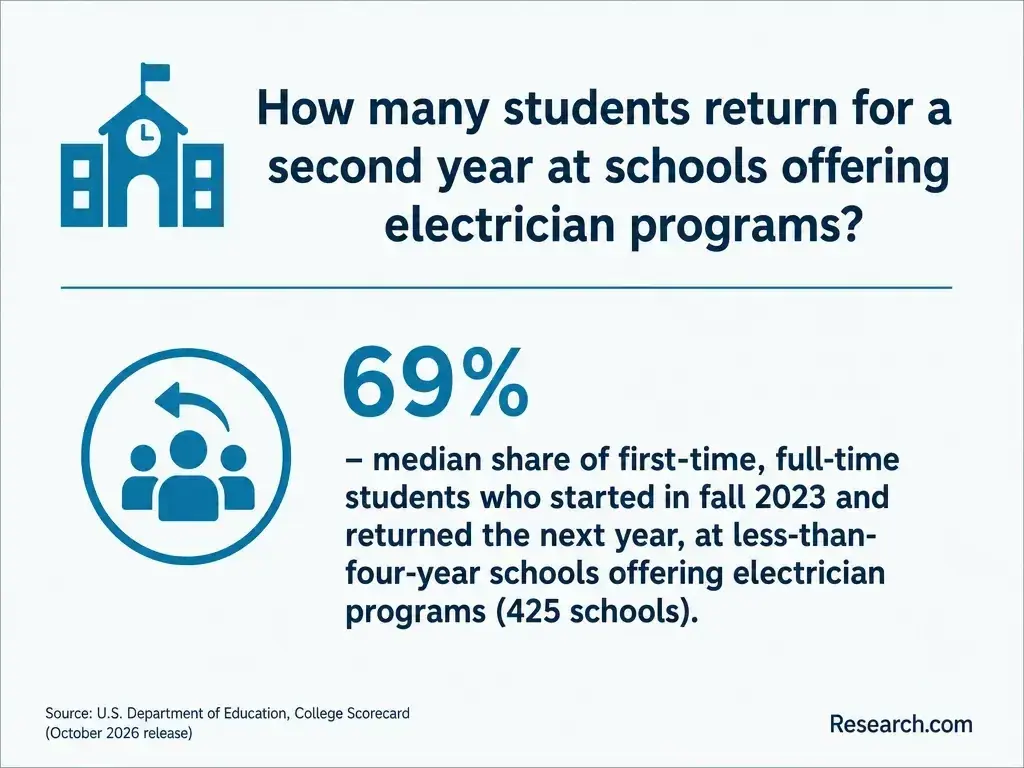
Illinois does not issue a general statewide occupational license for individual electricians; local jurisdictions may impose their own rules for electrical work or contractors. Chicago, for example, regulates electrical contractors through its Department of Buildings (Illinois Department of Financial and Professional Regulation; City of Chicago Department of Buildings). Before choosing training, contact the building department where you plan to work and ask what applies to your intended role, who may supervise you, and what a contractor must hold.
A school certificate, an optional industry credential, and a registered apprenticeship completion record are distinct from a local license. Do not assume that graduating makes you eligible to operate independently or that rules in one municipality carry over to another. If self-employment is your eventual goal, investigate local contractor requirements early; they may affect which experience and examination preparation you need after school.
Start with the job you want and work backward: identify the local rules, the employer or apprenticeship entry route, the supervised experience needed, and only then the school credential. A ranking can help you shortlist programs, but it cannot tell you whether a particular lab schedule, commute, or sponsor relationship fits your circumstances. Likewise, a list of best non profit accredited online colleges does not establish that an electrician program provides accessible hands-on instruction.
Put the same questions to every school and apprenticeship sponsor so that their answers are comparable.
Verify institutional accreditation with the accreditor, school authorization with the relevant Illinois regulator, and apprenticeship registration with the sponsor or U.S. Department of Labor. Treat an unclear practical-training plan, an unverifiable placement claim, or pressure to enroll before receiving a complete cost estimate as a reason to pause.
A realistic first step is a supervised helper or apprentice role, followed by more complex installation or maintenance work as skills and experience grow. Electricians may later specialize in residential or commercial construction, industrial controls, or service troubleshooting; some move into supervision or contracting, subject to applicable local rules (U.S. Bureau of Labor Statistics; City of Chicago Department of Buildings). The relevant question is which first job a program prepares you to pursue, not how many advanced titles appear in its brochure.
If earnings drive your decision, a comparison with majors that make a lot of money is less useful than comparing your own electrician training costs, paid apprenticeship opportunities, and likely progression. An associate degree may suit someone seeking broader technical coursework; a registered apprenticeship may better suit someone ready for sustained paid field training. Neither route guarantees a supervisory job or independent contracting work.
The U.S. Bureau of Labor Statistics projects 9.2% growth in electrician employment nationally from 2025 to 2035. That signals a growing occupation, but a national projection does not measure vacancies near your Illinois home or guarantee an apprenticeship opening. Construction activity, maintenance needs, and the availability of sponsors can differ across local labor markets.
For a local check, use Illinois Department of Employment Security occupational projections and compare them with current postings from contractors and registered apprenticeship sponsors in commuting range. Note whether postings seek beginners, experienced electricians, or workers with a particular specialization. If most suitable openings require field experience, prioritize a program with a credible transition into supervised work over one that offers only classroom instruction.
Education is a substantial investment, so the Research.com team built this ranking to help readers compare electrician programs with other options in the same occupation and location. The team checks multiple education and recognition sources and evaluates outcomes, costs, and quality rather than relying on tuition or reputation alone. Only programs with completions reported to IPEDS qualify for inclusion; an unlisted apprenticeship or training provider is not necessarily a poor option.
Best-program rankings assess completion and full-time and part-time retention; earnings one year after completion and earnings relative to annual attendance cost; tuition, attendance cost, debt - including debt held by students who withdrew - and federal loan default rates; and accreditation, relevant industry recognition, and student support. Relevant programmatic accreditation or industry recognition accounts for 20% of the score, institutional accreditation for 10%, and student support for 10%. The remaining 60% covers outcomes, earnings, and costs, with weights assigned using an entropy-based method that gives more weight to indicators that vary more across programs. Most-affordable-program rankings instead score only tuition, attendance cost, median debt, and federal loan default rates; accreditation and other quality indicators do not enter that score.
The following sources were used to create the ranking. Some cover occupations outside electrical work; their inclusion as ranking sources does not mean those organizations accredit electrician programs.
Use the ranking to narrow your choices, then confirm each program's current schedule, total price, hands-on instruction, and route into employment. Research.com explains its broader approach on its methodology page.
# 1 position
# 2 position

# 3 position
# 4 position

# 5 position
# 6 position
# 7 position

# 8 position

# 9 position
Electrical and Power Transmission Installation/Installer, General
Delivery mode: On Campus (May Include Online Courses)
21.74
/ 100
Final score
Accreditation
Institutional accreditation from Higher Learning Commission.
Illinois Eastern Community Colleges received a Research.com Trade Program Score of 21.74/100.
# 10 position
# 11 position
# 12 position

# 13 position

# 14 position
# 15 position

# 16 position

# 17 position

# 18 position
# 19 position

# 20 position
Not necessarily. Some sponsors admit applicants directly and provide related instruction alongside paid work. Ask the sponsor whether prior school training improves admission prospects or earns advanced standing (U.S. Department of Labor).
Online coursework can teach theory, but it cannot replace hands-on installation and supervised field experience. Confirm where and how a program provides practical training before enrolling.
A certificate may be a shorter route to foundational skills; an associate degree includes broader coursework. Choose based on the curriculum, cost, and whether employers or apprenticeship sponsors recognize the training - not the credential name alone.
No certificate alone establishes that right. Illinois has no general statewide individual electrician license, while local rules may apply to electrical work or contracting. Check the jurisdiction where you intend to work (Illinois Department of Financial and Professional Regulation; City of Chicago Department of Buildings).
Get the full price, including tools and travel, then verify its hands-on hours and route into supervised employment. Compare that cost with eligible aid or paid-apprenticeship wages and ask for evidence supporting program-specific outcomes.