# 1 position

Audited and Verified:
Our Editorial and Data Verification Process
Research.com uses government datasets, official education statistics and primary institutional information to support its career and degree guides. Our review process checks factual accuracy, occupational definitions, source dates and the requirements associated with the credentials discussed.
How This Article Was Fact-Checked
Our editorial team verifies salary estimates, employment projections, education requirements and program information against original data providers and official organizations. Salary figures are checked against the relevant occupational definitions and reporting periods. Information about licensure, accreditation and required in-person training is reviewed separately.
Fact-checked and verified on:

Co-Founder and Chief Data Scientist

Reviewed by Karolina Broda
Fact-Checker and Data Verification
If you live near Creston, the central question is whether an electrician program will help you enter a paid apprenticeship - not simply whether it awards a credential. The U.S. Bureau of Labor Statistics projects 9.2% growth in electrician employment nationwide from 2025 to 2035. This guide compares training routes, costs, Iowa licensing rules, and career prospects. It also accompanies the Best Electrician Trade Schools in Creston for 2027 ranking, created by the Research.com team of data scientists to help students identify programs worth considering and make an informed choice.
Expect instruction in circuits, wiring methods, electrical-code use, testing, and jobsite safety, paired with supervised practice. A useful lab has students work with panels, conduit, meters, and fault-finding equipment - not just watch demonstrations. Ask how much time is spent physically performing tasks and who evaluates that work.
Southwestern Community College is a local institution to contact about current electrical courses, credential availability, and any apprenticeship connections; do not assume a particular offering is available without checking its current catalog. A registered apprenticeship is a different route: it combines paid, supervised jobsite work with related instruction under an apprenticeship sponsor. For someone ready to seek an employer, that can be more direct than paying for a standalone school credential. School training may fit someone who first needs foundational skills or help finding an apprenticeship.
The decision test is whether the training supplies a usable credential and a realistic route into supervised electrical work. Request the written curriculum, lab schedule, placement arrangements, and the sponsor or employer names behind any apprenticeship claim.
Potential workplaces include residential and commercial electrical contractors, construction sites, agricultural operations, industrial facilities, and building-maintenance teams. In and around Creston, the size of the commuting area matters: an apprenticeship may require travel to changing jobsites rather than one fixed campus or employer address.
Ask prospective sponsors where apprentices actually report, whether travel time or mileage is paid, and whether work is steady across the year. Training in agricultural or industrial troubleshooting can be useful if those are the employers you plan to approach, while a contractor-focused apprenticeship may better suit someone seeking installation work. A maintenance job that involves some electrical tasks is not automatically equivalent to a licensed-electrician pathway; confirm how the work is supervised and documented under Iowa rules.
The U.S. Bureau of Labor Statistics reports a $63,190 national median annual wage for electricians in May 2025. This describes workers across experience levels nationwide, not new graduates, apprentices, or Creston specifically. A reliable Creston-specific electrician wage is not established here, so use actual local offers and apprenticeship wage schedules when budgeting.
Compare the starting wage, scheduled apprentice increases, benefits, travel requirements, and expected hours - not just an advertised journeyman rate. To judge whether training is worth its cost, consider what you earn now, the likelihood of finishing, aid and debt, earnings during training, and how long it may take for any later wage gain to repay your investment.
A school certificate or diploma may take less time than an apprenticeship, but its length depends on the actual curriculum and schedule. A registered electrician apprenticeship generally extends over several years because classroom instruction is paired with extensive supervised work. The U.S. Department of Labor describes time-based apprenticeships using substantial annual on-the-job training and related instruction; the sponsor's registered standards specify the hours that apply.
For an advertised "accelerated" option, ask what it accelerates. Completing classroom material sooner does not necessarily shorten the supervised experience needed for an Iowa license. Part-time attendance may preserve current income but delay entry into an apprenticeship; paid apprenticeship may take longer to finish while allowing you to earn throughout training.
Online instruction can be practical for electrical theory, calculations, and some code study. It cannot replace hands-on wiring, instrument use, safe equipment handling, or supervised jobsite experience. An on-campus or hybrid option is stronger when it provides accessible labs and a documented connection to local employers; the best format is the one that lets you complete every required practical component.
Before enrolling remotely from Creston, get the locations, frequency, and cost of required in-person sessions in writing. Marketing for fast online degree completion programs for working adults describes a different kind of study; it should not be taken as evidence that online electrical coursework satisfies Iowa's occupational requirements.
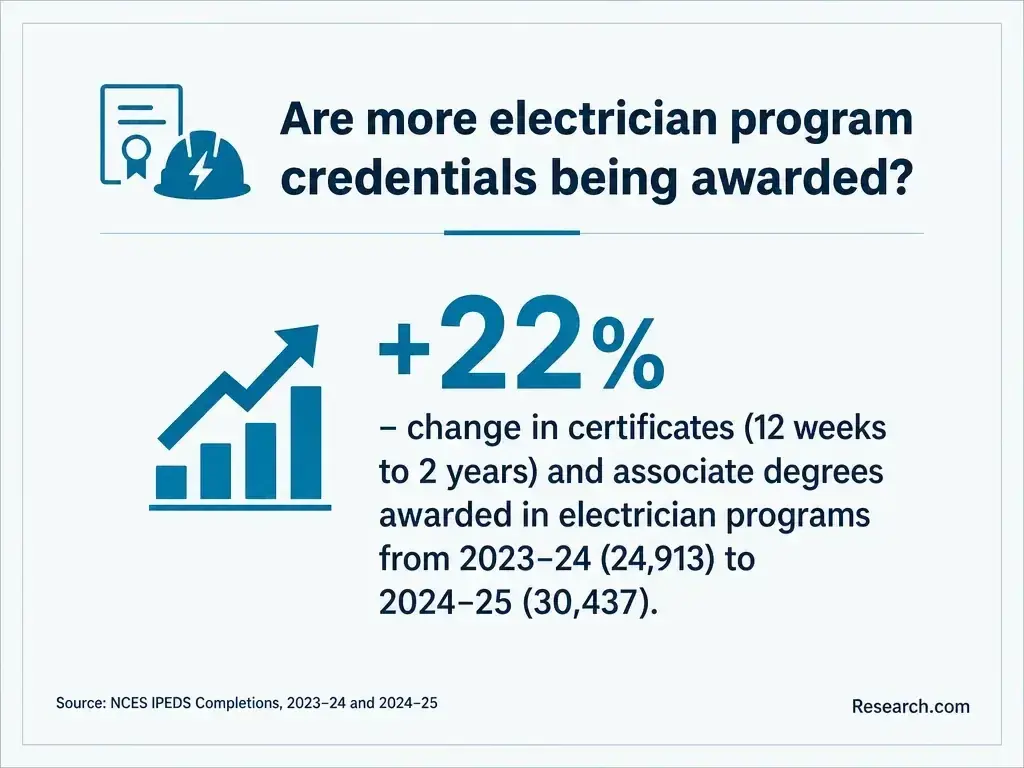
There is no defensible single average for Creston electrician training across school programs and paid apprenticeships. Ask each provider for a current, itemized estimate rather than comparing tuition advertisements. The following cost categories show why the cheapest-looking option may not be the least expensive route to job readiness.
| Cost or offset | What to compare |
| School charges | Tuition, mandatory fees, books, and consumable lab materials |
| Entry equipment | Required tools, meter, work clothing, and protective gear |
| Work and travel | Trips to campus and changing jobsites; income forgone while studying |
| Credential expenses | Any required examination, application, or licensing fees |
| Offsets | Grants, eligible aid, employer-paid instruction, and apprentice wages |
Federal Student Aid eligibility depends on the institution and program; it should not be assumed for every short course or apprenticeship. Ask Southwestern Community College or a sponsor about available aid, workforce funding, and what an employer supplies. Listings of affordable online college programs can inform general cost comparisons, but they cannot price the in-person electrical practice or commuting you may need.
The answer depends on the provider: a school may award a certificate, diploma, or associate degree, while a registered apprenticeship leads to an apprenticeship completion credential under its sponsor's standards. An industry training certificate, such as one aligned with the National Center for Construction Education and Research, documents particular learning; it is not an Iowa occupational license. Ask exactly what appears on the completion document and whether any school coursework receives credit toward a registered apprenticeship.
Institutional accreditation, permission to operate a school, industry recognition, apprenticeship registration, and an electrician license answer different questions. None substitutes automatically for the others. Guides to easy online degrees to get do not establish whether an electrical credential includes the practical experience needed for this trade.
Requirements vary by school and sponsor. Programs may assess reading and algebra readiness because electricians interpret plans, calculate loads, and use code references. Apprenticeship sponsors may also require an application, assessment, interview, and the ability to meet jobsite and employer conditions. Ask for the current requirements rather than assuming that admission to a school guarantees an apprenticeship opening.
If you already have relevant work or electrical coursework, ask whether the provider awards prior-learning or transfer credit and whether an apprenticeship sponsor will grant advanced standing. Get any proposed reduction in required coursework or supervised hours in writing; school credit and apprenticeship credit are separate decisions.
Core training should connect electrical theory to installation and troubleshooting: reading drawings, selecting materials, bending or installing raceway, making terminations, testing circuits, interpreting the applicable electrical code, and recognizing shock and arc hazards. The U.S. Bureau of Labor Statistics identifies installation, maintenance, testing, and repair as central electrician duties.
Compare lab assignments with the work you want to do. Someone interested in industrial maintenance should ask about motors and controls; someone pursuing a construction apprenticeship should ask about installation practice and plan reading. Code editions and equipment change, so the ability to find and apply current requirements matters more than memorizing a fixed set of answers.
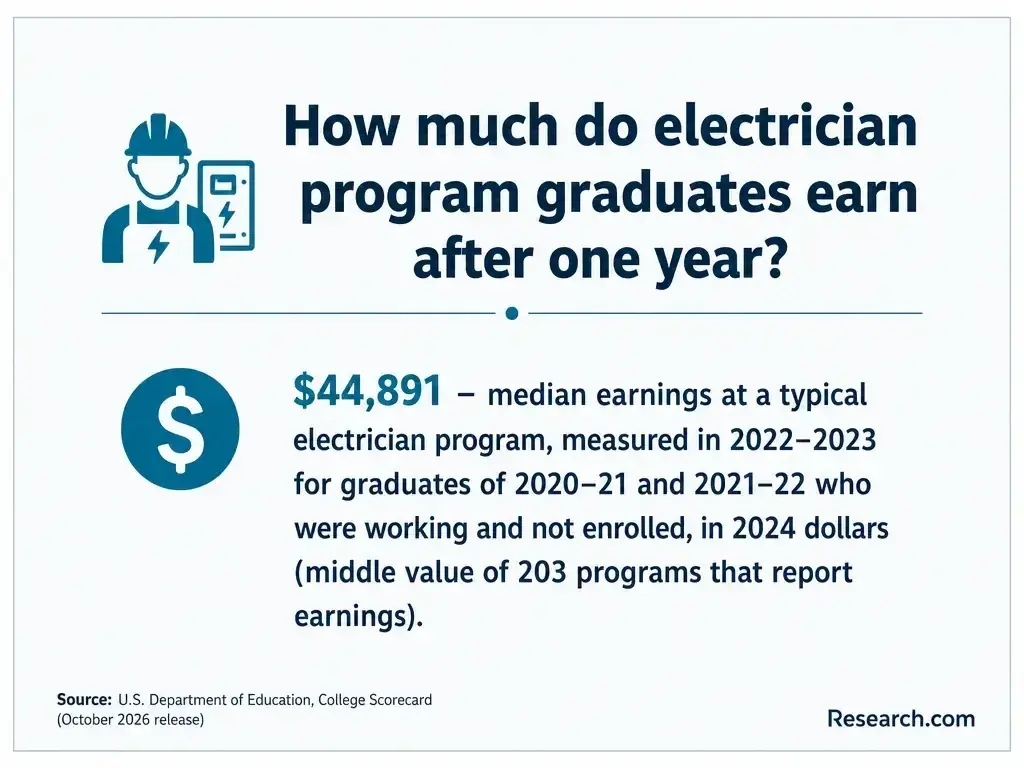
Yes, Iowa regulates electrician licensing. The Iowa Electrical Examining Board sets licensing categories and requirements, including rules affecting apprentices and progression to journeyman work. The applicable requirements depend on the work and license sought. A school completion certificate alone does not authorize independent electrical work, and a voluntary industry certificate is not a substitute for a state license.
Before enrolling, ask the Iowa Electrical Examining Board and the prospective apprenticeship sponsor which registration, supervised experience, training, and examination requirements apply to your intended route. Confirm that the employer can provide appropriately supervised work and document it. If you might move across state lines, check the destination state's rules separately rather than assuming an Iowa credential transfers automatically.
Choose the route that gets you from training to legally supervised work at a cost and schedule you can sustain. A ranking can narrow the field, but it cannot show whether a specific apprenticeship has an opening or whether its jobsites are within your commuting range.
Use these questions when speaking with a school or sponsor; request written answers for anything that affects cost or licensing:
A red flag is a promise that a short, entirely online course makes you a licensed electrician. Also check accreditation with the accreditor itself; a list of nationally accredited colleges cannot verify a particular electrician program's current status, practical training, or Iowa licensing fit.
A realistic progression is supervised entry-level work, completion of an applicable apprenticeship or qualifying experience, and then pursuit of the Iowa license appropriate to the work. With further experience, electricians may specialize in construction, industrial systems, controls, or maintenance; supervisory or contracting work can involve additional business and licensing obligations. These are possible paths, not automatic outcomes of a school credential.
If your goal is hands-on electrical employment, prioritize documented field experience over unrelated credentials. Even a non dissertation phd would not replace the supervised trade experience or Iowa licensing steps applicable to electrician work.
The U.S. Bureau of Labor Statistics projects 9.2% national electrician employment growth from 2025 to 2035. That indicates demand across the United States, not a forecast of openings in Creston. Local opportunities depend on contractors' workloads, maintenance hiring, and available apprenticeship positions; a small local market may require a wider job search or commute.
Before paying for training, contact sponsors and employers serving the area to ask when they recruit and what preparation they value. Treat national growth as a reason to investigate the trade, not as a promise of local placement.
Investing in training is an important decision, so Research.com evaluates electrician programs against other programs in the same occupation and location. Its best-program rankings consider student outcomes; earnings and return on investment; costs and debt; and quality and recognition. The measures include completion and retention, earnings one year after completion, earnings relative to attendance cost, tuition, total attendance cost, student debt - including debt held by students who withdrew - and federal loan default rates.
Programmatic accreditation or relevant industry recognition accounts for 20% of the score, institutional accreditation for 10%, and student support for 10%. The remaining 60% covers outcomes, earnings, and costs, with weights distributed through an entropy-based method that gives more weight to indicators that differ more across programs. Most-affordable-program rankings instead score only tuition, attendance cost, debt, and loan default rates; accreditation and other quality measures are not part of that affordability score.
The Research.com team draws on the following sources when building trade-program rankings across occupations. Some health-care-specific sources do not establish the quality or licensing eligibility of an electrician program:
Only programs with completions reported to IPEDS are eligible for these rankings. That makes the ranking useful for comparing covered programs, but it can omit registered apprenticeships, employer training, and other viable routes. Readers should use it as a shortlist, then verify hands-on training, costs, and Iowa licensing alignment directly. Research.com explains the approach further on its methodology page.
# 1 position
# 2 position
Not necessarily. A registered apprenticeship is another training route. Confirm your intended route and licensing requirements with the Iowa Electrical Examining Board and the apprenticeship sponsor.
No online-only course can provide the physical installation practice and supervised jobsite experience involved in electrician training. Ask where a hybrid program requires in-person attendance.
Choose school if you need foundational instruction and its cost and employer connections make sense. Compare it with apprenticeship if you are ready to apply for paid, supervised training now.
Not by itself. Iowa licensing requirements are separate from a school's graduation requirements; verify the applicable experience, registration, and examination steps with the Iowa Electrical Examining Board.
No. The Bureau of Labor Statistics' May 2025 national median includes experienced electricians. Use current local job offers and apprenticeship wage schedules to estimate starting income.