# 1 position
Pima Community College - Electrical and Power Transmission Installation/Installer, General.
certificate or diploma

Audited and Verified:
Our Editorial and Data Verification Process
Research.com uses government datasets, official education statistics and primary institutional information to support its career and degree guides. Our review process checks factual accuracy, occupational definitions, source dates and the requirements associated with the credentials discussed.
How This Article Was Fact-Checked
Our editorial team verifies salary estimates, employment projections, education requirements and program information against original data providers and official organizations. Salary figures are checked against the relevant occupational definitions and reporting periods. Information about licensure, accreditation and required in-person training is reviewed separately.
Fact-checked and verified on:

Co-Founder and Chief Data Scientist

Reviewed by Karolina Broda
Fact-Checker and Data Verification
Choosing electrician training in Tucson means deciding whether to pay for classroom preparation, apply directly to a paid apprenticeship, or combine the two. The choice matters: the U.S. Bureau of Labor Statistics projects 9.2% growth in electrician employment nationally from 2025 to 2035, but a short certificate alone does not replace supervised field experience. The Research.com team of data scientists created its Best Electrician Trade Schools in Tucson for 2027 ranking to help students identify programs worth considering. This guide explains the costs, credentials, work requirements, and career prospects behind that decision.
Expect a mix of electrical theory and supervised practice: interpreting plans, calculating circuits, working with conduit and wiring, testing equipment, and following safety procedures. A certificate can prepare you to seek an entry-level helper or apprentice position. It is not the same as completing the field experience needed to perform increasingly independent work.
Pima Community College is one local option to investigate for current electrical training. Compare its published curriculum and lab schedule with registered apprenticeships sponsored through employers or labor-management partnerships, including opportunities associated with IBEW Local 570 and electrical contractors. Apprenticeships combine paid work with related instruction, while a school-first route may suit someone who wants foundational skills before applying. Neither route guarantees a placement. If your goal is electrical fieldwork, a list of degrees that pay well is not a substitute for checking the practical training and hiring connections of a specific electrician program.
Potential workplaces include residential and commercial electrical contractors, construction projects, industrial facilities, building-maintenance teams, and employers installing or maintaining power and control systems. Tucson's mix of construction, facilities, and industrial work makes your intended setting important: residential wiring, commercial conduit, and industrial controls call for different practice.
Ask a provider which local employers take its students as helpers or apprentices and whether those positions involve supervised electrical work rather than general labor. A certificate may help you compete for an entry-level opening, but employers decide what tasks you can perform safely under their supervision.
The U.S. Bureau of Labor Statistics reports a $63,190 national median annual wage for electricians in May 2025. This is the midpoint for employed electricians across experience levels, not a Tucson wage or a forecast of what a new apprentice will earn. Pay also varies with employer, specialty, overtime, and apprenticeship progression.
For a local decision, compare current Tucson-area electrician wages in the BLS Occupational Employment and Wage Statistics series with actual apprentice wage schedules or written job offers. Use the entry rate - not the national occupational median - when estimating whether tuition, commuting, and time away from other work are affordable.
A school certificate and an apprenticeship have different finish lines. Certificate length depends on the current course sequence and whether you attend full- or part-time; ask for the published calendar, total contact hours, and lab hours rather than relying on a marketing description such as "accelerated." An associate degree, where offered, adds broader coursework and takes longer than a short occupational certificate.
Registered electrician apprenticeships generally span multiple years of paid, supervised work plus related classroom instruction. The U.S. Department of Labor notes that apprenticeship requirements are set in each program's registered standards, so confirm the sponsor's actual work-hour, instruction-hour, and advancement rules. Prior coursework may or may not earn credit; get any advanced-standing decision in writing before counting on a shorter route.
Online instruction can work for code concepts, calculations, and some blueprint reading. It cannot replace physically assembling circuits, bending conduit, using meters, practicing lockout/tagout, or receiving feedback while working safely around equipment. A hybrid program is useful only if its in-person labs and any required worksite experience are accessible from Tucson and substantial enough for your goal.
Be wary of a fully online course advertised as a complete route to becoming an electrician. Even easy certifications to get online that pay well are a different proposition from demonstrating electrical trade competence. Ask exactly which tasks are assessed in person and whether the program helps arrange supervised employment.
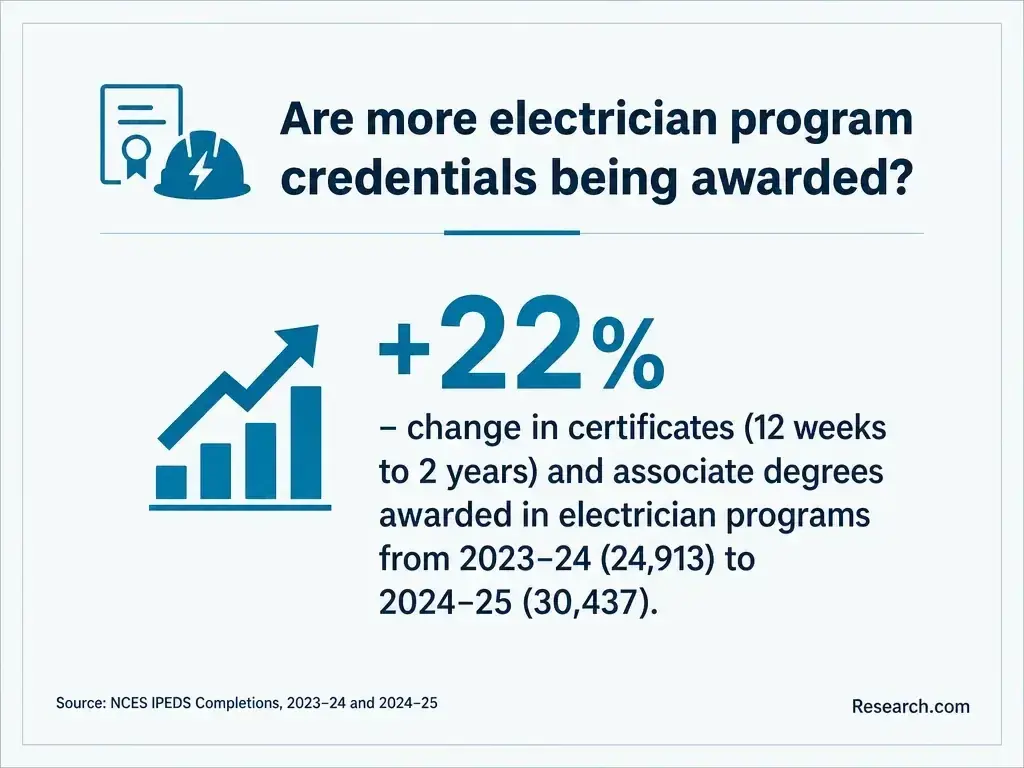
There is no single defensible average price for Tucson electrician training: a college certificate, a private course, and a paid apprenticeship charge - and pay - students differently. Request a current, itemized cost of attendance for your residency status and schedule. Tuition alone omits costs that can change which route is affordable.
Include mandatory fees, books or software, tools, safety gear, consumable materials, transportation to labs or jobsites, and earnings forgone while attending classes. Ask which purchases are included, which tools an employer supplies, and whether federal aid, workforce funding, or a paid apprenticeship can offset the bill. Federal aid eligibility depends on the institution and program, not merely on its trade-school label (Federal Student Aid). For comparison, cheapest online bachelors programs address a different education goal and do not price the equipment or fieldwork needed for this trade.
The credential depends on the pathway: a school may award a certificate or, for an eligible program, an associate degree; a registered apprenticeship documents completion under its approved standards. An employer may offer training without awarding an academic credential. Ask for the exact credential name and whether it represents completed classroom instruction, demonstrated lab skills, supervised work, or some combination.
Institutional accreditation concerns the school; state authorization concerns its permission to operate; apprenticeship registration concerns the sponsor's approved training standards. None is automatically an Arizona electrical contractor license. If you are comparing training investments, an online accelerated bachelor's degree serves a different purpose and does not replace electrician field experience.
Requirements differ by provider. A school may specify minimum age, prior schooling, placement steps, or prerequisite math; an apprenticeship sponsor may also screen for jobsite readiness, assess applicants, and require them to meet employer hiring conditions. Do not assume admission to a classroom program includes admission to a registered apprenticeship.
Before applying, ask for the current entry checklist, application dates, math expectations, physical job requirements, and any costs due before classes or paid work begin. If you already have relevant coursework or construction experience, ask whether the school or sponsor assesses it for credit or advanced standing - and who makes that decision.
Useful entry training connects electrical principles to tasks: reading drawings, applying code rules, calculating loads, selecting materials, installing raceways and conductors, making terminations, and testing or troubleshooting circuits. Safety instruction should cover hazard recognition, personal protective equipment, and procedures for de-energizing equipment. The U.S. Bureau of Labor Statistics identifies installation, maintenance, repair, and testing as core electrician work.
Look beyond a course title. Request a lab inventory and a breakdown of supervised practice versus lecture. A program centered on small training boards may build fundamentals, but someone targeting commercial construction should also ask about full-scale conduit work and opportunities to practice on jobsites under qualified supervision.
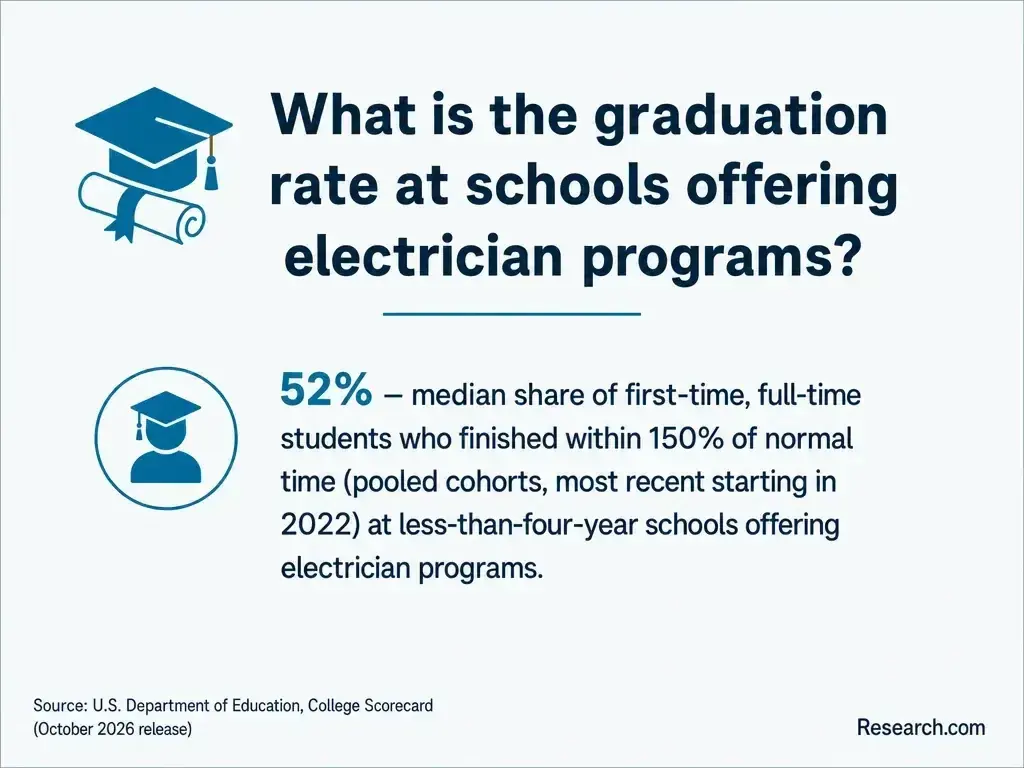
Arizona does not have a general statewide journeyman-electrician license that every employee must obtain before working for an electrical contractor. That does not mean a new trainee can independently offer electrical contracting services. The Arizona Registrar of Contractors regulates electrical contractor license classifications and their qualifying-party experience and examination requirements. Verify the classification relevant to your intended work with the registrar before paying for training marketed as a path to self-employment.
Employers may value documented apprenticeship completion, safety training, or industry credentials, but those are not interchangeable with contractor licensure. Likewise, institutional accreditation or a school certificate does not by itself establish contractor-license eligibility. If you plan to work outside Arizona, check that jurisdiction's rules separately.
Start with the job you want: entry-level residential helper, commercial apprentice, maintenance worker, or eventually contractor. Then compare the training against that goal rather than choosing by rank or course speed alone. These checks expose the differences most likely to affect your time and money:
A red flag is a promise that a short course alone makes you licensed, job-ready for unsupervised work, or certain to earn an established electrician's wage. The stronger investment is the route you can complete that provides relevant hands-on skills and a realistic next step into supervised employment.
A practical progression is helper or apprentice, experienced electrician, then specialist, lead worker, supervisor, or - after meeting separate state requirements - electrical contractor. Experience can also lead toward commercial installations, industrial maintenance, controls, or other work requiring additional equipment-specific training. The route is not automatic: each step depends on demonstrated skills, available work, and any applicable employer or regulatory requirements.
If your goal is running an electrical business, ask how a program supports the field experience needed before a contractor-license application rather than paying extra for an unrelated credential. Cheapest online phd programs, for example, do not address the supervised trade experience required for that plan.
The U.S. Bureau of Labor Statistics projects 9.2% national employment growth for electricians from 2025 to 2035. That indicates broader demand for the occupation, not a guarantee of openings in Tucson or admission to an apprenticeship. Construction schedules, contractor hiring, and the availability of supervised positions determine when a new trainee can enter the local market.
Use that projection as a reason to investigate - not as your enrollment decision. Check current Tucson-area postings for the tasks and experience employers request, then ask training providers and apprenticeship sponsors how students move into those roles. A program with strong lab instruction but no plausible route to supervised work may be a poor fit for someone who needs to earn while learning.
Investing in training is consequential, so Research.com compares programs with other options in the same occupation and location rather than treating every trade credential as interchangeable. The best-programs ranking considers student outcomes; earnings and return on investment; costs and debt; and quality and recognition. Programmatic accreditation or relevant industry recognition accounts for 20% of the score, institutional accreditation for 10%, and student support for 10%. The remaining 60% covers outcomes, earnings, and costs, with weights distributed through an entropy-based method.
To support credible, accurate comparisons, the Research.com team uses the following sources. Occupation-specific recognition sources are considered where relevant; a healthcare or dental accreditor is not evidence of electrician-program quality.
Only programs reporting completions to IPEDS are eligible for this ranking. That makes the comparison useful for evaluating represented schools, but it does not mean an unlisted union, employer-sponsored, or registered apprenticeship is unavailable or inferior. The separate most-affordable-programs methodology scores costs and debt only; it does not include accreditation or other quality measures. Readers can review the full approach on Research.com's methodology page and then verify current program details directly before enrolling.
# 1 position
# 2 position
No single school credential is the required route. Some people enter through registered apprenticeships or employer training; school coursework can help build fundamentals or strengthen an application. Confirm the employer's or sponsor's entry rules.
Registered apprenticeships combine paid work with related instruction. A school-only program may not pay you, so compare its total cost with apprentice wages and any fees the sponsor requires.
Online lessons can teach theory, but installation, testing, and safe tool use require in-person practice and supervised work. Verify exactly what a hybrid program provides locally.
No. Arizona does not issue a general statewide journeyman-electrician license, and a certificate is not an electrical contractor license. Check contractor licensing separately with the Arizona Registrar of Contractors.
Choose based on your immediate need. A certificate may provide foundational instruction before job applications; an apprenticeship provides structured instruction alongside paid field experience. Ask whether certificate coursework earns any apprenticeship credit before assuming you can combine them.