# 1 position
United Education Institute-Las Vegas - Electrician.
certificate or diploma

Audited and Verified:
Our Editorial and Data Verification Process
Research.com uses government datasets, official education statistics and primary institutional information to support its career and degree guides. Our review process checks factual accuracy, occupational definitions, source dates and the requirements associated with the credentials discussed.
How This Article Was Fact-Checked
Our editorial team verifies salary estimates, employment projections, education requirements and program information against original data providers and official organizations. Salary figures are checked against the relevant occupational definitions and reporting periods. Information about licensure, accreditation and required in-person training is reviewed separately.
Fact-checked and verified on:

Co-Founder and Chief Data Scientist

Reviewed by Karolina Broda
Fact-Checker and Data Verification
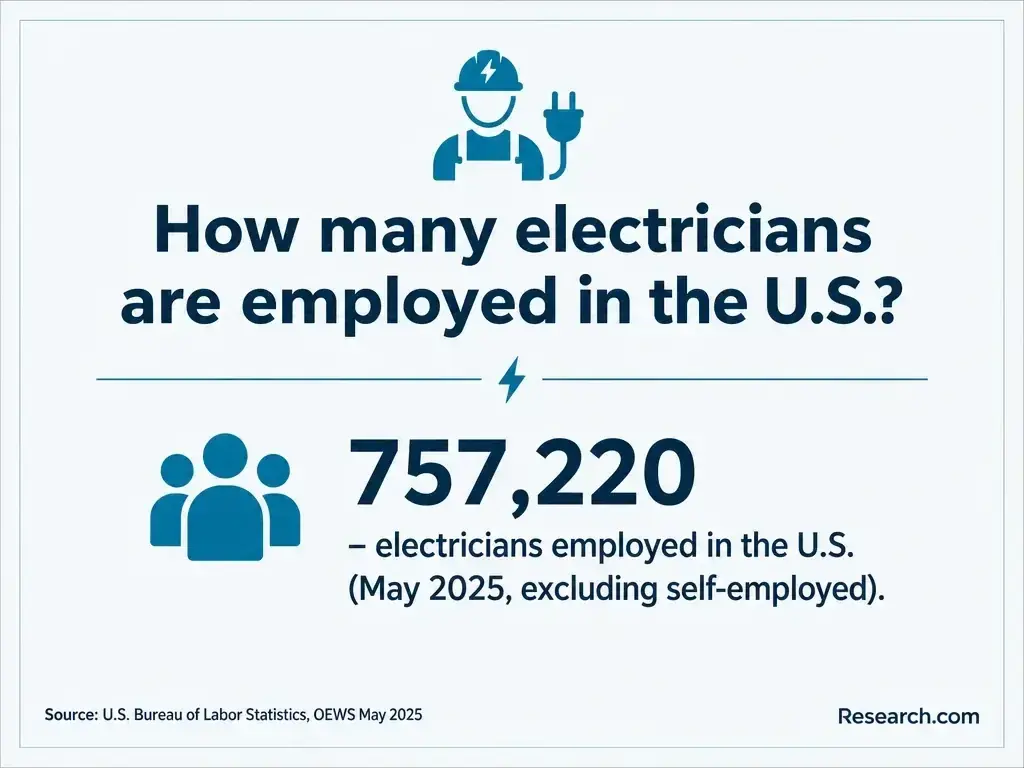
A short electrical training program may teach useful skills, but will it give you enough supervised experience to work toward becoming an electrician? That is the central choice for Las Vegas students. The U.S. Bureau of Labor Statistics projects 9.2% national employment growth for electricians from 2025 to 2035, making the training decision timely. This guide compares school-based instruction, paid apprenticeships, costs, credentials, and Nevada requirements. It also accompanies a Best Electrician Trade Schools in Las Vegas for 2027 ranking created by the Research.com team of data scientists to help students identify programs worth considering.
Expect instruction in electrical theory, circuits, wiring methods, blueprint reading, testing, and safe work practices, followed by practice in a lab or shop. The decisive difference among options is what happens after class: a school credential documents completed instruction, whereas an apprenticeship also organizes supervised work over time. A short program should not be mistaken for a quick route to independent electrical work, even when comparing fastest degrees that pay well.
The table separates pathways by the experience they actually provide. Ask each provider to identify its credential and whether any coursework receives apprenticeship credit; similar-sounding certificates need not represent equivalent training.
| Pathway | Typical credential or result | Practical experience | Best fit |
| School-based certificate or diploma | School-issued credential | Labs; field placement only if arranged | Beginners seeking structured fundamentals before applying for work or apprenticeship |
| Community-college electrical program | Certificate or, where offered, associate degree | Course labs; job-site experience depends on the program | Students who want a broader, potentially stackable curriculum |
| Registered apprenticeship | Completion credential from the registered program | Paid, supervised job-site training plus related instruction | Applicants ready for employment-based training and a longer commitment |
| Employer-sponsored entry route | Employer training record; credentials vary | Worksite training that varies by employer | Applicants with a verified training plan and supervised duties |
A person aiming to enter the trade quickly should compare apprenticeship openings with short school programs before enrolling. A person who needs introductory practice or a more flexible class schedule may find school valuable - but should obtain written confirmation of any promised placement or advanced standing.
Electrical contractors hire workers for building construction and renovation; other opportunities involve commercial-property maintenance, industrial equipment, and building systems. In Las Vegas, work on hotels, convention facilities, housing, and other large properties can involve different schedules and technical systems. That matters when choosing training: a program focused on basic residential wiring may not provide much exposure to commercial controls or troubleshooting.
School training alone generally qualifies someone to seek entry-level, supervised opportunities - not to advertise independent contracting services. Ask whether employers recruiting from the program offer an apprenticeship or another documented route to the experience needed for more responsible work. The U.S. Bureau of Labor Statistics identifies construction, maintenance, and manufacturing among electricians' work settings.
The U.S. Bureau of Labor Statistics reports a $63,190 national median annual wage for electricians in May 2025. This describes workers across experience levels and employers; it is neither a Las Vegas wage estimate nor a starting-pay promise. Apprentices commonly earn less than experienced electricians while they train, and pay can differ by contractor, specialization, and hours worked.
For a local decision, request the current apprentice wage schedule or a written entry-level offer, then compare it with tuition and the earnings you would give up while studying. Treat an advertised "electrician salary" cautiously unless it identifies the occupation, geography, reference year, and experience level.
A school program may take months rather than years, depending on its published clock hours, course load, and schedule. That is time to finish the school credential, not necessarily time to become an experienced electrician. Even a program marketed alongside 6 month associate programs online would need separately verified in-person electrical practice and occupational experience.
A registered apprenticeship is a longer, work-based commitment. Federal apprenticeship rules describe approximately 2,000 hours of on-the-job learning per year as a standard and recommend at least 144 hours of related instruction annually, according to the U.S. Department of Labor. The registered program's approved standards determine its actual length and requirements. Before enrolling in school first, ask the apprenticeship sponsor whether it awards advanced standing for that specific coursework; do not assume it shortens the apprenticeship.
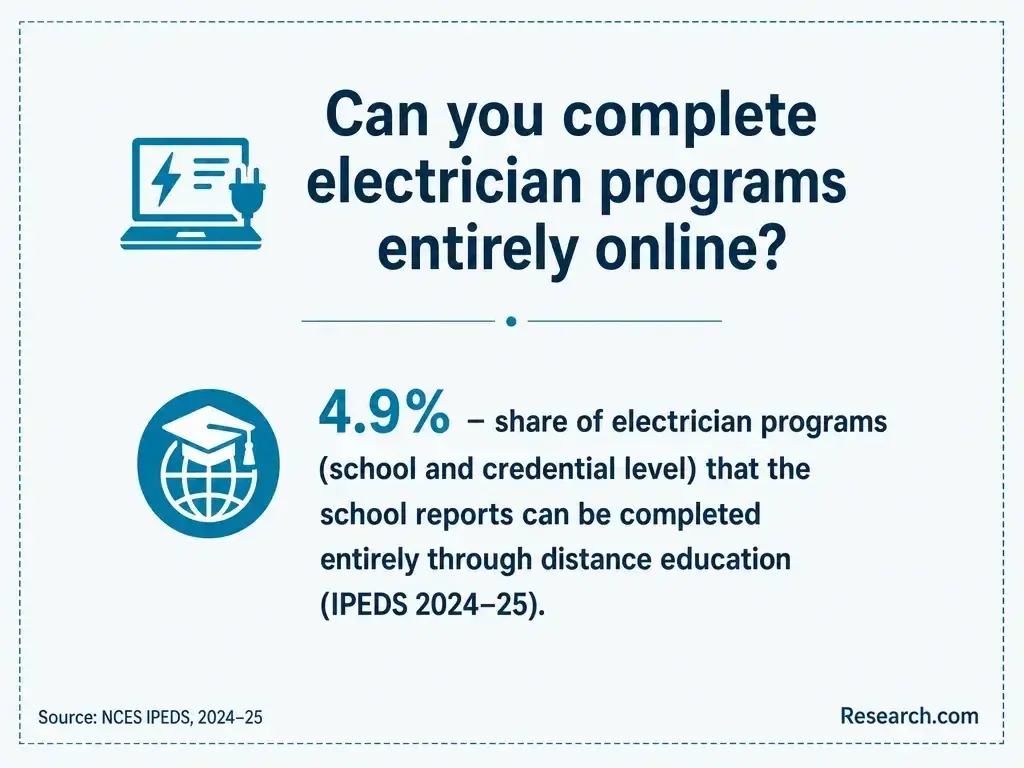
Online coursework can cover theory, calculations, code concepts, and some safety instruction. It cannot, by itself, show that a student can install wiring, use test equipment safely, or troubleshoot an energized system under supervision. Those competencies require in-person labs, a shop, or a worksite. A hybrid program is useful when its practical sessions and travel schedule are realistic for the student.
Ask for the number and location of supervised practical hours, required attendance dates, equipment used, and who evaluates skills. Do not infer that an online credential meets an apprenticeship sponsor's or local authority's requirements. Searches for unrelated options such as low cost online master's programs should not replace that hands-on comparison.
There is no single reliable Las Vegas-wide average that captures school certificates, college programs, and paid apprenticeships on comparable terms. Tuition alone also understates the amount needed to become job-ready. Obtain an itemized quote from each provider and compare the same expense categories.
The table shows costs that can change the value of a seemingly inexpensive program. Confirm which items are included before comparing offers.
| Cost or offset | What to verify |
| Tuition and mandatory fees | Total for the complete program, not one term or a promotional rate |
| Tools, materials, and PPE | Required purchases, replacement supplies, and whether equipment is loaned |
| Travel and lost earnings | Commutes to labs or worksites and hours away from paid work |
| Later career-entry expenses | Any applicable examination, credential, or application charges |
| Offsets | Grants, eligible aid, employer support, and wages during apprenticeship |
Federal Student Aid eligibility depends on the student, institution, and program; a school's authorization or accreditation does not itself guarantee aid. Ask about eligible aid and local workforce assistance, but compare net cost only after confirming the award. A paid apprenticeship may reduce foregone income, though admission, wages, and expenses vary by sponsor.
It depends on the route: a career school may award a certificate or diploma; a community college may offer a certificate or associate degree; and a registered apprenticeship awards a completion credential under its approved standards. None of those labels, by itself, establishes that its holder can work independently or operate an electrical contracting business.
Check the exact award named on the program's completion documents, whether an apprenticeship accepts its instruction, and whether any college credits can be transferred or applied toward another electrical credential. Institutional accreditation, school authorization, industry recognition, apprenticeship registration, and occupational licensing answer different questions. Transfer discussions - including lists of easiest bachelors to get - should not be confused with evidence of electrical job-site competence.
Requirements vary by provider. School applicants may need proof of prior education, an application, and a placement assessment; apprenticeship sponsors may also assess math preparation, availability for work, and eligibility for employment. A school's admission decision does not secure an apprenticeship position. Check each provider's current published criteria rather than assuming one standard applies throughout the city.
Ask about physical job demands and the ability to reach changing worksites before committing. If algebra or basic electrical math is an entry barrier, find out whether preparatory instruction is available and whether it adds time or cost. Get any policy on prior learning or advanced standing in writing.
A useful introductory curriculum connects electrical calculations and circuit theory to wiring, diagrams, measurement, fault-finding, and safe tool use. Instruction should address the National Electrical Code while making clear that applicable code editions and enforcement are determined by the relevant authority, not by the school. The U.S. Bureau of Labor Statistics describes testing, installation, maintenance, and repair as core electrician work.
For a Las Vegas program, look beyond a topic list: ask to see the lab schedule, the tasks students personally perform, and the equipment available for commercial as well as residential practice if both interest you. Simulation can support learning, but it is not a substitute for supervised installation and troubleshooting.
Do not treat graduation as permission to perform any electrical job independently. Nevada's State Contractors Board licenses electrical contractors; its contractor licensing process is distinct from a school certificate and involves applicable experience and examination requirements. Journeyman-card or competency requirements for particular work can depend on the Southern Nevada jurisdiction and employer. Verify the rule with the authority responsible for the work location before selecting training.
A registered apprenticeship is an approved training arrangement, not a contractor license. Likewise, a school's institutional accreditation concerns the institution, while industry certifications document particular knowledge or skills; neither replaces required supervised experience, examinations, or authorization. If your goal is eventually to run a contracting business, check the Nevada State Contractors Board's current electrical classification and qualifying-experience rules early, because a short certificate is not the whole route.
Start with the job you want and work backward. Compare a school-based program with registered apprenticeship openings before deciding whether paying for preliminary instruction improves your route into supervised work. Consider College of Southern Nevada, United Education Institute-Las Vegas, or Advanced Training Institute only after confirming each provider's current electrical offerings and terms directly; program names and availability can change.
Use these questions to test claims that matter more than a ranking position:
Compare likely net earnings over a realistic period, not salary against tuition alone: account for program length, wages forgone or earned during training, aid, debt, the chance of completion, and the timing of later earnings. If credit mobility matters, investigate it directly; a list of universities that accept nationally accredited degrees cannot establish whether a particular electrical course transfers or counts toward an apprenticeship. Red flags include guaranteed job or wage claims and promises of licensing without a clear explanation of required experience.
An entry route may begin with supervised electrical work or an apprenticeship, followed by more complex installation, maintenance, or troubleshooting as skills develop. Experience can support specialization in commercial systems, controls, or industrial maintenance; supervisory responsibilities require more than an introductory credential. Operating an electrical contracting business is a separate step subject to Nevada State Contractors Board requirements.
Choose training for the first role you can realistically obtain, then check whether it develops skills for the next one. Someone interested in maintaining large facilities should ask about motors, controls, and diagnostic practice; someone targeting construction should prioritize installation experience and access to supervised job sites.
The U.S. Bureau of Labor Statistics projects 9.2% growth in U.S. electrician employment from 2025 to 2035. That national projection signals continuing demand for the occupation, but it does not predict the number of openings in Las Vegas or guarantee placement for a particular graduate.
Local opportunity also depends on construction schedules, maintenance hiring, and access to employers willing to supervise beginners. Before enrolling, check current Nevada labor-market information and ask local apprenticeship sponsors and employers when they recruit. That will tell you more about your immediate entry prospects than a national growth rate alone.
Investing in electrical training is a consequential decision, so Research.com compares programs with others in the same occupation and location rather than with unrelated schools. The ranking includes only programs with completions reported to IPEDS. That makes its comparisons useful, but it also means an unlisted apprenticeship or employer training program is not necessarily a poor option.
Best-program rankings assess student outcomes, earnings and return on investment, costs and debt, and quality and recognition. Programmatic accreditation or relevant industry recognition accounts for 20% of the score, institutional accreditation for 10%, and student support for 10%. The remaining 60% covers completion, retention, earnings, attendance costs, tuition, debt - including debt held by students who withdrew - and federal loan default rates. An entropy-based method assigns more weight to measures that vary more across programs. Most-affordable rankings instead score only tuition, attendance costs, median debt, and default rates; they do not include accreditation or other quality measures.
The Research.com team uses the following data sources across its trade-program rankings, checking occupation-specific relevance rather than treating every source as an electrical-training requirement:
Health and dental organizations in that source list do not accredit electrician training. For electrical programs, the ranking is a starting point: readers should separately confirm current hands-on instruction, apprenticeship connections, and applicable local requirements. More detail about the approach appears in Research.com's methodology.
# 1 position
# 2 position

# 3 position
# 4 position

Not necessarily. A registered apprenticeship combines related instruction and supervised paid work. A school program can prepare you to apply, but confirm whether a sponsor recognizes it before paying tuition.
Online study can cover theory, but electrical installation, testing, and troubleshooting require practical, supervised training. Verify any in-person requirements and the credential's acceptance before enrolling.
No. A school certificate, apprenticeship completion, locally applicable competency requirements, and Nevada electrical contractor licensing are distinct. Check the requirements for the work you intend to perform.
It may be if you are ready for employment-based training and can obtain a place. A certificate may help you build fundamentals first, but compare its full cost and any verified apprenticeship credit.
Ask for the most recent electrical-program completion and placement figures, their definitions, the employers involved, and whether positions include supervised training. Placement is not the same as independent-work eligibility.