# 1 position
Nunez Community College - Electrician.
associate

Audited and Verified:
Our Editorial and Data Verification Process
Research.com uses government datasets, official education statistics and primary institutional information to support its career and degree guides. Our review process checks factual accuracy, occupational definitions, source dates and the requirements associated with the credentials discussed.
How This Article Was Fact-Checked
Our editorial team verifies salary estimates, employment projections, education requirements and program information against original data providers and official organizations. Salary figures are checked against the relevant occupational definitions and reporting periods. Information about licensure, accreditation and required in-person training is reviewed separately.
Fact-checked and verified on:

Co-Founder and Chief Data Scientist

Reviewed by Karolina Broda
Fact-Checker and Data Verification
Choosing electrician training in Chalmette means comparing more than tuition: a classroom credential, hands-on practice, and a paid apprenticeship serve different purposes. The U.S. Bureau of Labor Statistics projects 9.2% national growth in electrician employment from 2025 to 2035. For career starters and working adults, this guide explains costs, credentials, local work options, and Louisiana licensing considerations. It also accompanies the Best Electrician Trade Schools in Chalmette for 2027 ranking, created by the Research.com team of data scientists to help students make an informed choice about programs worth considering.
Expect instruction in electrical safety, circuits, wiring methods, blueprint reading, testing, and the National Electrical Code, followed by supervised practice. A school program builds foundational skills; an apprenticeship combines related classroom instruction with paid work under experienced electricians. Neither a certificate nor classroom attendance alone proves readiness to work independently.
These pathways lead to different credentials and amounts of workplace experience. Compare them against the type of electrical job you want, not just the credential's name.
| Pathway | Typical result | Best fit and key limitation |
| Community college or career-school program | Certificate, diploma, or, where offered, associate degree | Useful for structured fundamentals and lab practice; ask how graduates enter supervised employment. |
| Pre-apprenticeship | Preparation or completion credential | Useful for building entry skills; admission to a registered apprenticeship is not automatic. |
| Registered apprenticeship | Paid, supervised training and a completion credential | Strong fit for learners ready to work while training; openings and entry screening may be competitive. |
| Employer-sponsored entry | Employer training and work experience | Can reduce upfront school costs; verify the scope of instruction and whether experience is documented. |
For a Chalmette resident, a program's lab location and an employer's job sites can matter as much as its address. Ask Nunez Community College about its currently available electrical offerings, if any, and compare the actual schedule with apprenticeship and employer-training openings across the New Orleans area.
Electricians may work for residential or commercial electrical contractors, industrial facilities, maintenance departments, or construction firms. Around Chalmette, that means comparing jobs in St. Bernard Parish with opportunities elsewhere in the New Orleans labor market. A position based across the metro area may require travel to changing job sites, so ask employers about the service area, start time, vehicle requirements, and whether travel is paid.
Commercial construction, industrial maintenance, and residential service use overlapping fundamentals but different equipment and work routines. If a particular setting interests you, ask whether the program includes the relevant motor controls, conduit work, troubleshooting, or service-panel practice - and whether its work-placement contacts serve that setting.
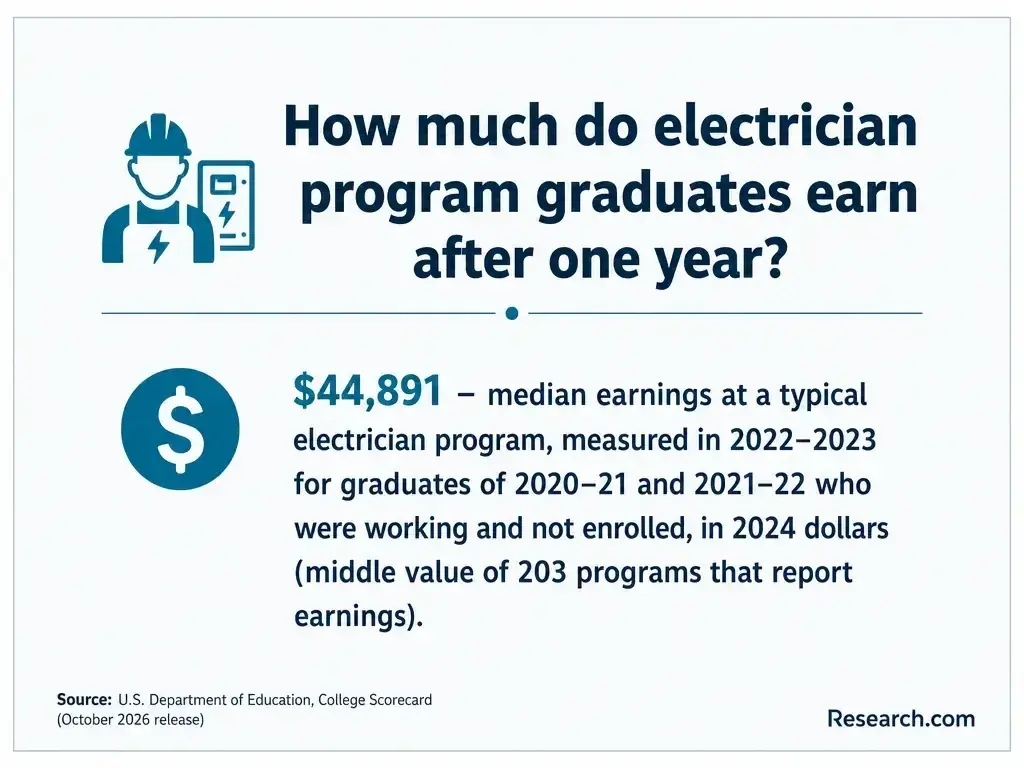
The U.S. Bureau of Labor Statistics reports a $63,190 national median annual wage for electricians in May 2025. That figure covers experienced and newer workers across the United States; it is neither a Chalmette wage estimate nor a likely first-year offer. Compare actual local openings and apprenticeship wage schedules before estimating your income.
Pay can change with experience, specialty, overtime, employer, and whether work is steady or project-based. For an investment decision, compare the wages you could earn while training with a school route's tuition, foregone work hours, and realistic prospects for supervised employment afterward.
There is no single electrician-training timeline. A short introductory credential may teach fundamentals before a student applies for an entry-level job; a more extensive diploma or associate degree takes longer. A registered apprenticeship generally spans multiple years because it includes both related instruction and substantial supervised work. Apprenticeship.gov describes registered apprenticeships as paid programs combining on-the-job learning with classroom instruction.
Request each provider's published calendar and clock or credit hours, then separate classroom hours, lab hours, and supervised job hours. Ask whether part-time attendance changes the completion date and whether prior coursework or documented work can receive credit or advanced standing. Do not assume school hours transfer into an apprenticeship: the sponsor must confirm what it accepts.
Online study can cover electrical theory, calculations, code concepts, and some blueprint reading. It cannot replace supervised practice with tools, wiring, test instruments, and safe work procedures. An on-campus or hybrid option is more useful if it gives you accessible labs and a clear route to field experience; an online-only course is best treated as supplementary preparation unless a prospective employer or apprenticeship sponsor confirms how it fits its requirements.
Working adults, including readers browsing online programs for seniors, should check the in-person timetable before choosing a flexible format. Specifically, ask where labs meet, how often attendance is required, who arranges field placements, and whether missing a lab delays completion.
There is no defensible single Chalmette average across school programs and paid apprenticeships: providers charge differently, and apprentices may earn wages while learning. Request a written, current total from each school that includes tuition, mandatory fees, books, tools, personal protective equipment, consumables, and any required exam or application charges. Add travel to labs and job sites and the earnings you would give up to attend.
Compare the net cost to become job-ready, not the advertised tuition. Ask whether tools are included, which costs grants cover, and whether aid must be repaid. For eligible school programs, verify federal aid through the provider and Federal Student Aid; a list of online colleges that accept FAFSA does not establish that a particular electrician program or apprenticeship qualifies. Also ask about Louisiana workforce-training assistance and employer-paid options before borrowing.
The award depends on the provider: it may be a certificate, diploma, or associate degree. A registered apprenticeship awards its own completion credential. Industry training credentials may document particular skills, but they are distinct from institutional accreditation, apprenticeship registration, and legal permission to perform regulated work.
Ask for the exact credential title and whether an apprenticeship sponsor or local employer recognizes it for placement or advanced standing. Guides to highest paying certificates can help frame a cost comparison, but no electrician certificate by itself establishes a wage level or replaces field experience.
Requirements differ by route. A school may assess reading and math readiness and require an application or placement process. An apprenticeship sponsor or employer may also screen for eligibility to work, physical job demands, transportation, interviews, and other job-related requirements. Obtain the current written criteria from the specific provider rather than assuming that admission to school means admission to its partner apprenticeship.
Before applying, ask who supplies tools, when lab or work shifts begin, and whether you must travel beyond Chalmette. These practical conditions can determine whether a seemingly affordable program is possible to complete while working.
A useful curriculum connects electrical theory to safe installation and diagnosis: reading plans, calculating loads, identifying conductors and overcurrent protection, bending or installing raceways, making connections, and using meters. Code instruction matters because electricians must apply the rules adopted by the jurisdiction where they work - not merely memorize examples from a textbook. The U.S. Bureau of Labor Statistics identifies testing, troubleshooting, and following safety practices as core electrician work.
Ask to see the lab equipment and a sample skills assessment. If your goal is industrial maintenance rather than residential installation, look for meaningful motor-control and troubleshooting practice. A similarly titled credential with little supervised tool time may leave you less prepared for that goal.
Do not assume a school certificate is an electrician license. Louisiana's State Licensing Board for Contractors regulates contracting under applicable state contractor-license rules; local authorities may impose additional requirements for electrical work in their jurisdictions. The rules relevant to a supervised employee can differ from those for someone bidding on or contracting electrical jobs. Confirm your intended role with the Louisiana State Licensing Board for Contractors and the building or permitting authority for St. Bernard Parish; check other jurisdictions separately if you plan to work there.
Before enrolling, ask the provider which documented training or experience its program supplies, whether graduates still need supervised work or an examination for their intended role, and who verifies eligibility. Institutional accreditation, school authorization, industry certification, registered-apprenticeship status, and occupational licensure are separate checks; none automatically substitutes for another.
Start with the job you want, then compare programs against the experience and credential needed to reach it. A school route may suit someone who needs structured fundamentals before seeking work; a paid apprenticeship may better suit someone ready for employer selection and sustained on-site learning. A faster course is not necessarily a cheaper route if it offers too little lab time or no credible next step into supervised work.
Use these checks before paying a deposit; they address the most consequential gaps a ranking or brochure may not show.
A common mistake is choosing the shortest or highest-ranked option without checking its hands-on component. Another is applying an appealing earnings figure to a first-year budget. Keep the comparison focused on electrician entry: an affordable phd online resource, for example, cannot answer whether an electrical training program provides the practice and supervised-work route you need.
Initial training can lead to supervised installation or maintenance work. With additional field experience, electricians may move into commercial systems, industrial troubleshooting, service work, estimating, or crew supervision. Contracting independently is a separate step that can trigger licensing and business requirements; it is not an automatic outcome of finishing a program.
For a broader look at trade school career options, compare occupations by the work you actually want to perform. Within electrical work, ask prospective employers which entry tasks they assign to new hires and what experience they require before allowing more independent responsibilities.
The U.S. Bureau of Labor Statistics projects 9.2% growth in U.S. electrician employment from 2025 to 2035. This is a national projection, not a forecast of vacancies in Chalmette or a guarantee of placement. It supports considering the trade, but your near-term opportunity depends on local hiring, apprenticeship openings, and willingness to reach job sites across the New Orleans area.
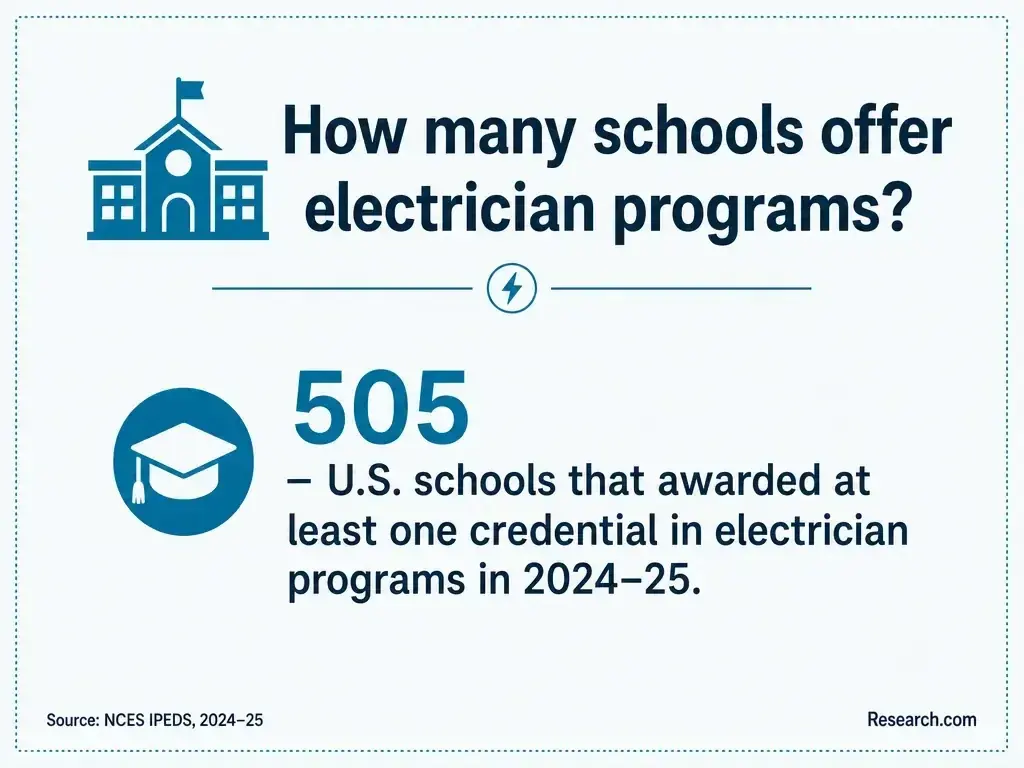
When evaluating a provider, ask for its recent electrician-program completion figures and how many completers entered electrical work or apprenticeships. Request the period and definition behind any placement claim. Then check current employer and sponsor openings: those are more useful for timing an application than a long-range national projection alone.
Investing in training is an important decision. Research.com created this ranking to help readers compare electrician programs with other programs in the same occupation and location, rather than with unrelated schools nationwide. The team checks outcomes, costs, recognition, and student support against multiple sources to improve the ranking's credibility and accuracy. Only programs with completions reported to IPEDS are eligible; an apprenticeship or employer program missing from the ranking is not necessarily unavailable or low quality.
Best-program rankings assess student completion and full-time and part-time retention; earnings one year after completion and earnings relative to annual attendance cost; tuition, attendance cost, debt - including debt held by students who withdrew - and federal loan default rates; and relevant recognition and student support. Programmatic accreditation or occupation-relevant industry recognition receives 20% of the score, institutional accreditation 10%, and student support 10%. The remaining 60% covers outcomes, earnings, and costs, with entropy-based weights giving more weight to indicators that vary more across programs. Most-affordable-program rankings score only costs and debt, using entropy-based weights; accreditation and other quality indicators are not part of that score.
The team used the following data sources to build and check the ranking. Some cover particular provider types or occupations rather than every electrician training route, so readers should also verify a program's current details directly.
The ranking is a starting point, not a substitute for confirming a current electrical curriculum, lab access, apprenticeship connections, and total cost. Research.com explains the broader approach on its methodology page.
# 1 position
# 2 position
Not necessarily. Some apprenticeships recruit entrants directly and provide related instruction alongside paid work. Ask each sponsor about prerequisites and whether prior school training earns advanced standing.
Online coursework can teach theory, but electrical installation and troubleshooting require supervised, hands-on practice. Confirm how any online program connects you to labs and field training.
No. A certificate documents training, not automatic permission to contract or perform work without supervision. Check the rules for your intended role and the jurisdiction where the job is located.
Choose based on admission access, hands-on training, net cost, wages during training, and the route to employment. School can provide a structured start; an apprenticeship integrates instruction with paid field experience. Neither is universally better.