# 1 position
Pensacola State College - Electrician.
certificate or diploma

Audited and Verified:
Our Editorial and Data Verification Process
Research.com uses government datasets, official education statistics and primary institutional information to support its career and degree guides. Our review process checks factual accuracy, occupational definitions, source dates and the requirements associated with the credentials discussed.
How This Article Was Fact-Checked
Our editorial team verifies salary estimates, employment projections, education requirements and program information against original data providers and official organizations. Salary figures are checked against the relevant occupational definitions and reporting periods. Information about licensure, accreditation and required in-person training is reviewed separately.
Fact-checked and verified on:

Co-Founder and Chief Data Scientist

Reviewed by Karolina Broda
Fact-Checker and Data Verification
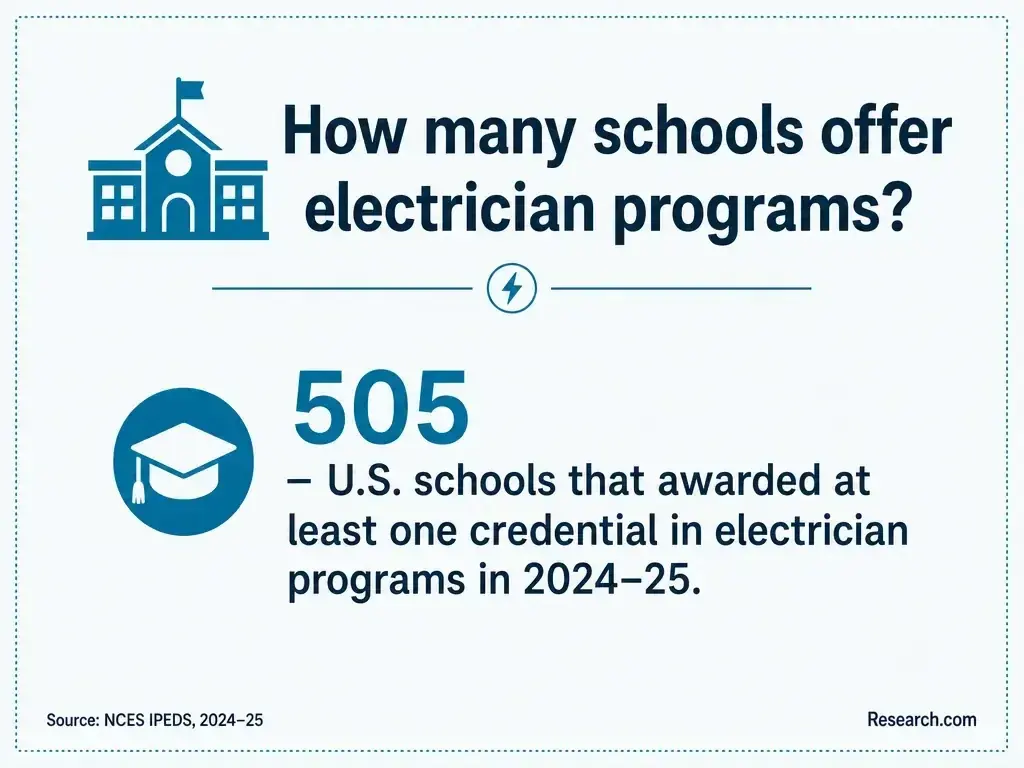
Choosing electrician training in Pensacola means comparing more than tuition: a short school program and a paid apprenticeship can lead to very different amounts of field experience. The U.S. Bureau of Labor Statistics projects 9.2% national growth in electrician employment from 2025 to 2035, making the training decision timely. This guide compares local pathways, costs, credentials, and licensing implications. It also features a Best Electrician Trade Schools in Pensacola for 2027 ranking created by the Research.com team of data scientists to help students make an informed choice about programs worth considering.
Expect a combination of electrical theory and supervised practice: reading plans, working with circuits, selecting materials, using test equipment, and following safety procedures. A school program usually provides structured classroom and lab instruction. An apprenticeship combines related instruction with paid, supervised work over a longer period; employer-sponsored entry positions may also provide on-the-job learning. These routes are not interchangeable simply because each teaches electrical skills (U.S. Bureau of Labor Statistics; U.S. Department of Labor).
For a local school option, ask Pensacola State College or George Stone Technical College for the current electrician-related program outline and a breakdown of lab versus classroom hours. Then ask whether graduates receive help finding an apprenticeship or entry-level employer. A certificate is most useful when its practical training and employer access match the work you want to do - not when its title merely sounds relevant.
Local possibilities include electrical contractors serving residential and commercial construction, building-maintenance employers, industrial facilities, and infrastructure or utility-related contractors. Some jobs involve travel between sites across the Pensacola area; a convenient classroom location may still mean substantial commuting during field training. Electricians install, maintain, and repair power, lighting, communications, and control systems, but an entry-level trainee works under appropriate supervision rather than independently contracting for jobs (U.S. Bureau of Labor Statistics).
Before choosing a program, review actual local trainee postings for the driving, schedule, safety, and experience requirements they specify. If industrial controls interest you more than residential wiring, look for relevant labs and employer connections; the broad label "electrician training" does not establish that specialization.
A reliable Pensacola-specific electrician wage figure is not established here, so do not treat a national figure as a local offer. The U.S. Bureau of Labor Statistics reports a $63,190 national median annual wage for electricians in May 2025. That figure includes experienced workers and does not describe typical first-year trainee pay. Compare local job advertisements and apprenticeship wage schedules before estimating what you could earn while training or immediately afterward.
Pay also depends on the type of work, experience, overtime, and employer. To evaluate the investment, compare likely trainee wages and later earnings against what you earn now, then account for training time, aid, debt, and the possibility of not completing. For broader context - not a substitute for local offers - see trade school careers salary comparisons.
Length depends on the credential and schedule. A school certificate may be completed before a worker has accumulated extensive field experience; a registered apprenticeship takes substantially longer because it integrates classroom instruction with supervised, paid work (U.S. Department of Labor). Neither a short completion date nor a large advertised hour total tells you, by itself, when you can work independently.
Request the current catalog's total clock or contact hours, weekly schedule, and required lab hours from each school. For an apprenticeship, request its written related-instruction and on-the-job training requirements, wage progression, and completion conditions from the sponsor. Ask whether prior electrical work or school instruction can earn documented advanced standing; never assume credits or hours transfer automatically.
Online instruction can be useful for electrical theory, calculations, code study, and some plan reading. It cannot, on its own, demonstrate safe installation, tool use, testing, troubleshooting, or supervised work at a jobsite. A hybrid program makes sense only if its required in-person labs and field opportunities are accessible from Pensacola.
For a career changer balancing work and training, compare the actual on-campus timetable - not just an "online" label - with your job hours and transportation. Ask who assesses practical competencies, where that assessment happens, and whether employers or an apprenticeship sponsor recognize the instruction. Do not assume remote coursework qualifies you for a credential or license.
There is no defensible single average for all local electrician routes: school charges, eligibility for aid, and paid apprenticeship arrangements differ. Ask Pensacola State College and George Stone Technical College for a current, program-specific written estimate rather than relying on a general tuition rate. Compare that estimate with an apprenticeship's required purchases and wages while training.
The amount that matters is the cost of becoming job-ready. Add tuition and mandatory fees, textbooks and materials, tools, work clothing and protective equipment, transportation to labs and worksites, and any applicable examination or application charges. Subtract grants or employer support, and consider earnings you would give up to attend. Eligible students should check federal aid with the school's financial aid office; aid eligibility depends on both the student and the program (Federal Student Aid). If you are comparing application costs across schools, apply to accredited online schools no fee required covers a different kind of cost saving, not a substitute for checking electrician lab access.
That depends on the pathway. A school may award a career certificate or another named occupational credential; a registered apprenticeship documents completion under its sponsor's approved training standards (institutional program catalogs; U.S. Department of Labor). Ask for the exact credential name and whether it records instruction alone or also supervised work. An optional industry credential, such as one aligned with NCCER training, is distinct from both school completion and government licensure (NCCER).
Institutional accreditation addresses the school, state authorization addresses permission to operate, apprenticeship registration addresses a training program, and occupational licensure addresses legal authority to perform regulated work. None automatically substitutes for another. Confirm the recognition that matters to your intended employer and, if you eventually plan to contract independently, to the relevant licensing authority.
Requirements vary by school and apprenticeship sponsor. Expect to confirm the current application process, academic preparation for electrical math, identification or work-eligibility requirements where applicable, and your ability to attend labs safely. Apprenticeship sponsors may have separate selection steps and employer-related requirements; admission to a school does not secure an apprenticeship position (U.S. Department of Labor).
Ask each provider which requirements must be met before enrollment and which apply only before placement at a worksite. This distinction can prevent paying for a program whose schedule, physical tasks, or work-placement conditions do not fit your circumstances. A reader weighing other education routes can consult what is the easiest bachelors degree to get, but ease of admission is not a sound measure of electrician career readiness.
Core instruction typically covers electrical safety, circuits and calculations, blueprint reading, wiring methods, testing, and code awareness. Practical work should let students use tools and meters, identify faults, and perform installations under supervision - not merely watch demonstrations. Electricians must also communicate with customers and coworkers and document work accurately (U.S. Bureau of Labor Statistics; O*NET).
Check how the curriculum treats current workplace needs such as controls and energy-related electrical equipment, but prioritize demonstrated fundamentals and safe practice over a long list of technologies. Ask to see the lab equipment and competency checklist. If your goal is a particular type of contractor or facility, ask what graduates can actually do on their first day of supervised work. Lists of highest-paying college majors answer a different question; an electrician curriculum should be judged against the tasks and experience your intended job requires.
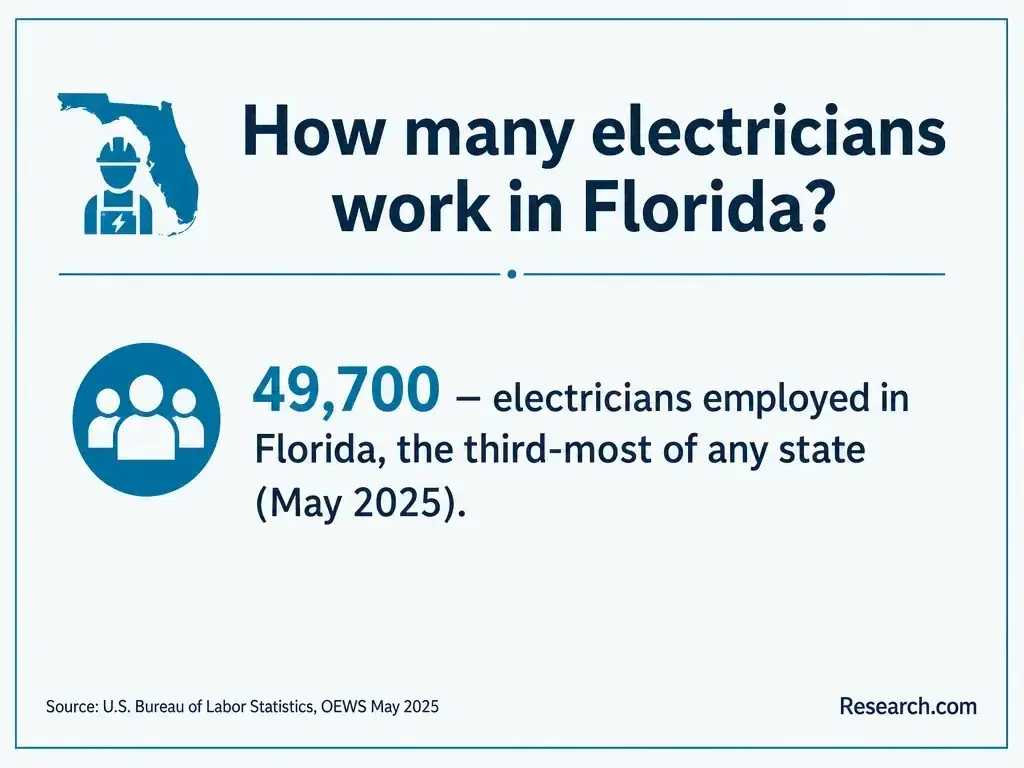
Do not confuse working as a supervised trainee with holding authority to operate as an electrical contractor. Florida's Department of Business and Professional Regulation regulates electrical contractor licensing, including certified and registered contractor categories. Contractor licensure involves requirements beyond finishing trade school; graduating does not itself grant a license. Local rules and employer requirements can also affect the role you may take, so verify the position and jurisdiction before relying on a claimed "license-ready" program (Florida Department of Business and Professional Regulation).
Ask the school or sponsor to specify which examination, documented experience, or contractor-license requirements its instruction supports, and confirm that answer with the appropriate licensing authority. NCCER credentials and school certificates may help demonstrate training, but they are not Florida contractor licenses. If independent contracting is your long-term goal, plan for supervised experience as well as classroom study.
Start with your target job: supervised trainee, a particular electrical specialty, or eventually independent contracting. Then compare local school programs with registered apprenticeships and employer-sponsored openings. A school route may suit someone who needs structured fundamentals before seeking field work; a paid apprenticeship may better suit someone ready to compete for entry and learn while earning. Neither choice is automatically cheaper or better once time and earnings are counted.
Use these checks before paying a deposit or accepting a training offer:
Red flags include an entirely online course presented as complete practical preparation, an unclear total price, or a promise that graduation automatically confers a contractor license. Rankings can narrow the search, but a route absent from college datasets may still be worth examining. If you are comparing the investment with high paying bachelor degrees, keep the electrician decision grounded in its distinct training time, supervised work, and licensing path.
Many entrants begin in supervised electrical work and build experience in residential, commercial, maintenance, or industrial settings. Later opportunities may involve troubleshooting, controls, crew leadership, or contracting, depending on the work performed and any additional qualifications required. The progression is not automatic: a school credential signals training, while employers assess practical ability and Florida regulates contractor licensing (U.S. Bureau of Labor Statistics; Florida Department of Business and Professional Regulation).
If you want a specialty, choose initial training that gives you sound wiring and safety fundamentals, then seek a sponsor or employer offering that type of fieldwork. Do not pay extra for an advanced-sounding certificate without checking whether local employers recognize it or whether it moves you toward the experience your goal requires.
The U.S. Bureau of Labor Statistics projects 9.2% growth in electrician employment nationally from 2025 to 2035. That is a useful signal that the occupation is expanding nationally, not a forecast of Pensacola vacancies or a guarantee of placement. Local construction schedules, maintenance hiring, and the availability of apprenticeship positions will matter more to your immediate search.
Before enrolling, compare recent local trainee postings with the skills a program teaches, and ask sponsors about their next intake. Treat a provider's placement claim as evidence to verify: request its definition of placement, reporting period, and whether jobs were specifically in electrical work. National growth supports considering the trade; a clear local route into supervised employment supports choosing a particular program.
Investing in training is an important decision. Research.com created its ranking to help readers compare electrician programs against other programs in the same location and occupation, using reported outcomes, costs, and quality indicators rather than a school's name alone. The team checks the credibility and relevance of its data, but the ranking includes only programs with completions reported to IPEDS; it cannot represent every apprenticeship or employer-sponsored route.
Best-program scores cover student completion and full- and part-time retention; earnings one year after completion and earnings relative to annual attendance cost; tuition, attendance cost, debt - including debt held by students who withdrew - and federal loan default rates; and accreditation, occupation-relevant recognition, and student support. Occupation-relevant programmatic accreditation or industry recognition accounts for 20%, institutional accreditation for 10%, and student support for 10%. An entropy-based method distributes the remaining 60% among outcomes, earnings, and cost indicators according to how much they differ across programs.
For most-affordable-program rankings, the score instead uses tuition, attendance cost, median debt, and federal loan default rates, with entropy-based weights. Accreditation and other quality indicators are not part of that affordability score. The following sources inform Research.com rankings across occupations; inclusion of a healthcare or dental organization here does not imply its recognition applies to electrician training:
Use the ranking to build a shortlist, then confirm each program's current schedule, total charges, hands-on instruction, and connection to paid work. More detail about the approach appears in Research.com's methodology.
# 1 position
# 2 position
Not necessarily. A registered apprenticeship or employer-sponsored supervised training may provide another route. Compare each option's instruction, field experience, entry requirements, and cost before enrolling (U.S. Department of Labor).
No. A certificate documents specified training; it does not itself grant a Florida electrical contractor license or replace supervised experience (Florida Department of Business and Professional Regulation).
You can study some theory online, but installation, testing, safety practice, and supervised field competencies require in-person participation. Verify where a hybrid program provides those components.
Choose based on access and fit. School can offer structured preparation before applying for field work; an apprenticeship combines instruction with paid experience but has its own selection process. Compare total cost, time, and the path to your intended job.
Request a written estimate covering required fees, books, tools, protective gear, and travel - not tuition alone. Also ask about aid, paid placements, and whether any required purchases can be used once you start work.