# 1 position


Audited and Verified:
Our Editorial and Data Verification Process
Research.com uses government datasets, official education statistics and primary institutional information to support its career and degree guides. Our review process checks factual accuracy, occupational definitions, source dates and the requirements associated with the credentials discussed.
How This Article Was Fact-Checked
Our editorial team verifies salary estimates, employment projections, education requirements and program information against original data providers and official organizations. Salary figures are checked against the relevant occupational definitions and reporting periods. Information about licensure, accreditation and required in-person training is reviewed separately.
Fact-checked and verified on:

Co-Founder and Chief Data Scientist

Reviewed by Karolina Broda
Fact-Checker and Data Verification
Choosing an affordable electrician program in Honolulu means comparing more than tuition: you need training that fits Hawaiʻi's licensing rules and gives you meaningful hands-on experience. The U.S. Bureau of Labor Statistics projects 9.2% national growth in electrician employment from 2025 to 2035. For prospective students and career changers, this guide explains costs, credentials, apprenticeships, and local career options. It also accompanies the Most Affordable Electrician Trade Schools in Honolulu for 2027 ranking, created by the Research.com team of data scientists to help students make informed choices about programs worth considering.
Expect a mix of electrical theory and physical work: reading plans, installing wiring and equipment, testing circuits, and practicing safe procedures. A classroom or lab credential can prepare you to seek an entry-level job or apprenticeship, but it does not replace the documented experience required for a Hawaiʻi journey worker license. The Hawaiʻi Board of Electricians and Plumbers sets licensing requirements; each provider sets its own curriculum and admission rules.
These pathways serve different goals. Compare the credential and work component before comparing prices.
| Pathway | What you receive | Best fit and principal limitation |
| College certificate | Academic credential with classroom and lab training | Useful for building fundamentals before employment; confirm whether coursework meets board requirements and whether work placement is available. |
| Associate-level trade program | Academic credential with broader technical coursework | May suit students seeking a wider technical foundation; more time in school does not automatically mean more qualifying work hours. |
| Registered apprenticeship | Structured instruction and paid, supervised work; an apprenticeship completion credential | Strong fit for those ready to earn while training; entry depends on sponsor selection and available openings. |
| Employer-sponsored entry route | Work experience and any instruction the employer arranges | Can limit upfront school costs; confirm supervision, records, and qualifying coursework before relying on it for licensure. |
Ask any provider to identify its lab activities, employer connections, and the documentation it issues for completed instruction. Two programs awarding certificates are not equivalent if one has substantially less practical preparation.
Potential workplaces on Oʻahu include electrical contractors' residential and commercial projects, building maintenance teams, industrial facilities, and utilities. The work differs: construction emphasizes installation to plans and codes, while maintenance emphasizes troubleshooting existing systems. The U.S. Bureau of Labor Statistics describes electricians as working across construction and maintenance settings; an employer determines which tasks an entry-level worker can perform under appropriate supervision.
Honolulu's island location makes travel to worksites and access to an employer willing to document experience practical selection factors. Before paying for training, ask where apprentices or entry-level hires actually work, whether assignments require travel across Oʻahu, and whether the hours align with your intended Hawaiʻi license classification.
A reliable Honolulu starting-wage figure cannot be inferred from a national median. The U.S. Bureau of Labor Statistics reports a $63,190 national median annual wage for electricians in May 2025. That is the midpoint for employed electricians across experience levels - not a forecast for someone finishing a certificate or entering an apprenticeship. Request current Honolulu-area wage information for the specific occupation and experience level from Hawaiʻi's labor-market agency, and compare actual apprentice pay schedules when sponsors provide them.
For an investment decision, compare likely earnings during training as well as afterward. A paid apprenticeship may improve cash flow even if a school certificate gets you into the job market sooner; neither outcome is assured.
Program length and time to independent practice are different. A certificate may take less time than an associate-level program, but Hawaiʻi's general journey worker electrician requirements include five years of practical experience totaling at least 10,000 hours and 240 hours of electrical academic coursework, according to the Hawaiʻi Board of Electricians and Plumbers. Other license classifications have different requirements. Confirm the current classification and documentation rules with the board before enrolling.
If speed is your priority, ask whether you can begin qualifying paid work while taking classes. Advertised "fast" training should not be mistaken for a shortcut to a license. A reader considering what is a quick degree that pays well? should apply a different timetable here: electrician training is a progression from initial instruction through documented experience and examination.
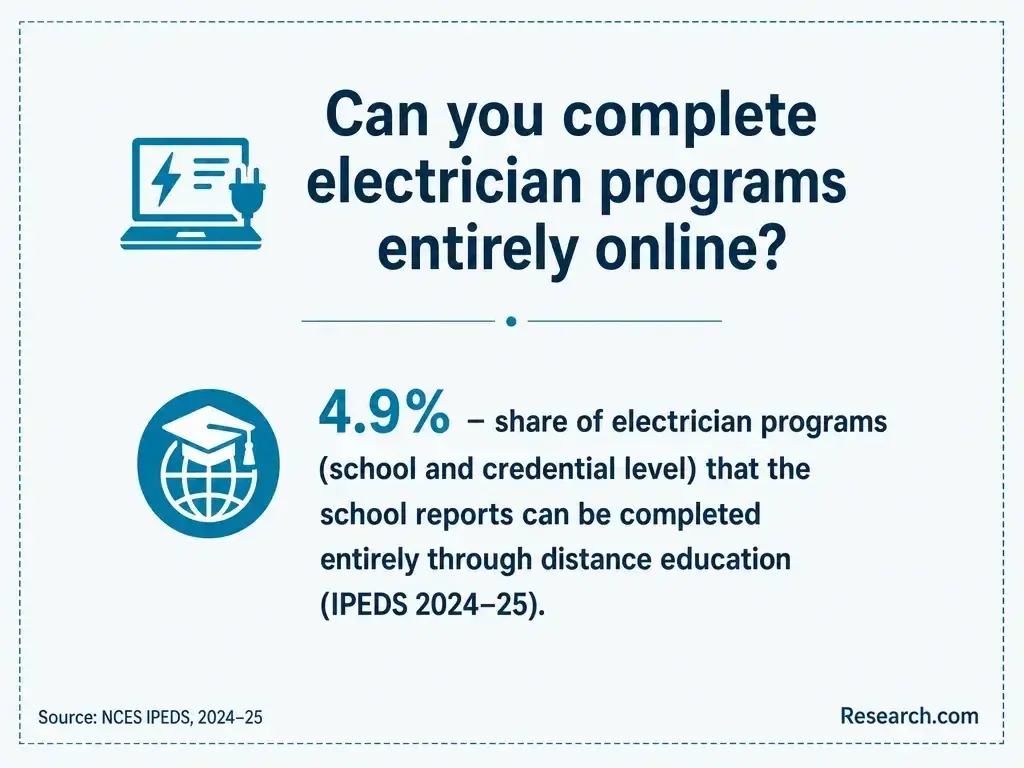
Online delivery can make code concepts, calculations, and other theory easier to study around work. Campus labs and supervised worksites allow practice with tools, wiring methods, testing, and safety procedures. An entirely online course should not be assumed to provide practical competence, qualifying experience, or Hawaiʻi licensing eligibility.
For a working adult attracted to the fastest online degree for working adults, the relevant electrician question is narrower: which theory classes can be taken remotely without delaying labs or paid fieldwork? Ask for a timetable showing every required in-person session, its Oʻahu location, and how missed sessions are made up.
There is no single defensible Honolulu average that covers college programs, paid apprenticeships, and employer-sponsored training on comparable terms. Published tuition also leaves out costs that can determine affordability. Request an itemized, current quote rather than treating a ranking position as your final price.
The comparison below separates charges from expenses and possible offsets. It helps reveal when a low-tuition option could still be costly to complete.
| Cost or offset | What to verify |
| Tuition and mandatory fees | Your residency rate, program-specific charges, payment schedule, and refund terms. |
| Job-ready supplies | Required tools, PPE, books, and materials; whether they are supplied, lent, or purchased separately. |
| Training and entry expenses | Travel to labs and Oʻahu worksites, required application or exam fees, and income forgone while attending. |
| Offsets | Eligible federal aid, Hawaiʻi or workforce assistance, scholarships, employer support, and apprenticeship wages. |
Federal Student Aid explains that eligibility depends on the student and eligible institution or program; do not assume every short course or apprenticeship qualifies. Compare net cost and borrowing with the likelihood of finishing, the time until paid work, and earnings over a realistic time horizon. An apprenticeship's wages can matter more than a modest difference in advertised tuition.
The credential depends on the route: a college may award a certificate or associate degree, while a registered apprenticeship awards a completion credential. An employer's training record is different again. None is itself a Hawaiʻi journey worker electrician license. Institutional accreditation, an industry credential, apprenticeship registration, and state occupational licensure answer separate questions; verify each one that matters to your goal.
If you want training that builds toward additional study, ask Honolulu Community College how credits or documented prior learning may apply to its available electrical programs; do not assume transfer or advanced standing. Unlike dual degree programs, the immediate value of an electrician credential rests largely on relevant instruction, practical skill, and a viable route to documented qualifying work.
Requirements vary by provider and pathway. A college may ask for an application and placement or course prerequisites; a registered apprenticeship sponsor may assess applicants and interview for available positions. Employers can set their own hiring and work-readiness conditions. Check the current written requirements rather than assuming admission to classes guarantees an apprenticeship or job.
Adults returning to study - including readers exploring best online programs for seniors - should ask about math preparation, scheduling, and physical lab participation before committing. Those questions are more useful for this trade than whether general online coursework is convenient.
Relevant instruction covers electrical calculations, circuitry, reading drawings, wiring methods, testing, code use, and jobsite safety. In labs or supervised work, students must apply those concepts with tools and equipment rather than only answer questions about them. The U.S. Bureau of Labor Statistics identifies installing, maintaining, and testing electrical systems as core electrician work.
Review the actual course and lab schedule against the work you want. Someone targeting installation should look for substantial installation practice; someone drawn to maintenance should ask how often students diagnose faults on equipment. Also ask who records completed classroom hours and whether the instruction fits the Hawaiʻi license classification you intend to pursue.
Yes, Hawaiʻi licensure matters for work as a licensed electrician. The Hawaiʻi Board of Electricians and Plumbers administers electrician license classifications and their experience, education, and examination requirements. For the general journey worker electrician classification, the board specifies at least 10,000 hours of practical experience over five years and 240 hours of electrical academic coursework. Completing school alone does not satisfy the experience requirement or confer a license.
Entry-level employment under appropriate supervision is distinct from independently holding a journey worker license. Before choosing a program, ask the board which coursework and experience documentation it accepts for your target classification, and ask a prospective sponsor how it tracks your work. Optional industry certifications may demonstrate skills, but they do not substitute for a required state license.
Start with the license classification and job you want, then work backward to the required instruction, practical experience, and affordable way to obtain both. Honolulu Community College, registered apprenticeship sponsors - including union-connected opportunities associated with IBEW Local 1186 - and employers may offer different combinations of instruction and work. A ranking can narrow your search, but its affordability score does not assess lab quality or licensing fit.
Use these questions when speaking with a program representative and an apprenticeship coordinator; request written answers before paying a deposit.
Warning signs include promises of automatic licensure, an "all-online" practical pathway without fieldwork, or a price that excludes required equipment. Avoid choosing solely by institutional accreditation or tuition: neither proves that you can complete the work hours needed for your intended license.
An entry route can lead from supervised installation or maintenance work to the relevant Hawaiʻi journey worker license after qualifying experience, coursework, and examination. With further experience, an electrician may pursue more specialized work or supervisory responsibilities, subject to the requirements of the role and any applicable license. Do not treat a short program as an immediate route to independent contracting.
If you are comparing career-change timelines - including options such as fastest masters online - judge electrician training by its own milestones: time to paid supervised work, time to document required hours, and cost through licensure. For someone who wants hands-on work, those milestones are more informative than the speed of an unrelated credential.
The U.S. Bureau of Labor Statistics projects 9.2% growth in U.S. electrician employment from 2025 to 2035. This supports considering the trade, but it is a national projection - not a count of Honolulu vacancies or a promise of local placement. Construction activity, maintenance needs, and sponsor hiring determine which Oʻahu opportunities a new trainee can access.
Before enrolling, check Hawaiʻi labor-market information and current apprenticeship openings, then ask local employers what preparation they expect from beginners. A program is a better investment when its schedule and practical training match an attainable supervised job, not merely a growing national occupation.
Investing in electrician training is an important decision, especially when a low advertised price may not cover the experience needed for licensure. Research.com's team built this ranking to help readers compare reported costs and debt among relevant local programs, while reviewing multiple data sources for credibility and accuracy.
Trade-school programs are compared with programs in the same occupation and location. Only programs with completions reported to IPEDS are eligible. For the most affordable ranking, the score uses tuition, cost of attendance, median student debt, and federal loan default rate; an entropy-based method assigns more weight to indicators that vary more across programs. Accreditation and other quality measures are not part of this affordability score. Separately, Research.com's best-program rankings assess student outcomes, earnings and return on investment, costs and debt, and quality and recognition; those rankings are not the affordability ranking presented here.
The ranking draws on the following sources. Some cover providers or credentials outside electrician training; inclusion as a data source does not mean an unrelated approval applies to electricians.
Use the ranking to identify programs for closer comparison, not as a complete directory of Honolulu training. Apprenticeships and other providers without IPEDS-reported completions may be absent. Research.com provides further detail on its ranking methodology.
# 1 position
# 2 position
Not necessarily. A registered apprenticeship or suitable employer-sponsored route can combine instruction and supervised work. Check how any route meets the Hawaiʻi Board of Electricians and Plumbers' requirements for your intended license.
No. A certificate may document instruction, but licensure also requires qualifying experience and an examination under the applicable board rules.
Registered apprenticeships generally combine paid work with related instruction, according to Apprenticeship.gov. Ask the local sponsor for its current wages, fees, selection process, and work schedule.
You may be able to study some theory online. Wiring, testing, and supervised work require in-person practice; do not assume an online-only course meets Hawaiʻi licensing requirements.
There is no universal winner. Compare the full price of school, required tools and travel, available aid, apprenticeship wages, and how soon each route lets you accumulate qualifying work experience.