# 1 position


Audited and Verified:
Our Editorial and Data Verification Process
Research.com uses government datasets, official education statistics and primary institutional information to support its career and degree guides. Our review process checks factual accuracy, occupational definitions, source dates and the requirements associated with the credentials discussed.
How This Article Was Fact-Checked
Our editorial team verifies salary estimates, employment projections, education requirements and program information against original data providers and official organizations. Salary figures are checked against the relevant occupational definitions and reporting periods. Information about licensure, accreditation and required in-person training is reviewed separately.
Fact-checked and verified on:

Co-Founder and Chief Data Scientist

Reviewed by Karolina Broda
Fact-Checker and Data Verification
For an aspiring electrician in Grants, the cheapest tuition may not be the cheapest route to paid work: tools, travel, and supervised experience matter too. The U.S. Bureau of Labor Statistics projects electrician employment to grow 9.2% nationally from 2025 to 2035. This guide helps prospective students and career changers compare training, costs, credentials, and New Mexico licensing. It also accompanies the Most Affordable Electrician Trade Schools in Grants for 2027 ranking, created by the Research.com team of data scientists to help students identify programs worth considering.
Expect instruction in electrical theory and safe installation, plus practical work with circuits, wiring methods, drawings, and test instruments. A classroom certificate can build entry-level skills, but it is not the same as an apprenticeship: an apprentice performs supervised work while receiving related instruction and wages. The U.S. Bureau of Labor Statistics describes apprenticeship as the typical route into the electrician occupation.
For someone in Grants, the decisive question is whether local lab access and employer connections justify the program's price and travel. Ask New Mexico State University-Grants to confirm its current electrician-related offerings, credential, lab schedule, and employer partnerships rather than assuming a program is available from the institution's name. If electrical work is one of several careers you are weighing, a broader look at useful college majors can inform that choice; it does not replace checking electrician-specific training.
Electricians work for electrical contractors and employers maintaining buildings, equipment, and power systems; assignments can involve construction sites, existing facilities, or service calls (U.S. Bureau of Labor Statistics). In and around Grants, a prospective apprentice should ask about the actual service territory and jobsite locations before accepting an offer. A manageable classroom commute does not necessarily mean a manageable daily worksite commute.
Some work involves independent troubleshooting; other assignments require close coordination with crews and customers. If that distinction matters to you, compare the working conditions described in best high paying careers for introverts with the employer's description of the specific electrician role, rather than assuming every electrical job has the same social demands.
A verified Grants-specific electrician wage is not available here, so the national figure is a benchmark, not a local pay quote. Electricians had a $63,190 national median annual wage in May 2025 (U.S. Bureau of Labor Statistics). The median covers workers at different experience levels; it should not be used as an apprentice starting-wage estimate.
To assess a local offer, request the apprentice wage schedule, expected hours, travel expectations, and benefit details from the sponsor or employer. Compare those terms with any unpaid time you would spend in school. That gives a more useful near-term picture than comparing a first-year training decision with an occupation-wide median.
Length depends on the credential and, more importantly, the route to independent work. A short pre-apprenticeship or certificate may prepare someone to apply for entry-level work; it does not replace the supervised experience required for a journeyman pathway. A registered apprenticeship combines related instruction and substantial on-the-job training over multiple years (U.S. Department of Labor; U.S. Bureau of Labor Statistics).
Before comparing advertised completion dates, ask for the program's clock or credit hours, scheduled lab hours, and any documented credit toward an apprenticeship. Ask the New Mexico Construction Industries Division which experience counts for your intended journeyman classification. Prior work or coursework should be treated as advanced standing only when the receiving sponsor or regulator confirms it.
Online coursework can help with electrical theory, calculations, and code study. Wiring, measuring, fault-finding, equipment use, and supervised jobsite practice require physical participation. A hybrid program is useful only if its required labs and work placements are realistically accessible from Grants; an entirely online course should not be assumed to satisfy an employer's practical expectations or New Mexico licensing requirements.
Ask where and when hands-on sessions occur, who supervises them, and whether any work experience is arranged or must be found independently. A cheaper remote course can become the more expensive option if it leaves you needing separate lab training or extensive travel.
There is no verified Grants-wide average price here, and it would be misleading to calculate one from an incomplete set of providers. Compare written, current estimates for the total cost to become job-ready, not a tuition figure alone. The table separates charges that students often see at enrollment from costs that can arise later.
| Cost component | What to verify |
| School charges | Tuition, mandatory fees, books, materials, and any separate lab charges |
| Work readiness | Required tools, test equipment, work clothing, and personal protective equipment |
| Career entry | Any applicable examination, application, and licensing costs after qualifying |
| Access and time | Travel to classes and jobsites, plus earnings forgone during unpaid training |
| Offsets | Grants, eligible federal or state aid, employer support, and wages during an apprenticeship |
For New Mexico State University-Grants, request a program-specific cost sheet and confirm whether the chosen training qualifies for federal aid or New Mexico assistance; eligibility depends on both the student and the program (Federal Student Aid; New Mexico Higher Education Department). A paid apprenticeship may reduce borrowing, but its wage and schedule matter. ROI depends on completion, debt, lost earnings, future pay, and how long you expect to work - not institution type alone. Comparisons such as masters degrees with the highest roi use a different education pathway and should not substitute for an electrician-specific cost calculation.
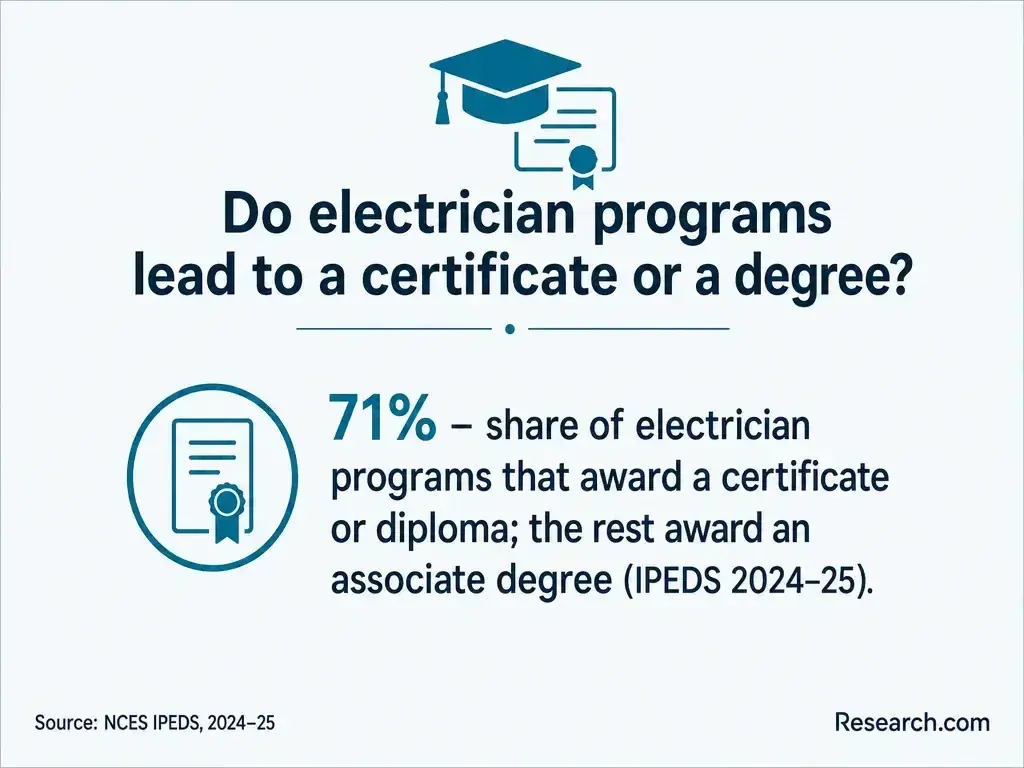
The credential depends on the provider: a short program may award a completion certificate, a college may offer an occupational certificate or associate degree, and a registered apprenticeship awards an apprenticeship completion credential after its requirements are met. An industry training credential, where offered, is distinct from both a school award and an occupational license (U.S. Department of Labor; National Center for Construction Education and Research).
Ask for the exact credential name in writing. Then ask whether an apprenticeship sponsor accepts its coursework or grants advanced standing. Neither institutional accreditation nor a similarly named certificate establishes that New Mexico will count the training or experience toward a particular electrical license.
Requirements vary by provider and route. A school may assess reading and math readiness and set its own application requirements. An apprenticeship sponsor can additionally require an application, an aptitude assessment or interview, and the ability to reach assigned jobsites. Confirm the current rules with the specific provider or sponsor rather than treating a school's admission offer as admission to an apprenticeship.
For a Grants applicant, reliable transportation can be as important as class availability: related instruction and supervised jobs may occur in different places. Before paying a deposit, ask when practical training begins, whether a placement is offered, and what happens if no employer position is available.
Useful instruction connects electrical calculations and code concepts to safe, repeatable tasks: reading drawings, selecting wiring methods, installing circuits, using meters, and diagnosing faults. The U.S. Bureau of Labor Statistics identifies testing equipment, blueprints, and safety practices as central to electricians' work. A program's value therefore depends partly on how much students actually practice under supervision, not just which topics appear in a catalog.
Request a lab outline showing the equipment used and the practical tasks assessed. If your goal is an apprenticeship, also ask whether instruction prepares you for the sponsor's entry process and whether completed coursework can be recognized; do not assume similar course titles will transfer.
New Mexico regulates electrical contracting and journeyman classifications through its Construction Industries Division. The classification and work performed determine the applicable experience, examination, and licensing requirements (New Mexico Construction Industries Division). A new entrant may train under appropriate supervision, but finishing school alone does not authorize independent licensed electrical work.
Before enrolling, identify the type of electrical work you intend to do and ask the division which supervised experience it accepts for that classification. Ask the training provider how it documents work hours and whether its instruction is recognized by the apprenticeship sponsor you plan to join. Institutional accreditation, school authorization, apprenticeship registration, optional industry certification, and a state occupational license serve different purposes; none should be presented as a substitute for another.
Start with the intended job, then work backward to its supervised-training and licensing requirements. For Grants residents, the strongest low-cost option may be a school program with accessible labs, a paid apprenticeship, or a combination - but only if the route provides the experience you still need. The affordability ranking is a shortlist, not a determination of licensing eligibility or program quality.
Use these checks before committing money or turning down paid work:
A common mistake is choosing the lowest advertised tuition while overlooking an inaccessible lab or no route to supervised hours. Another is treating an online course as a licensing shortcut. If flexibility is your priority, guides to an easiest degree online address a different question: electrician training still requires in-person competence and an occupation-specific entry plan.
One practical progression is introductory training, supervised electrical work, and - after meeting the applicable New Mexico requirements - journeyman-level work. Experience can then support specialization in areas such as installation, maintenance, or troubleshooting, as well as supervisory or contracting ambitions where the relevant licensing rules are met. These are possible paths, not outcomes conferred by a certificate (New Mexico Construction Industries Division; U.S. Bureau of Labor Statistics).
Choose training that matches the work you want to perform: broad wiring and jobsite experience may serve an aspiring construction electrician differently from a narrowly focused maintenance course. For someone comparing long-term education choices, shortest doctoral programs concern a separate pathway; they provide no substitute for electrical work experience or New Mexico licensing.
The U.S. Bureau of Labor Statistics projects 9.2% national growth for electricians from 2025 to 2035. That indicates demand across the occupation, not a forecast of openings in Grants or a guarantee of a local apprenticeship seat. A student planning to remain nearby should check current sponsor intake, employer service areas, and the distance to available jobsites before choosing a training schedule.
Growth also does not erase the difference between a trained beginner and a licensed, experienced electrician. Programs that help students obtain supervised work may be more valuable than faster classroom-only options when occupational entry is the goal.
Investing in electrician training is an important decision, especially when an inexpensive program may still leave a student needing substantial work experience. Research.com's team built the ranking to make cost comparisons more credible and useful. Programs are compared with other electrician programs in the same geographic market, and only programs with completions reported to IPEDS are eligible.
The most affordable ranking scores tuition, cost of attendance, median student debt, and federal loan default rate. Indicator weights are distributed using an entropy-based method, which gives more weight to measures that differ more across programs. Unlike a best-program ranking, this affordability score does not include accreditation, recognition, student support, or outcomes as quality measures. Readers should check those separately before enrolling.
The team used the following data sources to develop and check its rankings. Some cover institutions broadly; occupation-specific and apprenticeship sources help provide context but are not a substitute for verifying a particular electrician pathway.
This approach helps readers shortlist lower-cost, IPEDS-reporting programs, not determine that every local training option has been ranked. Registered apprenticeships and employer training may be absent from college-oriented datasets. See Research.com's ranking methodology for more information, then confirm current prices and New Mexico licensing relevance directly with each provider.
# 1 position
# 2 position
# 3 position
Not necessarily. A registered apprenticeship is a major route because it combines paid supervised work with related instruction. A school program can help you prepare, but ask a sponsor whether it recognizes the coursework (U.S. Bureau of Labor Statistics; U.S. Department of Labor).
No. School completion and New Mexico occupational licensure are separate. Check the Construction Industries Division's requirements for the classification and work you intend to pursue.
Theory may be available online, but practical electrical tasks and supervised jobsite work require in-person participation. Verify where a hybrid program's labs take place before enrolling.
There is no single cheapest option for everyone. Compare full school costs and travel with a paid apprenticeship's wages, schedule, and entry requirements; the lowest tuition may not produce the lowest total cost.
Confirm current electrician-related offerings directly with the institution before applying. Ask for the exact credential, practical-training arrangements, price, and whether an apprenticeship sponsor will recognize the instruction.