# 1 position


Audited and Verified:
Our Editorial and Data Verification Process
Research.com uses government datasets, official education statistics and primary institutional information to support its career and degree guides. Our review process checks factual accuracy, occupational definitions, source dates and the requirements associated with the credentials discussed.
How This Article Was Fact-Checked
Our editorial team verifies salary estimates, employment projections, education requirements and program information against original data providers and official organizations. Salary figures are checked against the relevant occupational definitions and reporting periods. Information about licensure, accreditation and required in-person training is reviewed separately.
Fact-checked and verified on:

Co-Founder and Chief Data Scientist

Reviewed by Karolina Broda
Fact-Checker and Data Verification
Choosing affordable electrician training in Levelland means comparing more than tuition: a low-cost program may still leave you needing years of supervised work. The U.S. Bureau of Labor Statistics projects 9.2% national growth in electrician employment from 2025 to 2035. For prospective students and career changers, this guide explains local training options, Texas licensing, costs, and career prospects. It also features a Most Affordable Electrician Trade Schools in Levelland for 2027 ranking, created by the Research.com team of data scientists to help you make an informed choice about programs worth considering.
Expect instruction in electrical theory, safe work practices, wiring methods, code use, and testing, paired with supervised practice. The important distinction is between learning electrical skills and accumulating the documented work experience needed for a Texas license. South Plains College is based in Levelland; ask it which electrician-related programs and hands-on components are actually available for your intended start date (South Plains College).
The following pathways lead to different credentials and amounts of workplace experience. Compare the outcome you need, not just the program title.
| Pathway | Typical outcome | Best fit and main limitation |
| Trade-school or college certificate | School-issued certificate and practical foundations | Useful before seeking electrical work; confirm whether an employer will recognize the training and whether any hours can count toward licensing. |
| Electrical associate degree | Academic degree with technical coursework | May suit someone who wants broader technical study; usually costs more time than a shorter certificate and does not itself grant a license. |
| Registered apprenticeship | Paid, supervised work plus related instruction and an apprenticeship completion credential | Strong fit for earning while building documented experience; entry depends on an available sponsor and its selection requirements. |
| Employer-sponsored entry route | Supervised work and employer training, which may not award a school credential | Can reduce upfront school costs; verify Texas apprentice registration, supervision, instruction, and experience records. |
A pre-apprenticeship can help someone prepare for an apprenticeship application, but it is not the same as a registered apprenticeship. Ask any provider how much instruction occurs in a lab or on a worksite, who supervises it, and whether it helps you secure qualifying employment. A classroom-only credential may be a poor investment if your main obstacle is finding a supervised position.
Potential settings include building contractors, facility maintenance operations, industrial sites, agricultural electrical work, and utility-related employers. Duties and hiring requirements differ: installing branch circuits in a building is not the same job as maintaining industrial controls or working on utility distribution equipment (U.S. Bureau of Labor Statistics). Ask employers which entry-level roles accept trainees and whether a licensed electrician can supervise the experience you need.
Levelland's smaller labor market makes commute distance a practical part of program choice. Before paying for training, search for apprentice openings within the area you can reliably travel to, including Lubbock if that commute works for you. A nearby class is less useful if its required worksite or placement is beyond your reach.
The U.S. Bureau of Labor Statistics reports a $63,190 national median annual wage for electricians in May 2025. It is not a Levelland wage estimate or an expected first-year apprentice salary. Pay varies with experience, duties, employer, and hours; apprentices generally earn while learning but start below fully qualified electricians (U.S. Bureau of Labor Statistics; U.S. Department of Labor).
For a useful local estimate, ask prospective apprenticeship sponsors or employers for their current apprentice pay progression, expected weekly hours, and work locations. Compare those figures with the income you would give up during full-time school. Do not use the national median as the return on investment for a short certificate.
School-program length depends on the credential and schedule; request the current calendar, total contact hours, lab hours, and any required work placement before enrolling. Completing classes is not the same as reaching independent electrician status. Texas generally requires 8,000 hours of supervised on-the-job training for a journeyman electrician license; its residential wireman route has a separate 4,000-hour experience requirement and a narrower scope of work (Texas Department of Licensing and Regulation).
A short program may get you ready to apply for entry-level work sooner, while an apprenticeship integrates paid work and instruction over a longer period. Do not choose an accelerated option solely because it finishes quickly: check when you can start recording qualifying supervised hours. Unlike a search for the easiest online college degree, this decision turns on physical skills and documented work experience.
Online lessons can cover electrical theory, calculations, code concepts, and some safety instruction. They cannot replace supervised practice with tools, wiring, testing equipment, and jobsite procedures. An on-campus or hybrid option is worth more when its lab access fits your schedule and leads to a realistic work-based training opportunity.
If you are comparing affordable online colleges, check the electrician program separately from the institution's general online offerings. Ask where and when practical sessions occur, whether you must travel to another site, and who arranges any fieldwork. Neither an online certificate nor institutional accreditation, by itself, establishes Texas licensing eligibility (Texas Department of Licensing and Regulation).
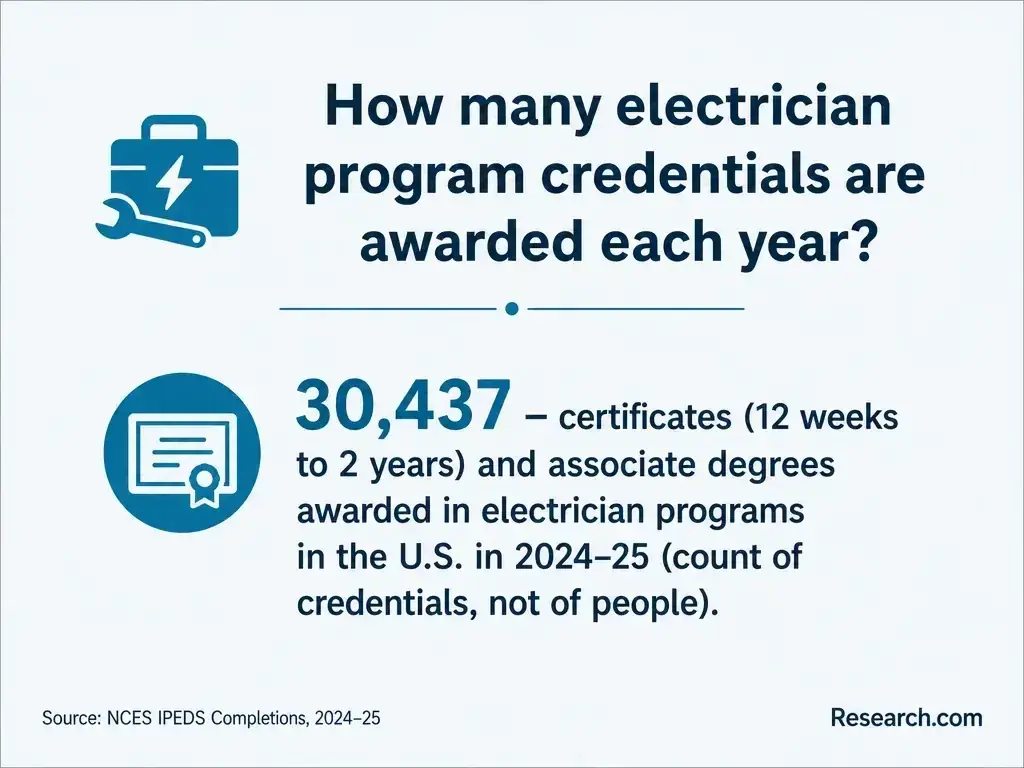
There is no reliable single average here that captures certificates, associate programs, and paid apprenticeships on the same basis. Request a current, itemized quote for each available program instead. For tuition-based study, add mandatory fees, books, consumables, tools, testing equipment, safety gear, travel, and any licensing or exam charges. Then subtract grants or employer contributions for which you actually qualify.
A cheapest associate degree online comparison can provide a tuition benchmark, but it cannot price the in-person electrical labs and supervised work needed for this occupation. Paid training may improve cash flow even when its classroom component takes longer. Federal aid eligibility depends on the institution and program; check with the provider and Federal Student Aid rather than assuming every short course qualifies (Federal Student Aid).
To judge value, compare total out-of-pocket cost and debt with apprentice wages, earnings you would forgo, your likelihood of completion, and a realistic path to licensed work. A longer time horizon matters: the cheapest first term is not necessarily the cheapest path to becoming job-ready.
The award depends on the route: a school may issue a certificate or associate degree; a registered apprenticeship has its own completion credential. None is the same as a Texas electrician license. If a provider advertises industry credentials, ask for the exact credential name, issuing organization, exam requirements, and whether the cost is included.
Lists of highest paying certificates cannot tell you whether a particular electrical credential counts toward your intended job. Institutional accreditation concerns the school; industry recognition concerns training or assessment; apprenticeship registration concerns the work-and-instruction arrangement; and occupational licensure is governed by Texas. Verify each separately with the relevant institution, sponsor, or regulator.
Requirements vary by provider and pathway. A school may ask for an application, prior education records, and placement information; an apprenticeship sponsor may also screen for the math, availability, and worksite readiness needed for its jobs. Ask for the current written criteria rather than assuming that admission to classes includes an apprenticeship position.
Before performing electrical work as a trainee in Texas, check the applicable apprentice electrician licensing requirements with the Texas Department of Licensing and Regulation. If you already have electrical experience, ask the provider whether it offers prior-learning credit or advanced standing, and ask the regulator or sponsor what documentation is needed for work hours. School credit and qualifying supervised experience are different determinations.
Useful training connects circuit theory and calculations to reading plans, selecting and installing wiring methods, using meters, troubleshooting faults, and working safely around energized equipment. Code instruction should help students learn how to find and apply requirements, not merely memorize answers. Electricians also need communication, documentation, and coordination skills on shared worksites (U.S. Bureau of Labor Statistics).
Judge a curriculum by what students physically do. Ask to see the equipment list and lab sequence: will you practice installation, measurement, fault-finding, and safe procedures under supervision? If your goal is industrial maintenance rather than building installation, check for relevant controls and troubleshooting practice instead of assuming every "electrical" program teaches the same job.
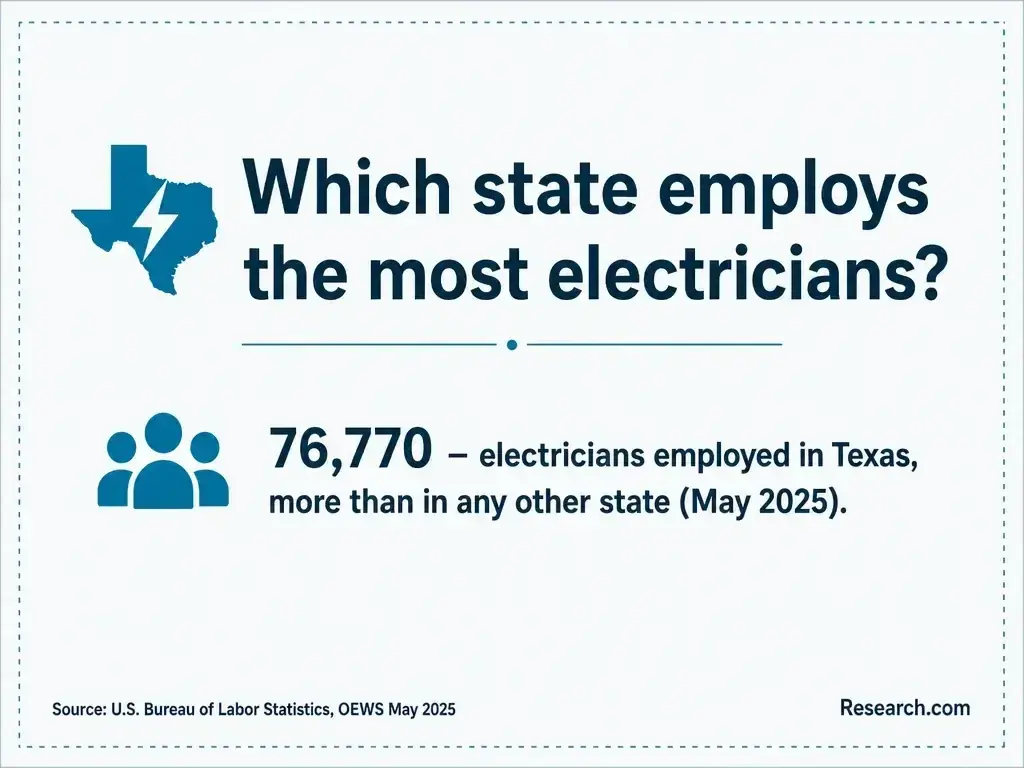
Texas regulates electrical work through the Texas Department of Licensing and Regulation (TDLR). Entry-level workers should check the apprentice electrician license and supervision rules before starting work. For the journeyman electrician license, TDLR generally requires 8,000 hours of supervised on-the-job experience and passage of an examination. The residential wireman license is a distinct route with 4,000 supervised hours and a more limited work scope (Texas Department of Licensing and Regulation).
A school certificate is not an occupational license, and an optional industry certification does not substitute for TDLR requirements. Before enrolling, tell the provider which Texas license you eventually want and ask how its instruction connects to supervised work, experience documentation, and exam preparation. Confirm current rules directly with TDLR before relying on a school's eligibility claim.
Start with the role you want, then compare the full route to that role. An affordable program is worth considering when it provides useful practical skills at a manageable net cost and helps you reach qualifying supervised work. A paid apprenticeship may be the better first application if you are ready to work and can meet its entry requirements.
Get written answers to these questions before committing money or declining a paid opportunity:
Watch for promises that graduation automatically brings a license, salaries presented as guaranteed starting pay, or "fully online" practical training with no clear hands-on site. Rankings help identify options; they cannot replace checking current offerings, work placements, and your own budget.
A common progression is supervised apprentice work, additional documented experience, and - after meeting Texas requirements - the appropriate licensing examination and license. Later choices may include residential or commercial installation, industrial troubleshooting, supervisory work, or business ownership, depending on experience and any additional regulatory requirements (Texas Department of Licensing and Regulation; U.S. Bureau of Labor Statistics).
Electrician work is one of several trade jobs that pay well, but specialization should follow the work you can access, not a salary headline. In and around Levelland, ask employers which electrical tasks they perform and who trains new hires. If you want utility-line work, verify that a program specifically prepares for that occupation rather than assuming electrician training is interchangeable.
The U.S. Bureau of Labor Statistics projects 9.2% growth in electrician employment nationally from 2025 to 2035. That indicates demand across the occupation, not a forecast of openings in Levelland. Construction schedules, maintenance needs, and the availability of employers willing to supervise apprentices will shape your immediate prospects.
Use the national outlook as a reason to investigate the trade, not as proof that a particular course will lead to a local job. Check current openings and apprenticeship sponsors before choosing a start date. If you can work across a wider commuting area, compare that opportunity against fuel costs and the time required to reach classes and jobsites.
Investing in electrician training is a consequential decision. Research.com's most-affordable ranking compares programs in the same occupation and location, so readers can assess options against their relevant local alternatives. The team checks multiple education and training sources to improve the ranking's credibility and accuracy.
Only programs with completions reported to IPEDS are eligible. The most-affordable score uses tuition, cost of attendance, median student debt, and federal loan default rate; an entropy-based method gives more weight to measures that differ more across programs. Accreditation and other quality indicators are not part of this affordability score. Registered apprenticeships and other training routes may therefore be worth considering even when they do not appear in the ranking.
The sources used to create the ranking are:
These sources cover multiple occupations; their inclusion does not mean every organization accredits electrician training. Use the ranking to narrow your cost comparison, then verify current program availability, practical instruction, and Texas licensing requirements directly. More information about the approach appears in Research.com's methodology.
# 1 position
# 2 position
# 3 position
# 4 position
Not necessarily. Supervised work and the applicable Texas licensing requirements are central; a school program can build skills and help you seek employment, while an apprenticeship combines work with instruction (Texas Department of Licensing and Regulation; U.S. Department of Labor).
Not on the certificate alone. Texas journeyman applicants generally need 8,000 hours of supervised on-the-job experience and must pass an examination (Texas Department of Licensing and Regulation).
It may involve less upfront tuition and pays wages, but compare sponsor fees, tools, travel, earnings, and the time involved. Availability and admission requirements also matter.
You can study some theory online, but wiring practice and supervised electrical work require in-person participation. Ask where the practical training takes place.
Confirm which electrical programs are currently offered, their total required cost, lab hours, schedule, credential, and any connection to qualifying supervised work.