# 1 position
Hawaii Community College - Electrician.
associate

Audited and Verified:
Our Editorial and Data Verification Process
Research.com uses government datasets, official education statistics and primary institutional information to support its career and degree guides. Our review process checks factual accuracy, occupational definitions, source dates and the requirements associated with the credentials discussed.
How This Article Was Fact-Checked
Our editorial team verifies salary estimates, employment projections, education requirements and program information against original data providers and official organizations. Salary figures are checked against the relevant occupational definitions and reporting periods. Information about licensure, accreditation and required in-person training is reviewed separately.
Fact-checked and verified on:

Co-Founder and Chief Data Scientist

Reviewed by Karolina Broda
Fact-Checker and Data Verification
Choosing an electrician program in Hilo means comparing more than tuition: hands-on training, paid apprenticeship options, and Hawaii's licensing rules can change the value of each path. The national median pay for electricians was $63,190 in May 2025, according to the U.S. Bureau of Labor Statistics (BLS), but that is not a starting wage. This guide accompanies the Most Affordable Electrician Trade Schools in Hilo for 2027 ranking, created by the Research.com team of data scientists to help students identify training programs worth considering and choose a path toward work.
Expect instruction in electrical theory, blueprint reading, code use, safe tool handling, and wiring practice - not an immediate license. Hawaii Community College is the local institution to investigate for electrical training. Ask for its current credential, course sequence, lab schedule, and any arrangements that help students enter supervised work; offerings and requirements can change.
The main decision is whether to learn foundational skills in a college setting before seeking a job or to pursue a registered apprenticeship that integrates classroom instruction with paid work from the outset. A shorter school program may suit someone who needs structured preparation for an entry-level application. An apprenticeship may suit someone ready for a longer, work-centered commitment and able to secure a place with a sponsor. Neither route should be judged by credential title alone: the amount and type of supervised wiring experience matter.
Potential worksites include electrical contractors' residential and commercial projects, building maintenance operations, and infrastructure or utility-related projects. BLS describes electricians' work as installing, maintaining, and repairing electrical power, lighting, and control systems. The precise duties an entrant can perform depend on supervision and Hawaii law, not simply on finishing a course.
Hilo's island location makes travel and worksite access part of the decision. Ask employers or apprenticeship sponsors where jobs are actually based and whether reliable transportation is needed for early starts or changing sites. A program located nearby is less useful if required work experience is difficult to reach.
BLS reports a $63,190 U.S. median annual wage for electricians for May 2025. This is the middle wage across employed electricians nationally, including experienced workers; it is neither a Hilo wage nor an expected first-year salary. Apprentices generally earn wages while learning, with pay progression determined by their sponsor or employer.
For a local comparison, look for the latest BLS Occupational Employment and Wage Statistics estimate covering the relevant Hawaii labor market and ask sponsors for their current apprentice wage schedule. Compare those figures with your present earnings, expected hours, travel costs, and time until licensure. Do not use the national median as the sole basis for borrowing.
A classroom credential and the full path to independent electrical work have different timelines. Certificate requirements can be shorter than those of an associate degree, while an apprenticeship typically unfolds over multiple years of related instruction and supervised employment. The relevant duration is the time until you have both usable training and the experience required for your intended Hawaii license.
Request the current catalog's credit or contact-hour requirements and a realistic part-time schedule. Then ask whether instruction can count toward any state requirement and who documents qualifying work hours. Do not assume that a school's lab hours automatically replace supervised employment; confirm any credit directly with the Hawaii Board of Electricians and Plumbers.
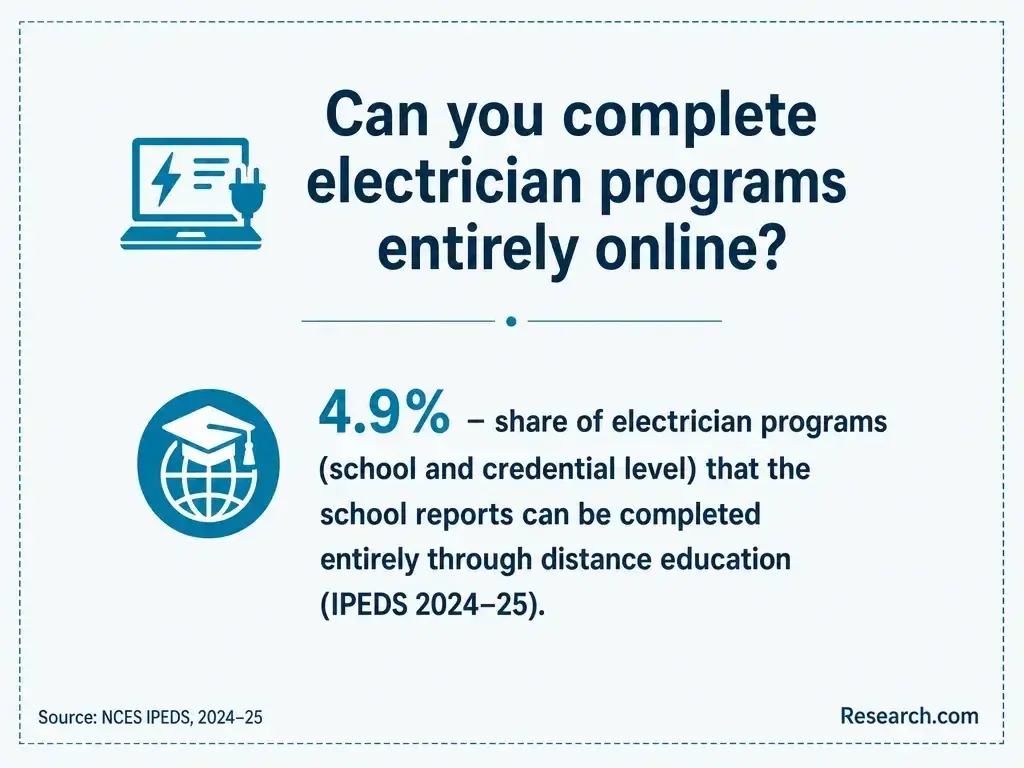
Online instruction can make theory, calculations, and some code study easier to schedule. It cannot by itself demonstrate safe installation, testing, troubleshooting, and worksite practices. On-campus labs and supervised jobs provide opportunities to practice those skills with equipment and feedback.
For a Hilo resident considering a hybrid option, the decisive question is where and when the practical component happens. Check required lab attendance, equipment access, and the location of any work placement before paying. Be wary of an entirely online course marketed as a complete route to Hawaii licensure without a documented plan for qualifying experience and examinations.
There is no defensible single "Hilo average" that covers college training, private instruction, and paid apprenticeships on the same basis. Published tuition is only one component. Compare a written, current estimate from Hawaii Community College with any alternative's charges, and distinguish a school's price from an apprentice's wages while training.
The following cost categories show why the cheapest advertised tuition may not be the cheapest route to job readiness.
| Cost or offset | What to verify |
| School charges | Tuition by residency status, required fees, books, and materials |
| Practical preparation | Tools, testing equipment, safety gear, and replacement supplies |
| Career entry | Application or examination charges and travel to classes or worksites |
| Income and assistance | Lost work hours, apprentice wages, grants, and aid eligibility |
Ask for the cost through completion, not just the first term. Federal aid eligibility depends on the institution, program, and student; Federal Student Aid is the authority for federal-aid rules. Hawaii workforce assistance and employer support may also be worth checking, but neither should be counted as a discount until eligibility and funding are confirmed.
The award depends on the specific program: a college may offer a certificate or an associate degree, while a registered apprenticeship documents completion of a structured work-and-instruction program. Ask Hawaii Community College which electrical credentials are currently offered and what each one certifies. A completion document demonstrates training; it is not itself a Hawaii journeyman license.
Compare course content and documented hours before transferring from one route to another. Prior coursework or experience may be considered for placement or advanced standing by a provider or sponsor, but recognition is not automatic. Get any proposed credit - and its effect on the time and cost still required - in writing.
College admission, entry to an electrical program, hiring as a trainee, and acceptance into a registered apprenticeship are separate steps. Providers may assess math readiness and ability to meet safety or worksite expectations; apprenticeship sponsors can also have their own application and selection procedures. Confirm current requirements directly rather than assuming that general college admission secures a lab seat or apprenticeship position.
If a college describes its admission as open, clarify whether that also applies to the electrical program and when required classes are available. Information about college admission open policies is no substitute for checking trade-program capacity and sponsor selection locally.
Useful foundational instruction connects circuit theory and electrical calculations to actual wiring, measurements, drawings, code interpretation, and hazard control. BLS identifies troubleshooting and physical work with wiring and equipment as central to the occupation. Ask to see the current syllabus and observe whether students practice diagnosing faults and using test instruments, rather than only watching demonstrations.
Technology can change the jobs available after foundational training: controls, efficient building systems, and other specialized equipment create reasons to keep learning on the job. A program should first establish safe electrical fundamentals, then explain how students encounter newer systems through labs or supervised work. Training branded as an accelerated degree program online should not be confused with verified, hands-on electrician preparation.
Hawaii regulates electrician licensure through its Board of Electricians and Plumbers. The board sets the experience, education, examination, and application requirements for the relevant license classification. Someone entering the trade may work under appropriate supervision while accumulating qualifying experience, but graduating from school does not automatically authorize independent electrical contracting or establish eligibility for a journeyman examination. Confirm the classification and current rules with the board before choosing training.
Institutional accreditation concerns the school; apprenticeship registration concerns the training arrangement; an optional industry certificate concerns a defined skill or curriculum; occupational licensure is state permission to perform regulated work. None substitutes automatically for another. Ask a provider to identify precisely which hours it documents, whether those hours meet board rules, and what supervised work remains.
Start with the job and license classification you want, then compare the cheapest viable routes - not just the lowest tuition. The affordability ranking is a starting filter, not a verdict on lab quality or licensing eligibility. A paid apprenticeship may lower borrowing needs, while a college program may provide useful preparation before you compete for a position.
Use these questions when speaking with admissions staff and apprenticeship coordinators; written answers make unlike routes easier to compare.
A common mistake is treating a short course, a school credential, and an apprenticeship completion as interchangeable. Another is calculating return on investment from an experienced-worker wage alone. Account for completion probability, debt, earnings forgone or earned during training, your current income, and the time until you can qualify for higher-responsibility work. Comparisons with low cost doctorate degree online searches do not answer those electrician-specific questions.
One path is supervised electrical work followed by the experience and examination required for an applicable Hawaii journeyman license. With further experience, electricians may move into specialized installation, maintenance, estimating, supervision, or a license classification that permits a different scope of work. Each step has different employer expectations; optional technical training does not replace mandatory state credentials.
If the goal is to own or manage an electrical contracting operation, check the separate Hawaii licensing and business requirements before assuming a journeyman credential is sufficient. Pages about best 1 year phd programs online do not describe this work-and-licensure progression.
BLS projects 9.2% growth in U.S. electrician employment from 2025 to 2035. This national projection supports investigating the trade, but it cannot tell an applicant how many apprenticeships or entry-level jobs will open in Hilo. Construction timing, local employers, and the availability of supervised placements matter more to an immediate job search.
Before enrolling, ask local sponsors about recruiting cycles and ask the program how it connects students with employers. Someone who needs work quickly should compare that timeline with a direct trainee opening, rather than assuming training completion brings an offer. A search for dual graduate degree programs is not a substitute for checking actual electrician entry routes and local hiring conditions.
Investing in training is an important decision, especially when a low-priced program may still leave substantial costs or licensing requirements. Research.com created this ranking to help readers compare electrician programs against other options in the same location and occupation. Only programs reporting completions to IPEDS are eligible; that limit means the ranking may not capture registered apprenticeships or other legitimate training routes.
The most affordable ranking scores costs and debt: tuition, cost of attendance, median student debt, and federal loan default rate. An entropy-based method assigns more weight to measures that vary more across eligible programs. Accreditation, instruction quality, and licensing alignment are not part of this affordability score, so readers should check them separately. Research.com's broader best programs methodology also considers outcomes, earnings, student support, accreditation, and relevant industry recognition; those broader measures should not be mistaken for this ranking's score.
The ranking draws on the following databases and reference organizations. Some cover institutions broadly, while others help assess occupation-specific recognition; their inclusion as sources does not mean every organization accredits electrician programs.
Use the ranking to narrow the cost comparison, then confirm current charges, practical training, and Hawaii licensing relevance with each provider. More detail on the approach is available in Research.com's methodology.
# 1 position
# 2 position
Electrician
Delivery mode: On Campus (May Include Online Courses)
82.62
/ 100
Final score
Accreditation
Institutional accreditation from Western Association of Schools and Colleges Accrediting Commission for Community and Junior Colleges.
Hawaii Community College earned a Research.com Affordability Score of 82.62/100, supported by $3,204 annual in-state tuition and $6,461 median student debt.
No. College training is one option; registered apprenticeships and supervised, employer-based routes may also be relevant. Compare how each provides instruction, qualifying work experience, and documentation for Hawaii licensing.
No. A school certificate is not an occupational license. Check the Hawaii Board of Electricians and Plumbers' current requirements for the work and license classification you intend to pursue.
Registered apprenticeships combine paid employment with related instruction, according to Apprenticeship.gov. Confirm a particular sponsor's wage schedule, eligibility rules, and available openings before relying on that income.
Online lessons can cover some theory, but practical wiring skills and qualifying supervised experience require in-person participation. Verify a program's labs and work arrangements before enrolling.
Compare total out-of-pocket cost and earnings during training, then check whether each route leads toward the supervised experience and license you need. The lowest advertised tuition may leave the most important training unfinished.