# 1 position

Audited and Verified:
Our Editorial and Data Verification Process
Research.com uses government datasets, official education statistics and primary institutional information to support its career and degree guides. Our review process checks factual accuracy, occupational definitions, source dates and the requirements associated with the credentials discussed.
How This Article Was Fact-Checked
Our editorial team verifies salary estimates, employment projections, education requirements and program information against original data providers and official organizations. Salary figures are checked against the relevant occupational definitions and reporting periods. Information about licensure, accreditation and required in-person training is reviewed separately.
Fact-checked and verified on:

Co-Founder and Chief Data Scientist

Reviewed by Karolina Broda
Fact-Checker and Data Verification
Choosing the cheapest electrician training near Creston is not as simple as comparing tuition: a short course and a paid apprenticeship can lead to very different levels of work experience. The Research.com team of data scientists created the Most Affordable Electrician Trade Schools in Creston for 2027 ranking to help students identify programs worth considering. With electrician employment projected to grow 9.2% nationally from 2025 to 2035, according to the U.S. Bureau of Labor Statistics, this guide helps you compare costs, credentials, hands-on training, and the path to working legally in Iowa.
Expect instruction in electrical theory, wiring methods, code use, testing, and jobsite safety, alongside labs where you install and troubleshoot circuits. Ask Southwestern Community College which electrician-related credentials and courses it currently offers, where required labs meet, and whether a credential can be applied toward an apprenticeship. A classroom credential can prepare you to seek supervised work, but it does not replace the work experience or examination required for an Iowa electrician license.
The main decision is whether you need classroom preparation before applying for a job or would learn more efficiently while earning wages. A short pre-apprenticeship may suit someone testing the trade; a registered apprenticeship combines employment with structured instruction and is generally the more direct route toward independent electrical work. Readers comparing 6 month certifications that pay well should check what an electrical certificate actually qualifies them to do: finishing quickly is not the same as becoming licensed.
Potential workplaces include residential and commercial electrical contractors, construction sites, industrial facilities, utilities, and building-maintenance operations. The U.S. Bureau of Labor Statistics describes electricians as installing, maintaining, and repairing electrical power, lighting, and control systems; the work setting determines whether the job emphasizes new construction, service calls, or equipment troubleshooting.
In a smaller labor market such as Creston and surrounding Union County, a workable job search may include travel to other southwest Iowa communities. Before paying for training, ask local employers and apprenticeship sponsors where apprentices report each day, whether travel is paid, and whether they accept the credential you are considering. Those answers can materially change both your budget and your choice of pathway.
The U.S. Bureau of Labor Statistics reports a $63,190 national median annual wage for electricians in May 2025. This is the midpoint for employed electricians across experience levels, not a Creston wage estimate or a likely first-year apprentice offer. Without a comparable, current Creston-specific figure, use actual local job postings and written apprenticeship wage schedules to budget.
Apprentice pay typically changes as training milestones are completed, while experienced electricians may earn differently depending on their license, employer, specialty, and hours worked. Compare offers using wages and benefits, overtime expectations, travel costs, and whether classroom time is paid. A higher advertised hourly rate may be worth less if the commute is substantially longer.
A short introductory course may take months, while a more extensive college credential can take longer; the exact calendar, contact hours, and lab hours depend on the current program. A registered electrician apprenticeship generally spans several years because it combines related instruction with substantial supervised work. The U.S. Bureau of Labor Statistics describes electrician apprenticeships as commonly lasting four or five years, but Iowa licensing eligibility must be checked against Iowa Electrical Examining Board requirements rather than inferred from a typical duration.
Ask a provider for its written schedule of classroom hours, lab hours, and work-based hours. Also ask whether completed coursework earns apprenticeship credit: time spent in school should not be assumed to shorten a registered apprenticeship unless the sponsor confirms advanced standing in writing.
Online study can be useful for electrical theory, calculations, code reading, and some safety instruction. It cannot by itself demonstrate safe installation, tool handling, live-work precautions, or field troubleshooting. A campus or hybrid program is stronger for a prospective electrician when it provides supervised labs and a clear route into employer-based experience.
For Creston residents, a hybrid schedule may reduce trips for lectures but not for labs or apprenticeship work. Before enrolling in any of the online certificates that pay well, confirm the physical lab location, attendance requirements, and whether an Iowa apprenticeship sponsor recognizes the training. Do not assume an entirely online electrician course meets licensing experience requirements.
There is no reliable single Creston average that covers college training, short courses, and paid apprenticeships on comparable terms. Published tuition may omit mandatory fees, books, tools, personal protective equipment, transportation, and income forgone while studying. Request a current, itemized cost sheet from Southwestern Community College or any apprenticeship sponsor you are considering; confirm whether tools are supplied, purchased, or deducted from wages.
A paid apprenticeship can reduce upfront education costs and provide income, but an apprentice still needs to budget for commuting and any required supplies. For school-based training, check federal aid eligibility with the provider and ask IowaWORKS about potential workforce-training assistance; eligibility depends on the student and program. A list of best cheap online schools that accept fafsa is not a substitute for checking aid eligibility and in-person lab requirements for the specific electrical credential.
For a fair comparison, calculate your expected out-of-pocket cost through job entry, then account for grants, paid training, likely borrowing, and the chance of completing the pathway. The cheapest tuition is not necessarily the lowest-cost route to supervised employment.
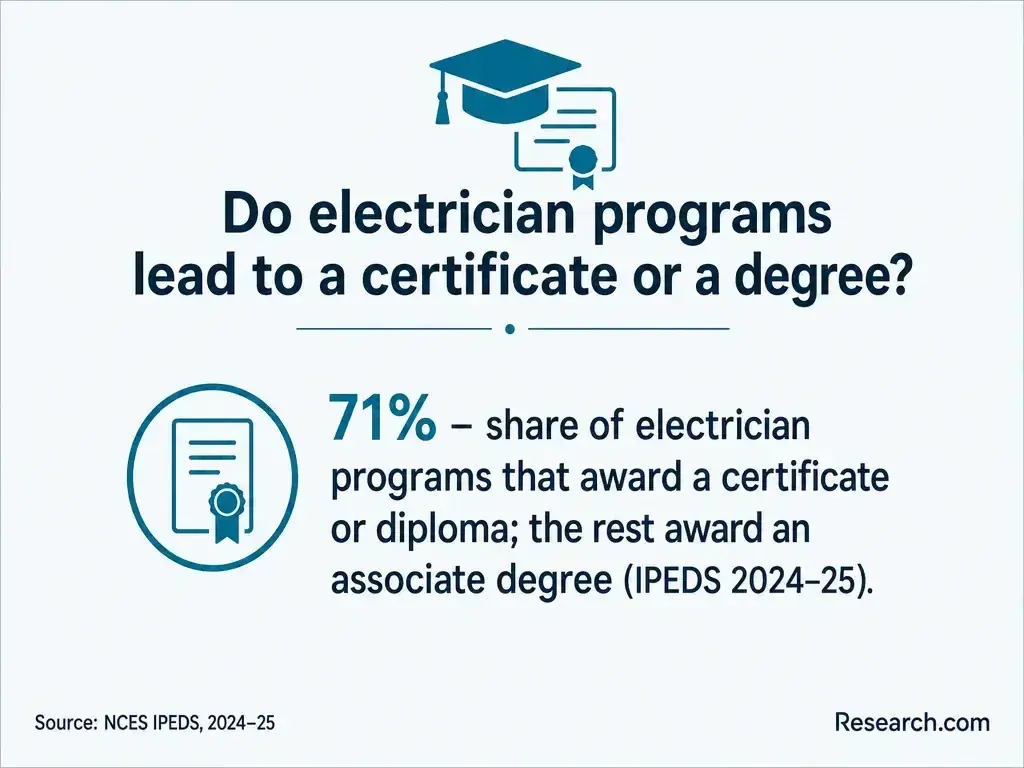
The award depends on the provider: possibilities include a pre-apprenticeship completion document, a college certificate or diploma, or an academic associate degree where a program awards one. A registered apprenticeship has its own completion credential and structured work-and-instruction requirements. Similar-sounding school awards are not interchangeable if their lab content, employer recognition, or accepted apprenticeship credit differs.
Keep four distinctions clear. Institutional accreditation concerns the school; state school authorization concerns permission to operate; apprenticeship registration concerns the work-based training program; and occupational licensure concerns permission to perform regulated electrical work at a given level. An industry certificate may document skills but does not automatically substitute for any of these. Ask which credential appears on your transcript or completion record and what, specifically, an Iowa sponsor or licensing authority will accept.
School and apprenticeship admissions are separate processes. A school may ask for an application, prior education records, and placement information; an employer or apprenticeship sponsor may also assess math skills, interview candidates, and require a driver's license or the ability to reach changing jobsites. Obtain the current requirements directly from Southwestern Community College and any sponsor rather than assuming that admission to one guarantees a place in the other.
Before applying, check the schedule against your work commitments and ask whether you must secure an employer to start, whether prior relevant work can be evaluated, and when you must register as an apprentice under Iowa Electrical Examining Board rules. A program that accepts you promptly may still be a poor fit if its labs or required jobsite travel are impractical.
Useful electrician training connects circuit theory and electrical calculations to hands-on work: reading plans, selecting materials, bending and installing raceways, making connections, testing circuits, and diagnosing faults. It should also teach applicable electrical-code use, lockout/tagout, and safe work practices. The U.S. Bureau of Labor Statistics identifies technical instruction and supervised on-the-job training as core parts of electrician preparation.
Look beyond a course title. Ask to see the current curriculum and how students are assessed in the shop or field. If your goal is industrial maintenance, ask about motors and controls; if it is residential contracting, ask about service equipment, branch circuits, and inspection practices. The right curriculum is the one that builds competencies an employer will let you practice safely under supervision.
Yes, Iowa regulates electrical work. The Iowa Electrical Examining Board administers electrician licensing and apprentice registration. An entrant can work toward the trade as a registered apprentice under applicable supervision rules; independent work at a journeyperson or contractor level involves additional Board requirements, including qualifying experience and examination where required. A school completion certificate is not an Iowa electrical license.
Before paying for a program, verify your intended work category and current requirements with the Iowa Electrical Examining Board. Ask the school or sponsor whether its instruction counts toward required training, who arranges supervised employment, and what documentation of hours you will receive. National industry certifications can be useful evidence of skills, but they do not replace Iowa occupational licensure.
Start with the job you want: supervised apprentice entry, industrial electrical work, or eventual journeyperson licensure. Then compare each option's practical training and employer connection before comparing price. For someone ready to work full time, a paid registered apprenticeship may offer better immediate cash flow; for someone who needs foundational math and shop practice first, a school-based credential may make entry more realistic.
Use the same questions with each provider so that an inexpensive listing does not conceal a costly gap in your route to work:
Verify school accreditation and authorization separately from licensing alignment. Rankings can help you shortlist options, but a search for what's the easiest masters degree to get will not answer whether an electrician pathway supplies the supervised hours you need. That is the decisive question before you commit money or time.
A typical progression begins with supervised apprentice work, followed by eligibility for a higher Iowa license after the applicable experience and examination requirements are met. With experience, electricians may concentrate on residential service, commercial construction, industrial controls, or maintenance; some move into supervision or contracting, subject to additional business and licensing requirements. These are possible paths, not automatic outcomes of a certificate.
If you are changing careers, judge training against the work you actually want to do and the time until you can earn while learning. Searches for cheap phd options address a different career investment; they do not replace the practical experience needed for electrical work. Ask prospective employers which entry-level roles they hire for and what they expect an applicant to demonstrate safely.
The U.S. Bureau of Labor Statistics projects 9.2% national growth in electrician employment from 2025 to 2035. This supports considering the trade, but it does not forecast openings in Creston or guarantee that a particular credential will lead to a job. Local construction schedules, contractor hiring, and willingness to commute will matter more to an individual applicant than the national rate alone.
Before enrolling, look for current apprentice openings within a workable travel radius and ask sponsors when their next intake occurs. If openings are scarce at the moment, compare a preparatory course with waiting or applying more widely; avoid taking on substantial debt solely because the national outlook is positive.
Investing in training is an important decision, so Research.com uses documented data and a consistent comparison method rather than treating a low advertised tuition price as the whole cost. Programs are compared with other electrician programs in the same geography. Only programs with completions reported to the Integrated Postsecondary Education Data System (IPEDS) can appear; an apprenticeship or other provider absent from IPEDS is not necessarily unavailable or lower quality.
The most affordable ranking scores tuition, cost of attendance, median student debt, and federal loan default rate. Indicator weights are assigned using an entropy-based method, which gives more weight to measures that vary more across included programs. Accreditation and other quality indicators do not enter this affordability score. Research.com's separate best programs methodology considers outcomes, earnings, costs, and quality; it assigns 20% to relevant programmatic accreditation or industry recognition, 10% to institutional accreditation, 10% to student support, and the remaining 60% to outcomes, earnings, and costs using entropy-based weights. Readers should still verify current prices and Iowa licensing alignment before enrolling.
The ranking draws on the following data sources. Occupation-specific relevance varies: health-care accreditation and certification sources, for example, should not be mistaken for electrician program approvals.
This approach helps narrow a cost-conscious shortlist, not declare which option will qualify every student for an Iowa license. More detail is available in Research.com's ranking methodology.
# 1 position
# 2 position
Not necessarily as a separate step. A registered apprenticeship combines instruction and supervised work. School can help you prepare, but confirm the Iowa Electrical Examining Board's current requirements and how a sponsor treats prior coursework.
No online course alone supplies the supervised hands-on experience needed for the usual apprenticeship-to-licensure pathway. Online theory may be useful if the program also provides appropriate in-person training and a route to documented work experience.
It may cost less upfront because apprentices earn wages, but compare supplies, travel, instruction costs, and the time needed to complete each route. Get a written breakdown from both the sponsor and the school.
No. A school certificate documents training, not independent-work authority. Check the Iowa Electrical Examining Board's licensing rules before accepting work outside the scope allowed for your registration or license.
Ask which electrical credential is currently available, its full cost and lab schedule, whether local sponsors recognize it for credit, and what supervised experience you would still need afterward.