# 1 position
Central Community College - Electrician.
associate

Audited and Verified:
Our Editorial and Data Verification Process
Research.com uses government datasets, official education statistics and primary institutional information to support its career and degree guides. Our review process checks factual accuracy, occupational definitions, source dates and the requirements associated with the credentials discussed.
How This Article Was Fact-Checked
Our editorial team verifies salary estimates, employment projections, education requirements and program information against original data providers and official organizations. Salary figures are checked against the relevant occupational definitions and reporting periods. Information about licensure, accreditation and required in-person training is reviewed separately.
Fact-checked and verified on:

Co-Founder and Chief Data Scientist

Reviewed by Karolina Broda
Fact-Checker and Data Verification
Choosing affordable electrician training in Grand Island means comparing more than tuition: you need a route to supervised work and Nebraska licensure. National electrician employment is projected to grow 9.2% from 2025 to 2035, according to the U.S. Bureau of Labor Statistics. This guide explains costs, credentials, apprenticeships, wages, and the checks to make before enrolling. It will also feature a Most Affordable Electrician Trade Schools in Grand Island for 2027 ranking created by the Research.com team of data scientists to help students make an informed choice about programs worth considering.
Expect electrical theory alongside practical work: reading plans, calculating circuits, installing and testing wiring, using meters, and working safely under the National Electrical Code. A campus program may provide shop practice before you seek employment; a registered apprenticeship combines related instruction with supervised work for an employer. According to the U.S. Bureau of Labor Statistics, electricians commonly enter through apprenticeships, and some first attend a technical program.
For a Grand Island applicant, the decisive question is what happens after the classroom. Ask Central Community College how much of the electrical training occurs in a lab, whether employers recruit from it, and whether coursework can receive credit within a particular apprenticeship. Obtain any credit arrangement in writing from the apprenticeship sponsor; a school's certificate is not automatically equivalent to completed on-the-job hours.
A short certificate can suit someone testing the trade or preparing for an entry-level helper role. Compare it with other high paying certificate programs only after checking the occupation each credential actually prepares you to enter: electrician work has supervised-experience and licensing considerations that a salary-focused list cannot resolve.
Potential workplaces include electrical contractors serving homes and commercial buildings, industrial facilities maintaining equipment and controls, and employers responsible for building or utility infrastructure. The work differs: construction crews may move between jobsites, while industrial maintenance may involve troubleshooting at one facility. The U.S. Bureau of Labor Statistics identifies electrical contractors and manufacturing among electrician employers.
Grand Island's location makes the service area and commute important. Ask prospective sponsors whether apprentices report to one site or travel across central Nebraska, whether a driver's license is needed, and who pays for travel or tools. Classroom training may help you obtain an interview, but electrical installation should be performed under the supervision required by Nebraska rules; do not treat a school credential as permission to work independently (Nebraska State Electrical Division).
A verified Grand Island-specific wage is not available here, so the most defensible benchmark is the May 2025 U.S. median annual wage of $63,190 for electricians (U.S. Bureau of Labor Statistics, Occupational Outlook Handbook). It describes workers across experience levels and locations - not a local offer or an apprentice's starting pay.
When evaluating a Grand Island opportunity, request the employer's actual starting wage, scheduled raises, benefits, travel expectations, and overtime policy. Compare those terms with tuition and any income you would give up while studying. A paid apprenticeship can change the financial calculation substantially even if its time to independent work is longer than a classroom program.
There is no single duration: a school certificate or diploma follows its own published schedule, while an electrician apprenticeship typically lasts 4-5 years and includes paid on-the-job learning and technical instruction (U.S. Bureau of Labor Statistics). A shorter credential can get you into a shop sooner, but it should not be confused with finishing an apprenticeship or satisfying Nebraska's experience requirements.
Ask for the program's published contact hours, lab hours, full-time and part-time schedules, and likely time to completion - not merely its shortest advertised timeline. If comparing an associate-level electrical technology program, check whether prior technical coursework or documented experience earns credit. Resources on the fastest way to get associate's degree can help frame the time question, but speed matters less here than usable hands-on skills and any apprenticeship credit confirmed by a sponsor.
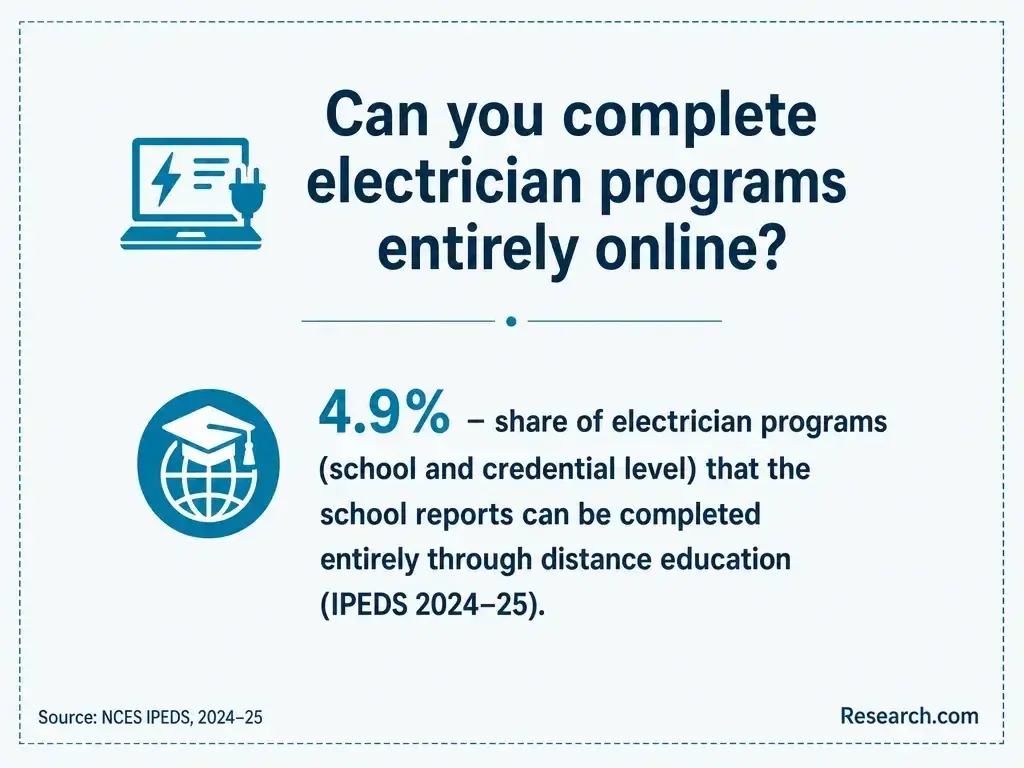
Online lessons can cover electrical theory, code concepts, calculations, and some exam preparation. They cannot replace installing circuits, safely operating tools and test equipment, or completing supervised work at a jobsite. For a new entrant, an on-campus or hybrid program with accessible labs is generally more useful than a theory-only online course; a working apprentice may value remote classroom sessions around a job schedule.
Before paying for distance training, confirm where hands-on instruction takes place, who supervises it, and whether a Nebraska apprenticeship sponsor accepts the coursework. If schedule flexibility is your priority, a guide to online college that accepts financial aid can help you investigate delivery and aid questions, but online availability and aid eligibility do not establish electrician licensing eligibility (Nebraska State Electrical Division; Federal Student Aid).
There is no verified, comparable 2027 average program cost for Grand Island in this article. A single tuition quote would also understate what many applicants must spend to become job-ready. Request a current, itemized estimate from each training provider and a compensation schedule from each apprenticeship sponsor.
The comparison below separates the expenses that can change your decision. Availability and amounts depend on the specific program or employer.
| Cost or offset | What to compare |
| School charges | Tuition, mandatory fees, books, and consumable lab materials |
| Work readiness | Tools, meter, protective equipment, and any required work clothing |
| Career entry | Applicable exam and license application charges |
| Time and travel | Trips to campus and jobsites, schedule changes, and earnings forgone during unpaid study |
| Offsets | Eligible grants or aid, employer-paid instruction or tools, and apprentice wages |
A lower tuition figure is not necessarily the lower-cost route if it requires more unpaid time or offers less usable practical training. To assess return on investment, compare expected completion, debt and aid, baseline earnings, likely post-training earnings, time to licensure, and the period over which you expect the investment to pay off; future earnings should be discounted rather than treated as immediate. A guide to the best affordable online schools for working students may help with general cost comparisons, but electrician training still requires a separate check of local labs and supervised work.
The award depends on the route. A school may award a certificate, diploma, or associate degree in an electrical-related field. A registered apprenticeship documents completion of its work-based training and related instruction. None of those awards is the same thing as a Nebraska occupational license. Confirm the exact credential on the program's published materials and ask employers or apprenticeship sponsors whether they recognize it (U.S. Department of Labor, Apprenticeship.gov; Nebraska State Electrical Division).
Institutional accreditation addresses an institution's standing; state authorization concerns its permission to operate; apprenticeship registration concerns a particular work-based training program. Industry training recognition and occupational licensure are separate again. A useful credential is one that advances your intended next step - entry-level employment, apprenticeship credit, or eligibility to apply for a license - not simply one with a familiar name.
Requirements vary by provider and pathway. Ask Central Community College for its current admission, placement, prerequisite, and program-entry requirements. A registered apprenticeship sponsor may have a separate application, assessment, interview, work-eligibility, and driver or transportation requirements. Meeting a school's admission rules does not mean an employer will hire you or a sponsor will admit you to an apprenticeship (Central Community College; U.S. Department of Labor, Apprenticeship.gov).
If you already work in a related trade, ask whether documented experience, prior coursework, or military training can reduce repeated instruction. Get separate written answers from the school and apprenticeship sponsor: credit on a school transcript does not automatically reduce the supervised experience Nebraska requires for licensure (Nebraska State Electrical Division).
Relevant training covers circuit fundamentals, electrical calculations, drawings, wiring methods, grounding and bonding, code use, troubleshooting, and safe tool and meter use. Lab quality matters because recognizing a wiring diagram is different from building, testing, and correcting a circuit. The U.S. Bureau of Labor Statistics describes installation, inspection, testing, and repair as core electrician tasks.
Match the curriculum to the work you want. Residential installation emphasizes building wiring and jobsite methods; industrial maintenance may require more motors, controls, and fault-finding. Ask to see the lab equipment and course outline, then check whether local employers teach additional equipment-specific skills on the job. A broad electrical title alone does not show how much practical preparation a program provides.
Nebraska regulates electrical work through the Nebraska State Electrical Division. An apprentice can learn while working under the applicable supervision rules, but independent electrician work requires the appropriate state license. Licensing is distinct from finishing a school program: applicants must satisfy the experience and examination requirements for the license they seek (Nebraska State Electrical Division).
Before enrolling, identify the license category that matches your intended work and ask the division which supervised experience counts, how training is documented, whether classroom education receives any credit, and what examination applies. Ask a prospective employer who will supervise and document your hours. Optional industry certificates may help demonstrate a specialty, but they do not substitute for Nebraska licensure; likewise, institutional accreditation alone establishes no licensing eligibility.
Choose the route that gets you to documented practical competence and the right licensing pathway at a manageable net cost. A campus program can be worthwhile if you need structured labs and help entering the trade. A paid apprenticeship may fit better if you can secure a placement and want to earn while learning. Someone already employed in electrical work should first check whether targeted instruction and employer-sponsored training would avoid paying to repeat skills.
Use this sequence to turn an affordability ranking into a decision:
Red flags include a "fully online electrician" claim with no practical component, a promise of automatic licensure, and a tuition quote that omits required tools. Do not choose on ranking position alone. If your goal is an unrelated academic path such as the easiest master degree to obtain, an electrician trade program is not a shortcut to it; judge this investment against the electrical occupation you actually intend to enter.
An entrant may begin as an apprentice or helper, build supervised experience, and pursue the applicable Nebraska electrician license. With experience, possibilities include residential or commercial installation, industrial maintenance and controls, crew supervision, or electrical contracting subject to the relevant state requirements. Training can also support related maintenance roles, but their duties and licensing rules should be checked separately (U.S. Bureau of Labor Statistics; Nebraska State Electrical Division).
Pick training for the next realistic step, not the eventual job title alone. A student seeking industrial troubleshooting should look for substantial motors-and-controls practice and relevant work placements; someone aiming to run a contracting business must plan beyond a starter certificate for experience, licensing, and business responsibilities.
U.S. electrician employment is projected to grow 9.2% from 2025 to 2035 (U.S. Bureau of Labor Statistics, Employment Projections). That national projection suggests continuing opportunities but does not measure openings in Grand Island or guarantee a local apprenticeship place.
For a local decision, ask employers and apprenticeship sponsors about upcoming intakes and the mix of construction and maintenance work they expect. Also check whether you can commute to jobsites across central Nebraska. The most useful outlook is the one for the work and travel area you can actually accept, paired with a training route that lets you qualify for those openings.
Investing in electrician training is an important decision, particularly when a low advertised price may not reflect the full cost of becoming job-ready. Research.com evaluates programs against others in the same occupation and location so readers can compare relevant options. Only programs with completions reported to IPEDS are eligible for the ranking; a registered apprenticeship or employer training route may still be worth considering even if it does not appear.
The most affordable ranking scores costs and debt: tuition, cost of attendance, median student debt, and federal loan default rate. An entropy-based method assigns more weight to indicators that differ more across eligible programs. Accreditation, student outcomes, earnings, and other quality measures are not part of this affordability score. Readers should check them separately before deciding that a lower-ranked-cost option is the better investment.
To support the ranking's quality, credibility, and accuracy, the Research.com team draws on the following data sources. Some cover institutions broadly rather than electrician training specifically; their inclusion does not mean that an allied-health credential applies to electricians.
The ranking can narrow a cost-conscious shortlist, not establish Nebraska licensing eligibility or guarantee a job. See Research.com's methodology for more information about how rankings are created.
# 1 position
# 2 position
Not necessarily. Apprenticeship is an established route combining paid supervised work with instruction. School can provide useful preparation, but check Nebraska's experience and examination rules for your intended license (Nebraska State Electrical Division; U.S. Bureau of Labor Statistics).
No. A school certificate is not a Nebraska electrician license. Ask the Nebraska State Electrical Division what supervised experience and examination your license category requires.
You may complete some theory remotely, but installation, testing, and supervised jobsite work require in-person participation. Verify where practical training takes place before enrolling.
It depends on total school charges, tools, travel, aid, and income while training. An apprenticeship offers wages, while a school program may provide structured preparation before you obtain a job. Request itemized costs and actual pay terms.
No. The ranking includes only eligible programs with completions reported to IPEDS. Investigate registered apprenticeships separately, even if they do not appear in a school ranking.