# 1 position
Bates Technical College - Electrician.
associate

Audited and Verified:
Our Editorial and Data Verification Process
Research.com uses government datasets, official education statistics and primary institutional information to support its career and degree guides. Our review process checks factual accuracy, occupational definitions, source dates and the requirements associated with the credentials discussed.
How This Article Was Fact-Checked
Our editorial team verifies salary estimates, employment projections, education requirements and program information against original data providers and official organizations. Salary figures are checked against the relevant occupational definitions and reporting periods. Information about licensure, accreditation and required in-person training is reviewed separately.
Fact-checked and verified on:

Co-Founder and Chief Data Scientist

Reviewed by Karolina Broda
Fact-Checker and Data Verification
Choosing electrician training in Tacoma means checking more than a school's name: the program must fit Washington's pathway to supervised work and certification. The U.S. Bureau of Labor Statistics projects 9.2% national growth in electrician employment from 2025 to 2035. For new entrants and career changers, this guide compares school and apprenticeship routes, costs, credentials, and career prospects. It also features a Best Electrician Trade Schools in Tacoma for 2027 ranking created by the Research.com team of data scientists to help students make an informed choice about programs worth considering.
Expect instruction in electrical theory, code use, wiring methods, measurement, and jobsite safety, plus supervised practice where the program offers labs or work placement. The central question is whether that practice counts toward your intended Washington certification pathway. A school certificate documents education; an electrical trainee certificate, registered apprenticeship, and eventual electrician certification serve different regulatory purposes. Washington Department of Labor & Industries (L&I) oversees electrical certification and training rules.
The main Tacoma-area choices differ in what they provide and how soon they put you on a paid jobsite. Use this comparison to identify the route that matches your goal rather than assuming similarly named credentials are equivalent.
| Training route | What you receive | Best fit and key check |
| Technical-college or career-school program | School-issued certificate, diploma, or, where offered, associate degree; coursework and possible labs | Useful for structured preparation. Ask which hours, if any, count toward Washington requirements and whether employers recognize the training. |
| Registered apprenticeship | Paid, supervised work plus related instruction and an apprenticeship completion credential | Strong fit for applicants seeking a work-and-learn route to the applicable electrician certification; confirm the sponsor's registration and occupational track. |
| Employer-sponsored trainee route, where permitted | Supervised work and required instruction rather than necessarily a school credential | May suit someone with a qualifying employer; verify that the specific work and instruction satisfy L&I rules. |
Some programs marketed among top trade schools online can help with theory, but an online listing cannot confirm local lab access, supervised work, or Washington eligibility.
Depending on training and certification, electricians work for electrical contractors on residential, commercial, and industrial projects, or in maintenance roles at facilities and public agencies. Construction sites, building renovations, and equipment maintenance can require different schedules and skills. Tacoma applicants should ask a program or apprenticeship sponsor where its actual jobsite placements are: a placement elsewhere in Pierce County or the wider Puget Sound area can change commuting costs and the kinds of experience available.
School training alone may prepare someone to apply for supervised trainee work; it does not make that person a certified journey-level electrician. Washington L&I's certification category and supervision rules determine which tasks an individual can perform.
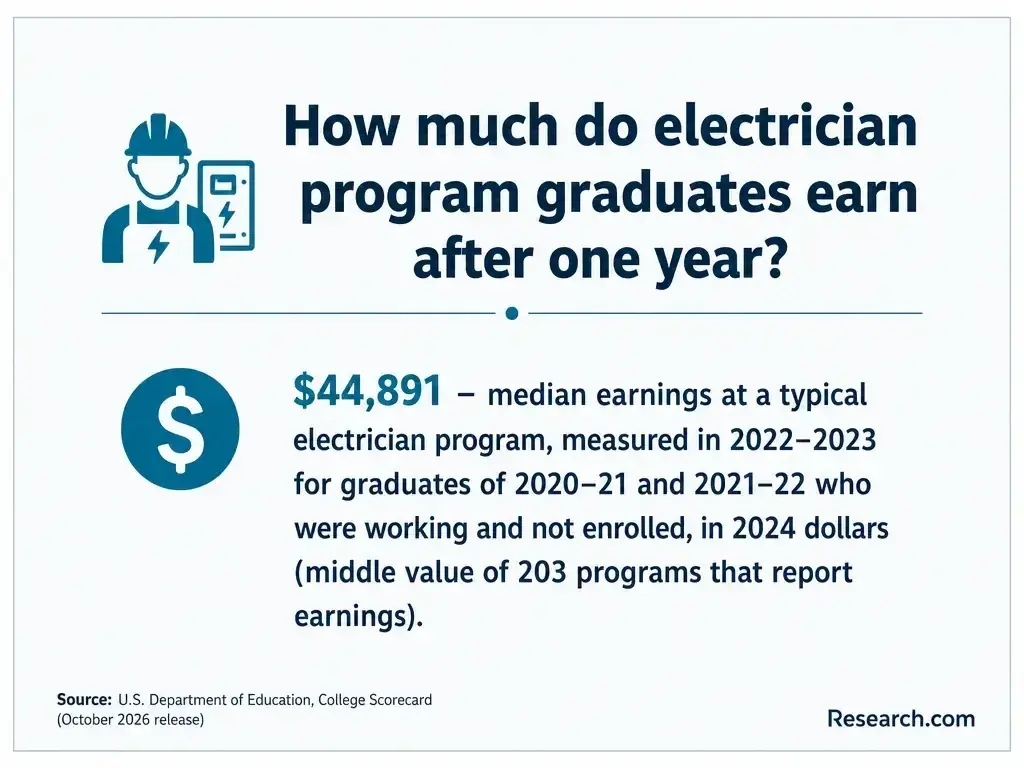
A reliable Tacoma-specific wage should come from an identified local occupational dataset, not a school's advertised graduate figure. As a national benchmark, the U.S. Bureau of Labor Statistics reports a $63,190 median annual wage for electricians in May 2025. That figure covers working electricians across experience levels and locations; it should not be used as expected pay for a newly hired Tacoma trainee.
For a practical local comparison, request the current wage progression from each apprenticeship sponsor or prospective employer, including when raises occur and whether benefits are included. Compare those earnings with tuition, commuting, and any time spent in school before paid work begins. A higher eventual wage does not automatically make a more expensive program the better investment.
A school program can be much shorter than the route to independent electrical work. Some introductory certificates may take months, while broader school programs take longer; published schedules and actual weekly attendance determine the finish date. A registered apprenticeship combines related instruction with substantial supervised work over multiple years. Washington L&I's general journey-level pathway requires a registered apprenticeship, subject to applicable exceptions, so a short course should not be mistaken for a shortcut to that certification.
Ask for the program's clock or credit hours, lab hours, calendar length, and any documented credit toward apprenticeship or supervised-experience requirements. An quick 6 month certification that leads to high paying jobs may sound attractive, but duration alone says little about electrician licensing eligibility. Applicants who need earnings sooner should compare the wait to enter an apprenticeship with the time before a school program leads to paid work.
Online or hybrid delivery can work for code reading, mathematics, and some theory. Wiring, testing, tool handling, fault-finding, and jobsite safety require physical practice and supervision. An on-campus program may provide that practice in a lab; an apprenticeship provides it at worksites. Neither format, by itself, establishes that hours qualify under Washington L&I rules.
Before choosing a hybrid course, confirm where labs occur, who assesses practical skills, whether the schedule works with a job, and how any supervised work is documented. Even if easy college classes to take online appeal to your schedule, electrician preparation should be judged by its required in-person competencies - not by how much coursework can be completed remotely.
There is no single defensible Tacoma-wide average that covers school programs and paid apprenticeships alike. Published tuition may exclude required purchases, while an apprentice can earn wages during training. Request an itemized, current estimate for each route and distinguish charges paid to a school from costs incurred to become job-ready.
The following comparison shows which cost categories can change the real price of training. It is a budgeting framework, not a claim that every program charges every item.
| Cost or offset | What to verify | Why it changes the decision |
| Tuition and mandatory fees | Full program total, residency rules, payment schedule, and refund policy | A low per-term price can conceal a longer, more expensive route. |
| Tools, PPE, books, and materials | Required purchase list and what the provider or employer supplies | Up-front costs may arise before paid work starts. |
| Work and regulatory costs | Transportation, trainee or exam fees, and any required screening | Jobsites and application steps add costs beyond school charges. |
| Financial offsets | Paid apprentice wages, employer contributions, grants, scholarships, and eligible aid | Net cost can differ substantially from the sticker price. |
Check federal aid eligibility with the provider and Federal Student Aid, and ask Washington workforce agencies about assistance for which you may qualify. For return on investment, weigh net cost and debt against completion probability, time to paid work, your current earnings, plausible post-training earnings, and how long it may take to recoup the investment. Do not assume that a shorter or cheaper route meets the same certification requirements.
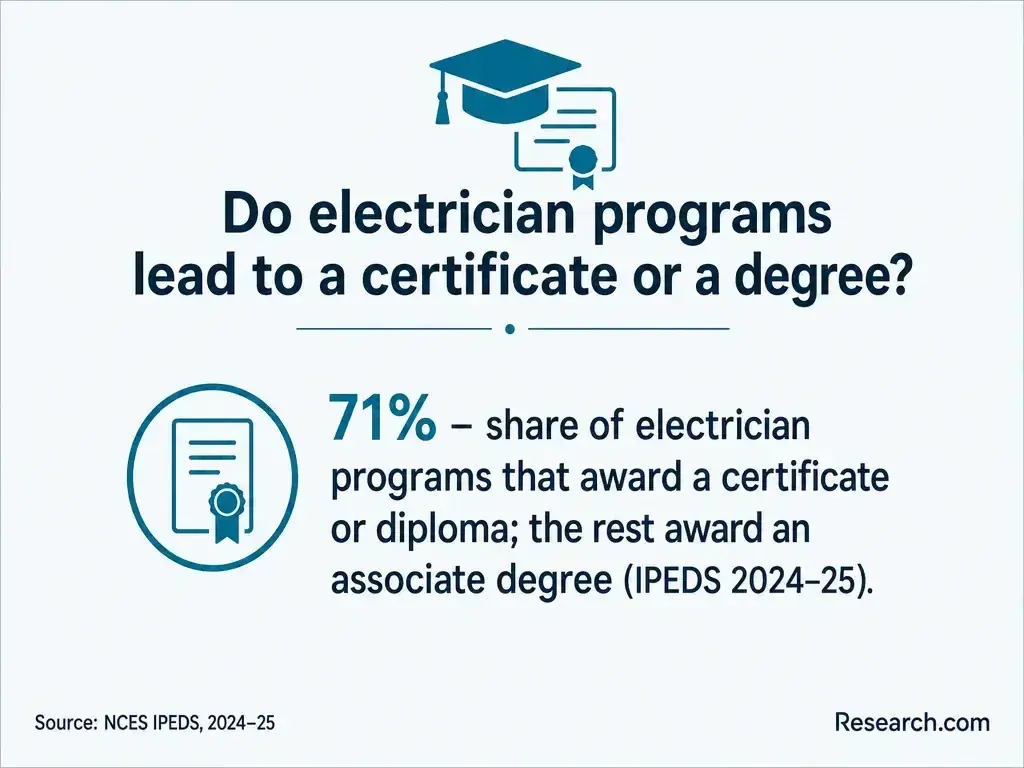
It depends on the provider: a program might award a certificate, diploma, or associate degree. A registered apprenticeship awards its own completion credential after required work and instruction. None should be described as a Washington electrician license. L&I issues the applicable electrical trainee or electrician certification; eligibility depends on the state's requirements for the specific category, not the wording on a school award.
An associate program may offer broader technical coursework, while a shorter certificate may focus on entry skills. Neither is automatically better than paid apprenticeship training. A fast track associates degree online listing, for example, cannot establish whether its electrical coursework includes acceptable practical training. Ask for written details on transfer credit, prior-learning credit, and apprenticeship articulation; never assume previously earned credits also count as supervised electrical work hours.
Requirements vary by provider and route. A school may assess mathematics, reading, or readiness for shop work. Apprenticeship sponsors may set separate application, aptitude, interview, and work-eligibility requirements; admission to a school does not secure an apprenticeship place. Washington electrical trainees also need to meet L&I's requirements for trainee status before performing regulated work.
Ask each provider for its current admission checklist and next start date, then check whether required math or safety preparation can be completed before applying. If a program promises direct access to a job, request the placement terms in writing: find out whether employment is guaranteed, competitive, or simply supported through referrals.
Relevant training connects circuit theory and electrical calculations to reading plans, applying the electrical code, selecting materials, installing wiring methods, using test instruments, and diagnosing faults. Safe work practices are not an optional extra: students need supervised opportunities to identify hazards and perform tasks correctly before facing live jobsite conditions. The U.S. Bureau of Labor Statistics identifies installation, testing, repair, and code compliance among electricians' occupational duties.
Compare what students physically do, not just course titles. Ask to see the lab task list, equipment available, instructor-to-student supervision arrangements, and how performance is assessed. If the intended route is commercial or industrial work, look for preparation relevant to those settings rather than assuming residential-only practice covers every specialization.
Yes - Washington regulates electrical work through L&I. Someone entering the trade typically needs the appropriate electrical trainee certificate to perform work under required supervision; independent work requires the applicable electrician certification. Categories have different experience, education, and examination rules. For the general journey-level category, Washington's registered-apprenticeship requirements make it especially important to verify a training route before paying school tuition (Washington Department of Labor & Industries).
Keep the approvals separate: institutional accreditation concerns a school; state school authorization concerns its permission to operate; apprenticeship registration concerns a work-and-learn program; and L&I certification concerns permission to perform regulated electrical work. Industry certificates may demonstrate skills but do not substitute for state certification. Before enrolling, tell L&I and the provider which electrician category you seek, and request confirmation of how coursework and supervised hours will be counted.
Start with the certification category and work setting you want, then compare programs by their verified route to that goal. Bates Technical College may be one school option to investigate, but a paid registered apprenticeship may make more sense if you can enter one and want to earn while learning. A school program may be worthwhile when its instruction, schedule, and practical preparation fill a gap you cannot address through direct apprenticeship entry.
Use these checks before committing money; they target the mistakes most likely to leave a student with an unsuitable credential or an unexpected bill.
Be wary of a provider that says its certificate automatically makes you a journey-level electrician, cannot explain where practical training occurs, or quotes tuition without required tools and fees. Rankings can help form a shortlist; documented regulatory eligibility and fit with your work goals should decide it.
A common progression is supervised electrical trainee or apprentice work, followed - after the required training, experience, and examination - by certification in an applicable Washington category. From there, experience can support moves into specialized installation or maintenance work, crew leadership, estimating, or contracting. These are possible paths, not automatic outcomes of completing school.
Choose training with the next role in mind. Someone aiming at general commercial work should check that their apprenticeship track and documented work experience support that goal; someone interested in a narrower specialty should ask L&I about that category's scope before choosing a shorter route. Running an electrical contracting business brings additional state requirements beyond an individual's training credential (Washington Department of Labor & Industries).
The U.S. Bureau of Labor Statistics projects 9.2% growth in U.S. electrician employment from 2025 to 2035. This national projection signals potential demand but does not measure openings in Tacoma or promise a local placement. Construction schedules, maintenance hiring, and access to apprenticeship jobs can make an individual's prospects differ from the national trend.
Before choosing a program, compare current vacancies and apprenticeship intake across the area you can realistically commute to. Ask sponsors how often they accept new apprentices and providers where recent participants found supervised work. Those answers are more useful for a Tacoma enrollment decision than applying a national growth rate to one school's graduates.
Investing in electrician training is an important decision, especially when a program's price and credential do not tell you whether it supports your intended Washington career path. The Research.com team created the ranking to help readers compare programs in the same occupation and location. The team evaluates reported outcomes, costs, recognition, and support using multiple sources, while checking the relevance of each measure to the occupation.
Only programs with completions reported to the Integrated Postsecondary Education Data System (IPEDS) are eligible. That makes the ranking useful for comparing covered programs, but it is not a complete list of Tacoma-area training options: an apprenticeship or employer program can be legitimate even if it does not appear in IPEDS. For best-program rankings, programmatic accreditation or relevant industry recognition receives 20% of the score, institutional accreditation 10%, and student support 10%. The remaining 60% covers completion and retention, earnings one year after completion and relative to annual attendance cost, tuition and attendance cost, student debt - including debt among students who withdrew - and federal loan default rates. An entropy-based method assigns more weight to indicators that vary more across programs.
Most-affordable-program rankings use only tuition, attendance cost, median debt, and federal loan default rates, with entropy-based weights; accreditation and other quality measures do not enter that score. These are the data sources used to create the ranking. Occupation-specific recognition sources are considered where relevant, not treated as electrician approvals merely because they appear in the source set.
Use the ranking to narrow a shortlist, then verify current program details and Washington requirements directly before applying. Further scoring details appear on the Research.com methodology page.
# 1 position
# 2 position
Potentially. A registered apprenticeship combines paid work and instruction and may be the more direct route for someone who can secure a place. Verify the route for your intended Washington certification category with L&I.
No. A school certificate is not Washington electrician certification. Regulated work requires the appropriate trainee or electrician status and compliance with applicable supervision rules.
Do not assume so. Theory can be studied online, but practical skills and required supervised work need in-person settings. Confirm how any online coursework fits Washington's requirements before enrolling.
Choose based on access, cost, and the certification pathway. School can provide structured preparation; an apprenticeship combines paid work with required instruction. Ask whether school training earns documented credit toward your intended route.
It can be if the training builds needed practical skills and advances your verified path to paid work or certification. Compare its full cost and time to employment with available paid-apprenticeship options, not just with another school's tuition.